Category Archives: Economics

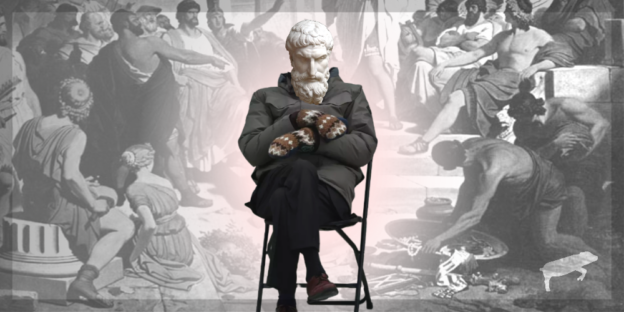
Modified from "Pericles's Funeral oration" by Philipp Foltz (1852)

We Got Beef: A Disembowelment of the Dialectic, Politics, and Other Organs of Bullshit


“Rhetoricians might flatter flies with honey,
but politicians feed flies bullshit.”
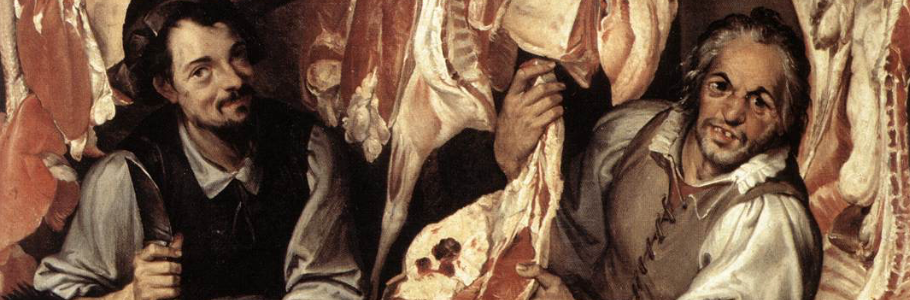

Modified from “The Butcher’s Shop” by Gabriele Passerotti (1580)

WE GOT BEEF

A DISEMBOWELMENT OF THE DIALECTIC,
POLITICS, AND OTHER ORGANS OF BULLSHIT


I have a bone to pick with rhetoric.

Here’s the heart of the issue: talk is cheap. People chew fat in political chats without purpose — no learning occurs, no truth is shared, no friendship is found. Everyone misses the meat of the matter. Opinions are skin-deep. Debate rarely disembowels delusion. Too often, rhetoricians and orators enlist themselves in the service of manipulation. After all, “the end of rhetoric is to persuade in a speech” and not to validate truth with evidence (Philódēmos, On Rhetoric, I, col. 3). Their art does not “depend on arguments from physical facts” because “their art is a power of persuasion” (Ibid., II, 12, col. XIX). For instance, it is agreeable to suppose that honey attracts more flies than vinegar — true, but as a student of nature and pupil of the Garden (so guided to treat politics with suspicion), I observe that nothing attracts so many flies as bullshit.

Those who study in the rhetorical schools are deceived. They are charmed by the tricks of style, and pay no attention to the thought, believing that if they can learn to speak in this style they will succeed in the assembly and court of law. But when they find that this style is wholly unfitted for practical speaking they realize that they have lost their money.
(Epíkouros, Against the Rhetoricians)

The rhetorical τέχνη (tékhnē, “technique”) of the sophists provides a technical method without practical application; at the same time many practical orators enjoy success, and wield influence without technically possessing any teachable skills, having mastered neither art nor science. Dialecticians may enjoy sagacious reputations, but may also lack receptivity, perspective, and may provide people with impractical, ineffective advice. Both educated rhetoricians and natural orators present dangers as agents of persuasion — dialecticians turn the practical benefits of philosophy into abstractions; rhetors misuse the art of prose for manipulation; orators’ aptitude for practical persuasion lacks a foundation in natural ethics.

Each of the rhetorical arts and practices fails to ground themselves in nature. As human agents of manipulation, professional persuaders fail to refer to the natural “goal” of “living blessedly” (Laértios 10.128). Each of these tools can be appropriated to service a political agenda. Only the true philosophy provides students with the tools they need to understand reality and pursue happiness. To quote the lead character from a favorite, adult cartoon, “Everyone wants people they like to be right. That’s why popular people are fucking dumb” (Rick and Morty, Season 3, Episode 4). As Epíkouros teaches, “the purest security is possible by means of the peace and the withdrawal from the masses”, never by chasing their satisfaction (Key Doctrine 14).

Modified from artwork by Kasten Searles for “The Queen’s Gambit” from the Arkansas Times, March 2024

THE PRISON OF POLITICS

Unlike other schools, the Garden rejects politics as a valid field of inquiry and remonstrates the rhetorical tools that support the political ambitions of professional persuaders. As φιλοσοφία (philosophía) is the “love of wisdom”, so politics is antithetical to friendship and wisdom. While Epíkouros does not dismiss civic engagement, he warns against pursuing a political career. Such a pursuit requires either subservience to wealthy interests, or else, submission to popular opinion, or engagement with senseless gossip. The most effective politicians are not those who are the most educated, for “some come out of the schools worse than when they went in” (On Rhetoric, I, 35, 1 ff.=Suppl. 19.13 ff.), but those who are best at “studying what pleases the crowd and practicing” (Ibid., I, 45, 13 ff.=Suppl. 23, 20 ff.) In this way, through pleasing speech, an otherwise unskilled narcissist “can become skilled in politics” (Ibid.).

Political narratives, in particular, are uniquely dubious. Self-promoting orators spoil healthy discourse by drawing people into pointless debates. Rhetoricians excel at erecting scarecrows. Argumentative puppets present themselves as prime cuts of intelligence, yet many are without substance. Popular speakers are incentivized to sell unpalatable policies for the sake of their own enrichment. Politicians dress the inedible entrails they cook with zest. They spice lies to hide their rancid flavor. They sew empty arguments from skin and bones. Debates are dressed for taste, and, as mentioned, rarely dissect the meat of the matter. Dialectical discourse is dangerous. Rhetoric and oratory are ineffective at verifying true statements and, more importantly, impractical at cultivating friendships. As Philódēmos acknowledges, “Politics is the worst foe of friendship; for it generates envy, ambition and discord.” (On Rhetoric, II, 158, fr. XIX).

In speaking of a “free life”, Epíkouros affirms that it

is not possible to be acquired by a lot of money [made] through an unscrupulous means [nor] is without servility to the mob or authority, rather [it] acquires everything [it needs] in continuous abundance; nevertheless if [one did procure] any money by chance, then the latter can be easily distributed to those nearby for goodwill. (Vatican Saying 58)

In this essay, I mean to review rhetoric, dissect dialectic, purge politics, and oust the aura of oratory. We will skim the fat from inference by demonstrating the dangers of logical induction. As Epíkouros teaches, we “must liberate ourselves, out of the prison [built] upon circular” proceedings, social programming, indoctrination, senseless gossip, “political” affairs”, and other practices that sacrifice the testimony of the senses for persuasive story-telling (Vatican Saying 58). “If you contest every single one of the sense perceptions, you can neither judge the outward appearance nor can you affirm which of the sensations you, yourself say are deceptive according to the way in which the criterion operates” (Key Doctrine 23).
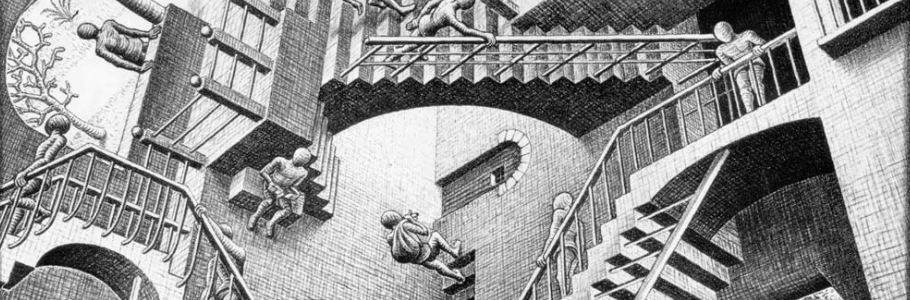
“Relativity” by M. C. Escher (1953)

UNFOUNDED INFERENCE

Epicureans reject both philosophical “reasonings in the form of Aristotelian syllogisms or inductions” as well as “other dialectical procedure(s)”  (On Irrational Contempt 2). As Polýstratos writes, those persuaded by such procedures “are fools who construct their argument solely on the basis of the conviction of others” and not through empirical investigation (Ibid.). “[B]y the dialectical means mentioned, one cannot deliver the soul from fear and anxious suspicion” because the conclusions of the rhetor, the orator, and the dialectician are not founded on physics (Ibid.). The dialectic is rejected “for want of qualification” as a reliable criterion of knowledge, for the Epicureans “suppose the study of nature provides the proper space for the voices of the facts” (Laértios 10.31). The only valid testimony is from the senses — speculation, hearsay, assumption, induction, and conjecture are inferior practices to the process of confirming hypotheses with evidence. “We shall say that the one who infers thus fails because he has not gone through all appearances well, and indeed that he is corrected by the appearances themselves” of real things (On Signs). When “divorced [from] the real phenomena”, then reality gets “cast out of the whole study of nature and then flows from a myth” (Laértios 10.87).

By contrast, Epicureans employ “the method of analogy”, observing nature, inferring hypotheses, and substantiating with evidence. “For there is no other correct method of inference besides this” (Philódēmos, On Signs). Sophistic rhetoric further confounds the process of substantiating hypotheses with observation. By contrast, evidence justifies the demonstrable truth of statements. Otherwise, flawed methods lead to self-defeating conclusions. “For the arguments that they devise to refute the [Epicurean] method of analogy contribute to its confirmation. […] It is the same in other cases, so that as a result they refute themselves.” (Ibid.). As pertains to professional persuaders, rarely are politicians and scientists the same people.
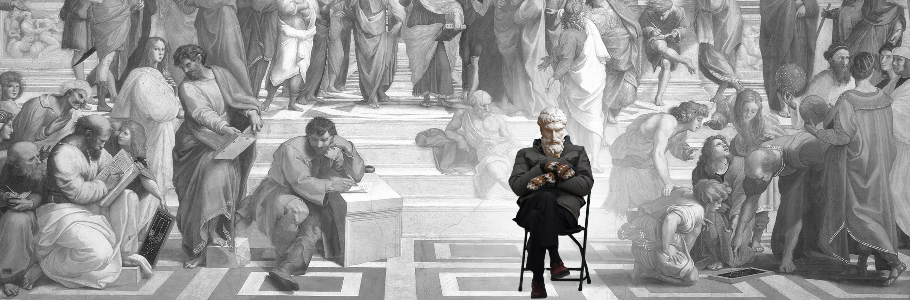
Modified from “The School of Athens by Rafael (1509-11)

DIABOLECTICIANS

Unlike other philosophers, Epíkouros does not recognize the dialectic as a distinct branch of philosophy (Laértios 7.41). Rather, he recognizes the dialectic as a mere method, which, by itself, cannot arrive at the “truth” it seeks to find. Speaking of the Epicurean Garden, Diogénēs reports that “she has withdrawn the Dialectic [and] rejects it for want of qualification;” for the Epicureans “suppose the [study of] natural [phenomena] provides [the proper] space for the voices of the facts.” (Ibid., 10.31). Epíkouros called “the Dialecticians totally toxic” (Ibid., 10.8) and later refers to “dialectic” as being “pretentious” (Epistle to Hēródotos 10.72). Contemporaneously, “Metródōros wrote […] Against the Dialecticians” (Laértios 10.24). He was documented “ridiculing those who consider the dialectic method more accurate” (On Rhetoric, II, 45, col. XLV). Philódēmos positively identifies the position of “the dialectician” as “a position which we refute” (Ibid., I, 190, col. IX; I, 191, col. X). Polýstratos writes that dialectical reasoning is based purely upon the false premises of dialectician’s “own conviction” (On Irrational Contempt 2). Instead, “one must, for the sake of oneself” observe nature to determine the truth of statements (Epistle to Hēródotos 10.72). Otherwise, as Philódēmos notes, “those who use dialectical reasoning do not know that they are shamefully refuting themselves” (On Signs).

For a demonstration of the dialectic in action, consider the following exampe, courtesy of the American, two-party political system: Suppose the Pink Team asserts that ‘An asteroid is coming! We need funds to stop it!’ The Yellow Team responds: ‘There is no asteroid. You just want money.’ Fortunately, everyone is a respectable, patient, educated dialectician, and everyone agrees to the wise rules of their admirable methodology. They proudly reach a compromise: ‘After extensive consideration, we have determined that there is a chance that an object, perhaps, in this case, an asteroid, of indeterminate size, mind you, may enter a region of spa —’

SLAM. That was the sound of nature crushing their dialectic.

Modified from “Asteroid Crashing into a Primordial Earth” by Don Davis / NASA (1991).png

THE RACKET OF RHETORIC

“[T]o practice rhetoric is toilsome to body and soul, and we would not endure it. [Rhetoric] is most unsuitable for one who aims at quiet happiness, and compels one to meddle more or less with affairs, and provides no more right opinion or acquaintance with nature than one’s ordinary style of speaking, and draw the attention of young men from philosophy”
(Philódēmos, On Rhetoric, II, 52, col. 38., II, 53, col. L).

Rhetoric is a technique, an art of prose. Therein, Epicureans “do not claim that rhetoric is bad in itself” (Ibid., II, 142, fr. XIII). Simply, that rhetoricians “are like pilots, who have a good training but may be bad men.” Rhetoric is a weapon that any trained person can learn to wield. Even “the perfect orator” need not “be also a good man and a good citizen” as “in the case of any other art;” for example “a good musician may be a villain” (Ibid., II, 127, fr. XIII=II, 75, fr. XIII.). The 19th-century, French author Flaubert cautions, “Il ne faut pas toucher aux idoles: la dorure en reste aux mains” or “You shouldn’t touch idols: a little gold always rubs off” (Madame Bovary 3.5) — we receive this phrase as “never meet your heroes“. Indeed, were “the greatest rhetors [to] accomplish all they wish […] then they would be tyrants.” (On Rhetoric, II, 151, fr. VIII).

“To tell the truth,” so writes Philódēmos, “the rhetors do a great deal of harm to many people”, by defending the art of manipulation (Ibid., II, 133, fr. IV). He documents that rhetoricians “were not in good repute at the very beginning” as far as “in Egypt and Rhodes and Italy” (Ibid., II, 105, fr. XII). Hermarkhos claims that “rhetors [do not] deserve admiration”. “Moreover the rhetors charge for the help they give, and so cannot be considered benefactors” (Ibid., II, 159, fr. XX). By contrast, “the philosophers give their instruction without cost” (Ibid.). “Metrodorus teaches in regard to rhetoric that it does not arise from a study of science” (Ibid., II, 193, fr. 2). “The end of rhetoric is to persuade in a speech”, designed to disregard nature as is convenient. “It is clearly proven that the art of the rhetor is of no assistance for a life of happiness” (Ibid., I, 250, XVIII).
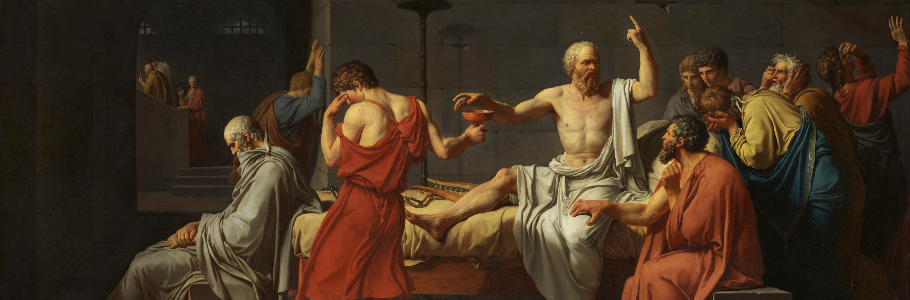
Modified from “The Death of Socrates” by Jacques-Loius David (1787)

STUPID SOPHISTS

If he knew that he could not […] become a philosopher […] he might propose to teach grammar, music, or tactics. For we can find no reason why anyone with the last spark of nobility in his nature should become a sophist…” (Ibid., II, 54, col. 39., col, LI).

The Epicurean critique against rhetoric is dually applied to and principally exhibited by a method that they refer to as sophistic (also referred to as “panegyric” or “epideictic” rhetoric). In general, people “are led astray by sophists and pay them money merely to get the reputation for political ability” (Ibid., II, 46, col. 33). It has been grossly easy for rich orators to persuade poor laborers to fund their schemes. Philódēmos observes that “sophistical training does not prevent faulty speech” (Ibid., I.182, col. I—I, 186, col. V). In fact, “some do not care at all for what they say” so long as it accomplishes their rhetorical goal, regardless of the greater goal of life (Ibid., I, 244. col XIII). “And when they do praise a good man they praise him for qualities considered good by the crowd, and not truly good qualities” (Ibid., I, 216 col. XXXVa, 14).

“[I]t follows that”, as is the case with other forms of technical rhetoric “those who possess this ability [of sophistic rhetoric] have acquired it without the help of scientific principles” (Ibid., I, 136, 20=Suppl. 61, 19). “[R]hetorical sophists” are known “for wasting their time on investigation of useless subjects, such as […] the interpretation of obscure passages in the poets”, as when civic policy is guided by mythic texts (Ibid., I, 78, 19 ff.=Suppl. 39, 5 ff). Compared against the philosophers, “the instruction given by the sophists is not only stupid but shameless, and lacking in refinement and reason” since it does not take into account the goal of life, nor commit to a devoted study of nature (Ibid., I, 223, fr. III). Instead, sophistic rhetoric appeals to authority and tradition by means of equivocation, obfuscation, and exploitation of ignorance.
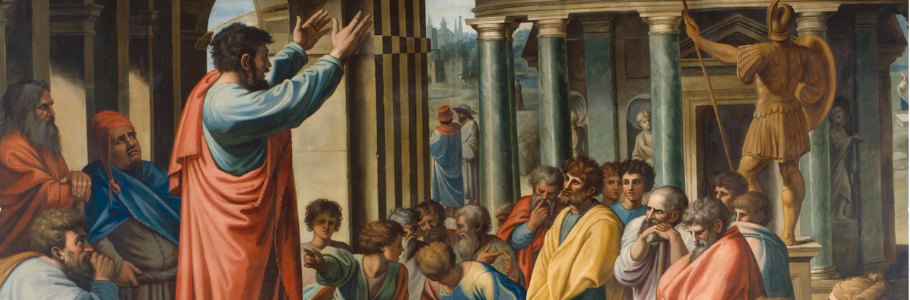
“Paul Preaching in the Areopagus” by James Thornhill (1729-31)

CULTIVATING IGNORANCE

Often, obfuscation “is intentional”, as is the case “when one has nothing to say, and conceals the poverty of his thought by obscure language that he may seem to say something useful” as with equivocation (Ibid., I, 156, col. XIII). Other times, we observe “unintentional obscurity [that] arises from not mastering the subject, or not observing the proper formation […] and in general from failure” (Ibid., I, 158, col. XVI). Obscurity in discourse also arises “from ignorance of the proper meanings of words, their connotation, and the principles on which one word is to be preferred to another” (Ibid., I. 159, col. XVII). In these cases, the success of an orator corresponds not with knowledge, nor coherence, but with a practical ability to persuade a mob. “Most, if not all [of] the arguments do not prove what they claim to prove even if the premises be granted.” (Ibid., I, col. 5). “The worst class of arguments are those which act as boomerangs and demolish the position of the disputant” (Ibid. I, 4, col. I=Suppl. 4, 17).

For example, suppose that a sophist means to convince a legislative body to support a piece of legislation, but they lack meaningful substance. It behooves them to appeal to their audience’s preferences — moderates appreciate an appeal to custom (e.g. it’s the way it is); traditionalists appreciate an appeal to myth (e.g. it’s the way it’s always been); legalists appreciate an appeal to authority (e.g. it’s the law); populists appreciate an appeal to popularity (e.g. it’s what we want); economists appreciate an appeal to wealth (e.g. it’s profitable); bleeding-hearts appreciate an appeal to empathy (e.g. have a heart); ignorant people appreciate an appeal to simplicity (e.g. they’re trying to confuse you). The most ignorant are the most gullible, easy prey for skilled sophists. (Intentional obfuscation is masterfully exemplified by the “Chewbacca Defense” from the October 7, 1998 episode of South Park. The “Chewbacca Defense” leads to an irrelevant conclusion based on non-sequitur speech and a red herring.)
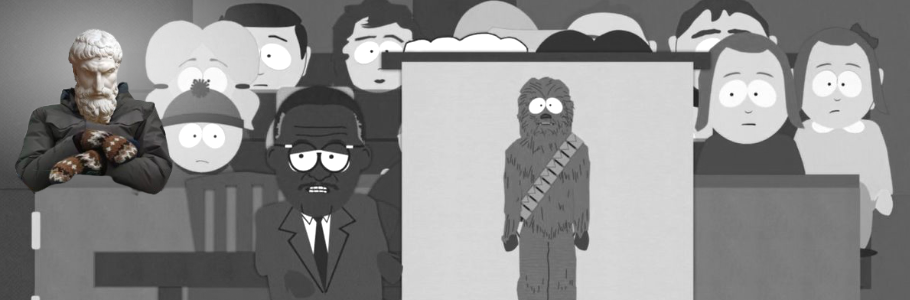
Modified from a screenshot of “Chef Aid,” South Park, season 2, episode 14, Comedy Central, 1998

EMPTY ORATORY

Philódēmos spends the better part of On Rhetoric distinguishing rhetoric as a technical art versus legislative and judicial oratory, which he identifies as a practical skill. He writes:

The practical skill acquired by observation is not called an art by the Greeks except that sometimes in a loose use of language people call a clever woodchopper an artist. If we call observation and practice art we should include under the term all human activity.
(Ibid., I, 57, 23 ff.=Suppl. 29, 15 ff.)

There is a “division between the different parts of rhetoric (i. e. sophistic and practical rhetoric) which was made by Epicurus and his immediate successors (Ibid., I, 49, 14 ff.=Suppl. 25, 15 ff.). Unlike sophistic, Philódēmos suggests that one “could find reason for pursuing practical rhetoric”, even though this form of oratory does not qualify as a formal art (Ibid., II, 54, 41). Unlike sophistic methods of argumentation, practical oration (the ambassadorial oratory of diplomats, the deliberative oratory or legislators, the forensic oratory of lawyers) provides practical utility: “thousands of [Greeks] have been useful ambassadors, were prudent in their advice, were not the cause of disaster, did not speak with an eye to gain, and were not convicted of malfeasance in office.” (Ibid., II, 224, col. XIX). In these cases, “some do succeed by means of natural ability and experience without the aid of rhetoric” (Ibid., I, 47, I ff.=Suppl. 24, 10 ff.). They are less concerned with trying “to classify and describe metaphors” instead of trying to give “practical working instructions” (Ibid., I, 171, 2, col. XII).

Still, even without methodical manipulation, oratory does not guarantee happiness, and provides no moral direction. It allows fools without skill to run offices that benefit from skill. Popularity insulates celebrities from the consequences of their actions. Oratory is the favored tool of talentless politicians whose only object is the advancement of destructive pursuits.

By contrast against the empty promises, unhelpful eloquence, and practical lies of orators, Philódēmos argues for παρρησία (parrēsía, “frank” or “free speech”), explaining that it is truly καλή φράσις (kalḗ phrásis), “lovely phrasing” or “beautiful speech” (On Rhetoric, I, 149 IV). Epíkouros commits to using “ordinary expressions appropriately, and not express oneself inaccurately nor vaguely, nor use expressions with double meaning” (Ibid., I,161, Col XIX). Ornate oratory might promote popularity, but rarely does it reduce anxiety.

Modified from a screenshot from “They Live” by John Carpenter (1988)

POLITICAL PROGRAMMING

Rhetoricians might flatter flies with honey, but politicians feed flies bullshit.

Epicurus believed that there was no art of persuading large bodies of men; that those who are not rhetoricians sometimes are more persuasive than the rhetoricians; that those trained in panegyric are less able to face the tumult of the assembly than those who have no rhetorical training; that Epicurus spoke of arts, and said that those acquainted with them were benefited, but did not mean that this enabled them to attain the end; if anyone possesses the power of persuasion it is responsible for evil and not for good.
(On Rhetoric, I, 99, 5b=Suppl. 48, 15)

While the arts of persuasion are discouraged, even then, Epicureans evaluate the dialectic and rhetoric above political discourse. “[W]e declare [politics not] to be an art “ (Ibid., Section II-a). Politicians are famously dishonest because “a clever man without studying the technical works of the sophists can study some sophist’s speech and so learn to imitate them.” (Ibid., I, 130. col. XXIX). Command does not require comprehension. “They certainly leave no place for any science…” (Ibid., I, 49, 14 ff.=Suppl. 25, 15 ff.). Indeed, “Delivery depends, too, on natural endowment, beauty of voice, grace of body” (Ibid., Col. XV). The job of “the statesman” is only to “discover the inherent political arguments” corresponding to “what appears true to the crowd” and then to manipulate them to the best of their ability (On Rhetoric, I, 209. col. XXVIII). As conditions change, one politician can advance murderous schemes, while another need to only wear the wrong-colored outfit to incite widespread, public ridicule. “There is no method by which one can” reliably “persuade the multitude, either always or in the majority of cases”, so pursuing politics is akin to delaying your own happiness (Ibid., II, 120, fr. XIX). Usually, success in politics requires either “a lot of money made through unscrupulous means” or “servility to the mob or authority” (Vatican Saying 67). Neither of those conditions are conducive to happiness.

To sum up; by no means should the philosopher acquire political experience, or rhetoric of that sort. It is evident that it is the height of folly to say that a study of nature produces a ἕξις [“habit”] of political oratory, especially since they introduce into the scheme of philosophy example andenthymeme” (On Rhetoric, II, 35, col. 38).

Philódēmos identifies those arguments that appeal to prejudice, traditional paradigms, historical precedence, and common belief as being “vain” (Ibid., I, 286, col. VII). They are “mere padding [to] provoke applause”, all “because the multitude is foolish” (Ibid., II, 39, col. XLI, I. 14). It is equally foolish that those “in political speeches use syllogism and induction which the dialecticians pride themselves on using” (Ibid., I, 286, col. VII). Therefore:

“[The wise] will [not] meddle in politics […] nor will they tyrannize; nor will they bark like a Cynic, […] and they will serve jury duty, and they will leave behind writings, but will not make public endorsements, and they will take precautions for their possessions” (Laertios 10.119).

Modified from “Departure of Odysseus from the Land of the Phaeacians” by Claude Lorrain (1646)
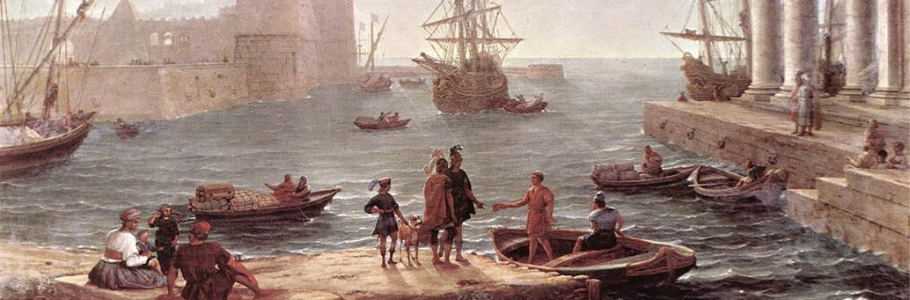
THE HARBOR OF PHILOSOPHY

“But this does not apply any more to philosophy”, nor does it apply to “the Epicureans who refrain from such things” (Ibid., II, 144, fr. II). “Philosophy is more profitable than epideictic rhetoric, especially if one practices rhetoric in the fashion of the sophists (Ibid., I, 225, fr. I). “To tell the truth”, so Philódēmos boasts, “philosophers gain the friendship of public men by helping them out of their troubles.” (Ibid., II, 133, fr. IV). He explains, “they live in peace and justice and tried friendship; those whom they find opposed to them they quickly soften” (Ibid., II, 160, XXI-XXV. II, 162, fr. XXVII). As mentioned, the Epicureans pride themselves on παρρησία (parrēsía, “free speech”). “In speaking one should not resort to ignoble rhetorical tricks, these have less effect than a straight-forward character” (Ibid., II, 126, fr. VI). Since the public tends to prefer comfortable lies, “it is better not to receive public preferment” (Ibid., II, 154, fr. XII.). Philosophers “help their country” not by patronizing the public, but “by teaching the young […] to act justly even if there are no laws, and to shun injustice as they would fire.” (Ibid., II, 154, fr. XIII.).

The primary resource that preserves the Epicurean deconstruction of oratory comes from Philódēmos in his book On Rhetoric. In this book, Philódēmos distinguishes technical rhetoric from practical oratory. He provides a critique of political speech and reviews the dialectic against the Epicureans’ method by analogy that anticipates the modern, scientific method.

Of chief concern, Philódēmos contrasts arts (like dialectic and rhetoric) against practical oratory and political speech, which are not teachable arts. “An art”, he writes “cannot be attained by one who has not studied it, and doing this regularly and certainly and not by conjecture.” He further explains that “this definition applies both to […] grammar and music”. He later adds “architecture, ship-carpentry, navigation, painting”, which all “had methods in olden time” (Ibid., I, 137, col. 33I.21). He concludes, “On the basis of this definition we declare sophistic to be an art” (Ibid., Section II-a). Here again, “That statement ‘He is a good rhetor’ simply means that he is experienced and skilled in speaking”, not that he is a good person. “For as we say ‘good rhetor’ we say ‘good artist’ meaning ‘skillful’” (Ibid., II, 234, col. XXXV).
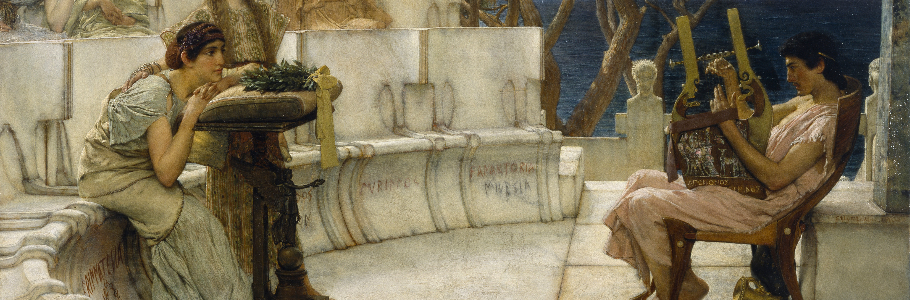
Modified from “Sappho and Alcaeus” by Sir Lawrence Alma-Tadema (1881)

VARIETIES OF DISCOURSE

“One cannot even say that all rhetors adopt one style”, since orators alter their deliveries to suit the disposition of their audience (Ibid., I.152, Col. VIII). In On Rhetoric, our friend Philódēmos provides an overview of the various types of rhetoric and oratory, in addition to reviewing the positions of the Peripatetics and Stoics. In The Art of Rhetoric, Aristotélēs distinguishes rhetoric by three domains of persuasion: [I] deliberative or symbouleutic (e.g legislative), [II] forensic (e.g. judicial), and [III] epideictic (e.g. charismatic speeches) types (Technē Rhētorikē). A later Peripatetic adds [IV] enteuctic (e.g. ingratiation) as a fourth category. Conversely, the Stoics refer to epideictic rhetoric as [V] enconmiastic (e.g. eulogistic). Philódēmos also identifies [VI] ambassadorial (e.g. diplomatic) oratory and [VII] eristic (e.g. controversial). While ambassadorial, deliberative, and forensic styles of oratory exemplify practical oratory, the precision of rhetoric qualifies it as a technical art. Unlike practical oratory, technical rhetoric is exemplified by epideictic, rhetoric, also called [VII] panegyric (e.g. pageantic) and/or [VII] sophistic (e.g. deceptive).

As regards dialectic, Philódēmos offers professional respect (especially when compared against the profession of politics, the practice of oratory, and the art of rhetoric). He elaborates:

For the method of question and answer is necessary not only in philosophy and education, but often in the ordinary intercourse of life. The method of joint inquiry frequently demands this style. Moreover this method is adopted by the rhetor in the assembly as well as in the court of justice. (On Rhetoric, I, 241, col. XI).

While Philódēmos rejects the dialectic as a criterion of knowledge for “lack of qualification”, he accepts the general procedure as a logical tool, and acknowledges its applications in both technical rhetoric and practical oratory. In this way, “the rhetor is like the dialectician” (Ibid., II, 42, col. 30, I. 12.). The varieties of discourse are defined further at the end of this essay.

Modified from “Trilogy of the Desert: Mirage” by Salvador Dalí (1946)

THE MIRAGE OF SUCCESS

False illusions of success encircle us. Salary is not a reflection of skill. Popularity is not a mirror of value. Wealth cannot enrich friendship. Power cannot procure safety. Usually, these things produce antithetical effects: success incentivizes corruption, popularity rewards dishonesty, wealth challenges friendship, and power instigates insecurity. In his Key Doctrines, Epíkouros warns, “If for every occurrence you do not constantly reference the goal of natural pleasure, but if you suppress both banishment of pain and pursuit of pleasure to operate for another purpose, your reasonings and practices will not be in accordance” (25).

Wishing to be worshipped and well-liked, people procured security from people so long as they can be pronounced popular. And if so then indeed they were safe since such a lifestyle inherits the natural benefit of the good. If, however, they procured no safety, then they did not receive that for which they initially strove. (Key Doctrine 7)

Philódēmos provides us with a further warning in On Rhetoric as well as an example of when politicians, wishing to be popular, failed to procure safety:

“[M]any statesmen have been rejected by their fellow citizens, and slaughtered like cattle. Nay they are worse off than cattle, for the butcher does not hate the cattle, but the tortures of the dying statesmen are made more poignant by hatred” (Ibid., I, 234, col. V).

Based on these factors, Hermarkhos calls those who willfully pursue a career in rhetoric “insane”. They rarely achieve the goal of nature that such wealth and popularity is meant to secure. He affirms that “’It is better to lose one’s property than to keep it by lawsuits which disturb the calm of the soul‘” (Ibid., I, 81, 3ff.=Suppl. 40, 23 ff). For “it is much better to lose one’s wealth if one can not keep it otherwise, than to spend one’s life in rhetoric” (Ibid., I, 235, col. VI). Epíkouros summarizes, “Better for you to have courage lying upon a bed of straw than to agonize with a gold bed and a costly table” (Usener, Epicurea 207).

Modified from “Landscape with Farmhouses and Palm Trees” by Camille Pissarro (1853)

LIVE UNKNOWN

“[L]et us be content”, writes Philódēmos, “to live the quiet life of a philosopher without claiming a share in the ability to manage a city by persuasion” (On Rhetoric, I, 234, col. IV). Nothing secures a pleasant life so much as friendship, and nothing guarantees a life of pain so much as politics. Philosophy is more valuable that rhetoric because the “philosophy that teaches us how to limit our desires is better than rhetoric which helps us to satisfy them.” (Ibid., II, 150, fr. VII)

Philosophy is more profitable than epideictic rhetoric, especially if one practices rhetoric in the fashion of the sophists […]. The philosopher has many τόποι [“topics” or “positions”] concerning practical justice and other virtues about which he is confident; the busybody (i. e. the rhetorician) is quite the opposite. Nor is one who does not appear before kings and popular assemblies forced to play second part to the rich, as do rhetors who are compelled to employ flattery all their lives. (Ibid., I, 225, fr. I).

Escape notice and live! So writes Philódēmos, every “good and honest [person] who confines [their] interest to philosophy alone, and disregards the nonsense of lawyers, can face boldly all such troubles, yea all powers and the whole world.” (Ibid., II, 140, fr. XII). He observes:

“inspired before the same loud clamor, some will strive with the effort of Apollophanes [the Stoic] to advance wonderfully to the podium, but others, having landed in [philosophy’s] harbor and with hopes offered them that ‘not even the venerable flame of Zeus would be able to prevent them taking from the highest point of the citadel’ a life that is happy, afterwards, in spite of opposing winds….” (P.Herc 463)

Modified still from Star Wars: Andor, “Rix Road” (Season 1, Episode 12, November 23, 2022).

A GALAXY CLOSE TO HOME

If you will humor me, and entertain the possibility that I might attempt to “rightly hold dialogue about both music and poetry” (Laertios 10.120), consider that many of these points have been artfully orchestrated by writer and director Tony Gilroy in the television series Star Wars: Andor. One character in the fiction, the galactic senator, Mon Mothma, highlights the perils of propaganda (and political office) by exposing a dangerous, manufactured narrative: her dissent in politics has made her a target, and her agency as an orator is being suppressed. She redresses the Senate one, final time before withdrawing to a base, hidden deep in a distant forest:

The distance between what is said and what is known to be true has become an abyss. Of all the things at risk, the loss of an objective reality is perhaps the most dangerous. The death of truth is the ultimate victory of evil. When truth leaves us, when we let it slip away, when it is ripped from our hands we become vulnerable to the appetite of whatever monster screams the loudest. (Season 2, Episode 9)

In this fiction, diplomatic puppets defend and regurgitate loaded propaganda, having been convinced that a small, non-violent protest was actually an uprising. Only the survivors of the massacre, who heard the screams and saw the bodies for themselves know the truth. Similarly, Epíkouros advises that there “is a need to take into account […] all of the self-evident facts, according to which we refer our opinions”. Otherwise, “if not everything will be full of foolishness and of confusion” (Key Doctrine 22). Otherwise, one might be mislead to excuse genocide in the name of “security”. Otherwise, one might be mislead by political pundits and influential personalities to defend an armed mob of triggered, masked agents, deputized by a corrupt system to act with impunity. In the drama, one stormtrooper even shoots a woman in the face.

Trust your physical feelings and the force of nature. Lies are impractical. Propaganda is self-destructive. Oratory can be sinister. Principally, they target those who dismiss evidence and embrace superstition. It is dangerously easy to compel gullible minds to commit acts of violence through persuasive speech. Indeed, the modern-French philosopher Voltaire (heavily influenced by the propositions of the Epicurean school) observed that “Certainement qui est en droit de vous rendre absurde est en droit de vous rendre injuste” (Questions sur la Miracles 412). “Those who can make you believe absurdities can make you commit atrocities.” Persuasion is dangerous, and we rightly treat the instruments by which it spreads with scorn.

No deceptive speeches, manipulative oratory, lofty dialectic, nor rhetorical bullshit will convince a wise person to doubt their own eyes, discard their own feelings, and abandon their own study of nature. I invite you to see with your own eyes. Your life likely depends on it.


INDEX

Modified from “The Butcher’s Shop” by Gabriele Passerotti (1580)

    • Technical rhetoric includes epideictic, encomiastic, and panegyric or sophistic types. Philódēmos teaches that these methods of rhetoric are true arts.
    • Practical oratory includes ambassadorial, deliberative (or symbouleutic), and forensic types. Statesmen employ these methods for practical functions.
    • Political discourse “in this respect […] may fittingly be compared to the art of prophecy” (Ibid., I, 31, 3 ff.=Suppl. 17, 20 ff.). It is sometimes practical.
    • The Dialectic is a systemic, but deeply flawed method of reasoning privileged by
    • Socratics, Megarians, Academics, Peripatetics, and Stoics.
    • The Method by Analogy refers to the empirical reasoning of the Epicureans, which draws inferences from observations that can then be tested.
    • Philódēmos mentions several other rhetoric types, including the entuectic and eristic types that are not explicitly categorized, and may be synonyms or subsets.

  • AMBASSADORIAL ORATORY – πρεσβευτικός (presbeytikós). This practical form of oratory is employed by dignitaries and diplomats. Ambassadorial oratory is the ability “to be able to persuade in diplomatic negotiations by speech, not by power or bribes or dignities or anything else an ambassador might possess” (Philódēmos, On Rhetoric, II, 217, col. XIII).

  • DELIBERATIVE ORATORY – συμβουλευτικά (symbouleutiká) is also known as “symbouleutic” oratory. This practical form of oratory is used by legislators. It “gives advice only on matters affecting the common welfare, and that this advice is not the product of the sophistic art, but of [something] quite a different…” (Ibid., I, 211. Col. XXX.19).

  • EPIDEICTIC RHETORIC – ἐπιδεικτικός (epideiktikós, “demonstrative”, “performative”). This is an art of study regarding “charming speeches” (Ibid., II, 244, col. XLII). It is also called “encomiastic” by Stoics (Laértios 7.142). It is far less profitable than philosophy “especially if one practices rhetoric in the fashion of the sophists” (Ibid., I, 225, fr. I.).

  • ENCOMIASTIC RHETORIC – ἐγκωμιαστικός (enkōmiastikós, “eulogistic” or “laudatory”) is rhetoric ἐπαίνους καὶ ψόγους (epaínous kai psógous) “of praise and blame”. “Furthermore, no one can believe encomiasts, because they praise bad men” (Ibid., 220, col. XXXIXa). Stoics called epideictic oratory “encomiastic” (Laértios 7.142)


  • ERISTIC SPEECH – ἐριστικός (eristikós, “eager for strife”). “Dialectic and eristic may be arts…” , however, the Epicurean school evaluates them as forms of persuasion, unconcerned with the validity of their statements as they correspond to reality (Ibid., I, 57, 23 ff=Suppl. 29, 15 ff.). Eristic speech is provocative and controversial.

  • FORENSIC ORATORY – δίκανικα (díkanika, “judicial”). Philódēmos compares the practicality of forensic oratory with “deliberative” and “ambassadorial” oratory (Ibid., I, 134, col. XXXI). Practically, forensic oratory is employed in courts of law in the form of criminal defense.

  • PANEGYRIC RHETORIC – πανηγυρικός (panēgyrikós, “assembly” speech). This form of rhetoric is synonymous with sophistic rhetoric. “Now we have already treated in a previous section the idea that sophistic or panegyric or whatever it may be called […] may be easily called rhetoric.” (Ibid., II, 234. col. XXXV.). Epíkouros writes that the wise “will not πανηγυριεῖν (panēgyrieîn)” or “make public speeches” (Laértios 10.120).

  • POLITICAL DISCOURSE – πολιτικός (politikós, “of the city”). Politics, by itself, is not an art. By itself, the “political faculty” is empty. It is not a technique, nor a method, but more like “prophecy”. “No man was able […] to impart to his contemporaries or to posterity [the principles of politics]” without the rhetorical arts of the philosophers (Ibid., I, 139, col. XXXIV). “[T]echnical treatises of rhetoricians […] are useless for producing the political faculty”, which does not require training (On Rhetoric, I, 64, II frr.=Supple. 32, 19 ff.).

  • PRACTICAL ORATORY – Practical forms of oratory (for example, speeches employed by dignitaries, deliberations employed by legislators, and defenses employed by lawyers) are distinguished from technical rhetoric (epideictic or enconmiatic, and panegyric or sophistic). Practical oratory is not considered an art that can be learned, only a practice that can be repeated, like civic speech, legislative debate, judicial defense, and diplomatic counsel. “Epicurean authorities hold that sophistic rhetoric does not perform the task of practical and political rhetoric” (Ibid., I, 119, 28 = Suppl. 59., 1e4. I, 120, 10= Suppl, 60, 6).

  • SOPHISTIC RHETORIC – σοφιστική (sophistikḗ). Sophistic is an art of epideixis, and of the arrangement of speeches, written and extemporaneous.” (Ibid., II-c). “Sophistic style is suited to epideictic oratory and written works, but not to actual practice in forum and ecclesia” (Ibid., III, 134. fr. V). Indeed, “the training given by the sophists does not prepare for forensic or deliberative oratory” (Ibid., II, 131, fr. I). “Sophistic can “persuade men to become villains. And when they do praise a good man they praise him for qualities considered good by the crowd, and not truly good qualities” (Ibid., I, 216 col. XXXVa, 14).

  • TECHNICAL RHETORIC – τεχνικός (tekhnikós, “technical”) refers to methods of oratory that properly fit the Epicurean definition of an “art” (or “technique”), including epideictic and sophistic methods. Technical rhetoric offers methods (as is the case with any true art) that can be taught, and reproduced to achieve the same result. “Two sciences produce the same result.” (Ibid., I, 4, co. I=Suppl. 4, 17.). However, compared against the study of nature, “technical rhetoric has never advanced anyone” (Ibid., I.192, col. XI).

  • THE DIALECTICδιαλεκτική (dialektikḗ). Before the idealistic Hegelians and materialistic Marxists, the “dialectic” was privileged by Socratics, Megarians, Academics, Peripatetics, and Stoics, who defined it as “the science of conversing correctly where the speeches involve question and answer — and hence they also define it as the science of what it true and false and neither” (Laértios 7.42). The Epicureans reject the dialect as being incapable of verifying “truth” because it assumes that “truth” is capable of being reasoned without reliance upon physical evidence. Most of the dialecticians encouraged political participation as a necessity to existential satisfaction; Epicureans outright reject political office.

  • THE METHOD BY ANALOGY καθ᾽ ὁμοιότητα τρόποϛ (ho kath’ homoiotēta tropos, “method according to similarity”) anticipated the modern, scientific method by several millennia. Epíkouros accepted that inferences must comport with observation and abide by nature. We must “create an analogy that corresponds with what we see“ (On Nature, Book 11, III, b5-12).” [W]e shall not be prevented from making inferences, provided that we use the method of analogy properly” (On Signs). And “we say that the method of analogy is a sound method of inference, with this condition, that no other appearance or previously demonstrated fact conflicts with the inference” (Ibid.).

For additional commentary, please see “Reasonings About Philodemus’ Rhetoric

For more on deliberate misrepresentation, please see “On Bullshit” by Dr. Harry Frankfurt

Clipped version of “Saint Epicurus” by Genevra Catalano (2023)

Be well and live earnestly!

Your Friend,
EIKADISTES
Keeper of Twentiers.com
Editor of the Hedonicon
Vegetarianism as a Life Choice for Epicureans

What follows is a recent discussion on vegetarianism as a life choice for Epicureans. Please read Hermarchus on the Ethics of Vegetarianism and Treatment of Animals for context.

Hiram. We’ve been wondering what thoughts people have on vegetarianism from an Epicurean philosophy perspective.

Ron. If death is nothing to us, it is nothing to the animals. However, they are sentient beings and while they are alive they deserve from us a pleasant life.

Lena. I think being involved in animal slaughter is a harm for the people involved. We can make this better by improving conditions for animals and people, but the physical and emotional danger to us must be part of the calculus.

Eileen. I don’t recall him ever saying killing is nothing, though. Epicurus believed we are not unique among the animals. Since we wouldn’t want to be killed, I can imagine he might think we should forgo killing them, especially since we can be healthy as vegetarians. I assume he was aware that people can be vegetarians because there were some in ancient Athens in his day. Maybe I’m assuming too much.

Anthony. I think as in all things hedonic calculus needs to be performed. In some situations, such as human starvation or malnutrition, there is less pain if the human, who has the blessing and curse of foresight (knowing they will starve to death or at least suffer much pain from hunger and malnutrition), the killing of an animal for food in my opinion is an obvious choice. I believe eating fish and insects may be more morally acceptable as those animals, as far as I know, are less aware of their fate and so have less anxiety about death.

Is it not natural and correct for the individual to first consider their own essential needs before another’s as we who understand nature would expect others to do?

Hiram. I suppose a more scientific approach to this from an ethical perspective that takes into consideration how much pleasure vs pain our choices and avoidances generate is to think in terms of the neural complexity of the creature that we kill for food. This has always seemed intuitively correct to me: like you said, a cricket is much less complex in his neural system than a cow or pig, and therefore getting protein from them is less cruel. I think the amount of unnecessary suffering generated is part of what generates discomfort and guilt in us.

Lena. Some Jains don’t eat potatoes because it destroys too many microbes, and I’ve seen an argument that the push to farm insects as protein isn’t a moral improvement over current livestock, because the quantity of lives and suffering would become so significant.

Hiram. The Epicurean Scholarch Hermarchus seems to be putting forward ecological management arguments in the cited article. If too many of certain creatures breed they should probably be eaten. On the other hand many species of fish will be depleted by 2050 because of over-fishing and will likely become protected species soon.

Matt. The best advice on this subject I ever have heard came from a Theravada Buddhist monk…though he himself was a vegetarian living in Sri Lanka, he admonished others that took a position that vegetarianism is the “correct” thing to do. He would say that Buddhists living in places where it is inhospitable to grow crops like Tibet and Mongolia … those monks must subsist on meat and dairy in lieu of a strictly vegetarian diet. So it can’t be a universal precept. It may be right for an individual but it can’t be proclaimed as universally orthodox since there are societies that have been subsisting on animal products since time immemorial and the reasoning has to do with necessity.

I have also made serious attempts to be vegetarian in my life, specifically when I adapted to a Hindu/Eastern philosophy years ago. I find the reasoning within eastern philosophy to be pretty flimsy, based on metaphysical idealism that doesn’t hold up to scrutiny. I have finally settled on the fact that meat eating is good for me, as a personal position. I have hunted and I have killed animals before for food and I am comfortable with this decision from an ethical perspective, even if I don’t personally kill the animal that produces the meat I consume or my family consumes on a regular basis.

Si. Personally I think that looking at what you eat and why is a part of the analyzed life. The industrial meat industry is a lot different than in the Hellenistic era. So even if Epicurus has the occasional meat, it’s very different now. With environmental considerations as well as ethics, I personally made the choice to be vegetarian and move towards having a mostly plant based. I try and cause as least pain as possible in an imperfect world.

Marcus. Evidence points to the ancient Epicureans being flexitarians, eating meat on occasion but mostly encouraging vegetarianism as healthier. Desire for meat was considered natural but not necessary.

Beryl. Biologically we have the dental apparatus of omnivores therefore we have adaptations to eat everything. That is our true nature as human beings. I have worked in medical research and seen the morally corrupting influence of using animals as vessels for our own natural urges and unnatural urges and interests Killing does seem to change people and reduce their empathy for living things. I turned my back on this type of medical research in my twenties viewing it as barbaric and pollutional for me.

Shahab. I think our nature or our natural body is more adapted for consumption of plants, rather than meat. Historically, people used less amount of meat. Eating meat was considered to be ceremonial, and somehow, a privilege for kings and their courtmen. Moreover, maybe by comparing the shape of our teeth to other non-human animals we can draw the conclusion that we are less adapted to eating meat than to plants.

Plus, the veganism is a modern subject, or let’s say, a reaction to the modern problem of over-production of meat, and kinds of diseases related to over-consumption of meat, and also the development of ethical framework which takes non-humans as subjects of ethical discussions.

When I remember my own childhood, or see other children’s affection toward animals, and their deep opposition to killing them, I can draw the raw conclusion that beside eating meat, killing animals regularly and on a mass scale is an outright deviation from our nature.

Hiram. Philodemus says that people who suffer from chronic, out-of-control rage are “like wild beasts”. Similarly we could argue that people who enjoy causing suffering to innocent animals are also “like wild beasts”, and that they remain in a wild, pre-civilized state. Whenever a creature complains or cries while being mistreated, it is understood that the animal is not giving its consent to how it’s being treated, that some form of communication of denial of consent is being given. Therefore, the act is unjust (as per Doctrine 32), and if animals have to be slaughtered for food, they should be killed in the least painful way possible.

Matt. This particular study shows evidence that human evolutionary progress was the result of an exceptionally high protein diet. Even our facial structure has been changed. Early humans have gone through multiple phases, but the reality is that humans have in fact had high protein diets in prehistoric times and even today. Agriculture is a fairly modern invention in the history of humankind. Human biology shows evidence that early humans became what we are now from a divergent lifestyle of pure herbivory.

This is not a condemnation of Vegetarianism or Veganism on philosophical or health grounds. I believe that a person chooses that lifestyle for many good reasons. I cannot say the vegetarianism of the Hindu Indian is ethically more correct than the traditional heavy protein rich diet of the Inuit in Nunavut. Both lifestyles arose organically and are currently being practiced, and there are many, many cultures that fall in between these two extremes that also arose entirely organically.

Beryl. I attended a conference six years ago now which looked specifically at new diagnostic methods to link human genome to food benefits with many researchers saying that individual diets for health optimization were being developed, so I agree what is natural and necessary for one person is not natural or even healthy for another. Ultimately hedonic calculus helps to determine the actions that make one healthy bodily and psychologically and which cause oneself and those about us least suffering.

Ultimately though I do believe we must evolve to develop greater empathy and connection with our fellow species on this planet and to step aside from our egotistical drives for survival which are now hurting vast swathes of the world’s populations and is causing global temperature. There are 7 billion of us on the planet and some animal species are down to their last 50 individuals. As an individual, I am starting where I am, taking responsibility for what I do and influencing where I can. I am not wedded to that though. If our species died out then that would mean nothing to me, however the future suffering of the upcoming generations does trouble me and perhaps that’s a topic for further discussion sometime.

Nate. If it works for you, it works for you. Nature gave us a variety of teeth, a variety of micro-bacteria in our guts, and a variety of digestible items in our environments from which to choose. It would be odd for an omnivorous, opportunistic mammalian species to exhibit anything less than diversity in diets.

Ethics of Philodemus: Philodemus’ Economics

I wish to conclude my book review of The Ethics of Philodemus with a critical look at Philodemus. He and his teacher Zeno of Sidon, and their group, argued frequently against other schools, and against Epicureans who held different views from their own. There were several Epicurean factions. The sources mention at least two factions: the rhetors (who elaborated on the doctrine, mainly inspired by their discussions with other Schools) and the orthodox (who stuck to memorizing the sources). Philodemus claimed orthodoxy by making frequent appeals to the authority of the four founders, but also engaged in these debates.

Since Zeno of Sidon was a Scholarch of Athens of direct lineage to Epicurus and Hermarchus, he is likely to have preserved the most loyal interpretation of Epicureanism … but this is not to say that other Epicurean groups didn’t have legitimate arguments to offer which did not survive in the sources, or indirectly by being criticized in the Herculaneum scrolls. It’s also true that Zeno of Sidon was the successor of Apollodoros, the “Tyrant of the Garden”, and that much of Zeno’s work involved rebelling against the excessive authoritarianism of his predecessor (which may have been necessary in order to protect the Garden and its finances). We know that Zeno was tolerant, friendly, greatly admired, and welcomed Stoics and other non-Epicureans into the Garden to study philosophy together–this may be part of his effort to reject the authoritarianism of Apollodoros.

The subject of economics is the best place for a critical view of Philodemus.

The first criticism of Philodemus has to do with his categorical statement in his scroll On the art of property management, that “the philosopher does not toil“–which seems impractical, except in the case of the very wealthy Romans whom he was teaching. Few people have this privilege to not toil. This odd statement depicts Epicureanism as an exclusive sect for the elite, which it most certainly wasn’t at its inception. 

It’s impossible to abstain from toils. In fact, Philodemus himself cites Metrodorus’ arguments concerning how hedonic calculus must be applied (and sometimes we must go through certain disadvantages for the sake of greater advantages). Here, Metrodorus (the co-founder of Epicureanism) contradicts Philodemus’ statement that the philosopher does not toil. He says that wealth, health, and friendship involve toil, but that this toil is worth pursuing because we will suffer greatly without these goods. The philosopher will toil for the sake of greater pleasures, or to avoid great disadvantages.

One other small critique of Philodemus that I must accept, as someone who has been promoting and writing books on Epicureanism for many years, is that he says that making money from teaching philosophy is the ideal way to make a living … but how many people can really do this? I know of no one who can do this, at least in our day.

While we all agree that the best life is free from toil, the question is HOW can we achieve this? This is a great, and interesting, moral challenge.

One additional note concerning the study of Philodemus’ scroll on the art of property management comes from one of the newest members of SoFE: Marcus reminds us that it’s important to keep in mind that Philodemus’ target audience was the aristocracy of the late Roman Republic. He says:

I found this short video about the Roman patronage system which is good background to understanding Philodemus’ on wealth and property management.

Concerning the utility of wealth, Philodemus says we shouldn’t reject whatever wealth we may get as useless. A natural measure of wealth is clearly preferable to poverty–but the superiority of wealth is practical, not moral. He argues that the Epicurean philosopher does not need to be an expert in management or economics, however personal sovereignty requires that we learn this skill to some extent. Philodemus adds an ethical dimension to it. He worries about our disposition (diathesis) and about issues of hedonic calculus as they relate to the management of our estate: How do you manage your property and home while living ethically and without sacrificing your happiness?

One final critique that we must accept about Philodemus of Gadara is that he seems, to an extent greater than most people do today, okay with the selfish exploitation of others (slavery was normal in his society). However, I’ve always appreciated that Epicurean economics posits a sustainable capitalism that emphasizes the limits of our desires, and therefore it’s a capitalism that is somewhat self-critical, and against excess. This is a necessary antidote to what we see today, particularly in the US. I believe Epicurean philosophy, in this manner, represents a very healthy defense of classical liberal Western values.

This essay concludes my five-part review of The Ethics of Philodemus, by Voula Tsouna. If you’ve enjoyed this content, please consider supporting me on patreon either once or monthly. Content creation is time-consuming, so I do not yet offer any special perks to my patreon subscribers, but it boosts my morale, and it helps support both this website and the teaching mission of the Epicurean Gardens.

Further Reading:

The Ethics of Philodemus

The Epicurean Doctrines on Wealth

The Epicurean Doctrines on Wealth

At one and the same time we must philosophize, laugh, and manage our household and other business, while never ceasing to proclaim the words of true philosophy. – Vatican Saying 41

According to VS 41, the founders believed that economics is an important component of how Epicureans philosophize. Also, according to Philodemus:

We believe that the tranquil administration of one’s property does not require great subtlety and that wealth is superior to poverty. At the same time we believe that it’s necessary to hand down a tradition of the most general principles and to outline many details in the treatises concerning the care and preservation of possessions.

This means that ancient Epicureans were not only writing down outlines or epitomes of the doctrines on physics and on ethics, but also about economics. When we discuss economics here, we must not assume that the ancient Epicureans referred to what in modern English is referred to as macro-economics (monetary policy, etc.), but micro-economics (household management and business management). Again:

If someone reproaches us because we write about economy, that would be enough for us, together with Epicurus and Metrodorus, who give advice and exhortations on household management in a particularly accurate way, albeit with minimal details. – Philodemus, On Vices and Virtues

This means that these doctrines were handed down by the founders. The word used in these quotes was oikonomias (usually translated as household management). There’s also a Philodeman scroll that bears this name. This is from my commentary on Peri Oikonomias (translated as On the Art of Property Management):

Philodemus makes frequent appeals to the authority of Metrodorus, one of the founders of the School, who promoted the idea that hedonic calculus must be employed in the management of one’s household and economic affairs, making the point time and again that we must run certain risks and go through certain inconveniences in order to avoid greater ruin and gain greater advantages.

He disagreed with the destitute life of the Cynics, and appears to have made this point while arguing against them and in favor of a doctrine of the natural measure of wealth. This corresponds to that which is needed to secure the natural and necessary pleasures, and to have the confident expectation that we will be able to secure them in the future.

While many modern Epicureans are following the founders’ advice to write outlines of the doctrines concerning the physics and ethics, the study of Epicurean economics has been mostly neglected. My attempts to create an outline of the economics when I initially read Peri Oikonomias yielded “Seven Principles of Autarchy” (or, self-sufficiency) at the conclusion of my discussion of the scroll, and last year I dedicated my blog’s content at the evaluation of various aspects of the economics.

One other difficulty with dealing with these doctrines has to do with resistance from Epicureans who are critical of what they see as the so-called “minimalist interpretation”, but who do not seem to be critical of the limitless desires, consumerism, and other problems related to not being able to recognize the upper limit of the natural measure of wealth. This probably has to do with the influence of Ayn Rand and other neoliberal philosophers on many who come to the study of Epicurus, and who attempt to inject Randian conceptions of ambition and greed into Epicureanism–where they clearly do not belong, since Epicurus wanted his followers to have a mind that is content, satisfied, grateful, and capable of understanding how much is enough. For this reason, it is important to clearly understand what the original doctrines on economics were, so as to not be swayed by modern revisionism in either direction (towards extreme greed, or towards extreme minimalism).

Metrodorus Against the Cynics

As we saw above, these doctrines were in part inspired in a rejection of the destitute life of the cynics. We know from Diogenes Laertius’ biography that Epicurus also rejected the Cynic practice of begging daily because this is a wretched way of life and involves much toil and suffering (DL 10.119), and said that the sage would not be a mendicant and would “regard to his property and to his future” (DL 10.8). But Metrodorus may have taken issue with more than the Cynics’ full rejection of wealth. Cynics were known for living like dogs, in utter poverty, sleeping on the streets, not practicing hygiene, and having sex in public. The health and social problems associated with lack of hygiene and a life of squalor raise issues when we carry out hedonic calculus.

Epicurean literary tradition has one scene that shows what the exchanges between the Cynics and the Epicureans may have been like. Chapter Four of A Few Days in Athens depicts a visit made by Gryphus, who is described as a “pale, dirty, hairy cynic” whose tunic was torn, to the Garden.

Gryphus, short, square, and muscular; his tunic of the coarsest and not the cleanest woollen, in some places worn threadbare, and with one open rent of considerable magnitude, that proved the skin to be as well engrained as its covering : his girdle, a rope: his cloak, or rather rag, had the appearance of a sail taken from the wreck of an old trader: his feet bare, and thickly powdered with dust: of his face, little more might be distinguished than the nose; the lower part being obscured by a bushy and wide-spreading beard, and the upper, by a profusion of long, tangled, and grisly hair.

The chapter is meant to have comedic value, but there is of course educational value in it also.

The Natural Measure of Wealth

In arguing against the destitute life of the Cynics, the co-founder of Epicureanism Metrodorus taught the doctrine of the natural measure of wealth. What does this consist of?

The wealth required by nature is limited and is easy to procure; but the wealth required by vain ideals extends to infinity. – Principal Doctrine 15

Poverty, if measured by the natural end, is great wealth; but wealth, if not limited, is great poverty. – Vatican Saying 25

We see here an Epicurean distinction between wealth that is “natural” (physikos) and wealth that is empty (kenos). Seneca attributes these words to Epicurus:

There is also this saying of Epicurus: “If you shape your life according to nature, you will never be poor; if you do so according to opinion, you will never be rich.”  For nature’s wants are small; the demands of opinion are boundless.

According to the authors of Philodemus and the New Testament World,

There is for the philosopher a measure of wealth that, following the founders of the school, we have passed down in “On Wealth”, so as to render the account of the art of managing the acquisition of this and the preservation of this. – Column 12 of On the art of property management

Concerning measuring our desires by nature rather than by culture, we must remember this from Letter to Menoeceus:

We must also reflect that of desires some are natural, others are groundless; and that of the natural some are necessary as well as natural, and some natural only. And of the necessary desires some are necessary if we are to be happy, some if the body is to be rid of uneasiness, some if we are even to live. – Epicurus, Letter to Menoeceus

Natural wealth will, therefore, include that wealth by which we procure health (food, water, health care), happiness (friends), and safety (warmth, shelter). But those are just the necessary natural desires. There are additional natural desires which are not necessary, and which merely add variety to our pleasure regimen.

The natural measure of wealth (ploutou metron) is not absolute (it depends on context), but it’s also not arbitrary. Concerning which unnecessary desires may be considered natural, Principal Doctrine 15 teaches that natural wealth is distinguished for being easily acquired (euporistos) while empty wealth is not. Notice that there is no absolute amount of wealth that is assigned to this. The natural measure of wealth will vary according to circumstances.

Philodemus’ On Wealth

There’s one more Philodeman source dealing with wealth. The scroll On Wealth is fragmentary, but mentions that death is nothing to us, probably meaning to explain that wealth will not protect us from death. At a later point in the scroll, Philodemus cites Epicurus offering a point-by-point refutation of Menander’s Georgos (“The Farmer”), a parody of the burdens of poverty. In this parody, the poet personifies Poverty as a hag that would not go away.

The essay On Wealth: New Fragments of Empedocles, Menander, and Epicurus by David Armstrong and Joseph Ponczoch argues that Epicurus defends Poverty in Menander’s Georgos (presumably so long as one is able to procure one’s natural desires, unlike the total destitution of the Cynics), and that

as is apparent from PHerc. 1570 as much as from the texts Balch cites, one can actually distinguish four clear degrees of wealth, with two extremes and two middle terms: immense wealth, (respectable) wealth, (respectable) poverty, and destitution. The notion that a state of poverty can still be respectable is at the heart of the content of pc. 5

Against Extreme Minimalism

In the Letter to Menoeceus, Epicurus described what could be described as a minimalist lifestyle

… we regard. independence of outward things as a great good, not so as in all cases to use little, but so as to be contented with little if we have not much, being honestly persuaded that they have the sweetest enjoyment of luxury who stand least in need of it, and that whatever is natural is easily procured and only the vain and worthless hard to win. Plain fare gives as much pleasure as a costly diet, when one the pain of want has been removed, while bread an water confer the highest possible pleasure when they are brought to hungry lips. To habituate one’s se therefore, to simple and inexpensive diet supplies al that is needful for health, and enables a person to meet the necessary requirements of life without shrinking and it places us in a better condition when we approach at intervals a costly fare and renders us fearless of fortune. – Epicurus, in his Letter to Menoeceus

There seems to be a curriculum of pleasure at play here. We educate ourselves to better enjoy luxurious pleasures if we do not have them frequently. This way, we avoid the hedonic treadmill. We also easily become self-sufficient and confident of our ability to procure our needs by adopting a simple way of living. What we need to keep in mind is:

Frugality too has a limit, and the man who disregards it is like him who errs through excess. – Vatican Saying 63

It’s important to note that the goal of the Epicurean is to live a life filled with all the pleasures that nature makes easily available to us, it’s not to live minimally. As Epicurus says to Menoeceus: it’s “not so as in all cases to use little”. So if the minimalist lifestyle we have chosen generates more disadvantages than advantages, it’s time to reassess the limits of our simple lifestyle. For this reason, Metrodorus said that sometimes we accept many disadvantages for the sake of things without which we would suffer greatly.

Against Extreme Ambition

Concerning the upper limit of the natural measure of wealth, the founders submit the following concerns to our consideration in our choices and avoidances:

The love of money, if unjustly gained, is impious, and, if justly gained, is shameful; for it is unseemly to be parsimonious even with justice on one’s side. – Vatican Saying 43

People generally dislike misers. The word used here, philokrematía (love of money), is also cited by Philodemus in Peri Oikonomias as a vice that we must guard against. It may lead to legal entanglements, reduce the number of our friends, and attract the distrust of friends and business associates. At least one of the Vatican Sayings criticizes how people sometimes sacrifice their freedom for money:

Since the attainment of great wealth can scarcely be accomplished without slavery to crowds or to politicians, a free life cannot obtain much wealth; but such a life already possesses everything in unfailing supply. Should such a life happen to achieve great wealth, this too it can share so as to gain the good will of one’s neighbors. – Vatican Saying 67

Being beholden to crowds or leaders, we may sacrifice our values, or our reputation, or our privacy for money. Some people sacrifice of too much time at work for the sake of money, without the balance of being able to enjoy the fruits of their labor. We call them workaholics. It is difficult to argue that this passes hedonic calculus.

The desire for fame, together with the desire for unlimited amounts of wealth, are both criticized here:

The soul neither rids itself of disturbance nor gains a worthwhile joy through the possession of greatest wealth, nor by the honor and admiration bestowed by the crowd, or through any of the other things sought by unlimited desire. – Vatican Saying 81

We are reminded of the Princeton University study that showed that happiness correlates to wealth with an income of up to $75,000. Beyond that, happiness varies according to other factors, like health, and the amount and quality of friends.

That wealth itself, once acquired, is far from a guarantee of happiness, is attested in the Philodeman scrolls where we see a huge amount of concern with flatterers as a category of false friends. This is probably due to the fact that Philodemus was teaching Epicureanism to wealthy Romans, who attracted many kinds of flatterers, false friends, and people who were seeking their own self-interest by associating with the wealthy. Therefore, even if one is very gifted in interpersonal charm and attracts true friends with ease, it may be difficult for a wealthy person to know with certainty which friends are true ones and which ones are flatterers.

There are other problems tied to not recognizing the upper limit of the natural measure of wealth. Consumerism is tied to anxiety about status, and to false attribution of value to things rather than relations and experiences. Being ostentatious about one’s wealth and suffering from the “keeping up with the Joneses” syndrome may lead to additional problems of debt (which is a form of slavery), and constant craving for more unnecessary things. Once the things we acquire no longer “smell new”, we tire of them and want new toys.

Under what circumstances is ambition advantageous or not, useful or useless?

As we have seen with the “easily acquired” attribution of natural wealth, if the attainment of something comes with little effort and little to no disadvantages, it’s hard to argue against this type of ambition. Particularly, our ambitious efforts lead to wealth that is easily acquired if we employ our aptitude (that which we are good at), and if we enjoy doing what it takes to acquire things. In other words, the greater our aptitude, the less effort we have to put in. If we make great attempts at achieving something that we are not good at, or that we don’t like doing, the effort may not pass hedonic calculus.

Finally, one practical advice given by José Mujica, former president of Uruguay, is that we should measure the true value of things in terms of time instead of money. If we consider how many hours of work it will take to pay for our “new toys”–for instance, a new car–we will be more hesitant to buy frivolous things than if we merely think about the value we get from owning a status symbol. In reality, for as long as we earn an hourly income and have limited amounts of money available (as is the case with almost everyone), it may appear that we are buying things with cash, but we are really buying things with our time and with our lives. If we think about the money that we spend frivolously as the bond of our indentured servitude that it really is, we will become more humane towards ourselves.

Brief Dialogue on Ambition

In order to discern what other Epicureans think about ambition as a virtue or a vice, and about wealth, we had discussions in the Garden of Epicurus Facebook group. Here are a few highlights.

Hiram. What do others think about the ethics of ambition, from an Epicurean perspective? Under which circumstances is ambition advantageous / virtuous and under what conditions is it disadvantageous / a vice?

Ron. Clearly ambition can’t be inherently bad, because Epicurus was very ambitious himself.

Hiram. I don’t think anything is “inherently bad” in Epicurean philosophy, other than pain that doesn’t lead to a greater pleasure.

Doug. If you enjoy doing what you’re doing, it would seem to be fine. If you’re doing it for fame and status, there would be a problem.

Hiram. Is that because fame and status are desires that are impossible to satisfy?

Doug. That would be part of it. In the case of fame and status, there are downsides of these that are commonly not considered until they appear. I’m reminded of what Robert Pirsig did when his book became a best seller and his phone rang off the hook with people asking for interviews. He quit his job, loaded up his RV, and disappeared.

Hiram. Well, then there are people like Whitney Houston and Michael Jackson, who were clearly unhappy and didn’t live lives worth living in spite of their incredible success and fame.

Ron. Not sure about status. Low status can be a source of pain I think. But I would say there is a limit to how much is necessary for a pleasant life, beyond which striving for it is not worth it.

Mike. Let’s be honest. Fame and high status are like a double-edged sword. Yes, there is nothing wrong in desiring and enjoying them. However, that’s not always the case. In many cases, fame and status create much trouble. It is good if they provide peace of mind, bad if they produce anxiety and insecurities. Principal Doctrine 7 is clear on this: “Some people have sought to become famous and renowned, thinking that thus they would make themselves secure against their fellow-humans. If, then, the life of such persons really was secure, they attained natural good; if, however, it was insecure, they have not attained the end which by nature’s own prompting they originally sought.”

Hiram. Famous people frequently lose their privacy. Privacy is an extremely important pleasure that most people take for granted. Consider the British prince and Duchess Megan who recently moved to Canada. Even being royalty can’t make up for the difficulties.

Brief Dialogue on Wealth

Jason. It often results in unnecessary political and/or legal entanglements too. Look at Seneca for an ancient example of wealth not leading to a happy life. I’m sure we can all think of more recent examples too.

Hiram. I have an ambitious acquaintance who is workaholic. She has no children so no reason to work so hard but I have a feeling it keeps her from dealing with “stuff”. Some people avoid having an intellectual or philosophical life in order to avoid existential baggage.

Jason. I know more than one retiree who is “lost” as a result of no longer having to work for a living. I can’t imagine being so bored and incurious that I didn’t know what to do with myself.

Mike. Anxiety is not only a rich man’s disease. It is also a poor man’s problem. There are poor people who are too anxious even about little things. But the fact that Epicurus said that “Wealth, if not limited, is great poverty” implies that infinite desire is vain and therefore produces troubles in the soul such as anxiety, stress, or even paranoia.

An Outline of Oikonomias

I have carried out an investigation of Epicurean economics to the best of my ability, assured by Philodemus that it’s “necessary to hand down a tradition of the most general principles and to outline many details in the treatises concerning the care and preservation of possessions”. As a result of this, below is my outline of the doctrines concerning Epicurean micro-economics. I invite other students to develop their own outlines.

  • There is a natural measure of wealth (ploutou metron), and an Epicurean distinction between wealth that is “natural” (physikos) and wealth that is empty (kenos). The wealth required by nature is limited and is easy to procure (euporistos); but the wealth required by vain ideals extends to infinity and is impossible or difficult to procure.
  • In economics, as in all else, we must run certain risks and go through certain inconveniences in order to avoid greater ruin and gain greater advantages.
  • Since the attainment of great wealth can scarcely be accomplished without slavery, a free life cannot obtain much wealth; but such a life already possesses everything in unfailing supply. Should such a life happen to achieve great wealth, this too it can share so as to gain the good will of one’s neighbors.
  • Our ambitious efforts lead to wealth that is easily acquired if we employ our aptitude (that which we are good at), and if we enjoy doing what it takes to acquire things. In other words, the greater our aptitude, the less effort we have to put in. If we make great attempts at achieving something that we are not good at, or that we don’t like doing, the effort may not pass hedonic calculus.
  • When we are habituated to simple pleasures, we are in a better position to enjoy luxurious ones.
  • Frugality too has a limit, and the man who disregards it is like him who errs through excess.
  • There is social wealth in addition to the wealth of things and possessions. Philodemus, in Art of Property Management, compares our investment of time and money and efforts on our friends with “sowing seeds” that will yield fruit in the future. (all the points that follow are from that scroll)
  • Association makes labor pleasant. We must choose our company prudently.
  • Our revenue must more than meet our immediate needs: it must facilitate a dignified life of leisure.
  • It’s prudent to cultivate multiple streams of income, among which deriving fees from the Garden’s teaching mission, rental property income and business ownership, which includes gainful employment of others, have special priority.
  • It’s prudent to have fruitful possessions, such as the various forms of ownership of means of production.

Further Reading:

On Philodemus’ Art of Property Management

Philodemus, On Property Management (Writings from the Greco-Roman World)ir?t=ataraxia0c-20&l=am2&o=1&a=1589836677

Horace, Ofellus and Philodemus of Gadara in Sermones 2.2, by Sergio Yona

An Epicurean measure of wealth in Horace

 [Philodemus] On Wealth (PHerc. 1570 Cols VI-XX, PCC. 4-6A): New Fragments of Empedocles, Menander, and Epicurus

Philodemus and the New Testament World

In Memory of “The Men”

Epicurus will immediately send us as ambassadors Metrodorus, Hermarchus and Polyaenus. – Leontion’s Epistle to Lamia

Happy Twentieth to Epicureans everywhere! In his Final Testament, Epicurus stipulated that the feasts on the 20th of every month had to continue in memory of him and his beloved friend Metrodorus as was “the established custom” before he died. This post is in celebration of “the Men”–the Founders of Epicurean Philosophy Epicurus of Samos, and his ambassadors Metrodorus of Lampsachus, Hermarchus of Mytilene, and Polyaenus of Lampsachus. Every Twentieth, it is they (as well as other Epicureans of importance who came after them) who are the reason for the season!

We must always orient our discourse for the benefit of those who are solidly armed for happiness: our disciples. – Epicurus of Samos, On Nature 28

The life of Epicurus is a lesson of wisdom. It is by example, even more than precept, that he guides his disciples. Without issuing commands, he rules despotically … We are a family of brothers, of which Epicurus is the father. Many of us have had bad habits, many of us evil propensities, violent passions. That our habits are corrected, our propensities changed, our passions restrained, lies all with Epicurus … he has made me taste the sweets of innocence, and brought me into the calm of philosophy. It is thus, by rendering us happy, that he lays us at his feet. He cannot but know his power, yet he exerts it in no other way, than to mend our lives, or to keep them innocent. Candor, as you have already remarked, is a prominent feature of his mind, the crown of his perfect character. – Metrodorus, in A Few Days in Athens

We are quite familiarized with Epicurus, but not so much with the other three. Our friend Josh wrote a poem titled Hermarchus, Seeing the Bust of Epicurus. Hermarchus was the co-founder and second Scholarch of the Garden. I recently shared the following fragment, which I found in the book Les Epicuriens and translated into English:

This is why Timeus affirms that, whenever they begin any enterprise, sages always in some way invoke divinity. But the Epicurean Hermarchus says: “How do we avoid regressing to infinity in all enterprise if, even for a minor matter, we have need to turn to prayer. Because for one prayer we will need yet another prayer, and we will never stop praying at any point.”

This is what we know from Book 10 of Diogenes Laertius’ Lives of Eminent Philosophers and other sources: Hermarchus, a student of rhetoric, was the successor of Epicurus and the first convert to the teachings of Epicurus in the early days when Epicurus first began teaching. He was born in Mytilene, Lesbos in 340 BCE from a poor family and died around 250 BCE of paralysis.

Hermarchus was the only one among the founders who was there both prior to Epicurus’ teaching mission, and at the time of his death when, according to Philodemus, he assisted the Hegemon, “wrapped him in a shroud, and kept vigil beside his remains“–a testimony of the tender love that existed among the first Friends of Epicurus who had grown old together in philosophy and were as family.

Some of the extant sayings in our tradition have been attributed to him, and it is believed that he was almost exclusively vegetarian and that he considered meat-eating an unnecessary desire because it contributes not to the maintenance of life but to a variation in pleasure.

A young man that loves glory, that is precocious wickedness. – Metrodorus of Lampsacus

Bust of Metrodorus / Epicurus

Bust of Metrodorus / Epicurus

Metrodorus of Lampsachus was known as a great administrator, linguist and financier, and was recognized as a sophos (sage) by the Epicureans and as “almost another Epicurus” by Cicero.

He was born in 330 BCE in Lampsachus, and died in 277 BCE, seven or eight years before the death of Epicurus. He never left Epicurus except once for six months spent on a visit to his native land. He had a bitter dispute with his brother Timocrates, who disagreed with certain key doctrines of the School–this was recently discussed in the essay Metrodorus’ Epistle to Timocrates.

He’s the one who formulated the importance of securing our natural and necessary goods now and making sure to have the confident expectation that we will be able to secure them in the future as part of the Epicurean art of living, and is responsible for these quotes:

I have anticipated you, Fortune, and entrenched myself against all your secret attacks. And we will not give ourselves up as captives to you or to any other circumstance; but when it is time for us to go, spitting contempt on life and on those who here vainly cling to it, we will leave life crying aloud in a glorious triumph-song that we have lived well. – Vatican Saying 47

The study of nature does not create men who are fond of boasting and chattering or who show off the culture that impresses the many, but rather men who are strong and self-sufficient, and who take pride in their own personal qualities not in those that depend on external circumstances. – Vatican Saying 45

Philodemus reports that Metrodorus was deeply interested in delineating doctrines concerning economics. He carried out careful evaluations concerning how to acquire and preserve wealth according to the elemental principles of Epicureanism, and applying hedonic calculus.

The good man is a good financier; The bad man is also a bad financier, just as Metrodorus has demonstrated. – Philodemus of Gadara

In addition, it’s possible to resume some of Metrodorus’ theses concerning both the sources from which one may procure wealth, as well as the manner by which one may preserve it. However, he constantly accentuated as a matter of fact that to meet occasionally with perturbations, worries and troubles is much more advantageous for the best mode of life possible than the opposite choice. – Philodemus of Gadara

From these quotes, it becomes clear that Metrodorus was a huge proponent of autarchy, which translates as personal sovereignty or self-sufficiency. He believed a sage had to be self-sufficient and neither depend on external factors, nor leave anything that is essential for happiness to Fate. He teaches us that we should always aim to have mastery over the things that we can control that concern our happiness. Hence, Norman DeWitt says that while all philosophers say that the unexamined life is not worth living, the Epicureans add that “the unplanned life is not worth living“.

Polyaenus of Lampsachus was the son of Athenodorus, a mathematician, and was considered a kind and trustworthy man. He died prior to Epicurus in 286 BC. Philodemus, in On Frank Criticism, says that Metrodorus described Polyaenus as “rather sententious … often insinuating himself into conversation and quite sociable”. Here are two quotes by him that I found in the book Les Epicuriens:

The more you benefit your friend, the more you serve your own self-interest. In fact, the kindness provoked by these benefits will come back to us.

Habit is born of small things, but (bad habits) gain vigor through (our) neglect.

This last fragment reminds me of Will Durant‘s materialist conception of identity: he said “We are what we repeatedly do. Excellence is not an act, but a habit.” From the description as “sententious”–whose original sense was ‘full of meaning or wisdom’–and from the fact that he dedicated a scroll to the problem of Definitions, we can imagine Polyaenus as very careful when choosing words to make his speech clear and concise. For him to have been considered an important foundational figure, we can surmise that he must have greatly influenced–and brilliantly exemplified–the Epicurean practice of parrhesia (frank criticism) softened with suavity (gentle speech). He was known for using powerful proverbs and adages. He was great at conversation, but did not speak idly. His words were useful and profitable to those who had the pleasure of his company.

So these are Epicurus’ ambassadors: Hermarchus the loyal friend, Metrodorus the administrator, and Polyaenus the eloquent social butterfly.

A big thank you to Jason and Tyler for their Patreon support.

Further Reading:

Epicurean Advice for the Modern Consumer, by Tim O’Keefe

The 17 Scholarchs and the Empress

Metrodorus’ Epistle to Timocrates

Happy Twentieth! On Epicurean Economics

Happy 20th to Epicureans everywhere! This month we celebrated 10 years of the GARDEN OF ATHENS: Celebration of a Decade of Pleasure, and the PEL podcast published their follow-up to the Lucretius episode (which focused on the physics), titled Epicurus on Seeking Pleasure. This one focuses on the ethics.

Episode 208: Epicurus on Seeking Pleasure (Part One)
Episode 208: Epicurus on Seeking Pleasure (Part Two)

This month, we discovered a piece published in thesimpledollar.com–a webpage that seeks to simplify financial education–titled How Epicurean Principles Can Help You Transform Your Financial and Personal Life, by Trent Hamm. The piece relates the Epicurean curriculum of control of desires and the mathematics of hedonic calculus to simple yet pleasant living, and financial independence. It’s also a great introduction and starting point for delving into Epicurean economics. The founders of EP specifically gave instructions to philosophize around economics, as autarchy (self-sufficiency) facilitates the confident expectation that we will be able to easily secure the natural and necessary goods, which confers tranquility and pleasure.

At one and the same time we must philosophize, laugh, and manage our household and other business, while never ceasing to proclaim the words of true philosophy. – Vatican Saying 41

Some of our precursors have begun to approach and flesh out the subject from various perspectives. Philodemus of Gadara, in the First Century, compiled the Epicurean wisdom tradition up to his day concerning economics into a scroll titled On the art of property Management. Both Trent Hamm and Philodemus wrote mainly on personal finances. Later on, Thomas Jefferson wrote on the excesses of wealth and poverty, and on his concept of the social contract. An NY Mag piece cites his initial introspections:

[T]he solitude of my walk led me into a train of reflections on that unequal division of property which occasions the numberless instances of wretchedness which I had observed in this country and is to be observed all over Europe. The property of this country is absolutely concentered in a very few hands … I asked myself what could be the reason that so many should be permitted to beg who are willing to work, in a country where there is a very considerable proportion of uncultivated lands? These lands are kept idle mostly for the aske of game. It should seem then that it must be because of the enormous wealth of the proprietors which places them above attention to the increase of their revenues by permitting these lands to be laboured.

Even in his early day, Jefferson had begun to worry about and problematize the gap between the rich and the poor and the moral problems related to the over-abundance and unequal distribution of wealth that characterize American capitalism. He was no socialist, but he did exhibit social-democratic tendencies in his ideas about progressive taxation. Here is how Jefferson proposes to address the obscene coexistence of concentrated wealth and underemployed workers:

I am conscious that an equal division of property is impracticable. But the consequences of this enormous inequality producing so much misery to the bulk of mankind, legislators cannot invent too many devices for subdividing property, only taking care to let their subdivisions go hand in hand with the natural affections of the human mind. The descent of property of every kind therefore to all the children, or to all the brothers and sisters, or other relations in equal degree is a politic measure, and a practicable one.

Another means of silently lessening the inequality of property is to exempt all from taxation below a certain point, and to tax the higher portions of property in geometrical progression as they rise. Whenever there is in any country, uncultivated lands and unemployed poor, it is clear that the laws of property have been so far extended as to violate natural right.

The main point I wish to accentuate here is this: “to exempt all from taxation below a certain point, and to tax the higher portions of property in geometrical progression as they rise“–as this reminds me of Philodemus’ doctrine of the natural measure of wealth, and there seems to be the beginnings of an Epicurean theory of taxation here, one that never got fully articulated until Jefferson’s day. The quickest explanation of the doctrine of the natural measure of wealth is from my commentary on Philodemus’ scroll:

One fundamental concept in the Epicurean understanding of economics is the concept of natural wealth.  In our assessment of desires, we classify them as either natural or unnatural and as necessary or unnecessary.  Those that are neither natural nor necessary, are said to be vain and empty.  The natural measure of wealth is that which corresponds to our natural and necessary desires, as opposed to empty desires.

Elsewhere in his scroll On Choices and Avoidances, Philodemus elaborates natural wealth in his doctrine of the principal things, or the chief goods (kyriotatai). These chief goods are things that lead to life, health, and happiness and include specifics like shelter, safety, food, clothing, health, and wholesome association. Here, Philodemus is echoing and elaborating on Epicurus’ Epistle to Menoeceus, where the Master says:

We must also reflect that of desires some are natural, others are groundless; and that of the natural some are necessary as well as natural, and some natural only. And of the necessary desires some are necessary if we are to be happy, some if the body is to be rid of uneasiness, some if we are even to live.

Philodemus–in On Choices and Avoidances–further criticizes people who do not discern clearly between the chief goods and empty desires. This preoccupation is one of the central concerns of Epicurean ethics, and it’s framed here by asking what it is that our own nature needs, and inviting us to separate natural pleasures form the vain desires instilled into our minds by cultural convention.

Column V. For men suffer the worst evils for the sake of the most alien desires which they take to be most necessary–I mean desires for sovereignty and … reputation and great wealth and suchlike luxuries … they neglect the most necessary appetites as if they were the most alien to nature.

And so Jefferson’s ideas on taxation are consistent with both the first elements of Epicurean ethics and with Philodemus’ elaboration of them, and they further flesh out both. He proposes that only income beyond what is needed to secure the natural and necessary desires should be taxed. This, of course, must be measured for each community (and even for some individuals who may, for instance, suffer from certain health risks or conditions) separately, based on particulars–for example, where housing or food is expensive, a greater allowance must be provided. Notice that access to health services is advocated here.

An Epicurean model of taxation based on Jefferson’s ideas would require that the basic measure of these chief goods be quantified, so as to only tax citizens beyond this point.

I have sought to present some of the basic ideas in Epicurean economics. My hope is that they will be further elaborated and discussed. Autarchy (self-sufficiency) involves some of the most important existential tasks that we have to undertake, as well as many of the most important instances of hedonic calculus that require long-term planning and deferral of gratification. The subject of autarchy should not be neglected: it should be one of the foundations upon which we build lives of easy pleasure.

Further Reading:

Philodemus, On Property Management (Writings from the Greco-Roman World)

Commentary on Philodemus’ scroll On the art of property management (Part I, Part II)

How Epicurean Principles Can Help You Transform your Financial Life