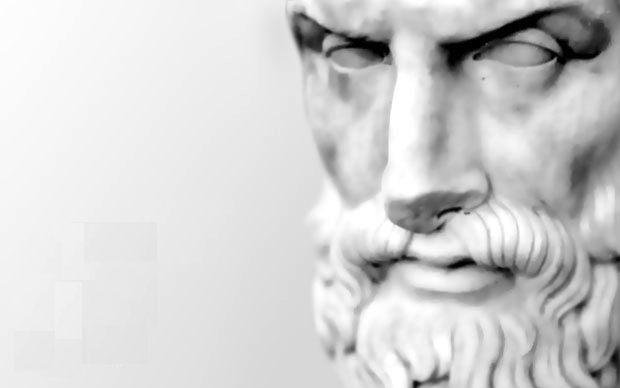
The following piece was kindly contributed by philosopher Dr. Dara Fogel, who has a Ph.D. from the University of Oklahoma (2006) & is currently an adjunct professor of philosophy at the University of Central Oklahoma. For many of us in the Epicurean community, it resonated exactly with our feelings about how philosophy has degenerated into irrelevance, how our contemporaries fail to see its value and use, and how applied Epicureanism might help to revive mainstream interest in philosophy. It also explains the Epicurean therapeutic process in some detail. The piece was originally written for the Province of the Mind page.
Contemporary academic philosophy fails to perform the time-honored therapeutic function of philosophy, leading to the marginalization of philosophy as a discipline and an increase in poor public philosophic hygiene. The study of ancient Greek philosophy, particularly that of Epicurus, can greatly enrich and heal our neurotic culture, bringing to it a lost art of thinking that is at once old and new.
The Failure of Philosophy
What do Epicurus, Friedrich Nietzsche, John Dewey and Ludwig Wittgenstein have in common? All four of these respected modern philosophers accuse philosophy as a discipline of the failure to respond to the philosophical needs of society. Philosophy has currently become devalued to the degree that the one-time “Queen of the Faculties” is now reduced to a narrow, dry field that seeks to drive away all but the most anal retentive nerds and the terminally boring/confusing geeks among those of us called to worship at the temple of Athene.
Over two millennia ago, Epicurus said: “Empty is that philosopher’s argument by which no human suffering is therapeutically treated. For just as there is no use in a medical art that does not cast out the sickness of bodies, so too there is no use in philosophy, if it does not throw out suffering from the soul.” (Us. 221 – Porph Ad Marc .31, p. 209 23 N; as in Nussbaum, p. 102)
Nietzsche decried the dishonesty of a philosophy that quests after some veiled abstract truth that no one but another professional philosopher could possibly appreciate (Raabe, p. 1, Suber, p. 2 and Melchert, ps. 549 & 600). Dewey urged the community of philosophy to become involved in solving human problems, not rhetorical ones (Raabe, p.2 and Melchert, ps. 594 & 595). Ludwig Wittgenstein questioned the use of philosophy if it had no application to the “important questions of everyday life.” (Raabe, p. 1) A philosophy that does not address human issues has little relevance outside its austere domain, and is justifiably marginalized by disciplines that better serve human issues. If philosophy as a distinct discipline or legitimate profession is to survive, she must be awake and responsive to the aching need for individual and social philosophical hygiene.
Moribund Philosophy
At some point in the last one hundred or so years, something happened to philosophy.
Instead of being the field of thought that acted as the catalyst between different disciplines, philosophy found herself losing ground that had once been securely within her domain, such as political theory, psychology and physics. Once stripped of her breadth of vision by her own children, the encroaching sciences, philosophy herself seemed to forget her once lofty role.
Trying to fit herself into the confines imposed by her ungrateful offspring, philosophy turned to sterile abstraction and meaningless regurgitation of the history of philosophy, rather than risking any original thoughts. Philosophy withdrew into herself, withdrawing from the tangible challenge of practical human dilemmas. Philosophy whored herself to the sciences and linguistics, teaching inductive and predicate logic without teaching about the larger philosophical context from which logic gets its meaning and justification. Philosophy has failed to re-assert her sovereignty, abdicating her throne as the discipline that combines and explains the cosmos, both inner and out. In her despondency, philosophy turned against herself, and began to erode her own historic foundations with acidic analysis, committing slow suicide as she systematically proved the logical fallibility and unreliability of every proposed ethic.
“[I]t cannot be just a question of philosophy having somehow spontaneously withered away over the past century or so; rather the significant fact is that there has been a deliberate and resolute effort to overthrow it, and that this indeed has been the principle project of philosophy itself in the ultra-modern era.” (Emphasis original. Jackson, p.2)
Post-modernists have claimed that the era of philosophy ended with Hegel and the denial of an absolutist worldview. Now, rationality has fallen from grace in a relativist culture. Reason no longer serves as the prime justifier, and wisdom is no longer sought in the field of higher education. Now, the parroting of professor’s pet theories and the flattery of administrative egos has supplanted the search for understanding. Higher education has become extended vocational training, with anything not contributing to that end vulnerable to budget cuts and loss of faculty.
The Need for Philosophy
As F.C. Schiller wrote in 1933: “The naïve student insists on viewing the system [of philosophy] from the outside, as a logical structure, and not as a psychological process extending over a lifetime. And he thereby throws away, or loses, the key to understand.” (in Suber, p.3)
Philosophy has historically been a subjective exercise, aimed at the dual goals of wisdom and personal enlightenment. These dual goals did not find value in the obscure and irrelevant, but rather sought the practical application of philosophy to resolve the complexities and paradoxes of human life and interaction. By viewing philosophy as a specialized field, rather than interdisciplinary, academic philosophy has failed to meet the deep human need for wisdom and understanding that gave rise to the birth of philosophy. Philosophy is not an empirical science and loses all justification if treated as such. The need for wisdom is as tangible today as it was two thousand years ago. But the only surviving philosophical establishments continually fail to answer this need.
But it was not always so…
Past Resurgence
“Natural philosophy does not make people boastful and loud mouthed, nor flaunters of culture, the thing so hotly competed for among the multitude, but modest and self-sufficient and proud at their own goods, not at those of their circumstances.” ~ (Epicurus Vatican Saying 45)
Ancient philosophers like Plato, Aristotle and Epicurus, were concerned with understanding the mysteries of the universe and the human psyche. They did not primarily concern themselves with the proper establishment of symbolic logic or the ranking of trivia. Ancient philosophy was used as a means of identifying and achieving what leads to a life well lived.
In the past two decades, a revival of ancient Greek thought has emerged, particularly in the field of ethics. Virtue Ethics (as this movement is called) harkens back to a teleological view of human life. Ancient philosophers often referred to their goal as eudaemonia, which has been translated variously as pleasure, happiness and flourishing, but the idea is intuitively evident, despite the difficulty in translation. Eudaemonia, as the idea of a satisfying, complete life, implies some degree of both social connection to others and existential health. The cultivation of certain virtues is seen as instrumental in achieving eudaemonia, primarily, the practice of phronesis is critical. In Aristotle, this is often taken to mean practical wisdom. In Epicurus, phronesis is often taken to mean prudence. Either way, the thought is the same: the exercise of reason is essential to discerning the path to eudaemonia.
This ancient philosophy has been adapted and re-fitted for contemporary tastes by Neo-Aristotelian Virtue Ethicists, such as Alasdair MacIntyre and Rosalind Hursthouse. In Neo-Aristotelian Virtue Ethics, the goal of eudaemonia is sought through the achievement of a moderation of the virtues that is neither deficient nor excessive. Sweet eudaemonia lies in maintaining a balance between extremes. Virtue leads to eudaemonia through appropriateness in manner, desires and actions.
Although Virtue Ethics acknowledges and tries to correct Aristotle’s cultural shortcomings regarding the status of women and charges of elitism, the Neo-Aristotelian Virtue ethicists generally accept Aristotle’s implicit assumption of the philosophical good health of social institutions and practices. From our current standpoint in an age of relativism, it is obvious to us that our customs and beliefs are rarely infected by rationality.
In the melting pot of America, we have the wholesale public adoption of bits and pieces from rival and often conflicting belief systems, as advertisers and spin doctors compete for our allegiance and our money. Our society is observably neurotic. But this is nothing new – humanity has always been plagued by the dilemma of conflicting goods. It just wasn’t as evident or as pressing in the days before mass communication and the population explosion.
But there was one ancient philosopher who was able to hear beyond the droning, reassuring lullaby of Mother Culture….
Two millennia ago, Epicurus called the whole fabric of social beliefs and practices into question, unlike Aristotle, who assumed that most socially derived beliefs and practices (hence, society itself) to be mostly true and healthy. Epicurus held this to be an extremely naïve assumption. Greed, anxiety, ambition and erotic obsession are the obvious evidence that society is not based on any model of rational or even healthy beliefs. Aristotle’s dialectic assumes aristocratic values as the norm, thus perpetuating elitism, as only those with the resources and education of an aristocrat could afford to engage in it. (Nussbaum, p.104) Therefore, a resurrection of Aristotelian thought carries limitations set by the basic assumptions of its paradigmatic model.
The philosophy of Epicurus provides a more suitable foundation for a recovery of the practice of philosophy, as it avoids the stumbling block of dependence on externals to achieve eudaemonia. The standards Epicurus employs are not culturally dependent in the sense that taints Aristotle’s ethics. Instead, the goal of eudaemonia is a subjective state of well being and not an external display. Katastemic disturbances of the soul are considered worse by far than kinetic pains in the body (Diogenes Laertius, 10.137 text 9). Pains in the body can be easily ignored or sedated, but you can never escape your own existential self without help. Peace of mind and painlessness in the body are the ultimate goal of Epicurean philosophy and therapy.
Philosophy is the means by which disturbances of the soul are cast out. Disturbances of the soul are caused by false belief and so-called “empty” desires, which are either avoidable altogether or amenable to alleviation. Human misery, Epicurus contended, is caused by endless demands of uncontrolled desire. As most desires are based on false belief, the removal or modification of the false belief can effectively remove the desire, and hence, the misery of dissatisfaction. (Nussbaum, p. 50)
The Four-Fold Remedy
Epicurus proposed the Four-fold Remedy as the means to armor oneself against the “slings and arrows of outrageous fortune.” The Four-fold Remedy dissolves the fundamental obstacle to happiness: Anxiety. The Four-fold Remedy deserves much greater depth and space than is allowable within the constraints of this essay. Space allows only a cursory review of the heart of Epicurus’ teachings. (Epicurus, Letter to Menoeceus 127-32, Diogenes Laertius 10.121-135)
The Four-fold Remedy is:
- Don’t fear the gods
- Don’t worry about death
- What is good is easy to get
- What is terrible is easy to endure
This effectively claims to do away with fear (both mortal and immortal), greed and status seeking. The emphasis is on learning to discern which desires are “natural (or normative, without excess), which are “natural but not necessary” (such as the desire for sex), and which desires are “empty” (inspired by the corruption of society). (Cicero, Tusclulan Disputation 5.93).
The Rediscovery of Applied Philosophy
In The Therapy of Desire, Martha Nussbaum discusses how Epicurus’ ancient techniques of applied philosophy might fill the void left when academic philosophy abandoned her therapeutic role.
The application of Epicurean therapy acts as a curative for wrong or dysfunctional beliefs, judgements and desires. Society is not held to be ethically healthy, and as such, it can infect individuals with its sickness. Childrearing techniques are often defective, with undue stress on wealth, status and competition. This can easily warp the defenseless soul of a child.
Epicurean therapy, as interpreted by Nussbaum, carries a commitment to action. This active philosophy seeks to restore the student to moral health through rigorous examination of beliefs, judgements and desires. This is to be opposed to a passive philosophy, content merely to record and systemize beliefs, like a cow chewing her cud. Epicurean philosophy is pro-active in alleviating suffering, instead of assigning the redemption of the masses to the mercy of religion, politics or medicine.
Epicurean philosophy is not merely reflective and abstract – its goal is no less than the change and redemption of the world, one mind at a time. The identification of an incorrect belief or judgement goes a long way towards the resolution of the problem. Therapeutic philosophy scrutinizes deeply entrenched, unconscious beliefs for falsehood and fallacy.
Problems interfering with the eudaemonic goal are seen to originate not within the person or the emotions, but rather, to be the result of a cognitive problem. Passions are held to rest upon the corrupt beliefs foisted by a corrupt society, and so liable to the same critiques as the social fabric. All human societies suffer from passions run rampant: anger, fear and erotic obsession; but each society has its own particular system of beliefs which gives rise to these passions. Therefore, applied philosophic techniques must take differences in cultures into consideration. To deal with the passions, reason is not abandoned, as passions are seen to be motivated by deeply held beliefs.
In Epicurus’ thinking, humans are born with a full capacity for flourishing, but this innate ability becomes corrupted through the adoption of socially derived “norms” which usurp the original, natural system of beliefs, creating a false self that is a slave to these culturally inspired corrupt feelings. (Nussbaum, p. 107) Without social conditioning, Epicurus claims that humans would be free from most psychic pain and disturbance. (Epicurus, Key Doctrines 7,40; Diogenes Laertius 10.117-20)
Eudaemonia, or fulfillment, is not a mere negative state, free of anxiety, pain and everything fun. It is also a positive state, in that it implies a fully functional, unimpeded activity using all the faculties. It is by no means stagnant or inactive.
“Philosophy heals human diseases, diseases produced by false beliefs. Its arguments are to the soul as the doctor’s remedies are to the body. They can heal, and they are to be evaluated in terms of their power to heal. As the medical art makes progress on behalf of the suffering body, so philosophy for the soul in distress. Correctly understood, it is no less than the soul’s art of life (techne biou).” (Nussbaum. p.14)
Epicurean philosophy differs from psychoanalysis in one critical way that must be noted: psychology does not want to admit to a “normative idea of health,” being content to just remove or alleviate troublesome symptoms. Epicurus employed the ultimate standard of Katastemic pleasure (freedom from fear and anxiety) as the end of eudaemonia to restore students to a flourishing life, and not just the reduction of symptoms. (ibid. p.26)
As Mother Culture’s crooning is often a corrupting influence, Epicurus appealed to a concept of nature that implies a normative state (ex: the “cradle” arguments in Diogenes Laertius 2.88, Inwood and Gerson, p. 44-45). This is an appeal to a state of nature prior to the corruption of society. This is necessarily value-laden, what Bernard Williams would term a “thick” concept. This “natural” norm is justified by deep human feelings and desires, not through any scientific means. Because this “nature” carries its own inherent values, it sees many articles of daily belief to be “impediments to flourishing.” (Nussbaum. p.32) Healthy, “natural” desires are easily fulfilled, whereas “empty” desires are never satisfied.
Three diagnostic ideas/tools are utilized by Epicurean therapy:
- First, the philosophic practitioner requires a tentative diagnosis of the disease(s) and which conflicting beliefs/judgements may be responsible for preventing the student from satisfaction with life.
- Second, some teleological standard of satisfaction is required in advance as the criteria of wholeness. This standard or norm is usually general and open to amendment as needed.
- Lastly, the philosophical practitioner requires a conception of the appropriate philosophical method and procedure required to treat the situation. (Nussbaum. p.28)
These philosophic tools provide for the recognition of error and tend, by their very nature, to lead to a direct grasp of the truth.
False beliefs lead to empty desires. The cure for false beliefs must challenge and defeat false belief through reason. Thus, philosophy is the cure necessary to a fulfilling life.
The Rationality of Emotion
Epicurean therapy urges the student to deal with irrational emotions (passions) as well as with beliefs and judgements. Reason is seen as the means to diagnose and relieve the passions. The argument is that even “irrational” passions have some system of belief. Modification of belief is held to result in a modification of the passions. In other words, intellect can and does control and modify both the emotions and bodily desires (appetites). Emotions, therefore, are granted a cognitive component that can be addressed by the practice of therapeutic philosophy. Epicurean philosophy supposes that the emotions are more complex and ruled by reason than usually given in most accounts of the emotions. To deal with passion, therapeutic philosophy does not abandon reason and arguments in favor of popping a Zoloft or St. John’s Wort pill. Therapeutic philosophy takes up the ancient challenge to confront the foundational assumptions, beliefs and judgements of passions, themselves motivated by deep-seated beliefs and arguments. In therapeutic philosophy, some emotions are taken as “natural,” but most emotions and passions are held to be social constructs and hence requiring restructuring. (ibid. p.40)
Therapeutic philosophy must therefore rely on many forms of interventionist procedures to heal, not just relying on dialectic, as Aristotle did. Dialectic alone often does not carry the necessary impact to dislodge obstacles to flourishing. Therapeutic philosophy will also use indirect techniques to delve deep into student’s psyches, in addition to straightforward deductive arguments. Thus philosophy can make full use of narrative, imagination, friendship and trust, as well as rhetoric, to regain her lofty perch.
Features of Epicurean Therapy
There are several distinct features of Epicurean philosophic therapy, as interpreted by Nussbaum. These include:
- A practical goal – all arguments are aimed at curing false beliefs and bringing the student to eudaemonia. Arguments must be causally effective and cure or change unwanted beliefs and behaviors.
- Value-relativity – this challenges students to see their cure as fulfilling their deepest desires. This involves getting students to recognize which desires are empty and which are choiceworthy.
- Responsiveness – arguments are adaptive to particular cases and situations. Treatment is highly individualized as needed.
- All arguments are directed to health as an individual, not applying a pre-established social or communal end.
- Reasoning is only instrumental to the achievement of eudaemonia and is not itself the goal. False beliefs cannot be permanently eradicated, and so even reason is vulnerable to the corrupting influences from society.
- The standards of virtue (ex: consistency, logic, validity and clarity) are purely instrumental. That is, they are valuable only so far as they lead to true beliefs. If the arguments fail to move the student, they are worthless.
- Asymmetry of roles – the student relies on the philosophic practitioner, like a medical patient relies on a doctor for a cure. Patients must be able to trust the knowledge and motives of their practitioner.
- Separation from alternative views – as Epicurus withdrew from the madness of the world to the Garden, so therapeutic philosophy seeks to shield its students from the corruption of the world. (ibid, p. 120 – 130)
As the above list shows, therapeutic philosophy is well suited to meet the needs of many a neurotic at the dawn of the third millennium.
Practices of Epicurean Therapy
Epicurean therapy utilizes three primary practices in pursuit of eudaemonia.
- The first is memorization – the repetition of Epicurus’ teachings makes the teachings internal, stimulating a subjective comprehension of the nature of desire.
- Second is confession: a psychic purge in which symptoms are brought into the open for analysis, diagnosis and treatment.
- And finally, informing – in which the practitioner uses alternative means to complete the diagnosis of reluctant confessors. (ibid. p. 132)
The deepest practices of Epicurean therapy pre-suppose an intended community dedicated to the telos of a particular view of eudaemonia. The whole environment is intended to contribute the greatest katastemic and kinetic pleasures to its members. Towards that end, the student must be willing to submit herself to the discipline of this kind of therapy. It will not appeal to all, as the choice of a philosophy is highly personal. But for some kinds of philosophers and some kinds of students, Epicureanism is highly appealing, either as a member of such a community or adapting Epicurus’ teachings to accommodate a worldly life. While some might recoil in distaste at the Epicurean practice of informing, we often fail to see the plank in our own eyes and we are incapable of confessing what we deny exists.
In dealing with deep-seated beliefs and judgements, Epicurus was the first philosopher to acknowledge the unconscious and to work on it through cognitive therapy.
“Therapeutic argument is searchingly concrete. It approaches the pupil with a keen awareness of the daily fabric of her beliefs. And it holds, as well, that this fabric of belief is learned in particular cultural circumstances – to it commits itself to learning about and grappling with those circumstances.” (ibid. p. 44)
Re-Evaluating Philosophy
As I claimed earlier, philosophy has abdicated her interdisciplinary throne, lowering her horizons and contenting herself with musty volumes and obscure journals full of dull, hair splitting rhetoric. Of what ultimate value is all this abstract analysis of minutia, while literally billions of people suffer from the deleterious effects of poor philosophical hygiene? In my humble opinion, philosophy has allowed the abuse and ingratitude of her offspring to shake her self-esteem and hence curtail her ability to shape social and personal realities.
For too long, the study of philosophy has meant the study of the history of philosophy. The practice of therapeutic philosophy, whether by the Epicurean model outlined above, or through the Neo-Aristotelian Virtue Ethics, espouses an active philosophy that engages the lives of practitioners and students alike, instead of being confined to mind-numbing tomes and boring lectures. In short, the larger concept of philosophy goes beyond the bounds of any curriculum or professional prestige. The view of therapeutic philosophy I advocate in this essay may not get me tenure, but it has the potential to change the world: to make philosophy more accessible to a public in dire need. A more philosophically hygienic world would be of benefit to everyone.
I further charge that those professional philosophers who have not used their privileged knowledge therapeutically have failed philosophy when they refused to defend her honor as the “queen of the faculties,” when they forsook the philosophical needs of society for the sake of keeping their tenure. When they sold out. Of what use is a dry, stale philosophy which matters to life not one whit? Who needs it? I don’t.
What I do need is a philosophy that enhances, enriches and – dare I say it – redeems human life. I need a philosophy that is the foundation and catalyst of all the other fields. I need a philosophy that lives and responds to the individuals who partake of her blessings. I need a philosophy that is, above all, an art of thinking, which helps me to untie the knots of my thinking by examining the beliefs that sabotage my peace of mind. I need a philosophy that “… is an activity that secures the flourishing life by arguments and reasonings.” (Sextus M 11.169.Us219) As a lover of wisdom, I need philosophy to reclaim her rightful place and mediator and transcender of knowledge. I need to know that the sacrifices laid at Athene’s altar are not in vain. I need for it to really mean something when someone says “Doctor of Philosophy”… And I’ve got a hunch that a lot of others need that kind of philosophy too.
Conclusion – Everything old is new again
I can’t help but wonder if this is an instance of infinite reoccurrence, as Epicurus’ atomism suggests.
But seriously, Epicurus’ therapeutic teachings seem amazingly sane, indeed, frighteningly so. To adequately describe the scope and depth of Epicurus’ eudaemonic teachings would require volumes itself, and is unfortunately beyond the scope of this essay. But the adoption of the Epicurean telos of katastemic pleasure seems most appealing to those buffeted on the high seas of life. The older I get, the more I crave undisturbedness. For this reason, I usually abhor procrastination. Recently, I have experienced the disturbance of conflicting goods. In my studies of Epicurus, I found myself applying his wise teachings to my own dilemmas. In examining my own beliefs, I found many of them to be empty desires, which no amount of striving will ever fulfill. I consider this to be invaluable self-knowledge. Although the process is arduous and continual, I truly have come to believe that philosophical hygiene is the greatest problem facing humanity. I charge that if you call yourself a philosopher and are not doing your part to bring others to philosophic health, then you are part of the problem, and not worthy of the honor of calling yourself a philosopher.
… So… Which side of the fence are you on?
And the blessed teacher wrote: “Let nobody put off doing philosophy when he is young, nor slacken off in philosophy because of old age. For nobody is either too young nor too old to secure the health of the soul.” ~ (Epicurus, Letter to Menoeceus 122, in Inwood and Gerson, p. 28)
Bibliography
Inwood, B and Gerson, L.P., trans., The Epicurus Reader. Indianapolis: Hackett, 1994
Long, A. and Sedley, D.N., The Hellenistic Philosophers, Vol. I Cambridge University Press 1987
Lucretius, The Nature of Things, Copley, F., trans. New York: W.W. Norton and Co. 1977
MacIntyre, A., After Virtue. Indianapolis: Notre Dame Press 1984
Nussbaum, M., The Therapy of Desire – Theory and Practice in Hellenistic Ethics. Princeton University Press 1994
Melchert, N., The Great Conversation – A Historical Introduction to Philosophy. Third Edition Mtn. View, CA: Mayfield Publishing Co. 1999
LeBon, T., “The Clinic – A Regular Philosophical Counseling Column” http://members.aol.com/timlebon/clinic.html
Suber, P., “Philosophy as Autobiography” http://www.earlham.edu/~peters/courses/meta/autobio.html
American Philosophical Practitioners Association, “What’s the APPA?” http://www.appa.edu.html
Jung, J., “The Future of Philosophy” http://www.bu.edu/wep/papers/cont/contjung.html
Jackson, F., “Post-Modernism and the Recovery of Philosophical Tradition” http://www.mun.ca/animus/1996vol1/jackson.html
Raabe, P., “What is Philosophical Counseling?” http://www.philosophynews.com/whip/pc/archived/pc199905.html

Tweet This