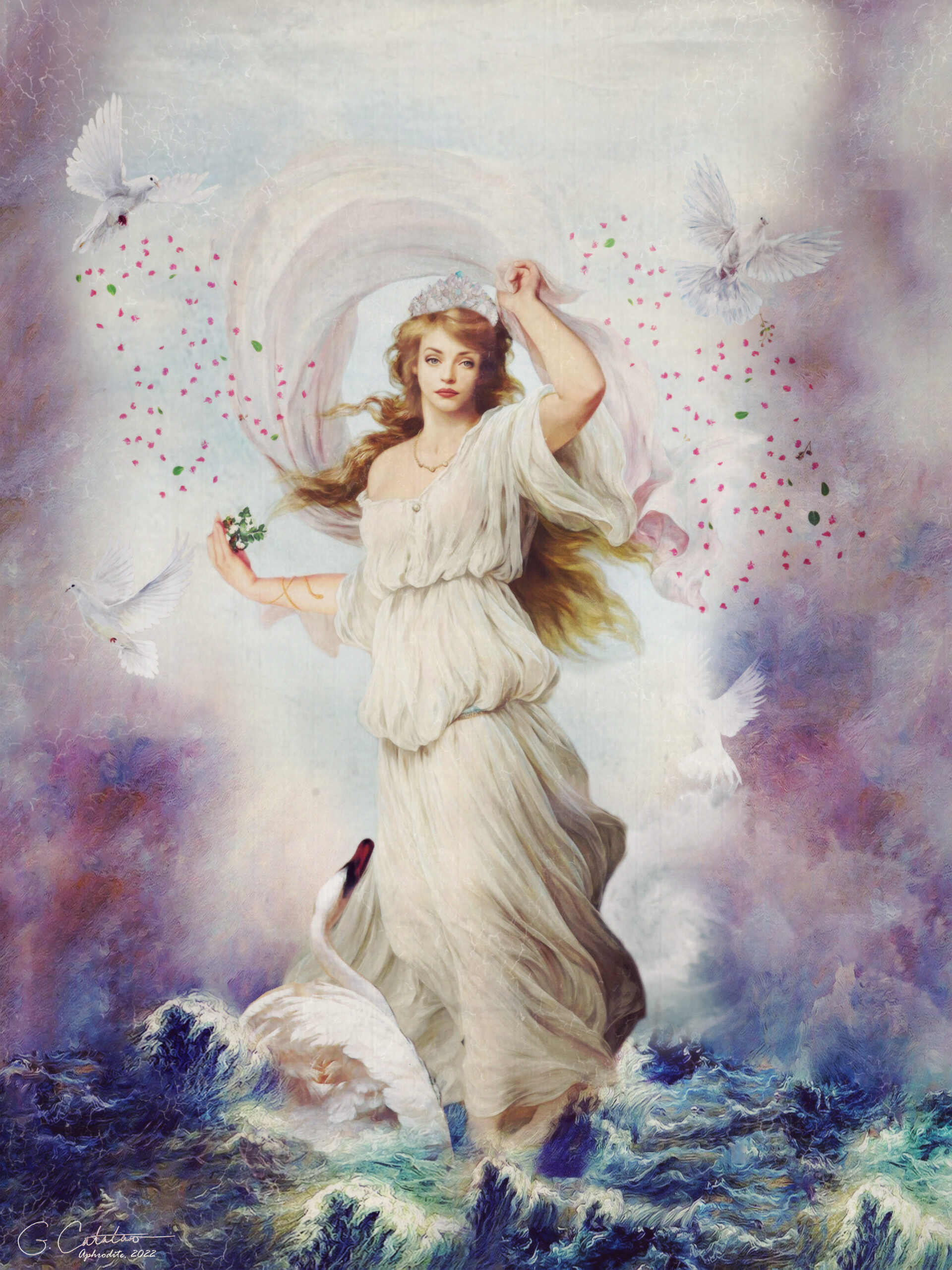
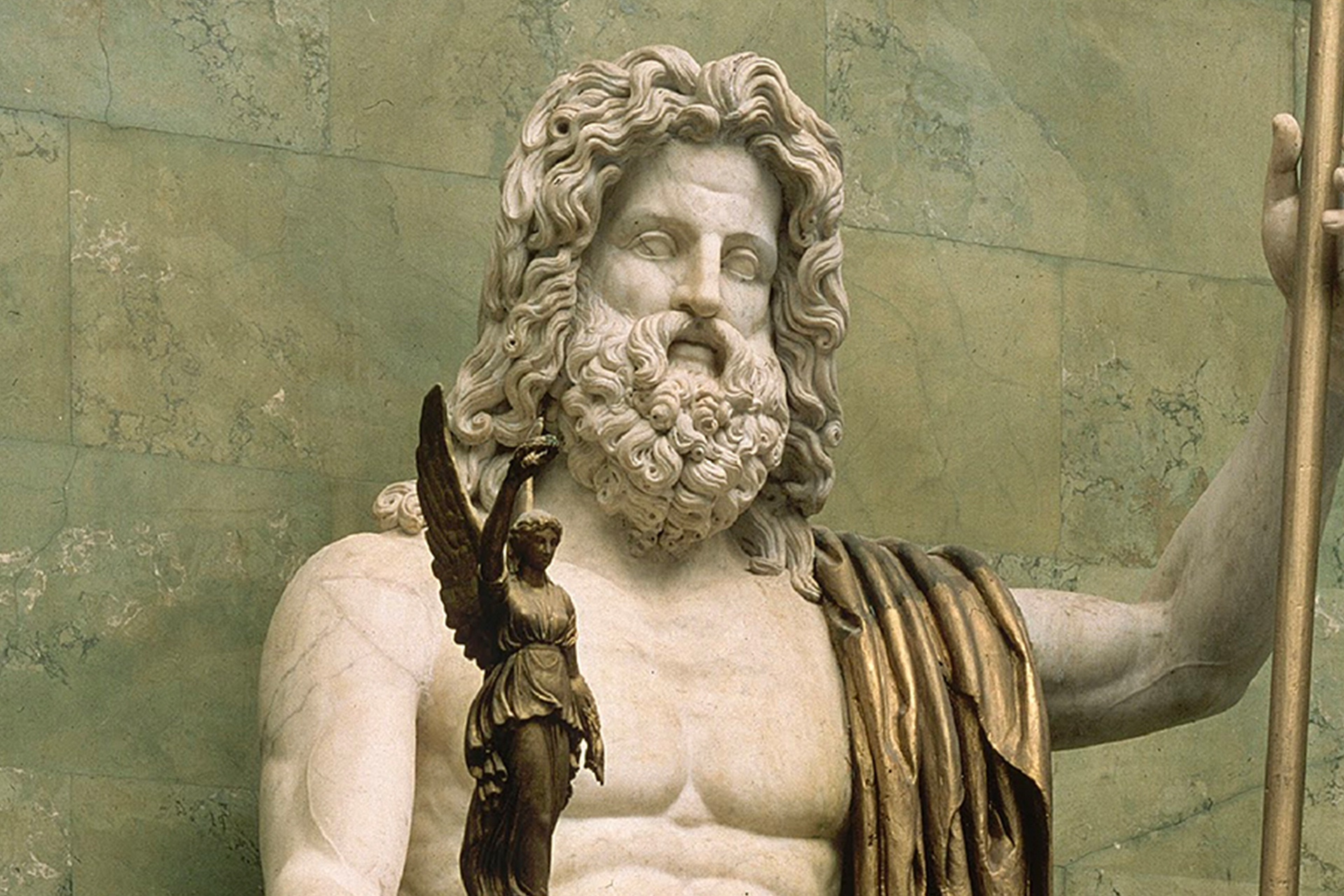
Author Archives: Eikadistes

About Eikadistes

Eikadistes is a smartass and soundsmith who has released three LPs, two soundtracks, and a handful of singles as the artist "Shazdar." Your support means the world to him and he accepts it kindly, hoping that that your financial enthusiasm will help him secure a home for a dog. He is a poet with a lyre, a composer for hire, a natural musician, a writer of non-fiction, a husband and uncle, of atoms, a bundle. He's spent time in the Shire and can't wait to retire.

Modified from "Pericles's Funeral oration" by Philipp Foltz (1852)

We Got Beef: A Disembowelment of the Dialectic, Politics, and Other Organs of Bullshit


“Rhetoricians might flatter flies with honey,
but politicians feed flies bullshit.”


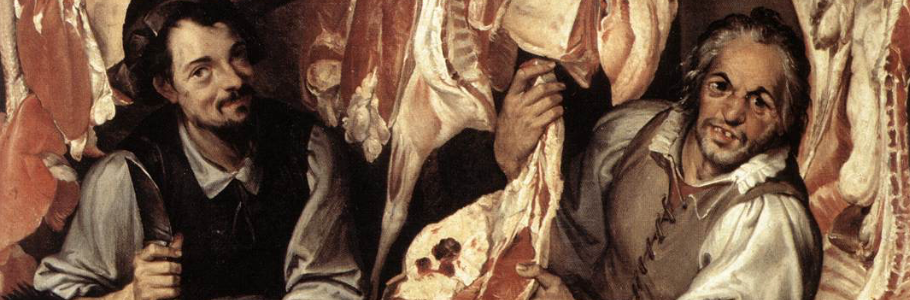
Modified from “The Butcher’s Shop” by Gabriele Passerotti (1580)

WE GOT BEEF

A DISEMBOWELMENT OF THE DIALECTIC,
POLITICS, AND OTHER ORGANS OF BULLSHIT


I have a bone to pick with rhetoric.

Here’s the heart of the issue: talk is cheap. People chew fat in political chats without purpose — no learning occurs, no truth is shared, no friendship is found. Everyone misses the meat of the matter. Opinions are skin-deep. Debate rarely disembowels delusion. Too often, rhetoricians and orators enlist themselves in the service of manipulation. After all, “the end of rhetoric is to persuade in a speech” and not to validate truth with evidence (Philódēmos, On Rhetoric, I, col. 3). Their art does not “depend on arguments from physical facts” because “their art is a power of persuasion” (Ibid., II, 12, col. XIX). For instance, it is agreeable to suppose that honey attracts more flies than vinegar — true, but as a student of nature and pupil of the Garden (so guided to treat politics with suspicion), I observe that nothing attracts so many flies as bullshit.

Those who study in the rhetorical schools are deceived. They are charmed by the tricks of style, and pay no attention to the thought, believing that if they can learn to speak in this style they will succeed in the assembly and court of law. But when they find that this style is wholly unfitted for practical speaking they realize that they have lost their money.
(Epíkouros, Against the Rhetoricians)

The rhetorical τέχνη (tékhnē, “technique”) of the sophists provides a technical method without practical application; at the same time many practical orators enjoy success, and wield influence without technically possessing any teachable skills, having mastered neither art nor science. Dialecticians may enjoy sagacious reputations, but may also lack receptivity, perspective, and may provide people with impractical, ineffective advice. Both educated rhetoricians and natural orators present dangers as agents of persuasion — dialecticians turn the practical benefits of philosophy into abstractions; rhetors misuse the art of prose for manipulation; orators’ aptitude for practical persuasion lacks a foundation in natural ethics.

Each of the rhetorical arts and practices fails to ground themselves in nature. As human agents of manipulation, professional persuaders fail to refer to the natural “goal” of “living blessedly” (Laértios 10.128). Each of these tools can be appropriated to service a political agenda. Only the true philosophy provides students with the tools they need to understand reality and pursue happiness. To quote the lead character from a favorite, adult cartoon, “Everyone wants people they like to be right. That’s why popular people are fucking dumb” (Rick and Morty, Season 3, Episode 4). As Epíkouros teaches, “the purest security is possible by means of the peace and the withdrawal from the masses”, never by chasing their satisfaction (Key Doctrine 14).

Modified from artwork by Kasten Searles for “The Queen’s Gambit” from the Arkansas Times, March 2024

THE PRISON OF POLITICS

Unlike other schools, the Garden rejects politics as a valid field of inquiry and remonstrates the rhetorical tools that support the political ambitions of professional persuaders. As φιλοσοφία (philosophía) is the “love of wisdom”, so politics is antithetical to friendship and wisdom. While Epíkouros does not dismiss civic engagement, he warns against pursuing a political career. Such a pursuit requires either subservience to wealthy interests, or else, submission to popular opinion, or engagement with senseless gossip. The most effective politicians are not those who are the most educated, for “some come out of the schools worse than when they went in” (On Rhetoric, I, 35, 1 ff.=Suppl. 19.13 ff.), but those who are best at “studying what pleases the crowd and practicing” (Ibid., I, 45, 13 ff.=Suppl. 23, 20 ff.) In this way, through pleasing speech, an otherwise unskilled narcissist “can become skilled in politics” (Ibid.).

Political narratives, in particular, are uniquely dubious. Self-promoting orators spoil healthy discourse by drawing people into pointless debates. Rhetoricians excel at erecting scarecrows. Argumentative puppets present themselves as prime cuts of intelligence, yet many are without substance. Popular speakers are incentivized to sell unpalatable policies for the sake of their own enrichment. Politicians dress the inedible entrails they cook with zest. They spice lies to hide their rancid flavor. They sew empty arguments from skin and bones. Debates are dressed for taste, and, as mentioned, rarely dissect the meat of the matter. Dialectical discourse is dangerous. Rhetoric and oratory are ineffective at verifying true statements and, more importantly, impractical at cultivating friendships. As Philódēmos acknowledges, “Politics is the worst foe of friendship; for it generates envy, ambition and discord.” (On Rhetoric, II, 158, fr. XIX).

In speaking of a “free life”, Epíkouros affirms that it

is not possible to be acquired by a lot of money [made] through an unscrupulous means [nor] is without servility to the mob or authority, rather [it] acquires everything [it needs] in continuous abundance; nevertheless if [one did procure] any money by chance, then the latter can be easily distributed to those nearby for goodwill. (Vatican Saying 58)

In this essay, I mean to review rhetoric, dissect dialectic, purge politics, and oust the aura of oratory. We will skim the fat from inference by demonstrating the dangers of logical induction. As Epíkouros teaches, we “must liberate ourselves, out of the prison [built] upon circular” proceedings, social programming, indoctrination, senseless gossip, “political” affairs”, and other practices that sacrifice the testimony of the senses for persuasive story-telling (Vatican Saying 58). “If you contest every single one of the sense perceptions, you can neither judge the outward appearance nor can you affirm which of the sensations you, yourself say are deceptive according to the way in which the criterion operates” (Key Doctrine 23).

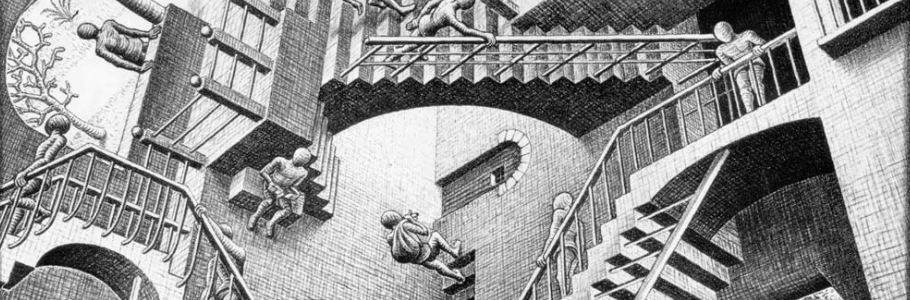
“Relativity” by M. C. Escher (1953)

UNFOUNDED INFERENCE

Epicureans reject both philosophical “reasonings in the form of Aristotelian syllogisms or inductions” as well as “other dialectical procedure(s)”  (On Irrational Contempt 2). As Polýstratos writes, those persuaded by such procedures “are fools who construct their argument solely on the basis of the conviction of others” and not through empirical investigation (Ibid.). “[B]y the dialectical means mentioned, one cannot deliver the soul from fear and anxious suspicion” because the conclusions of the rhetor, the orator, and the dialectician are not founded on physics (Ibid.). The dialectic is rejected “for want of qualification” as a reliable criterion of knowledge, for the Epicureans “suppose the study of nature provides the proper space for the voices of the facts” (Laértios 10.31). The only valid testimony is from the senses — speculation, hearsay, assumption, induction, and conjecture are inferior practices to the process of confirming hypotheses with evidence. “We shall say that the one who infers thus fails because he has not gone through all appearances well, and indeed that he is corrected by the appearances themselves” of real things (On Signs). When “divorced [from] the real phenomena”, then reality gets “cast out of the whole study of nature and then flows from a myth” (Laértios 10.87).

By contrast, Epicureans employ “the method of analogy”, observing nature, inferring hypotheses, and substantiating with evidence. “For there is no other correct method of inference besides this” (Philódēmos, On Signs). Sophistic rhetoric further confounds the process of substantiating hypotheses with observation. By contrast, evidence justifies the demonstrable truth of statements. Otherwise, flawed methods lead to self-defeating conclusions. “For the arguments that they devise to refute the [Epicurean] method of analogy contribute to its confirmation. […] It is the same in other cases, so that as a result they refute themselves.” (Ibid.). As pertains to professional persuaders, rarely are politicians and scientists the same people.

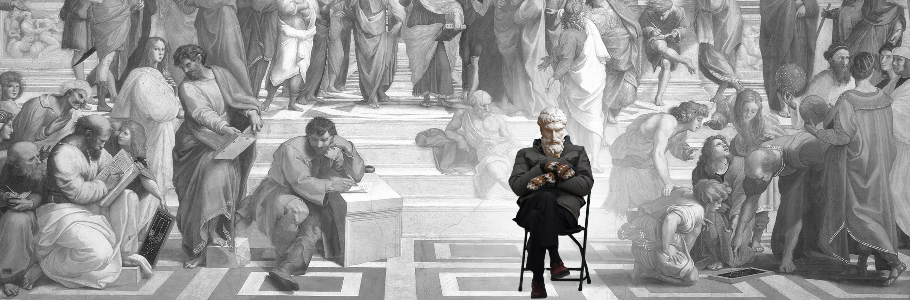
Modified from “The School of Athens by Rafael (1509-11)

DIABOLECTICIANS

Unlike other philosophers, Epíkouros does not recognize the dialectic as a distinct branch of philosophy (Laértios 7.41). Rather, he recognizes the dialectic as a mere method, which, by itself, cannot arrive at the “truth” it seeks to find. Speaking of the Epicurean Garden, Diogénēs reports that “she has withdrawn the Dialectic [and] rejects it for want of qualification;” for the Epicureans “suppose the [study of] natural [phenomena] provides [the proper] space for the voices of the facts.” (Ibid., 10.31). Epíkouros called “the Dialecticians totally toxic” (Ibid., 10.8) and later refers to “dialectic” as being “pretentious” (Epistle to Hēródotos 10.72). Contemporaneously, “Metródōros wrote […] Against the Dialecticians” (Laértios 10.24). He was documented “ridiculing those who consider the dialectic method more accurate” (On Rhetoric, II, 45, col. XLV). Philódēmos positively identifies the position of “the dialectician” as “a position which we refute” (Ibid., I, 190, col. IX; I, 191, col. X). Polýstratos writes that dialectical reasoning is based purely upon the false premises of dialectician’s “own conviction” (On Irrational Contempt 2). Instead, “one must, for the sake of oneself” observe nature to determine the truth of statements (Epistle to Hēródotos 10.72). Otherwise, as Philódēmos notes, “those who use dialectical reasoning do not know that they are shamefully refuting themselves” (On Signs).

For a demonstration of the dialectic in action, consider the following exampe, courtesy of the American, two-party political system: Suppose the Pink Team asserts that ‘An asteroid is coming! We need funds to stop it!’ The Yellow Team responds: ‘There is no asteroid. You just want money.’ Fortunately, everyone is a respectable, patient, educated dialectician, and everyone agrees to the wise rules of their admirable methodology. They proudly reach a compromise: ‘After extensive consideration, we have determined that there is a chance that an object, perhaps, in this case, an asteroid, of indeterminate size, mind you, may enter a region of spa —’

SLAM. That was the sound of nature crushing their dialectic.

Modified from “Asteroid Crashing into a Primordial Earth” by Don Davis / NASA (1991).png

THE RACKET OF RHETORIC

“[T]o practice rhetoric is toilsome to body and soul, and we would not endure it. [Rhetoric] is most unsuitable for one who aims at quiet happiness, and compels one to meddle more or less with affairs, and provides no more right opinion or acquaintance with nature than one’s ordinary style of speaking, and draw the attention of young men from philosophy”
(Philódēmos, On Rhetoric, II, 52, col. 38., II, 53, col. L).

Rhetoric is a technique, an art of prose. Therein, Epicureans “do not claim that rhetoric is bad in itself” (Ibid., II, 142, fr. XIII). Simply, that rhetoricians “are like pilots, who have a good training but may be bad men.” Rhetoric is a weapon that any trained person can learn to wield. Even “the perfect orator” need not “be also a good man and a good citizen” as “in the case of any other art;” for example “a good musician may be a villain” (Ibid., II, 127, fr. XIII=II, 75, fr. XIII.). The 19th-century, French author Flaubert cautions, “Il ne faut pas toucher aux idoles: la dorure en reste aux mains” or “You shouldn’t touch idols: a little gold always rubs off” (Madame Bovary 3.5) — we receive this phrase as “never meet your heroes“. Indeed, were “the greatest rhetors [to] accomplish all they wish […] then they would be tyrants.” (On Rhetoric, II, 151, fr. VIII).

“To tell the truth,” so writes Philódēmos, “the rhetors do a great deal of harm to many people”, by defending the art of manipulation (Ibid., II, 133, fr. IV). He documents that rhetoricians “were not in good repute at the very beginning” as far as “in Egypt and Rhodes and Italy” (Ibid., II, 105, fr. XII). Hermarkhos claims that “rhetors [do not] deserve admiration”. “Moreover the rhetors charge for the help they give, and so cannot be considered benefactors” (Ibid., II, 159, fr. XX). By contrast, “the philosophers give their instruction without cost” (Ibid.). “Metrodorus teaches in regard to rhetoric that it does not arise from a study of science” (Ibid., II, 193, fr. 2). “The end of rhetoric is to persuade in a speech”, designed to disregard nature as is convenient. “It is clearly proven that the art of the rhetor is of no assistance for a life of happiness” (Ibid., I, 250, XVIII).

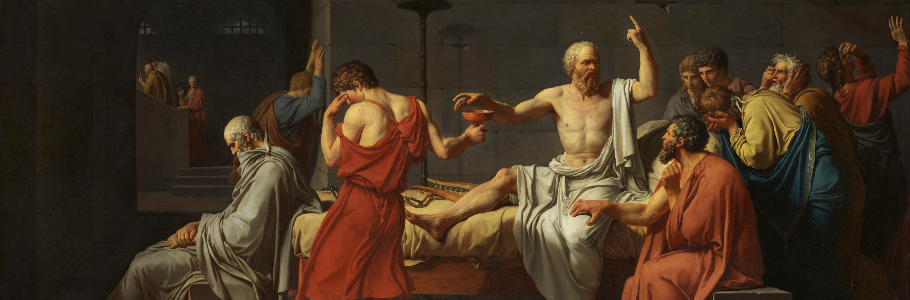
Modified from “The Death of Socrates” by Jacques-Loius David (1787)

STUPID SOPHISTS

If he knew that he could not […] become a philosopher […] he might propose to teach grammar, music, or tactics. For we can find no reason why anyone with the last spark of nobility in his nature should become a sophist…” (Ibid., II, 54, col. 39., col, LI).

The Epicurean critique against rhetoric is dually applied to and principally exhibited by a method that they refer to as sophistic (also referred to as “panegyric” or “epideictic” rhetoric). In general, people “are led astray by sophists and pay them money merely to get the reputation for political ability” (Ibid., II, 46, col. 33). It has been grossly easy for rich orators to persuade poor laborers to fund their schemes. Philódēmos observes that “sophistical training does not prevent faulty speech” (Ibid., I.182, col. I—I, 186, col. V). In fact, “some do not care at all for what they say” so long as it accomplishes their rhetorical goal, regardless of the greater goal of life (Ibid., I, 244. col XIII). “And when they do praise a good man they praise him for qualities considered good by the crowd, and not truly good qualities” (Ibid., I, 216 col. XXXVa, 14).

“[I]t follows that”, as is the case with other forms of technical rhetoric “those who possess this ability [of sophistic rhetoric] have acquired it without the help of scientific principles” (Ibid., I, 136, 20=Suppl. 61, 19). “[R]hetorical sophists” are known “for wasting their time on investigation of useless subjects, such as […] the interpretation of obscure passages in the poets”, as when civic policy is guided by mythic texts (Ibid., I, 78, 19 ff.=Suppl. 39, 5 ff). Compared against the philosophers, “the instruction given by the sophists is not only stupid but shameless, and lacking in refinement and reason” since it does not take into account the goal of life, nor commit to a devoted study of nature (Ibid., I, 223, fr. III). Instead, sophistic rhetoric appeals to authority and tradition by means of equivocation, obfuscation, and exploitation of ignorance.

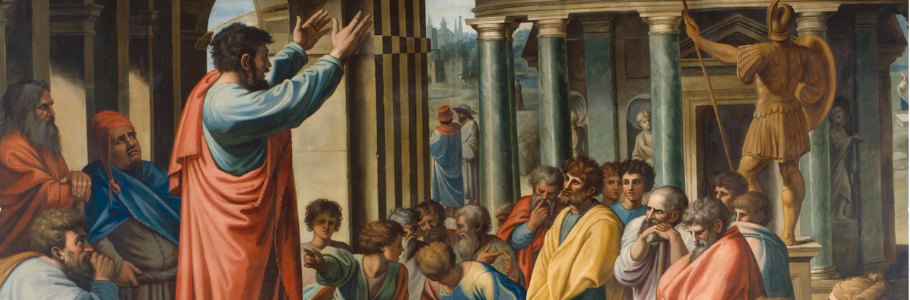
“Paul Preaching in the Areopagus” by James Thornhill (1729-31)

CULTIVATING IGNORANCE

Often, obfuscation “is intentional”, as is the case “when one has nothing to say, and conceals the poverty of his thought by obscure language that he may seem to say something useful” as with equivocation (Ibid., I, 156, col. XIII). Other times, we observe “unintentional obscurity [that] arises from not mastering the subject, or not observing the proper formation […] and in general from failure” (Ibid., I, 158, col. XVI). Obscurity in discourse also arises “from ignorance of the proper meanings of words, their connotation, and the principles on which one word is to be preferred to another” (Ibid., I. 159, col. XVII). In these cases, the success of an orator corresponds not with knowledge, nor coherence, but with a practical ability to persuade a mob. “Most, if not all [of] the arguments do not prove what they claim to prove even if the premises be granted.” (Ibid., I, col. 5). “The worst class of arguments are those which act as boomerangs and demolish the position of the disputant” (Ibid. I, 4, col. I=Suppl. 4, 17).

For example, suppose that a sophist means to convince a legislative body to support a piece of legislation, but they lack meaningful substance. It behooves them to appeal to their audience’s preferences — moderates appreciate an appeal to custom (e.g. it’s the way it is); traditionalists appreciate an appeal to myth (e.g. it’s the way it’s always been); legalists appreciate an appeal to authority (e.g. it’s the law); populists appreciate an appeal to popularity (e.g. it’s what we want); economists appreciate an appeal to wealth (e.g. it’s profitable); bleeding-hearts appreciate an appeal to empathy (e.g. have a heart); ignorant people appreciate an appeal to simplicity (e.g. they’re trying to confuse you). The most ignorant are the most gullible, easy prey for skilled sophists. (Intentional obfuscation is masterfully exemplified by the “Chewbacca Defense” from the October 7, 1998 episode of South Park. The “Chewbacca Defense” leads to an irrelevant conclusion based on non-sequitur speech and a red herring.)

Modified from a screenshot of “Chef Aid,” South Park, season 2, episode 14, Comedy Central, 1998

EMPTY ORATORY

Philódēmos spends the better part of On Rhetoric distinguishing rhetoric as a technical art versus legislative and judicial oratory, which he identifies as a practical skill. He writes:

The practical skill acquired by observation is not called an art by the Greeks except that sometimes in a loose use of language people call a clever woodchopper an artist. If we call observation and practice art we should include under the term all human activity.
(Ibid., I, 57, 23 ff.=Suppl. 29, 15 ff.)

There is a “division between the different parts of rhetoric (i. e. sophistic and practical rhetoric) which was made by Epicurus and his immediate successors (Ibid., I, 49, 14 ff.=Suppl. 25, 15 ff.). Unlike sophistic, Philódēmos suggests that one “could find reason for pursuing practical rhetoric”, even though this form of oratory does not qualify as a formal art (Ibid., II, 54, 41). Unlike sophistic methods of argumentation, practical oration (the ambassadorial oratory of diplomats, the deliberative oratory or legislators, the forensic oratory of lawyers) provides practical utility: “thousands of [Greeks] have been useful ambassadors, were prudent in their advice, were not the cause of disaster, did not speak with an eye to gain, and were not convicted of malfeasance in office.” (Ibid., II, 224, col. XIX). In these cases, “some do succeed by means of natural ability and experience without the aid of rhetoric” (Ibid., I, 47, I ff.=Suppl. 24, 10 ff.). They are less concerned with trying “to classify and describe metaphors” instead of trying to give “practical working instructions” (Ibid., I, 171, 2, col. XII).

Still, even without methodical manipulation, oratory does not guarantee happiness, and provides no moral direction. It allows fools without skill to run offices that benefit from skill. Popularity insulates celebrities from the consequences of their actions. Oratory is the favored tool of talentless politicians whose only object is the advancement of destructive pursuits.

By contrast against the empty promises, unhelpful eloquence, and practical lies of orators, Philódēmos argues for παρρησία (parrēsía, “frank” or “free speech”), explaining that it is truly καλή φράσις (kalḗ phrásis), “lovely phrasing” or “beautiful speech” (On Rhetoric, I, 149 IV). Epíkouros commits to using “ordinary expressions appropriately, and not express oneself inaccurately nor vaguely, nor use expressions with double meaning” (Ibid., I,161, Col XIX). Ornate oratory might promote popularity, but rarely does it reduce anxiety.

Modified from a screenshot from “They Live” by John Carpenter (1988)

POLITICAL PROGRAMMING

Rhetoricians might flatter flies with honey, but politicians feed flies bullshit.

Epicurus believed that there was no art of persuading large bodies of men; that those who are not rhetoricians sometimes are more persuasive than the rhetoricians; that those trained in panegyric are less able to face the tumult of the assembly than those who have no rhetorical training; that Epicurus spoke of arts, and said that those acquainted with them were benefited, but did not mean that this enabled them to attain the end; if anyone possesses the power of persuasion it is responsible for evil and not for good.
(On Rhetoric, I, 99, 5b=Suppl. 48, 15)

While the arts of persuasion are discouraged, even then, Epicureans evaluate the dialectic and rhetoric above political discourse. “[W]e declare [politics not] to be an art “ (Ibid., Section II-a). Politicians are famously dishonest because “a clever man without studying the technical works of the sophists can study some sophist’s speech and so learn to imitate them.” (Ibid., I, 130. col. XXIX). Command does not require comprehension. “They certainly leave no place for any science…” (Ibid., I, 49, 14 ff.=Suppl. 25, 15 ff.). Indeed, “Delivery depends, too, on natural endowment, beauty of voice, grace of body” (Ibid., Col. XV). The job of “the statesman” is only to “discover the inherent political arguments” corresponding to “what appears true to the crowd” and then to manipulate them to the best of their ability (On Rhetoric, I, 209. col. XXVIII). As conditions change, one politician can advance murderous schemes, while another need to only wear the wrong-colored outfit to incite widespread, public ridicule. “There is no method by which one can” reliably “persuade the multitude, either always or in the majority of cases”, so pursuing politics is akin to delaying your own happiness (Ibid., II, 120, fr. XIX). Usually, success in politics requires either “a lot of money made through unscrupulous means” or “servility to the mob or authority” (Vatican Saying 67). Neither of those conditions are conducive to happiness.

To sum up; by no means should the philosopher acquire political experience, or rhetoric of that sort. It is evident that it is the height of folly to say that a study of nature produces a ἕξις [“habit”] of political oratory, especially since they introduce into the scheme of philosophy example andenthymeme” (On Rhetoric, II, 35, col. 38).

Philódēmos identifies those arguments that appeal to prejudice, traditional paradigms, historical precedence, and common belief as being “vain” (Ibid., I, 286, col. VII). They are “mere padding [to] provoke applause”, all “because the multitude is foolish” (Ibid., II, 39, col. XLI, I. 14). It is equally foolish that those “in political speeches use syllogism and induction which the dialecticians pride themselves on using” (Ibid., I, 286, col. VII). Therefore:

“[The wise] will [not] meddle in politics […] nor will they tyrannize; nor will they bark like a Cynic, […] and they will serve jury duty, and they will leave behind writings, but will not make public endorsements, and they will take precautions for their possessions” (Laertios 10.119).

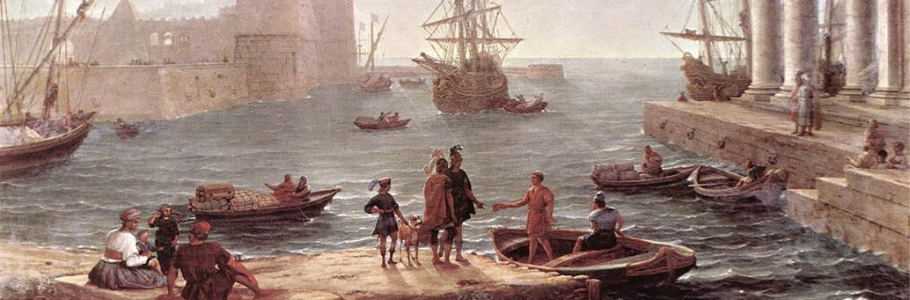
Modified from “Departure of Odysseus from the Land of the Phaeacians” by Claude Lorrain (1646)

THE HARBOR OF PHILOSOPHY

“But this does not apply any more to philosophy”, nor does it apply to “the Epicureans who refrain from such things” (Ibid., II, 144, fr. II). “Philosophy is more profitable than epideictic rhetoric, especially if one practices rhetoric in the fashion of the sophists (Ibid., I, 225, fr. I). “To tell the truth”, so Philódēmos boasts, “philosophers gain the friendship of public men by helping them out of their troubles.” (Ibid., II, 133, fr. IV). He explains, “they live in peace and justice and tried friendship; those whom they find opposed to them they quickly soften” (Ibid., II, 160, XXI-XXV. II, 162, fr. XXVII). As mentioned, the Epicureans pride themselves on παρρησία (parrēsía, “free speech”). “In speaking one should not resort to ignoble rhetorical tricks, these have less effect than a straight-forward character” (Ibid., II, 126, fr. VI). Since the public tends to prefer comfortable lies, “it is better not to receive public preferment” (Ibid., II, 154, fr. XII.). Philosophers “help their country” not by patronizing the public, but “by teaching the young […] to act justly even if there are no laws, and to shun injustice as they would fire.” (Ibid., II, 154, fr. XIII.).

The primary resource that preserves the Epicurean deconstruction of oratory comes from Philódēmos in his book On Rhetoric. In this book, Philódēmos distinguishes technical rhetoric from practical oratory. He provides a critique of political speech and reviews the dialectic against the Epicureans’ method by analogy that anticipates the modern, scientific method.

Of chief concern, Philódēmos contrasts arts (like dialectic and rhetoric) against practical oratory and political speech, which are not teachable arts. “An art”, he writes “cannot be attained by one who has not studied it, and doing this regularly and certainly and not by conjecture.” He further explains that “this definition applies both to […] grammar and music”. He later adds “architecture, ship-carpentry, navigation, painting”, which all “had methods in olden time” (Ibid., I, 137, col. 33I.21). He concludes, “On the basis of this definition we declare sophistic to be an art” (Ibid., Section II-a). Here again, “That statement ‘He is a good rhetor’ simply means that he is experienced and skilled in speaking”, not that he is a good person. “For as we say ‘good rhetor’ we say ‘good artist’ meaning ‘skillful’” (Ibid., II, 234, col. XXXV).

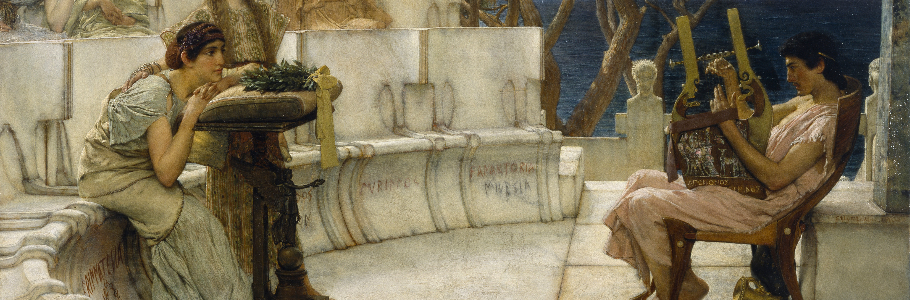
Modified from “Sappho and Alcaeus” by Sir Lawrence Alma-Tadema (1881)

VARIETIES OF DISCOURSE

“One cannot even say that all rhetors adopt one style”, since orators alter their deliveries to suit the disposition of their audience (Ibid., I.152, Col. VIII). In On Rhetoric, our friend Philódēmos provides an overview of the various types of rhetoric and oratory, in addition to reviewing the positions of the Peripatetics and Stoics. In The Art of Rhetoric, Aristotélēs distinguishes rhetoric by three domains of persuasion: [I] deliberative or symbouleutic (e.g legislative), [II] forensic (e.g. judicial), and [III] epideictic (e.g. charismatic speeches) types (Technē Rhētorikē). A later Peripatetic adds [IV] enteuctic (e.g. ingratiation) as a fourth category. Conversely, the Stoics refer to epideictic rhetoric as [V] enconmiastic (e.g. eulogistic). Philódēmos also identifies [VI] ambassadorial (e.g. diplomatic) oratory and [VII] eristic (e.g. controversial). While ambassadorial, deliberative, and forensic styles of oratory exemplify practical oratory, the precision of rhetoric qualifies it as a technical art. Unlike practical oratory, technical rhetoric is exemplified by epideictic, rhetoric, also called [VII] panegyric (e.g. pageantic) and/or [VII] sophistic (e.g. deceptive).

As regards dialectic, Philódēmos offers professional respect (especially when compared against the profession of politics, the practice of oratory, and the art of rhetoric). He elaborates:

For the method of question and answer is necessary not only in philosophy and education, but often in the ordinary intercourse of life. The method of joint inquiry frequently demands this style. Moreover this method is adopted by the rhetor in the assembly as well as in the court of justice. (On Rhetoric, I, 241, col. XI).

While Philódēmos rejects the dialectic as a criterion of knowledge for “lack of qualification”, he accepts the general procedure as a logical tool, and acknowledges its applications in both technical rhetoric and practical oratory. In this way, “the rhetor is like the dialectician” (Ibid., II, 42, col. 30, I. 12.). The varieties of discourse are defined further at the end of this essay.

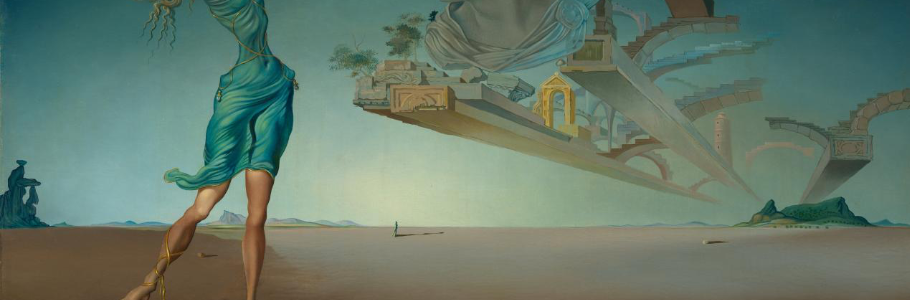
Modified from “Trilogy of the Desert: Mirage” by Salvador Dalí (1946)

THE MIRAGE OF SUCCESS

False illusions of success encircle us. Salary is not a reflection of skill. Popularity is not a mirror of value. Wealth cannot enrich friendship. Power cannot procure safety. Usually, these things produce antithetical effects: success incentivizes corruption, popularity rewards dishonesty, wealth challenges friendship, and power instigates insecurity. In his Key Doctrines, Epíkouros warns, “If for every occurrence you do not constantly reference the goal of natural pleasure, but if you suppress both banishment of pain and pursuit of pleasure to operate for another purpose, your reasonings and practices will not be in accordance” (25).

Wishing to be worshipped and well-liked, people procured security from people so long as they can be pronounced popular. And if so then indeed they were safe since such a lifestyle inherits the natural benefit of the good. If, however, they procured no safety, then they did not receive that for which they initially strove. (Key Doctrine 7)

Philódēmos provides us with a further warning in On Rhetoric as well as an example of when politicians, wishing to be popular, failed to procure safety:

“[M]any statesmen have been rejected by their fellow citizens, and slaughtered like cattle. Nay they are worse off than cattle, for the butcher does not hate the cattle, but the tortures of the dying statesmen are made more poignant by hatred” (Ibid., I, 234, col. V).

Based on these factors, Hermarkhos calls those who willfully pursue a career in rhetoric “insane”. They rarely achieve the goal of nature that such wealth and popularity is meant to secure. He affirms that “’It is better to lose one’s property than to keep it by lawsuits which disturb the calm of the soul‘” (Ibid., I, 81, 3ff.=Suppl. 40, 23 ff). For “it is much better to lose one’s wealth if one can not keep it otherwise, than to spend one’s life in rhetoric” (Ibid., I, 235, col. VI). Epíkouros summarizes, “Better for you to have courage lying upon a bed of straw than to agonize with a gold bed and a costly table” (Usener, Epicurea 207).

Modified from “Landscape with Farmhouses and Palm Trees” by Camille Pissarro (1853)

LIVE UNKNOWN

“[L]et us be content”, writes Philódēmos, “to live the quiet life of a philosopher without claiming a share in the ability to manage a city by persuasion” (On Rhetoric, I, 234, col. IV). Nothing secures a pleasant life so much as friendship, and nothing guarantees a life of pain so much as politics. Philosophy is more valuable that rhetoric because the “philosophy that teaches us how to limit our desires is better than rhetoric which helps us to satisfy them.” (Ibid., II, 150, fr. VII)

Philosophy is more profitable than epideictic rhetoric, especially if one practices rhetoric in the fashion of the sophists […]. The philosopher has many τόποι [“topics” or “positions”] concerning practical justice and other virtues about which he is confident; the busybody (i. e. the rhetorician) is quite the opposite. Nor is one who does not appear before kings and popular assemblies forced to play second part to the rich, as do rhetors who are compelled to employ flattery all their lives. (Ibid., I, 225, fr. I).

Escape notice and live! So writes Philódēmos, every “good and honest [person] who confines [their] interest to philosophy alone, and disregards the nonsense of lawyers, can face boldly all such troubles, yea all powers and the whole world.” (Ibid., II, 140, fr. XII). He observes:

“inspired before the same loud clamor, some will strive with the effort of Apollophanes [the Stoic] to advance wonderfully to the podium, but others, having landed in [philosophy’s] harbor and with hopes offered them that ‘not even the venerable flame of Zeus would be able to prevent them taking from the highest point of the citadel’ a life that is happy, afterwards, in spite of opposing winds….” (P.Herc 463)

Modified still from Star Wars: Andor, “Rix Road” (Season 1, Episode 12, November 23, 2022).

A GALAXY CLOSE TO HOME

If you will humor me, and entertain the possibility that I might attempt to “rightly hold dialogue about both music and poetry” (Laertios 10.120), consider that many of these points have been artfully orchestrated by writer and director Tony Gilroy in the television series Star Wars: Andor. One character in the fiction, the galactic senator, Mon Mothma, highlights the perils of propaganda (and political office) by exposing a dangerous, manufactured narrative: her dissent in politics has made her a target, and her agency as an orator is being suppressed. She redresses the Senate one, final time before withdrawing to a base, hidden deep in a distant forest:

The distance between what is said and what is known to be true has become an abyss. Of all the things at risk, the loss of an objective reality is perhaps the most dangerous. The death of truth is the ultimate victory of evil. When truth leaves us, when we let it slip away, when it is ripped from our hands we become vulnerable to the appetite of whatever monster screams the loudest. (Season 2, Episode 9)

In this fiction, diplomatic puppets defend and regurgitate loaded propaganda, having been convinced that a small, non-violent protest was actually an uprising. Only the survivors of the massacre, who heard the screams and saw the bodies for themselves know the truth. Similarly, Epíkouros advises that there “is a need to take into account […] all of the self-evident facts, according to which we refer our opinions”. Otherwise, “if not everything will be full of foolishness and of confusion” (Key Doctrine 22). Otherwise, one might be mislead to excuse genocide in the name of “security”. Otherwise, one might be mislead by political pundits and influential personalities to defend an armed mob of triggered, masked agents, deputized by a corrupt system to act with impunity. In the drama, one stormtrooper even shoots a woman in the face.

Trust your physical feelings and the force of nature. Lies are impractical. Propaganda is self-destructive. Oratory can be sinister. Principally, they target those who dismiss evidence and embrace superstition. It is dangerously easy to compel gullible minds to commit acts of violence through persuasive speech. Indeed, the modern-French philosopher Voltaire (heavily influenced by the propositions of the Epicurean school) observed that “Certainement qui est en droit de vous rendre absurde est en droit de vous rendre injuste” (Questions sur la Miracles 412). “Those who can make you believe absurdities can make you commit atrocities.” Persuasion is dangerous, and we rightly treat the instruments by which it spreads with scorn.

No deceptive speeches, manipulative oratory, lofty dialectic, nor rhetorical bullshit will convince a wise person to doubt their own eyes, discard their own feelings, and abandon their own study of nature. I invite you to see with your own eyes. Your life likely depends on it.


INDEX

Modified from “The Butcher’s Shop” by Gabriele Passerotti (1580)

    • Technical rhetoric includes epideictic, encomiastic, and panegyric or sophistic types. Philódēmos teaches that these methods of rhetoric are true arts.
    • Practical oratory includes ambassadorial, deliberative (or symbouleutic), and forensic types. Statesmen employ these methods for practical functions.
    • Political discourse “in this respect […] may fittingly be compared to the art of prophecy” (Ibid., I, 31, 3 ff.=Suppl. 17, 20 ff.). It is sometimes practical.
    • The Dialectic is a systemic, but deeply flawed method of reasoning privileged by
    • Socratics, Megarians, Academics, Peripatetics, and Stoics.
    • The Method by Analogy refers to the empirical reasoning of the Epicureans, which draws inferences from observations that can then be tested.
    • Philódēmos mentions several other rhetoric types, including the entuectic and eristic types that are not explicitly categorized, and may be synonyms or subsets.

  • AMBASSADORIAL ORATORY – πρεσβευτικός (presbeytikós). This practical form of oratory is employed by dignitaries and diplomats. Ambassadorial oratory is the ability “to be able to persuade in diplomatic negotiations by speech, not by power or bribes or dignities or anything else an ambassador might possess” (Philódēmos, On Rhetoric, II, 217, col. XIII).

  • DELIBERATIVE ORATORY – συμβουλευτικά (symbouleutiká) is also known as “symbouleutic” oratory. This practical form of oratory is used by legislators. It “gives advice only on matters affecting the common welfare, and that this advice is not the product of the sophistic art, but of [something] quite a different…” (Ibid., I, 211. Col. XXX.19).

  • EPIDEICTIC RHETORIC – ἐπιδεικτικός (epideiktikós, “demonstrative”, “performative”). This is an art of study regarding “charming speeches” (Ibid., II, 244, col. XLII). It is also called “encomiastic” by Stoics (Laértios 7.142). It is far less profitable than philosophy “especially if one practices rhetoric in the fashion of the sophists” (Ibid., I, 225, fr. I.).

  • ENCOMIASTIC RHETORIC – ἐγκωμιαστικός (enkōmiastikós, “eulogistic” or “laudatory”) is rhetoric ἐπαίνους καὶ ψόγους (epaínous kai psógous) “of praise and blame”. “Furthermore, no one can believe encomiasts, because they praise bad men” (Ibid., 220, col. XXXIXa). Stoics called epideictic oratory “encomiastic” (Laértios 7.142)


  • ERISTIC SPEECH – ἐριστικός (eristikós, “eager for strife”). “Dialectic and eristic may be arts…” , however, the Epicurean school evaluates them as forms of persuasion, unconcerned with the validity of their statements as they correspond to reality (Ibid., I, 57, 23 ff=Suppl. 29, 15 ff.). Eristic speech is provocative and controversial.

  • FORENSIC ORATORY – δίκανικα (díkanika, “judicial”). Philódēmos compares the practicality of forensic oratory with “deliberative” and “ambassadorial” oratory (Ibid., I, 134, col. XXXI). Practically, forensic oratory is employed in courts of law in the form of criminal defense.

  • PANEGYRIC RHETORIC – πανηγυρικός (panēgyrikós, “assembly” speech). This form of rhetoric is synonymous with sophistic rhetoric. “Now we have already treated in a previous section the idea that sophistic or panegyric or whatever it may be called […] may be easily called rhetoric.” (Ibid., II, 234. col. XXXV.). Epíkouros writes that the wise “will not πανηγυριεῖν (panēgyrieîn)” or “make public speeches” (Laértios 10.120).

  • POLITICAL DISCOURSE – πολιτικός (politikós, “of the city”). Politics, by itself, is not an art. By itself, the “political faculty” is empty. It is not a technique, nor a method, but more like “prophecy”. “No man was able […] to impart to his contemporaries or to posterity [the principles of politics]” without the rhetorical arts of the philosophers (Ibid., I, 139, col. XXXIV). “[T]echnical treatises of rhetoricians […] are useless for producing the political faculty”, which does not require training (On Rhetoric, I, 64, II frr.=Supple. 32, 19 ff.).

  • PRACTICAL ORATORY – Practical forms of oratory (for example, speeches employed by dignitaries, deliberations employed by legislators, and defenses employed by lawyers) are distinguished from technical rhetoric (epideictic or enconmiatic, and panegyric or sophistic). Practical oratory is not considered an art that can be learned, only a practice that can be repeated, like civic speech, legislative debate, judicial defense, and diplomatic counsel. “Epicurean authorities hold that sophistic rhetoric does not perform the task of practical and political rhetoric” (Ibid., I, 119, 28 = Suppl. 59., 1e4. I, 120, 10= Suppl, 60, 6).

  • SOPHISTIC RHETORIC – σοφιστική (sophistikḗ). Sophistic is an art of epideixis, and of the arrangement of speeches, written and extemporaneous.” (Ibid., II-c). “Sophistic style is suited to epideictic oratory and written works, but not to actual practice in forum and ecclesia” (Ibid., III, 134. fr. V). Indeed, “the training given by the sophists does not prepare for forensic or deliberative oratory” (Ibid., II, 131, fr. I). “Sophistic can “persuade men to become villains. And when they do praise a good man they praise him for qualities considered good by the crowd, and not truly good qualities” (Ibid., I, 216 col. XXXVa, 14).

  • TECHNICAL RHETORIC – τεχνικός (tekhnikós, “technical”) refers to methods of oratory that properly fit the Epicurean definition of an “art” (or “technique”), including epideictic and sophistic methods. Technical rhetoric offers methods (as is the case with any true art) that can be taught, and reproduced to achieve the same result. “Two sciences produce the same result.” (Ibid., I, 4, co. I=Suppl. 4, 17.). However, compared against the study of nature, “technical rhetoric has never advanced anyone” (Ibid., I.192, col. XI).

  • THE DIALECTICδιαλεκτική (dialektikḗ). Before the idealistic Hegelians and materialistic Marxists, the “dialectic” was privileged by Socratics, Megarians, Academics, Peripatetics, and Stoics, who defined it as “the science of conversing correctly where the speeches involve question and answer — and hence they also define it as the science of what it true and false and neither” (Laértios 7.42). The Epicureans reject the dialect as being incapable of verifying “truth” because it assumes that “truth” is capable of being reasoned without reliance upon physical evidence. Most of the dialecticians encouraged political participation as a necessity to existential satisfaction; Epicureans outright reject political office.

  • THE METHOD BY ANALOGY καθ᾽ ὁμοιότητα τρόποϛ (ho kath’ homoiotēta tropos, “method according to similarity”) anticipated the modern, scientific method by several millennia. Epíkouros accepted that inferences must comport with observation and abide by nature. We must “create an analogy that corresponds with what we see“ (On Nature, Book 11, III, b5-12).” [W]e shall not be prevented from making inferences, provided that we use the method of analogy properly” (On Signs). And “we say that the method of analogy is a sound method of inference, with this condition, that no other appearance or previously demonstrated fact conflicts with the inference” (Ibid.).

For additional commentary, please see “Reasonings About Philodemus’ Rhetoric

For more on deliberate misrepresentation, please see “On Bullshit” by Dr. Harry Frankfurt

Clipped version of “Saint Epicurus” by Genevra Catalano (2023)

Be well and live earnestly!

Your Friend,
EIKADISTES
Keeper of Twentiers.com
Editor of the Hedonicon

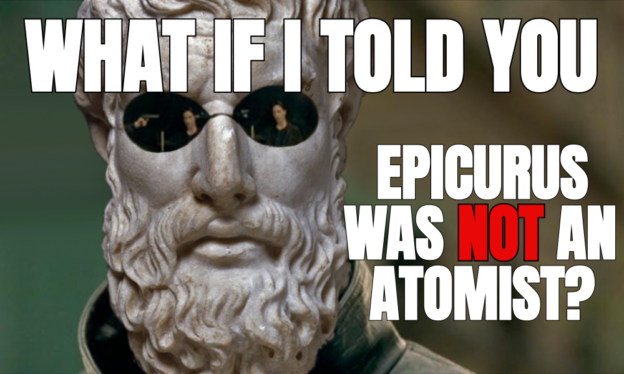
Epicurus Was Not an Atomist

Disclaimer: the ideas and opinions presented below are reflective of the author and
may or may not be shared by other members of the Society of Friends of Epicurus.

Epíkouros was not an atomist. (THUD.)

Nor was Dēmókritos. (GASP.)

… now that I have your attention, please excuse the provocative title — forgive my rhetorical provocation, having trespassed against the taxonomical conventions of academic tradition. I seek to provide nuance to your understanding of the teachings of Epíkouros, and to challenge the academic presentation of atomism as it has been so conceived. We will do so by privileging the perspective of a sweaty, 3rd-century Athenian and by providing critical context to supplement our understanding (we being students who are subject to the prejudices of modernity). We have been trained to catch ’em all, programmed to collect facts like cards. Too often, the presentation of philosophy is like a catalogue of products, each designed by a different manufacturer, each reviewed as a consumer flips the pages of a magazine. Yet Epíkouros did not manufacture sensations. He observed nature, and shared clever inferences. He arrived at his conclusions without the benefit of a vast repository of laboratory evidence.

In a nutshell, if you were an Epicurean in the Garden of Epíkouros (c. 3rd-century BCE), you would have had to have waited several thousand years before anyone called you an “atomist” (or ατομιστής). Prior to the Renaissance era, an Epicurean was just a “student of the Garden” or a “follower of Epíkouros”. The word “atomist” was coined by Renaissance minds in Latin, largely by anti-Epicurean thinkers who dismissed Epicurean particle physics as a silly fiction. The closest title I have found was employed by Athenaios in the 3rd-century CE (Deipnosophistaí 5.4) as προφήτας ἀτόμων (prophḗtas atómōn, meaning, literally, “prophets of atomic” particles). Here again, we find “of atoms” in a substantive, adjectival phrase, not as a proper noun. As a result, I wish to present an alternative lexicon that avoids the neologisms of our opponents.

Now, obviously the Hegemon teaches us that observable bodies are composed of atomic “particles” (and void, impressively anticipating the surprising conclusion of Rutherford’s gold foil experiment by over 2,200 years, demonstrating that solid objects are, generally speaking, about 0.01% stuff and 99.99% space). Nonetheless, the distinctions implied by words like “atoms” and “atomism” create slight incongruities that either warp Epíkouros’ description of particles, or else, beg misunderstandings as a result of sleepy translations and clumsy semantics. 

What’s in a Name?

Consider the fact that (so far as I have found) history does not document ancient proponents of particle physics as having referred to the “pieces” of reality by the plural noun άτομα (átoma, or “atoms”), nor any declension of the singular noun άτομο (átomo, or “atom”). This root compound “a-” and “témnō” is only ever found as an adjective ἄτομος (átomos, or “uncuttable”). Ancient texts do not record students of particle physics as having identified themselves by the proper noun ατομιστής (atomists, or “atomist”), nor as having codified their doctrines using the word ατομισμός (atomismós, or “atomism”). Epicureans did not see themselves as “atomists” attached to a theory of “atomism”, so much as adherents of the “true philosophy”, which understood the origins of “the real” world to be “atomic”. Of course, please NOTE: we do find the adjectival phrase ὁ ἄτομος (hó átomos, or “the atomic” body) and its various declensions throughout Epicurean texts. This substantive phrasing [article + adjective] implies a noun. Thus, translating   (“the”) átomos (“atomic”) as “the atom” is not unreasonable, nor inappropriate. Simply, I find it to be incomplete, and potentially-misleading. We miss an opportunity to expand our mental aggregate by reducing the swerving objects of Epicurean physics to mere “atoms”.

Cuttable Uncuttables

As it must seem ironic to students of Greek, the modern world refers to cuttable elements (like uranium) as “uncuttables”. Further complicating things, the Standard Model refers to the truly uncuttable bodies from which “uncuttables” are composed using the Latin prefix “sub-”, thus, framing “sub-atomic” particles as being (ironically) “under the [cuttable] uncuttables”. Historically, we inherit this irony as a vestige of the modern quest to identify the truly “uncuttable” components of nature. Scientists after the Renaissance assigned the atomic compounds they discovered with the allusive title of “atoms” (or “uncuttables”). Yet, as has been (unforgettably) demonstrated for just over eight decades, the modern “uncuttables” are actually, horrifyingly cuttable. Ancient “uncuttables”, however, were truly indivisible, and could not be split.

Of course, this nuance does not, in any way, invalidate ancient atomic theory. Simply put, ancient Epicureans did not imagine “atomic parts” the same way we imagine “hydrogen” and “oxygen” (as opposed to a correctly-named “lepton” which meets the “uncuttable” qualification). Granted, Epíkouros’ speculations were not infallible, and he sometimes assigns particles with an agency that properly belongs to “molecules” (as when he proposes that we are able to “smell” particles (10.53); in fact, we smell collections of particles “enlaced” as chemical “compounds”). Nonetheless, these naturalistic  propositions were deeply insightful, and functionally useful prior to the innovations of the 19th and 20th-centuries. Excitingly, modern physics provides modern Epicureans with the necessary, experimental evidence that is required (from the variety of explanations that Epíkouros provides, in accordance with his practice of entertaining multiple explanations prior to experimental confirmation) to eliminate false hypotheses, and to adopt coherent alternatives. No doubt, had the Hegemon (somehow) extended his lifespan (by a few, measly millennia), he would have welcomed the evidence that supports our discoveries, all of which are consistent with his explanation for the non-supernatural origins of reality. 

Body-and-Voidism

New followers of the true philosophy may be further mislead by the word “atomism” as Epíkouros, unlike Dēmókritos, rejected the reductive description of nature. Dēmókritos assumes that everything is “just” particles, for “atoms and the vacuum were the beginning of the universe; and that everything else existed only in opinion” (Laértios 9.44). From the Democritean perspective, what “truly” exists are microscopic bodies (and void). As a result, he concludes that we cannot be certain that our perceptions of bodies and their emergent qualities (like “color”) can be considered “true” because the “true” nature of reality (according to Dēmókritos) occurs at the atomic level — only atoms are “real”. Dēmókritos “rejects” emergent “qualities” that arise from atomic interactions: “Of a truth we know nothing, for truth is in a well.” (Ibid., 9.71).

Epíkouros rejects this skepticism. From the Epicurean perspective, what “truly” exists are bodies and void, some of which are visible, enlaced bodies (i.e. “compounds”) and some of which are invisible, simple bodies (i.e. “particles”). Both “compound bodies” and “simple bodies” are “real” (just as compound notions in the mind are physically “real” as images). As Epíkouros writes, “all” of our sensations are reliable. Consequently, even if we are to adopt the “ismizing” of the humanists, it is reasonable to suppose that, simply, “bodyism” (or “matterism”) would be appropriate designations for Epicurean particle physic, so much as “atomism” (which might be understood to implicate Dēmókritos’ teaching that only particles are real). Consider also that either attempt (including my flippant one) at neologizing particle physics yields the further implication that only particles (or bodies) are “real”, yet both Demokritos and Epíkouros agree that, indeed, “void” is also a “real” thing; it is simply “intangible” (Ibid., 10.39-40). Therein, it would be just as appropriate to call particle physicists “Voidists”, since they, unlike their many opponents, recognized the existence of empty space. Others, like Aristotélēs, insist that “nature abhors a vacuum” (Physikḗs 4.8). Technically, it would be reasonable to call Demokritos an “Atom-and-Voidist”, or to call Epíkouros a “Body-and-Voidist”. Practically, of course, these are clumsy and redundant neologisms, because the existence of one seems to imply the other. Nonetheless, be not mislead into thinking that the Sage taught that only atoms exist.

…Like Crumbs-of-Carbon and Water

As Diogénēs records, Epíkouros did not see himself as an ally to the tradition of Dēmókritos (Lives 10.4), and may have only temporarily considered himself as such during his youth (Ploútarkhos, Against Kōlõtēs 3). The Hegemon explicitly rebukes Dēmókritos’ philosophy for having been influenced by the skepticism of Dēmókritos’ teacher, Pýrrhōn, founder of Greek skepticism. For Epíkouros, his rejection of Pýrrhōn’s teachings, along with his necessary (and brilliantly modern) innovation of the παρέγκλισις (parénklesis, or CLINAMEN, “swerve”) places the Garden in a completely different category than the school of Dēmókritos. Grouping the two of them together, as philosophical allies, is a paradigm defended by ancient opponents of the Epicurean tradition and modern academics. So I argue, if, again, we are willing to entertain the anachronistic fantasy of ancient Epicureans adopting the Latin convention of “ismizing”, then Epíkouros would not have seen his physics as being the same “-ism” as Dēmókritos. It is reasonable to entertain the possibility thatsensualism” or “realism” (if someone puts a gun to our head and forces us to employ an “-ism”) are more reflective and complete expressions of Epicurean physics thanatomism”; and while Epíkouros does meet the criterion for our modern definition of an “atomist”, he did not see himself as such. Indeed, he reserved a collection of slurs for Dēmókritos, the so-called “Authority on Nonsense” (Diogénēs Laértios 10.8).

To my fellow Epicureans, I encourage you to challenge the paradigm that ancient philosophers who defended particle physics should be placed in the same category. In fact, their physics differed. (For a thorough comparison on the two physics, please set aside a few hours to read “The Difference Between the Democritean and Epicurean Philosophy of Nature”, the doctoral dissertation of Karl Marx. In particular, if you have a negative, political opinion of Marx, you may find yourself charmed by his encyclopedic knowledge of ancient, Hellenistic philosophy. Ultimately, he expresses sympathy for Aristotélēs … that is another topic for another essay).

Pieces of Reality

Sure, “atoms” is cool … but what about “seeds”, “grains”, “firstlings”, or “hooklets”? Have you thought about simplesplinters”, “centsof consciousness, or “motesof matter? Each of these expressions are employed by Epíkouros in his Epistle to Herodotos as alternative names for the bodies that are popularly identified as “atoms” (orchestrated more colorfully elsewhere). Yet, nowhere in ancient writings does the Hegemon explicitly name particles as “atoms”, only descriptively as uncuttable parts: Epíkouros only employs the adjective ἄτομος (átomos, or “uncuttable”, as in “the uncuttable” pieces of reality). While the substantive phrase ὁ ἄτομος (hó átomos, or “the uncuttable”) implies a noun, it does not provide a noun.

Even then, note that, based on the frequency with which each word is employed in the extant texts, the Hegemon only occasionally refers to the smallest pieces of tangible reality as being “uncuttable”. As many times as Epíkouros describes the fundamental pieces of reality as being “uncuttable”, he equally refers to them as being “countless”, “microscopic”, and “unchanging”. Just as easily as we have coined the contemporary neologism “atom”, we could have, consistent with linguistic conventions, conceived of a “particle” as an “apeiron“ (from ἄπειρος, Laértios 10.41-43, 45 56-57, 60), “micron” (from μικρός, Ibid., 10.59, 61), or “ametableton” (from αμετάβλητος, Ibid., 10.41). Each of these neologisms is as accurate (or inaccurate) as “atom”.

Of historical note, several words that Epíkouros employs when naming the microscopic pieces of reality have been preserved and functionally repurposed, having been enlisted in the service of contemporary physics. Indeed, the ancient words “photon” and “lepton” survived the turbulence of history and became codified into the jargon of modernity. We receive “lepton” from λεπτομερὲς (leptomerès), derived from λεπτός (leptós, or “fine–grained”, “refined”, “subtle”, “minute”) and μέρος (méros, or “part”, “component”, “portion”, “particle”)—meaning “small particles”, “minute motes”, or “fine grains”. A modern “lepton” is a class of particle in the Standard Model that includes the electron. Similarly, we receive “photon” from the ancient Greek φωτός (phōtós, meaning “of light“). This is the particle that carries the electromagnetic force. In both cases, the particles are sub-atomic, and cannot be further divided into parts.

Epíkouros properly names these bits of matter σπερμά (spermá, “seeds”), ᾰ̓ρχαί (ărkhaí, “beginnings” or “firstlings”), σώματα (sṓmata, “bodies”), ὄγκοι (ónkoi, “hooks”), τομαί (tomaí, “splinters”), λεπτομερής (leptomerḗs, “particles” or “fine parts”), λεπτοί (leptoí, “cents”), μόρια (mória, “motes”), and, most often, μέρη (mérē), meaning “parts”, “pieces”, or “particles”.

Uniquely, Epíkouros uses both the plural adjective a-tomoi (or “uncuttable” crumbs) as well as its opposite, τομὴν (tomḗn, Laértios 10.56) meaning “cutting” (as in a “cutting” of wood), or also, a “stump”, “splinter”, or “shedding”. It is employed by Epíkouros as a synonym for the “particles” that comprise creation; it is derived from the verb τέμνω (témnō) meaning “to cut”, “hew”, “butcher” or “sacrifice”. It is also the root of “a-tom”. Herein, Epíkouros employs the image of wood clippings from a tree as an analogy for the minute motes of matter spread through the multiverse. Epíkouros describes particles as “cuttings” that are, themselves, “uncuttable”, so we may just as easily call Epíkouros a “tomist” so much as an “a-tomist”. Here again, Epicurean physics employs analogical reasoning that relies upon visible phenomena. His method does not require abstract vocabulary, only imagery. Primarily, Epíkouros infers that visible phenomena results from invisible beginnings. The “firstlings” of physics are not expressed as contemporary, mathematical objects — the Sage of the Garden calls them “motes” like dust in a beam of sunlight, like “grains” of cereal, like fluffy “hooklets” from dandelions, like “cents” of money, and “splinters” of wood. They are “countless”, “unchanging”,  “infinite”, and “microscopic”.

Particles were so much more than merely being “uncuttable”.

The Prejudice of the Enlightment

In addition to these observations, note that Enlightenment-era thinkers like Descartes, Boyle, Newton, and Locke, those who loosely adopted the general notion of particle physics, popularly rejected the Greek designation of “atomist” (as one who accepts the doctrine of “atoms”) in favor of their preferred, Latin term “corpuscularian”, one who studies “corpuscules” (from the Latin CORPVSCVLVM meaning “small body”). This designation was partially made as a defense of piety, partially as a rejection of the “godless” and “immoral” behavior of Libertines (themselves, inspired by Epíkouros), and partially as a means of distinguishing their observations as being unique and unprecedented. The words employed by 17th-century thinkers to refer to particles were loaded with assumptions and prejudices. Many of these thinkers associated “atomism” with other, controversial positions, like “atheism” (despite the fact that all brands of ancient “atomists” rejected atheism). Additionally, the particle physics of some of these thinkers was mechanistic, and conflicted with the non-deterministic spirit of Epicurean ethics.

(For a much more thorough, accurate, and expansive treatment of the context of the debate between “corpuscularianism” and “atomism” as contextualized in the 17th-century, please see the first two chapters of Dr. Catherine Wilson’s book Epicureanism at the Origin of Modernity).

Even in the last few centuries, naturalists, having recognized the coherence of particle physics, have defined and redefined “atomism” according to their own preferences and prejudices, as well as by the misunderstandings they adopted about ancient history, and the social pressures they inherited from the societies that coerced them. On one hand, thinkers like Dēmókritos, Epíkouros, Galileo, Descartes, Boyle, Locke, and Einstein each flirted with general “atomism”; on the other hand, each thinker, more often than not, rejected having their own physics subsumed within the same ismistic grouping as their opponents. They did not necessarily identify as members of the same “-ism”, and often distinguished themselves as philosophical opponents.

In any case, be real and think big about history.

Big Diction Energy

Do not mistake my thesis — I do not mean to suggest that, given modern jargon, as employed by scholars of “philosophy”, Epíkouros should be identified as a “non-atomist”, or as an opponent to ”atomism”. (I recognize that this deconstructive approach risks obfuscation, so forgive me for beleaguering these post-structuralistic points.) Nevertheless, within our fellowship, speaking frankly, I observe that we can be considered “apeironists”, “micronists”, and “ametabletists” just as readily as “atomists”. Concurrently, Epicurean “particles” can be accurately expressed as “apeirons”, “microns”, and “ametabletons”, so much as they are “atoms”.

The ancient Greeks did not practice the convention of “ismizing”, or, as I write, “expressing different systems or processes as ‘-isms’” (see my earlier essay, “On -Isms and Pleasure Wisdom”). Historically, the Ismist paradigm is a result of the widespread adoption of Latin affixation, the ubiquitous “-ISMVS” from the rarely used “-ισμός”. We ismize ideas we detest, (e.g. “Islamism”), we ismize ideas we admire (e.g. “altruism”), and we ismize ancient ideas that never needed ismizing in the first place (e.g. “atomism”). Many of our certainties rest upon assumptions that have been inherited from derivative sources. In this case, our taste for ancient Greece has been spiked by the flavor of Renaissance Latin, yet ancient Epicureans enjoyed a pure draught. As a follower of this tradition, I seek to share the original flavor of the “true philosophy”, and I encourage seekers of knowledge to pursue their goal with the same intent.

Still … if you put a gun to my head … fine, I’ll properly “ismize” Epicurean physics as follows:

BEHOLD! Epíkouros properly defends a theory of somato-kenoism (versus the atomo-kenoism of Dēmókritos). Though, neither system exemplifies strict atomism, since both philosophers also accept the “intangible void” as a “real” part of their physics. Conversely, one might imagine a sort of “Peripatetic Atomist” who both believes that “nature abhors a vacuum”, but also, accepts that the “Five Elements” (including Aether) are made of invisible particles. … chew on that, Ismists.

Still, as always, I recommend against ismizing everyone and everything in the first place. (As a friend suggested, we are students of “Epicurean Philosophy” and not of “Epicureanism“.)

Anyway … Happy Solstice to the friends of the true philosophy!

And blessings to the swerving firstlings.

Your Friend,
EIKADISTES
Keeper of Twentiers.com
Editor of the Hedonicon

All Particles Go to Heaven: The Form and Formation of the (Epicurean) Gods

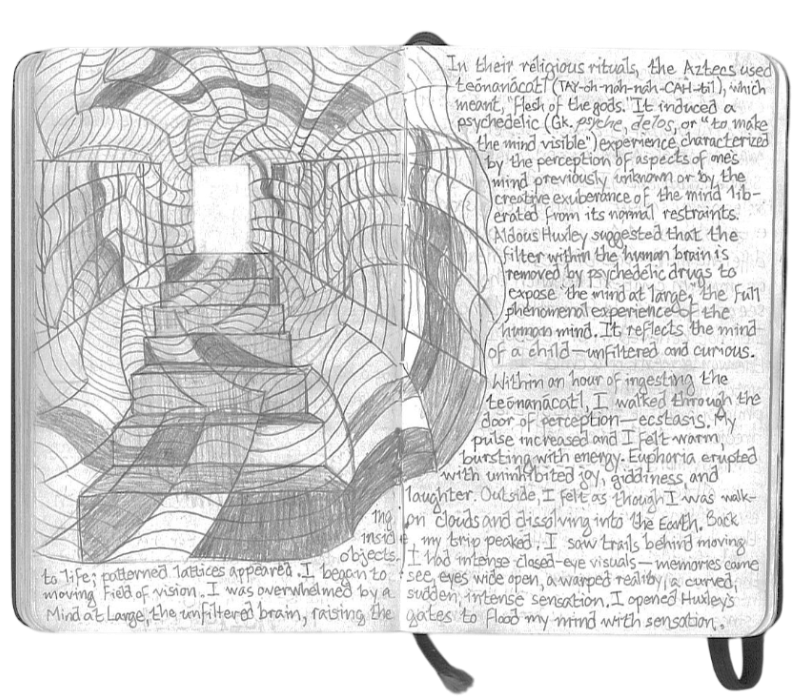
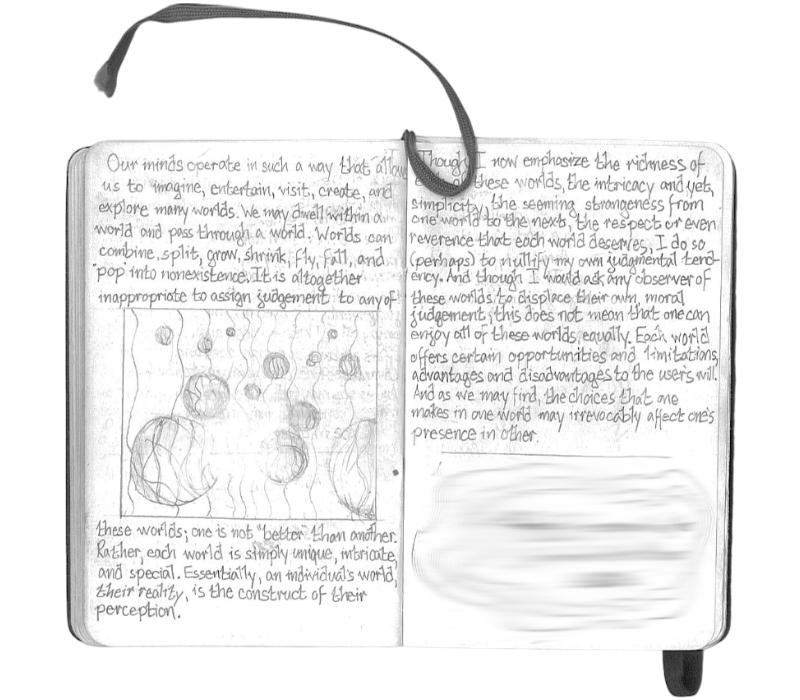
This paper was originally published on Academia.edu. The paper, itself has been adapted from a larger publication on ancient Epicurean piety. It has been edited and re-formatted for academic presentation. For additional commentary, see “Holy Shit: The Elements of Epicurean Psychedelia” published by the Society of Friends of Epicurus

Epíkouros advances a developed theology in his treatises Περὶ σιότητος (Perì Hosiótētos, “On Piety”), Περ Θεν (Perí Theôn, “On Gods”), Περὶ Φύσεως (Perì Phýseōs, “On Nature”), and his distinguished “Letter on Happiness” προς Μενοικεα (pròs Menoikéa, “to Menoikeus”). In these compositions, the Gargettian encourages the veneration of “the divine nature” while upholding the validity of atomic physics and underscoring the emptiness of supernatural myths. Therein, the Sage of the Garden conducts a survey of religious history, provides an evaluation of the efficacy of rites and rituals, and reflects upon the genesis of the profound mental impressions that have inspired centuries of pious devotion. While some of these works have been lost, Epíkouros’ ideas have been preserved by Philódēmos in his similarly-named works “On Piety” and “On Gods”, as well as Metródōros’ Περ Μεταβολής (Perì Metabolês, “On Change”), and a work by Demḗtrios of Lakōnía entitled Περ το Θεο Μορφς (Perì toû Theoû Morphēs, “On the Form of a God”) within which “god” is deconstructed.

Epíkouros, Metródōros, Philódēmos, Dēmḗtrios, and other atomistic philosophers contextualize both spiritual activities like (piety and prayer) and religious notions (like blessedness and divinity) within the framework of an intelligible reality, existing as a continuum of moving bodies. Consequently, piety is presented as a function of neuropsychologyand theology is evaluated as a feature of anthropology. Human animals cultivate wisdom upon a κανών (kanṓn) or “standard” of knowledge, a philosophical foundation that grounds truth in nature. As Diogénēs records, the criteria of knowledge includes “the [αἰσθήσεις or aisthḗseis] sensations and [προλήψεις or prolḗpseis] preconceptions and that of [πάθη or pắthē] feeling” (Laértios 10.31). Sensation triggers feeling and gradually conditions preconceptions — each preconception is a “memory of the appearances” received “repeatedly from abroad”, impressed by “the imprint of the sensations” (Ibid. 10.33). Far from being a supernatural revelation, the preconception of “blessedness” that defines “god”, like “justice” has been informed by daily occurrences. The gods, themselves are conceptual representations conditioned by memory. “Piety” is a consequence of psychology and “prayer” is a psychiatric practice. The θεία φύσις (theía phýsis) “divine nature” is a common expression of παντελῆ εὐδαιμονίαν (pantelḗ eudaimonían) “absolute happiness” (10.116). “Heaven” exists in the form of the μετακόσμιος (metakósmios 10.89) a boundless void containing countless κόσμοι (kósmoi). The “heavenly” homes of the gods exist as inferences within the colorful confines of the human mind.

Epíkouros explains that the divine nature (of “the gods”) is conditioned by the mental προλήψις (prolēpsis) “impression” of μακαριότητα (makariótēta) “blessedness” described by Philódēmos as τελείαν εδαιμονίαν (teleían eùdaimonían) “perfect happiness” (On Piety, Col. 13.7-8, 353-354). “The gods” of Epíkouros are primarily θεωρητούς (theōrētoús 10.62, 10.135) “observed” or “contemplated” as φαντασίαν τ διανοί (phantasían tḗi dianoíai) “visualizations” or “appearances [in] the mind” (Laértios 10.50). Epíkouros affirms that the gods μὲν εἰσιν (mèn eísin 10.123) “truly exist” yet are only “seen” or “reached” through an act of λόγῳ (lógoi) “contemplation”, “consideration”, “reasoning”, “reckoning”, or “logical accounting” (10.62, 10.139). He observes that the mental φαντάσματα (phantásmata) or “appearances” of the gods arise κ τς συνεχος πιρρύσεως (èk ts synekhoús èpirrū́seōs) “from a continuous stream” τν μοίων εδώλων (tn homoíōn eidṓlōn) “of similar” or “compatible images” that physically impress upon the soul. The impressions coalesce together through a process of ὑπερβάσεως (hyperbáseōs) “transposition” (On Piety, Col. 12.9, 324-5). The transposed formations have been ποτετελεσμένωι (ápotetelesménōi) “rendered” to human souls in human forms, immortal projections of mortal intellects, visualizations of perfectly-happy, perpetually-healthy people.

Having reviewed the psychiatric evidence of memory against the criteria of knowledge (embodied by the natural kanṓn), Epíkouros explains that the functional “coherence” or “resemblance” between internal φαντάσματα (phantásmata) “appearances” and external οσί (ousí) “beings” (or τοῖς οὖσί “reality” 10.51) requires that an initial impulse complete a sequence of successive impacts, ultimately yielding a perception in the mind, “since we could not have sought the investigation if we had not first perceived it” (Ibid., 10.33). A sensible τύπος (týpos) “impression” initiates a perceptual relay through various pathways in the soul — the sense organs are stimulated by ἁφή (aphḗ, “touch”), acoustic ῥεύμᾰτᾰ (rheúmata, “currents”), olfactory ὄγκοι (ónkoi, “hooklets”), and visual είδωλα (eídōla, “images”), all “impinging [upon] us [as] a result of both the colorful realities” to produce “a harmonious magnitude of related morphologies”. The μαχυμερέστερον (makhymerésteron) “marching army of particles” (Dēmḗtrios, On the Form of a God 21) enter “the face or the mind” […] yielding an appearance and an [affective] sympathy as a result of the observing” (Laértios 10.49-50). Thus, the mortal appearances we see during the day inspire the divine icons we envision at night.

Epíkouros “alone first founded the idea of the existence of the Gods on the impression which nature herself hath made on the minds of all men” (Cicero, On the Nature of Gods 26). He asks, “what nation, what people are there, who have not, without any learning, a natural idea, or prenotion, of a Deity?” The realization that isolated peoples developed parallel, mythic complexes became noticeably evident after Aléxandros III of Makedonía connected the intellectual culture of the Mediterranean with the Indian subcontinent, triggering a cross-cultural dissemination of wisdom literature. According to the Gargettian, prior to the historical development of these mythic narratives and institutionalized rituals, prehistoric humans organically conceived of deities as sublime psychological icons encountered during dreams and contemplations (On Nature 12). The Pyrrhonian skeptic Séxtos Empeirikós preserves Epíkouros’ historical thesis: “The origin of the thought that god exists came from appearances in dreams” that were conditioned by “the phenomena of the world” (Against the Mathematicians 9.45-46). The earliest humans who conceived of these notions assumed “the object of thought as a thing perceived in relation to a solid body […] understanding perception that can be grasped by corporeal sensation, which they also knew to be derived from a physical entity [i.e. nature]” (Philódēmos, On Piety, Col. 15.8-18). Yet, far from being prophetic symbols θεόπεμπτος (theópemptos) sent by the gods” (Diogénēs of Oìnóanda, Fr. 9, Col. 6), “the gods”, themselves exist as symbolic representations, composed from reproducible “stream[s] of similar images” that have been apprehended from a variety of natural inspirations (Laértios 10.139).

Prehistoric peoples’ perception of “the divine nature” and their visualizations of “divine” beings created lasting impressions upon the history of human civilization. Human devotees created conventions to celebrate the symbols of their insights. Traditions were cultivated and pious practice flourished, as did dramatic myths and misunderstandings.Eventually, “self-important theologians” and deluded priests diluted beliefs about the divine and perverted piety with a fog of fear (Philódēmos, On Piety, Col. 86A 1-2). “God” himself was assigned disturbing duties and became enlisted in the service of religious autocrats. Contrary to the chilling myths championed by “self-important theologians”, the blessed and incorruptible nature has no need to direct the production of the human drama. Epíkouros teaches that “it is foolish to ask of the gods that which we can supply for ourselves” (Vatican Saying 65). The true benefits of worship are enjoyed by worshippers, not by the fantastic objects of human obeisance. People conceive of gods as being kind, confident, and self-reliant; in emulating these virtues, people perfect their own pleasure. “Anyone who has these things […] can rival the gods for happiness”, despite their inability to fulfill prayers, subdue nature, and prevent death (Vatican Saying 33). Philódēmos exhorts students to “imitate their blessedness insofar as mortals can” and “endeavor most of all to make themselves harmless to everyone as far as is within their power; and second to make themselves so noble” (On Piety Col. 71.16-19, 23-29). Functional knowledge of piety and theology is integral to cleansing oneself of the turmoil that is symptomatic of magical thinking.

The Epicurean presentation of divinity contextualizes “the gods” as fantastic, mental entities that can be inspired passively through the indiscriminate mechanism of sensation, either “from abroad” through the trigger of touch, as when one views an idol, or internally, “in respect of slumbers” when the mind dreams freely, least encumbered by daily disturbances, and organically repurposes memories of remarkable figures before then augmenting them into deathless idols. “Gods” can also be summoned intentionally, through a directed act of contemplation, involving τινὰς ἐπιβολὰς τῆς διανοίας (tinàs épibolàs tḗs dianoías) “some applications of the intellect”, like μνήμην (mnḗmēn, “memory”). Dēmḗtrios of Lakōnía reiterates that the representations of “the gods” in the mind are triggered both as those memories manifest” through recollection, “and also” by the physical impulse of “pre-existing [bodies] that, upon [striking] the mind, produce constructive cognition”, as when one observes a icon (Dēmḗtrios, On the Form of a God 12). Because of this, mental representations of religious figures can be summoned through meditation as readily as when gazing upon the mass of a physical icon. In prayer, the supplicant manually retrieves an “apparent” image of blessedness, previously been stored in memory, having been initially sublimated in the imagination. Visual γνῶσις (gnṓsis, “knowledge”) of “the gods” has been ἐναργὴς (énargēs) “apparent”, “evident” or “manifest” (Laértios 10.123) for millennia — the fields of the Earth are filled with statues, votives, frescoes, mosaics, murals, metalwork, jewelry, pottery, and architecture that glorify “the divine nature”. Each civilization peppers its conception of divinity with fresh colors, shapes, and stories, just as each culture ritualizes a contemplative path to care for the health of the soul. In doing so, each group creates a cultural matrix into which subsequent generations are psychologically enmeshed — prior to the widespread proliferation of supernatural soap operas, the first peoples contemplated a raw form of divinity, unsullied by mythic adulterants.

To further isolate the genesis of the unadulterated notion of “god”, Epíkouros traces the crumbs of cognition to their sources in nature. In the case of divine entities, the Sage observes that divine representations have been conditioned by memories of the human animal combined with the congenital preconception of blessedness. When a supplicant prays, meditates, concentrates, reflects, or, generally applies directed focus toward the stored, mental expression of blessedness, they generate a internal image “as if” the practitioner were literally ἐν εἰκόνι (én eìkóni) “in the presence” of an external “representation”, “portrait”, or “icon”. As with the memories of “brightness”, “loudness”, “softness”, and “sweetness”, the characteristics of the gods have been conditioned by images and inspirations received from abroad — those images (like the form of a human body) and inspirations (like peak happiness) become amalgamated in the mind by an intellectual act of transfusion. As with other preconceptions, like χρόνος (khrónos) “time” and δίκαιος (díkaios) “justice”, the mental prototype of “god” functions as an organizing principle or “ruler” against which individual examples can be evaluated — any alleged divinity that punishes, terrorizes, rages, suffers, or fears neither meets the definitions of “blessed” nor “incorruptible”, and cannot by definition be identified as “god”. Epíkouros exhorts Menoikeus to “believe anything about” the image of god “that is able to preserve” that form’s conceptual “incorruptibility and blessedness” (Laértios 10.123). So long as an expression of divinity coheres with the preconception of blessedness, it can truly be called “a god”. Thus, an endless collection of divinities might be perceived, unique to each person, supported by the infinity of particles that constitute both the heavens and the heavenly forms of the mind.

The heavenly form of a “god” appears to the human mind as does any other, mundane formation, as τὸ ὄν (tò ón) “a being” or “an entity” (Philódēmos, On Piety Col. 66A, Line 11). According to Epíkouros, each “entity” can be conceived of as an individual ἑνότης (henótēs, Col. 13.12) “unity” or “union” composed of many other mental particles that coalesce together to form representational σύγκρισεις (sýnkriseis) “compounds” in the mind (Col. 12.11). As Metródōros writes, each νότητα διότροπον (henótēta idiótropon) “distinctive unity” also exists as a “compound made up of things that do not exist as numerically distinct” (On Change, preserved by Philódēmos in On Piety, Col. 4.13-15). Epíkouros further clarifies that “unified entities” in the mind can exhibit one of two constitutions — some “entities” of the mind “are perfected out of [1] the same elements and others are constituted from [2] similar elements” (On God, preserved by Philódēmos in On Piety Col. 8.14-17) The φύσεις (phýseis) “natures” or “constitutions” of all of these “unified entities” are therein grouped according to the origin of their birth, either from [1] a single source, or having coalesced from [2] multiple sources ἐξ ὑπερβάσεως τν (èx hyperbáseōs tôn) “as a result of transposition” during the traversal μεταξύ (metazù) “between” the source and the mind (Ibid., Col.12.8-9). If the mental form of an entity is composed of particles that only originate from [1] a single source, Epíkouros says that they are all αὐτή (autḗ) “the same” in constitution — “the same” form is one that reflects a numerically-singular entity in one’s environment. By contrast, Epíkouros says that appearances composed of particles coming from [2] multiple sources are only superficiallyὁμοία (homoía, Col. 12.6) “similar” because they are only related insofar as their composition as arrays of εἴδωλα (eídola). Besides their shared form as bundles of images, the conceptual amalgamations of “the gods” have been stitched together from a variety of environmental inspirations.

To demonstrate this constitution, one might visualize a dog. This visualized animal is a mental representation. It was previously impressed upon the mind when dog-particles travelled from a dog (or image of a dog) through the air. The visual impulse that impacts the eye triggers an internal cascade that yields the mental form of an animal. The resulting dog-form is a bundle of distinct particles that correspond κατ’ ἀριθμόν (kat’ arithmón, Col. 12.10) “in number” to the measurable proportions of [1] “that same”, furry creature in reality. This representation is composed of particles whose φύσεις (phýseis) “origins” are all αὐτή (autḗ) “the same” — the memory of this “dog” was apprehended “without contamination” from the particles of other, distinct objects (Philodemos, On Gods III, Col. 8). The generative flow of images reflects the activity of the original body, and a dog is not confused for another form (e.g. when dog-forms coalesce with human-forms in our imagination, we picture werewolves).

By contrast, one might visualize a god. Like the dog-form, the god-form is a mental image of an animal. Like the dog-form, the god-form is also apprehended by the intellect. Like the dog-form, the god-form, too was initially triggered by impulses “received from abroad”. However, unlike the mental aggregate that constitutes one’s impression of a “dog”, one’s impression of a “god” is a ὑπέρβασις (hypérbasis), a “superimposition” of at least two different bodies of εἴδωλα (eídola) that are only superficially ὁμοία (homoía) “similar” insofar as their material composition as pictures in the mind. Therein, the compound nature of these images enables their being φθαρτον “indestructible”. By comparison, after the death of a dog and the end of that dog’s eídola, the dog’s form can only be retrieved from memory — we are left with the impressions that a mortal creature gave us of itself during its limited lifespan. The forms of the gods, however, are not at risk of dissolution because they do not have a single source that is subject to death — the sources of the god-forms are unending, undying, and limitless, the infinite soup of particles that is constantly boiling before our very souls. In this regard, “the form of god” is neither [1] a simple body (like a particle), nor a regular compound (like a dog), but is a sort of [2] irregular compound. No compound is a simple body (i.e. a particle), and all compounds are combinations of simple bodies, but unlike the regular compound that is a dog-form, the god-form is not composed of particles that are κατ ριθμν (kat’ árithmòn) “numerically-identical” to their source. Rather, the form of “a god” is composed of particles that are καθ μοείδειαν (kath’ hòmoeídeian) “similar in consistency” such that they can become enlaced to imagine new forms. The image of “god” is formed when the image of a human is conjoined in the mind withthe concept of perfect happiness and the projection of deathlessness. As preserved by Diogénes, Epíkouros explains ος μν (oús mèn) “on one hand” the forms of the gods appear to be κατ ριθμν φεσττας (kat’ árithmòn hyphesttas) “subsisting by number”, as though each “unified entity” corresponds with a single, external body, “but” ος δ (oús mèn) “on the other hand” the gods” are formed καθ μοείδειαν (kath’ hòmoeídeian) from multiple, external sources due to their existence “as a similitude” of images that constitute “a common appearance” (10.139).

In the case of the specific characteristics of “the gods”, human minds tend to render the human visualization of perfection νθρωποειδς (anthrōpoeidṓs) “human-like” (Ibid.) or ἀνθρωπόμορφον (anthrōpómorphon) “human-shaped” (Dēmḗtrios, On the Form of a God 14-16). Granted, “the gods”, as mental projections of humanity, are not “to be considered as bodies of any solidity […] but as images, perceived by similitude and transition” (Cicero, On the Nature of the Gods 28). “We do not find the calculation” so writes Demḗtrios, “that any other shape” besides that “of the human” could qualify as a blessed and incorruptible being.” He explains that the gods “are granted to be perfectly happy; and nobody can be happy without virtue, nor can virtue exist where reason is not; and reason can reside in none but the human form”. Philódēmos writes that “we have to infer” their behaviors “from the appearances” made “manifest” to the mind; thus, we visualize god “as a living being” (Philódēmos, On Gods III, Col. 10):

One must [imagine] with Hermarchus that the gods draw in breath and exhale it, for without this, again, we cannot conceive them as such living beings as we have already called them, as neither can one conceive of fish without need in addition of water, nor birds [without additional need] of wings for their flight through the air; for such [living beings] are not better conceived [without their environment] .

Philódēmos further reflects on the conceived environments of the gods:

[E]very nature has a different location suitable to it. To some it is water, to others air and earth. In one case for animals in another for plants and the like. But especially for the gods there has to (be a suitable location), due to the fact that, while all the others have their permanence for a certain time only, the gods have it for eternity. During this time they must not encounter even the slightest cause of nuisance… (On Gods III, Col. 8).

Apollódōros the scholarch infers that “the dwellings” of the fearless gods, unruffled by ferocious winds and falling stars “have to be far away from the forces in our world” (Ibid., Col. 9). He stipulates that the security of these “locations” may not be preserved as a result of “distance” so much as a result of physical disengagement “from the hindering factors that clash against each other”. Epíkouros concurs that “it is possible for their nature to exist even with many troubles surrounding it” (On Piety, Col. 3.3-7). For “even if the things which generate” divine images were “as far away as anyone could wish”, the mundane images of people stored in memory would still combine with the preconception of “blessedness” and form the image of gods who “appear” to “transcend” any amount of “intervening distance” (Philódēmos, On Gods III, Col. 9). Memory, itself “transcends” the perils of our perishable plasma through a perpetual replenishment of minute, mental motes, “having changed each time for producing a thought” (On the Form of a God 12). Dēmḗtrios explains that “the memories people retain of” visual impressions were first “received as children” (Ibid., 11), and despite decades of disruption, those representations can be reproduced continuously. Through contemplation, a supplicant summons a memory of blessedness and transforms the mind into a holy menagerie, capable of hosting a variety of divine forms. After extensive consideration, Apollódōros concludes that the “dwellings” of “the gods” must be constructed “from some of their” own, finely-grained “elements”, repurposed through an act of contemplation (On Gods III, Col. 10).

Philódēmos further supposes that beings who inhabit the sublime territory of the pure mind possess “perception and pleasure”, as well as “an excellent disposition of things which endure” (On Piety, Col. 5). Accordingly, these projections exhibit the same preferences as their human projectors, finding recognizable pleasure in the activity of being rational animals:

we must claim that the gods use both voice and conversation to one another; for we will not conceive them as the more happy or the more indissoluble, [Hermarchus] says, by their neither speaking, nor conversing with each other, but resembling human beings that cannot speak; for since we really do employ voice, all of us who are not disabled persons, it is even the height of foolishness that the gods should either be disabled, or not resemble us in this point, since neither men nor gods can create utterances in any other way. And particularly since for good men, the sharing of discourse with men like them showers down on them indescribably pleasure. And by Zeus one must suppose the gods possess the Hellenic language or one not far from it, and that their voices in expressing rationalist are clearest(Philódēmos, On Gods III, Col. 13)

Humans picture “the gods” to be perpetually-happy people, ceaselessly-savoring the pleasures of friendship, “for it is not possible for them to maintain their community as a species without any social intercourse” (Philódēmos, On Gods, Fr. 87). Unburdened by the undue responsibilities of celestial governance, astral adjudication, and cosmic corrections, the holy inhabitants of the mind seem wholly self-reliant. Perfectly prudent, they appear to privilege the preservation of their own peace above impractical obligations. As ζῷον (zōîon 10.123) living figures, they are expected to respirate; as social figures, they are imagined to converse; as rational figures, they are understood to reflect; as blessed figures, they are acclaimed to live without fear, imperishable paragons of human perfection. The human-shaped deities appear to sustain a peak state of pure pleasure, that which cannot be heightened by excess.

Demḗtrios cautions that, “when we say in fact the God is human-shaped” we should note that God is not actuallyhuman (On the Form of a God 15). In On the Nature of the Gods, Cicero’s character Velleius concurs that god “is not body, but something like body” nor “does it contain any blood, but something like blood” (28). Like the concepts of “justice” and “time”, the concept of “god” is not “attached” to an external body, “except [in the case] of calculation, wherefore we interweave” thoughts in the mill of the mind from subtle threads of memory (Laértios 10.72). Velleius admits, “these distinctions were more acutely devised and more artfully expressed by Epicurus than any common capacity can comprehend”. The gods are, nonetheless “real”, “unified entities” as reproducible appearances in the mind.

In an effort to “realize” his own spiritual “fulfillment”, Philódēmos further scrutinizes the images of these “beings surpassing [περβαλλουσν or hyperballousōn] in power [δυνμει or dynámei] and excellence [σπουδαιότητι or spoudaiótēti]”, who equally “excel [περέχον or hyperékhon] in sovereignty [γεμονίαν or hegemonían]” and infers the following:

that of all existing things, [the divine nature] is the best [ριστον or áriston] and most holy [σεμνότατον or semnótaton, “dignified” or “revered”], most worthy of emulation [ξιοζηλωτότατον or áxiozēlōtótaton, “enviable”], having dominion over all good things [πάντων τῶν ἀγαθῶν κυριευόντα or pántōn tōn agathṓn kurieúonta], unburdened by affairs [πραγμάτευτον or pragmáteuton], and exalted [ψηλόν or hypsēlon, “sublime” or “proud”] and great-minded [μεγαλόφρονα or megalóphrona, “noble” or “generous”] and great-spirited μεγαλόψυχον or megalópsykhon, “magnanimous”] and ritually pure [γιον or hágion, “sacred”] and purest [γιοτατον or àgiōtaton, “holiest”] and propitious[ῑ̔́λεων or hī́leōn, “blameless”]. Therefore they say that they alone strive after the greatest form of piety and that they hold […] the purest views as regards the ineffable [φραστον or áphraston, “inexpressible” or “marvelous”] pre-eminence [περοχήν or hyperokhēn, “superiority”] of the strength[σχύος or ìskhúos, “power”] and perfection [τελειότητος or teleiótētos, “completeness”] of the divine[toû theíou] […] [Epíkouros] advises not to think [God] bad-tempered (as he is thought), for example, by the poets. (On Piety, Col. 45.2-30).

Lucretius observes that CAELESTI SVMVS OMNES SEMINE ORIVNDI “we have all come from heavenly seed” (De Rerum Natura 2.991). The pieces of reality that comprise our bodies are the same pieces that comprise the stars and the memories in our minds. Cosmic firstlings fall from the “heavens” and amalgamate upon this world, contributing to the body of the terrestrial aggregate. Nature repurposes these elements for the benefit of evolution — many of the “heavenly” particles become recycled into the motes of the mind, which are then reconstituted into the “heavenly” forms of “the gods”. Summarily, all particles travel through the heavens and can become repurposed into the “heavenly” bodies of divine idols. So long as mortals exist to engage in the enterprise of story-telling, immortals can exist in perpetuity.

The Epicurean philosophers confidently affirm that no “god” attended the inauguration of the Earth — no supernatural supervisors were present to oversee the development of the early cosmos. The existence of a human god did not precede the existence of a human animal. Prior to the emergence of the human being, the human body had yet to exist — “the god” had yet to be conceived. It was only after humans evolved, formed friendships, shared memories, and suffered loss that prehistoric peoples internalized their experiences, dreamed of deathlessness, and projected their inspirations as sublime, psychological icons, providing guidance and inspiration to generations of people. So long as human beings continue to dream, human egos will continue to project their ideals upon the walls of the mind, constructing holy heroes and righteous role models that embody their ideals; so too will people continue to manufacture tragic myths. While these forms of blessedness can be continuously reproduced, many fall into disuse as the masses champion tragic heroes who contradict the basic definition of perfection that “god” implies.

The primary concern of Epicurean theology is to protect the conceptual blessedness and incorruptibility of the “divine nature” from “contamination […] lest they become mixed up with” terrestrial troubles “to the detriment of their imperishability” (On God III, Col. 9). For Epíkouros, any fearful “contamination” poured upon the form of blessedness mutates the pure notion into a chimera (like a centaur or gorgon), a tragic antagonist in dramatic fiction. Accordingly, as the conceit of a medusa sublimates the notions of “woman” and “snakes”, so, too does the notion of a demiurgesublimate “god” with “artist” — prior to the laborious ingenuity of creative hands, no “creator” could be contrived. Likewise, the notion of LORD conjoins “god” with “king” — here again, prior to the phenomenon of “kings” lordingover subjects, no conception of a LORD could have existed. Similarly, understanding “god” to be “The Father” requires the believer to have been born within a species that observes the “male parent” to play a role in child-rearing — without this context, “The Father” is meaningless.

Compared with the chimeric myths of the masses, the pure conception of “blessedness” or “complete happiness” (e.g. impassivity, tranquility, cheerfulness, and delight) corresponds precisely with the natural standard that the word “god” implies. As humans employ the preconception of “time” to evaluate the duration of events, and, similarly employ the preconception of “justice” to evaluate the commensurability of relationships, so too do humans employ the preconception of “god” to evaluate ethical priorities and set behavioral goals.

While many imagine “god” as a “real animal” with “common” features that subsists beyond the walls of the world, this assumption leads to contradictions (Dēmḗtrios 16). [ I ] First, extreme isolation from the nutritive “forces of the world that produce things subject to generation and dissolution” would inhibit any inhabitant’s access to natural necessities. It would severely challenge any entity “resembling a human being” from being able to sufficiently replenish its losses and preserve its perfections (Philódēmos, On Gods III, Col. 9). The “happiness” promised “beyond Zeus” is expressed as “the cry of the flesh [that] neither hungers, nor does it thirst, nor does it shiver” (Vatican Saying 33). Consequently, a “living being”, “breathing in and out” that is restricted from the “forces of generation” that supply air and shed light would suffer the same impairments as a “disabled person” whose disposition restricts their ability to acquire breath and behold the “the sight of sweet motions” (Laértios 10.6). Philódēmos cautions that it is “the height of foolishness” to suppose “that the gods should either be disabled, or not resemble us in this point” (On Gods III, Col. 13). [II] Secondly, the notion of a pre-human, human-shaped entity contradicts Epíkouros’ description of cosmic evolution. Naturally, the pig cannot precede the piglet, and the human form cannot precede the emergence of the human animal. The memory of a human body cannot precede the body of a human being remembered. “Thus, each name follows [what] is visible […]For one must perceive the [external] form before the preconception” (Laértios 10.33). [III] Thirdly, the bodies of external gods could not be “evident” if they were truly unobservable. Dēmḗtrios explains that “the thinnest-particles”, such as those which constitute the mind, are too fine to “truly constitute” visual “perception” (On the Form of a God21). He further affirms that “nothing diaphanous [is] sensible” (Ibid., 22). Therefore, if knowledge of external god-bodies has yet “to be confirmed or to be contradicted” through direct apprehension due to their imperceptibility, then external gods could never be “manifest” to the mind (Laértios 10.51). Yet Epíkouros affirms that “knowledge of them” is “evident” as internal projections of blessedness (Ep. Men. 10.123). [IV] Finally, the mode of subsistence of non-terrestrial entities, though “human-like” would present hazards to any terrestrial animals attempting to emulate their lifestyles. The στοιχειώμaτa (stoikheiṓmata, “elementary principles” 10.36) affirm that the compounds of the Earth have been conditioned by local forces — non-terrestrial entities lack exposure to those forces that condition which sensations are pleasurable and painful, and for which animals. Thus, human animals incur great risk in attempting to emulate the behavior of entities that only superficially resemble the human-form. By contrast, Philódēmos encourages us to “imitate” the “blessedness” of recognizable idols, not to ritualize the idiosyncratic lifestyle of an alien (On Piety, Col. 71.16-17).

Ultimately, these speculative examples of divinity, proposed to exist, independent of the human mind, are unnecessary to contextualize religious practice and to justify a defense of spirituality. In the continuum of the mind, prayer has phenomenal power and piety has purpose. Dēmḗtrios concludes “that even by means of contemplation”, as streams of superimposed images in the mind, each “deity” physically “possesses a substance” and wields influence (On the Form of a God 15). Though Philódēmos concedes that “no one has been prolific in finding convincing demonstrations for the existence of” independent “gods” with “human-shaped” bodies, he “nevertheless” recognizes “all humans, with the exception of some” to “worship them […] as do we” (On Piety, Col. 23.13-21). “Apparent indeed is this knowledge” (Laértios 10.123).

Works Cited

Armstrong, David. “Epicurean virtues, Epicurean friendship: Cicero vs the Herculaneum papyri” in Epicurus and the Epicurean Tradition, Cambridge University Press, 2011, 126-8.

Cicero, Marcus, et al. Cicero on the Nature of the Gods. Translated by C. D. Yonge, 1872.

Dēmḗtrios of Lakonía. “On the Form of a God.” Translated by N. H. Bartman, Twentiers, 5 Apr. 2025, https://twentiers.com/form-of-god/ (accessed 14 Nov. 2025).

Diogénēs of Oìnóanda and Smith, Martin Ferguson. Supplement to Diogenes of Oinoanda the Epicurean Inscription. Bibliopolis, 2003.

Empeirikós, Séxtos. Against the Physicists. Against the Ethicists. Translated by R. G. Bury, Harvard University Press, 1953.

Epíkouros, et al. The Hedonicon: The Holy Book of Epicurus. Translated by N. H. Bartman et al., 1st ed., Leaping Pig Publishing, 17 Nov. 2023.

Essler, Holger. “Space and Movement in Philodemus’ De Dis [On Gods] 3: an Anti-Aristotelian Account.” Critical Studies in Ancient Physics, 2014.

Laértios, Diogénēs. “Book 10.” Diogenes Laertius: Lives of Eminent Philosophers. Translated by Stephen White, Cambridge University Press, 2021, 411-462.

Laértios, Diogénēs. Lives and Opinions of Eminent Philosophers: Book 10. Translated by Bartman, N. H. in “The Life of Epíkouros: A Translation for Twentiers”, Leaping Pig Publishing, 21 May 2025,www.academia.edu/129436319/The_Life_of_Ep%C3%ADkouros_A_Translation_for_Twentiers (accessed 17 Nov. 2025).

Logeion, University of Chicago, https://logeion.uchicago.edu/, (accessed 17 Nov. 2025).

Lucretius Carus, Titus. The Way Things Are. Translated by Rolfe Humphries, Indiana University Press, 1968, page 80.

Philódēmos of Gádara.On Gods”. Translated by Essler and Armstrong, Twentiers, Leaping Pig Publishing,https://twentiers.com/on-gods/ (accessed 16 Nov. 2025).

Philódēmos of Gádara. On Piety. Translated by Dirk Obbink, Oxford University Press, 1996.

Twentiers.com. Leaping Pig Publishing, https://www.twentiers.com/ (accessed 15 Nov. 2025).

Pleasure and Prudence in the Dhammapada

As we strive to maintain a synoptic view of the field of philosophy, so as to neither narrow the scope of our awareness nor limit the expression of our understanding, the Society of Friends of Epicurus pursues a commitment to inter-disciplinary study and cross-cultural analysis. Evaluating of our own beliefs against other wisdom traditions helps contextualize personal practice, and further illuminates a larger spectrum of spirituality. In particular, we have found it profitable to compare and contrast Epicurean Philosophy against the various traditions of बौद्ध धर्म (Buddha Dhamma), the “Law of the Awakened One”, represented to us in English as “Buddhism“. In particular, SoFE has explored the Mahāyāna Buddhist tradition as preserved by the famous Lotus Sutra. Other essays include reflections on Nichiren and Japanese Buddhism, as well as an essay on the Epicurean-like tradition of Charvaka, a hedonistic school of Indian materialism that outright rejected reincarnation and dismissed mystical practices.

As a supplement to our explorations on the Mahāyāna traditions, I wish to explore the Indian Theravāda tradition as preserved by an ancient text called the DHAMMAPADA:

“If all of the New Testament had been lost, it has been said, and only the Sermon on the Mount had managed to survive these two thousand years of history, we would still have all that is necessary for following the teachings of Jesus the Christ. The body of Buddhist scripture is much more voluminous than the Bible, but I would not hesitate to make a similar claim: if everything else were lost, we would need nothing more than the Dhammapada to follow the way of the Buddha.” (Eknath Easwaran, The Dhammapada 13).

The ancient धम्मपद (Dhammapada) is a collection of sayings attributed to Siddhartha Gautama, the बौद्ध (Buddha) or “Awakened One”. “Dhammapada means something like ‘the path of dharma’— of truth, of righteousness, of the central law that all of life is one” (Ibid. 14). The Dhammapada, itself is the second book of the Khuddaka Nikāya, the “Minor Collection”, the last of five nikāyas (or “volumes”) of the Sutta Piṭaka, the “Basket of Discourse”, the second of three divisions of the Tipiṭaka, the “Triple Basket”, the scriptural canon of Theravāda (“school of elders”).

The Theravāda school, founded in the 3rd-century BCE and found today in Sri Lanka, Myanmar, Thailand, Laos, and Cambodia, represents an earlier tradition that proposed a “Middle Way” between the “Eternalism” of the Brahmin religion that proposes the existence of an eternal आत्मन् (ātman) or “self”, versus the “Annihilationism” of Ajita Kesakambalī’s hedonistic school of Chārvāka (which is much more similar to Epicurean Philosophy). Buddha rejected (almost) all metaphysical propositions and described the true nature of one’s being as anattā, the “non-self”, lacking permanency. All knowledge is validated by two paramana or “proofs”, [1] pratyakṣa or “perception” and [2] anumāna or “inference”. Perception and inference are due to the six āyatana or “sense objects” of sight, sound, odor, taste, touch, and thought.

The criteria Buddha accepted lead him to conclude that reality is a changing, experiential aggregate, composed of [1] the elemental forms (rūpa), solid earth, cohesive water, mobile gas, warm fire, and empty space, [2] sensuous feeling (vedanā), [3] mental cognition (saṃjñā), [4] willful determination (saṅkhāra), and [5] consciousness (vijñāna). Natural patterns are observed, but propositions about them are are dismissed as meaningless speculations. Beings migrate through numerous planes of existence (ascending to heavens and descending to hells). One’s directionality at death reflects their कम्म (kamma) or moral causality. As they refine their kamma or “moral causality”, they get closer to the goal of निब्बान (Nibbāna). The goal of life is Nibbāna the end of दुक्ख (dukkhā) or “suffering” and release from संसार (saṃsāra), the cycle of rebirths caused due to one’s avijjā or “ignorance” of अनिच्चा (anicca) or “impermanence”. To achieve the goal of life, one must follow the Noble Eightfold Path according to the dhamma or “law” taught by Buddha to achieve the “extinguishment” of suffering: [1] Right Resolve, [2] Right Speech, [3] Right Conduct, [4] Right Livelihood, [5] Right Effort [6] Right Mindfulness, [7] Right Meditation, and [8] Right view that death is not the end. There are also a variety of blissful entities called Devas, who inhabit emotional “planes of existence”. Each realm is defined by the disposition of its inhabitant. The devas, themselves, are also working toward the goal of Nibbāna.

By contrast, the younger Mahāyāna school was cultivated by Nāgārjuna (c. 150-250 CE) who developed the highly influential Madhyamaka school of Buddhist philosophy (possibly influenced by Pyrrhonism through the works of Sextus Empiricus; Pyrrhonism, itself, was likely inspired by Sañjaya Belaṭṭhiputta, the founder of Ajñāna, a competitor of early Buddhism). Many other influential Buddhists helped spread the religion, such as Bodhidharma to China and Padmasambhāva to the Tibetan Plateau. The epistemology of Mahāyāna differs from its predecessor. In this school, all objects lack independent existences. Objects only meaningfully exists within the continuum of the mind. Physical phenomena is dismissed as माया (māyā), “magic” or “illusions”, and the appearance of the natural world is understood to be an ephemeral dream. Reality is fundamentally शून्यता (śūnyatā) or “emptiness”. All things lack a स्वभाव (svabhāva) or “independent nature” (as was used by the atheistic Chārvāka to refer to the physical nature of reality). The only “real” existence is consciousness. The energetic activities of nature are simply objects that exist within the mind, including the “body” and the “self”, which are also just temporary illusions within the continuous citta-santāna or “mindstream”.

A variety of mythic beings inhabit the various realms of existence according to Mahāyāna Buddhists, from gods to hungry ghosts. Heavens are idealized as Pure Lands, each of which is inhabited and ruled by its respective बोधिसत्त (bodhisattva). Buddha is treated as a universal deity, and other “Buddhas” are acknowledged to exist besides Shakyamuni (Gautama Buddha). “Buddhahood” is available to everyone and the achievements of Siddhārtha are not as emphasized as is the Buddha-nature, itself. To achieve Nirvāṇa, one must pursue the altruistic path of the bodhisattva, who works for the benefit of all beings by helping others achieve bodhi or “enlightenment”, and not simply one’s own enlightenment. Thus, the path of the Mahāyāna bodhisattva involves going beyond the Eightfold Path of the arhat to devote themselves toward practicing Buddhism for the benefit of all beings before finally achieving a state of Nirvāṇa. This continuous mission is thought to extend beyond an individual’s life into their future lives.

The Epicurean school overwhelmingly inhabits the opposite end of the philosophical spectrum. Our hedonistic school of indeterministic atomism proposes that reality exists independent of the mind. The universe is made of bodies and void. Bodies are either particles that can neither be created nor destroyed, or compounds that are composed of particles. All compound objects are subject to the forces of dissolution. Both space and the particles that move through it are infinite in number and eternal in time. The mind is a compound structure associated with a living animal, and can be located within the body. All knowledge begins with [1] sensation (aisthesis) caused by the interaction of external particles with our sensory organs. We detect pleasurable or painful [2] feelings (pathē) associated with the various sensations. Through repeated stimulation, we form [3] anticipations (prolepsis) about the patterns of nature.

The Earth, Sun, Moon, planets, and other linked objects comprise a kosmos in a spatially-infinite void with infinite kosmoi. All kosmoi are made of atoms. The seeds of life are everywhere. The gods are perfect figures in the mind, natural forms, imagined as indestructible humanoids, apprehended during dream-states, relative to our natural preconception of “blessedness”. Though, as was the case with the Buddhist schools, our Founder is also romanticized as having been god-like. Unlike the otherworldy goal of the Buddhists, we seek to achieve a godlike state of pure pleasure during our singular life, a disposition of imperturbable joy, free from physical pain and mental anguish. The practice of prudence will lead the wise person to the good life. We achieve such a life by calculating the advantages of every situation based on their possibility to provide stable, long-term pleasure. Actions are judged according to their consequences. There are no “eternal” ethical rules. There are, however, Key Doctrines written by Epíkouros that should be studied in order to minimize pain and maximize the pleasure of the good life.

While many of these positions are mutually-exclusive, the behaviors that compliment each traditions are universal. We find correspondence between a number of Buddhist and Epicurean attitudes: both traditions treat life with a sense of urgency, seek to organize healthy priorities, practice choice and avoidance, privilege the pursuit of knowledge, exercise discipline, and acknowledge the emptiness of political reputation. Both traditions warn against the consequences of greed, and caution against the vanity of power. Both encourage us to emulate role models, cultivate confidence, reject dishonesty, pursue study, exercise virtue, practice peace, reject empty ritual, and care for the health of the mind through contemplation. 

The following passages from the Dhammapada exemplify these SHARED points of agreement:

  1. There are those who do not realize that one day we all must die. But those who do realize this settle their quarrels. We have been born once, twice then we will not exist; it was fated for the eon [beyond] that we will no longer be; but you who are not the master-of-tomorrow delay the rejoicing; then a life is consumed by procrastination, and each one of us dies without leisure.” (Vatican Saying 14)
  1. Those who mistake the unessential to be essential and the essential to be unessential, dwelling in wrong thoughts, never arrive at the essential. No one who perceives what is evil prefers it for themself, but they are seduced by a good when a greater evil itself was pursued.” (Vatican Saying 16)
  1. Those who know the essential to be essential and the unessential to be unessential, dwelling in right thoughts, do arrive at the essential. Therefore adapt into a simple and not extravagant lifestyle as it forms an essential part of health and you will exercise the necessary [things] of life [that] make a person resolute and if you approach extravagant things after intervals it makes us stronger and you procure fearlessness against Luck.” (Epistle to Menoikeus 131)
  1. The foolish and ignorant indulge in heedlessness, but the wise one keeps his heedfulness as his best treasure. …you have taken time to devote yourself to thoughts concerning nature against those that are ignorant and [can now] behold an eon ‘both things as they are, things as they will be, and things before they are’ [as the poets say]” (Metródōros, Vatican Saying 10)A wise [person] combines about the necessities, more knowledge to share than to receive; they have discovered so great a treasure as that of [self-sufficiency].” (Vatican Saying 44)
  1. Just as one upon the summit of a mountain beholds the groundlings, even so when the wise man casts away heedlessness by heedfulness and ascends the high tower of wisdom, this sorrowless sage beholds the sorrowing and foolish multitude. But nothing is more welcome than to hold the lofty and serene positions well fortified by the learning of the wise, from which you may look down upon others and see them wandering all abroad and going astray in their search for the path of life, see the contest among them of intellect, the rivalry of birth, the striving night and day with surpassing effort to struggle up to the summit of power and be masters of the world.” (Lucretius, De Rerum Natura 2.3-13)
  1. Ere long, alas! this body will lie upon the earth, unheeded and lifeless, like a useless log. We have been born once, twice then we will not exist; it was fated for the eon [beyond] that we will no longer be; but you who are not the master-of-tomorrow delay the rejoicing; then a life is consumed by procrastination, and each one of us dies without leisure.” (Vatican Saying 14)
  1. Fools of little wit are enemies unto themselves as they move about doing evil deeds, the fruits of which are bitter. The ungrateful [essence] of the soul produces within a greedy animal an endless [craving] for a lifestyle of varieties.” (Vatican Saying 69)
  1. Ill done is that action of doing which one repents later, and the fruit of which one, weeping, reaps with tears. One cannot escape detection who secretly disturbs the pact one agreed upon with another neither to harm nor to be harmed, nor to trust that one will escape detection, even if ten thousand times the one present escapes detection. For until one’s reduction to nothingness one cannot suppose that one will ever escape detection.” (Key Doctrine 35)
  1. Well done is that action of doing which one repents not later, and the fruit of which one, reaps with delight and happiness. The greatest fruit of justice is tranquility.” (Vatican Saying 80)
  1. The fool seeks undeserved reputation, precedence among monks, authority over monasteries, and honor among householders. The disturbance of the soul cannot be ended nor true joy created either by the possession of the greatest wealth or by honor and respect in the eyes of the mob or by anything else that is associated with or caused by unlimited desire.” (Vatican Saying 81)
  1. Should one find a man who points out faults and who reproves, let him follow usch a wise and sagacious person as one would a guide to hidden treasure. It is always better, and never worse, to cultivate such an association. The worship of the wise is a great good to you who will worship.” (Vatican Saying 32)
  1. Just as a solid rock is not shaken by the storm, even so the wise are not affected by praise or blame. For we practice all of this in order to neither suffer nor dread. When once then this has come to pass because of us, we dispel the whole Storm of the Soul...” (Epistle to Menoikeus 128)
  1. He is indeed virtuous, wise and righteous who neither for his own sake nor for the sake of another (does any wrong), who does not crave for son, wealth, or kingdom, and does not desire success by unjust means. The disturbance of the soul cannot be ended nor true joy created either by the possession of the greatest wealth or by honor and respect in the eyes of the mob or by anything else that is associated with or caused by unlimited desire.” (Vatican Saying 81)
  1. Better than a thousand useless words is one useful word, hearing which one attains peace. Better than a thousand useless verses is one useful verse, hearing which one attains peace. (101-102) One must not pretend to study philosophy, but really study philosophy; for we do not pretend to need health, but in truth [really need] health.” (Vatican Saying 54)
  1. Better it is to live one day virtuous and meditative than to live a hundred years immoral and uncontrolled. “The same time [satisfies] both [in terms] of generation of the greatest good19 and of deliverance [from evil].” (Vatican Saying 42) The sensible person profits from one day they would by eternity.” (Philódēmos, On Death)
  1. Hasten to do good; restrain your mind from evil. He who is slow in doing good, his mind delights in evil. … anyone who is capable of restraint can bring that which is blessed in oneself by having preserved reasoning” (Usener fragment 485; Porphyrious, Letter to Marcella 29)
  1. Just as a trader with a small escort and great wealth would avoid a perilous route, or just as one desiring to live avoids poison, even so should one shun evil. [The] youthful part of [yourself, in regard to its] salvation, guard the [precious] part of life and preserve all of those things that are sullied by the raging desires.” (Vatican Saying 80)
  1. Neither in the sky nor in mid-ocean, nor by entering into mountain clefts, nowhere in the world is there a place where one may escape from the results of evil deeds. One cannot escape detection who secretly disturbs, that pact one agreed upon with another neither to harm nor to be harmed, nor to trust that one will escape detection, even if ten thousand times the one present escapes detection, for until one’s reduction to nothingness one cannot suppose that one will ever escape detection.” (Key Doctrine 35)
  1. Neither in the sky nor in mid-ocean, nor by entering into mountain clefts, nowhere in the world is there a place where one may will not be overcome by death. Some prepare throughout life for the [good] Life [in spite of the drug of death, yet] indiscriminately we have all been infused with the deadly drug from birth.” (Mētródōros, Vatican Saying 30)
  1. One who, while himself seeking happiness, oppresses with violence other beings who also desire happiness, will not attain happiness hereafter. One who, while himself seeking happiness, does not oppress with violence other beings who also desire happiness, will find happiness hereafter. (131-132) One [who is] untroubled, oneself, [is] also, for another, undisruptive.” (Vatican Saying 79)
  1. Neither going about naked, nor matted locks, nor filth, nor fasting, nor lying on the ground, nor smearing oneself with ashes and dust, nor sitting on the heels (in penance) can purify a mortal who has not overcome doubt. There was no point procuring protection from people if a person starts suspicion of those things from the sky and beneath the earth and generally in the Infinite.” (Key Doctrine 13)Impious then is not the one who rejects the deities of the masses, but the one who adheres to the masses’ doctrines about the deities. For [their] assertions are not impression but false assumptions of the masses about the deities.” (Epistle to Menoikeus 123-124)
  1. If one holds oneself dear, one should diligently watch oneself. Let the wise man keep vigil during any of the three watches of the night. [The] youthful part of [yourself, in regard to its] salvation, guard the [precious] part of life and preserve all of those things that are sullied by the raging desires.” (Vatican Saying 80)
  1. Good is it to see the Noble Ones; to live with them is ever blissful. One will always be happy by not encountering fools. The worship of the wise is a great good to you who will worship.” (Vatican Saying 32)
  1. The idler who does not exert himself when he should, who though young and strong is full of sloth, with a mind full of vain thoughts — such an indolent man does not find the path to wisdom. Neither should one who is new [to this world] hesitate to love wisdom, nor should an elder begin to grow tired loving wisdom. For no person is either unripe nor too ripe to be healthy throughout the[ir] soul.” (Epistle to Menoikeus 122)
  1. If by renouncing a lesser happiness one may realize a greater happiness, let the wise man renounce the lesser, having regard for the greater. …sometimes we step over many pleasures, since at such times more difficulties follow us from these; and we consider of the pleasures many pains better, whenever our greater pleasure follows many times these pains we endure.” (Epistle to Menoikeus 129)
  1. Entangled by the bonds of hate, he who seeks his own happiness by inflicting pain on others, is never delivered from hatred. One cannot be fearless [if] one causes [others to be] fearful.” (Usener fragment 537)
  1. [D]isciples of […] ever awaken happily who day and night delight in the practice… (296-301) Therefore, these and those things study for yourself, day and night, and with those like yourself, and at no time neither awake nor in a dream will you be confounded, for no living person surrounded by immortal Good seems like a mortal creature.” (Epistle to Menoikeus 135)
  1. Four mistfotunes befall the reckless man who consorts with another’s wife… (309-310) The wise will not have intercourse with a woman so far as the laws forbid so affirms Diogénēs [of Tarsós] in the Epitome of the Ethical Doctrines of Epíkouros” (Diogénēs Laértios, Lives and Opinions of Eminent Philosophers 10.118)
  1. If for company you find a wise and prudent friend who leads a good life, you should, overcoming all impediments, keep his company joyously and mindfully. Of those things that wisdom prepares for a full life of blessedness, by far the most important is the possession of friendship. The same knowledge that created confidence concerning both the fact that nothing terrible is eternal nor even enduring, and also in the same observations perceives that security is predominately perfected by friendships.” (Key Doctrines 27-28)
  1. Good is virtue until life’s end, good is faith that is steadfast, good is the acquisition of wisdom, and good is the avoidance of evil. For [it is] neither drinking and following festivals nor taking advantage of servants and women nor an expensive multitude of fish nor of however much else fills an extravagant table that makes life pleasant, but sober calculation and examining the cause of each choice and avoidance, and expelling the [masses’] doctrines, from out of these the greatest confusion overtakes our souls.” (Epistle to Menoikeus 132)
  1. One should not despise what one has received, nor envy the gains of others. The monk who envies the gains of others does not attain to meditative absorption. One must not spoil the present by yearning for the absent; but consider that also these [present] things were once of the [things for which] we wish.” (Vatican Saying 35)

While similarities are abundant, we find many passages that exhibit dissimilar attitudes, illustrating conceptual incompatibility between the systems, particularly in each traditions’ position on ethics and death. Theravāda Buddhism recommends a much more restrictive lifestyle than Epíkouros intended, much more reminiscent of the restrictive laws of the biblical books of Deuteronomy and Leviticus. Compared with Epicurean sensualism, Theravāda Buddhism is positively ascetic. Much of the voluminous Tipiṭaka contain lists of rules for monks (भिक्खु or bhikkus) and nuns (भिक्षुणी or bhikkunīs), supposing that the path to wisdom is necessarily monastic (as though a church were to have prescribed the restrictions of the Desert Fathers for everyone seeking God). Theravāda Buddhism presents a strict path of renunciation that involves the displacement of the self from personal affections and attachments.

The first book of the Pāli Canon is a code of conduct for monastics. To note a few rules:

  • Sexual intercourse leads to complete expulsion from the monastic community. (Pārājika 1)
  • Masturbating warrants correction. (Saṅghādisesa 1)
  • Holding hands with another person warrants correction. (Saṅghādisesa 2)
  • Marriage proposals warrant correction. (Saṅghādisesa 5)
  • Huts not built to the Buddha’s design specifications warrant correction. (Saṅghādisesa 6)

Epíkouros presents a very dissimilar approach to spirituality from these sexless Jedi: “We must simultaneously laugh and philosophize, and manage a household and administrate the economic affairs and never let go of the language of the forthright philosophy” (VS 41).

Differences are equally abound between Buddhist and Epicurean views on death (thanatology) and the afterlife (or explicit lack thereof). While both traditions acknowledge the inevitability of death, the Buddhist doctrine of कम्म (kamma) necessitates that an ethical component of the human aggregate survives the dissolution of the rest of the human frame. A moral quality of this component, which is cultivated throughout the life of the previous human aggregate, determines the manner in which this component becomes embodied in its next human form. Epíkouros unequivocally opposes this idea: “We have been born once, twice then we will not exist; it was fated for the eon [beyond] that we will no longer be…” (Vatican Saying 14).

Noticeably, the two traditions provide incompatible depictions of pleasure. The Dhammapada describe काम (kāma) (or “sense pleasure”) in the negative, exclusively linking “pleasure” with a state of recklessness and spiritual abandon in which one acts out of ignorance. Early Buddhists did not (as was also the case with Greek Kyrenaics) recognize “mental impassiveness” as a form of “pleasure”, and, instead, framed physical pleasures as being excessive and indulgent. By contrast, Epíkouros explicitly recognizes pleasure as the goal in life. He further acknowledges that the good life cannot be enjoyed after that life has ended. Pleasure is the happy goal in life, and it is categorically opposed to practices that are ignorant, reckless, and indulgent.

Additionally, each tradition provides noticeably different evaluations of friendship. The Epicurean tradition privileges friendship as a natural and necessary desire, as well the principle means of securing a happy life; conversely, the Buddhist tradition treats interpersonal bonds as unnecessary attachments that inevitably lead to suffering. This interpretation is contextualized within a larger paradigm that views desire as being painful (and thus, undesirable). For the atom prophets, the satisfaction of desires is a necessary practice to be enjoyed as we advance upon the path to wisdom. For Theravada monks, it is necessary to vanquish desire. For the sages of the Garden, the good life cannot be enjoyed without cultivating robust friendships and enjoying the fruits of companionship; for the monks of the forest, the best life is lived in total isolation.

These DIFFERENCES are illustrated with the following passages.

  1. Just as a storm throws down a weak tree, so does Mara overpower the man who lives for the pursuit of pleasures… “…we [Epicureans] say the goal is Pleasure…” (Epistle to Menoikeus 131)
  1. Just as rain does not break through a well-thatched house, so passion never penetrates a well-developed mind. [A wise person] will be more affected by passions, but [this] will not be an impediment toward their wisdom” (Diogénēs Laértios, Lives and Opinions of Eminent Philosophers 10.117)
  1. Do not give way to heedlessness. Do not indulge in sensual pleasures. Only the heedful and meditative attain great happiness. Neither can I, for one, possess what I know to be The Good by diminishing the pleasures of flavor, nor by diminishing the [pleasures] of Aphrodisian [intercourse], nor by diminishing the pleasures of hearing, nor even by diminishing the [pleasures] of appearance as far as the sight of sweet motions.” (Diogénēs Laértios, Lives and Opinions of Eminent Philosophers 10.6)
  1. The Destroyer brings under his sway the person of distracted mind who, insatiate in sense desires, only plucks the flowers (of pleasure). “[W]e say Pleasure is the beginning and ending of living blessedly” (Epistle to Menoikeus 128)
  1. As a bee gathers honey from the flower without inuring its color or fragrance, even so the sage goes on his alms-round in the village. The greatest fruit of self-sufficiency is freedom.” (Vatican Saying 77)
  1. Let none find fault with others; let none see the omissions and comissions of others. But let one see one’s own acts, done and undone. “For all {wise men} both love {their students} alike in accord with the worth of each and see their faults alike” (Philódēmos, On Frankness Col. Mb)
  1. Of all the fragrances — sandal, tagara, blue lotus and jasmine — the fragrance of virtue is the sweetest. “I spit upon pleasures that come from extravagance not because of them, but because of the difficulties that follow them.” (Epíkouros, Usener fragment 181)
  1. The good renounce (attachment for) everything. The virtuous do not prattle with a yearning for pleasures. The wise show no elation or depression when touched by happiness or sorrow. “Furthermore, for the sake of pleasure we choose the virtues, not for their own sake, [but] just as medicine, for the sake of health.” (Diogénēs Laértios, Lives and Opinions of Eminent Philosophers 138) “One must value what is beautiful, and the virtues, and such manners if they produce pleasure; but if they do not produce pleasure, one must bid them farewell” (Usener fragment 70)
  1. But those who act according to the perfectly taught Dhamma will cross the realm of Death, so difficult to cross. The [cessation called] death, in no way [does it exist] for us; for that which has dissolved lacks perception; but what lacks perception in no way [exists] for us.” (Key Doctrine 2)
  1. Giving up sensual pleasures, with no attachment, let the wise man cleanse himself of defilements of the mind. Nevertheless it will always be beneficial to offer friendship just as [it will always be beneficial]  for us to plant seeds in the earth, thus [friendship] itself cultivates those communities that [work together to] perfect the pleasures.” (Diogénēs Laértios, Lives and Opinions of Eminent Philosophers 10.120)
  1. Inspiring are the forests in which worldlings find no pleasure. There the passionless will rejoice, for they seek no sensual pleasures. Great stresses draw [life] short, and such times [provide] no great abundance.” (Usener fragment 447)”The peak of pleasure is the excision of all pain; and wherever pleasure is, for the time that it is, there is neither discomfort, nor distress, nor both” (Key Doctrine 3)
  1. Some are born in the womb; the wicked are born in hell; the devout go to heaven the stainless pass into Nibbana.We have been born once, twice then we will not exist; it was fated for the eon [beyond] that we will no longer be…” (Vatican Saying 14)
  1. … upon dissolution of the body that ignorant man is born in hell.…in the [clutches of ignorance], we were forever expecting some, perpetual terror [waiting for our souls after death], as if also to heed [some persuasive illusion] to the myths.” (Epistle to Herodotos 81)
  1. Easy to do are things that are bad and harmful to oneself. But exceedingly difficult to do are things that are good and beneficial.Thanks [to] the blessed nature that has made the necessities obtainable, but the unobtainable, unnecessary.” (Usener fragment 469)
  1. … The righteous live happily both in this world and the next.And truly also, of the whole amalgamation that is being dissolved, it is being removed [as] the soul is being dispersed and no longer possess the dynamics [of the sensations] themselves, just as [a] sensation has not been procured.” (Epistle to Herodotos 65)
  1. Seek no intimacy with the beloved and also not with the unloved, for not to see the beloved and to see the unloved, both are painful. Therefore hold nothing dear, for separation from the dear is painful. There are no bonds for those who have nothing beloved or unloved. From endearment springs grief, from endearment springs fear. From him who is wholly free from endearment there is no grief, whence then fear? From affection springs grief, from affection springs fear. From him who is wholly free from affection there is no grief, whence then fear? From attachment springs grief, from attachment springs fear. From him who is wholly free from attachment there is no grief, whence then fear? (210-214)And the most beautiful [feeling] is produced by meeting the earliest of those [friends] who share a like-mind and [also that feeling] is produced with great speed [upon meeting the earliest of those friends].” (Vatican Saying 61)
  1. One should give up anger, renounce pride, and overcome all fetters. Suffering never befalls him who clings not to mind and body and is detached. “…one must say that natural [anger] is not an evil, […] it is a good thing to submit to the natural kind of anger.” (Philódēmos, On Anger, Col. 38)
  1. Your life has come to an end now; You are setting forth into the presence of Yama, the king of death. No resting place is there for you on the way, yet you have made no provision for the journey!It might be possible to furnish security against misfortune, but against [that] of death every human lives in a city without walls” (Mētródōros, Vatican Saying 31)
  1. Unchastity is the taint in a woman…“…As long as you neither disregard the laws, nor dismiss those reasonably established customs, nor distress any of the neighbors, nor damage your flesh, nor deplete what is necessary, do as you please according to your own preference…” (Mētródōros, Vatican Saying 51)
  1. Of all the paths the Eightfold Path is the best; of all the truths the Four Noble Truths are the best; of all things passionlessness is the best: of men the Seeing One (the Buddha) is the best. This is the only path; there is none other for the purification of insight. Tread this path, and you will bewilder Mara.” (273-274) I shall abide by the words of Epicurus, according to whom I have chosen to live.” (An Epicurean oath as recorded by Cicero in On the Nature of Good and Evil)
  1. Cut off your affection in the manner of a man plucks with his hand an autumn lotus… Of those things that wisdom prepares for a full life of blessedness, by far the most important is the possession of friendship” (Key Doctrine 27).
  1. A tamed elephant is led into a crowd, and the king mounts a tamed elephant. Best among men is the subdued one who endures abuse.

    Great stresses draw [life] short, and such times [provide] no great abundance. For the stress that is hyperbolic will bring on to death.” (Usener fragments 448 and 457)
  1. Cut off the five, abandon the five, and cultivate the five. The monk who has overcome the five bonds is called one who has crossed the flood. If you contest every single one of the sense perceptions, you can neither judge the outward appearance nor can you affirm which of the sensations you, yourself say are deceptive according to the way in which the criterion operates.” (Key Doctrine 23)
  1. Nothing is better for a holy man than when he holds his mind back from what is endearing. To the extent the intent to harm wears away, to that extent does suffering subside. And the most beautiful [feeling] is produced by meeting the earliest of those [friends] who share a like-mind and [also that feeling] is produced with great speed [upon meeting the earliest of those friends].” (Vatican Saying 61)
  1. Like water on a lotus leaf, or a mustard seed on the point of a needle, he who does not cling to sensual pleasures — him do I call a holy man. Moreover, in the Kanon, Epíkouros is reckoning [that] the criterion of truth is the sensations and preconceptions and that of feeling” (Diogénēs Laértios, Lives and Opinions of Eminent Philosophers 10.31)
  1. He who, having abondoned sensual pleasures, has renounced the household life and become a homeless one has destroyed both sensual desire and continued existence — him do I call a holy man. Nevertheless the wise person will marry and will make children, so Epíkouros [affirms] in Puzzles and On Nature.” (10.119)
  1. He who, casting off human bonds and transcending heavenly ties, is wholly delivered of all bondages — him do I call a holy man. The same knowledge that created confidence concerning both the fact that nothing terrible is eternal nor even enduring, and also in the same observations perceives that security is predominately perfected by friendships.” (Key Doctrine 28)
  1. He who, having case off likes and dilikes, has become tranquil, is rid of the substrata of existence and like a hero has conquered all the worlds — him do i call a holy man.
    “[The wise person] will also be opinionated and will not be puzzled” (10.119)
  1. He who in every way knows the death and rebirth of all beings, and is totally detached, blessed and enlightened — him do I call a holy man. We have been born once, twice then we will not exist; it was fated for the eon [beyond] that we will no longer be; but you who are not the master-of-tomorrow delay the rejoicing; then a life is consumed by procrastination, and each one of us dies without leisure.” (Vatican Saying 14)
  1. He who knows his former births, who sees heaven and hell, who has reached the end of births and attained to the perfection of insight, the sage who has reached the summit of spiritual excellence — him do I call a holy man. There was no dissolving the fear over the most important matters if one does not know the whole of Nature, but who worries about the myths; since without an inquiry-of-origins there was no receiving the pure pleasures.” (Key Doctrine 12)

Though the traditions present conflicting frameworks, the ethical model exemplified by each traditions’ wise person reflects a larger pattern of human piety. As preserved in Chapter Six (“The Wise Person”), the Buddhist arhat and the Epicurean sage share many traits: both are contemplative, steadfast, disciplined, restrained, confident, self-reliant, knowledgable, considerate, patient, and peaceful. They exemplify self-control and exhibit masterful independence from vain desires. They reject wealth and status as unreliable means of achieving happiness. They lead minimalistic lifestyles, and prefer the setting of the natural world.

“Nevertheless the [Epicurean] wise person will marry and will make children”, and pursue pleasure, and feel anger at injustice, and reap the benefits of friendship; by contrast, the Buddhist arhat (in accordance with the example of their founder) abandons their role as a family member, rejects pleasure, and privileges the isolation of a life lived in solitude.

In general, stronger parallels exist between Buddhist ethics and epistemology and the Greek philosophies of Cynicism and Pyrrhonism; the skepticism of Pyrrho, itself, was likely inspired by the philosophy of Ajñana during the Indian campaign. Though an Indian competitor to early Buddhism, Ajñana nevertheless expresses similar attitudes in treating external constructs with suspicion, from Vedic orthodoxy to the possibility of obtaining happiness. “The pessimistic Hēgēsías of Kȳrḗnē, a Kyrenaic, despite his materialism, may also have been influenced by Buddhist missionaries to Kyrene and Alexandria. Each of these philosophers rejected the comfort of external pleasures and treated the proposition of atomism with suspicion.

As is the case with the majority of wisdom traditions originating from the Indian subcontinent, Buddhism shares many of the metaphysical doctrines of the Orphic Mysteries of Greece — those Mysteries heavily influenced Epíkouros’ philosophical opponents, the Pythagoreans and Platonists. The dharmic traditions of India teach that a piece of the human aggregate undergoes a पुनर्भव (punarbhava) or “re-birth” after the dissolution of the human frame; the corresponding goal of life then becomes overcoming the exhausting cycle of re-births. This belief is later echoed by Pythagoras and his teacher Pherekýdes of Syrios, who introduced the idea of μετεμψύχωσις (metempsýkhōsis) or “reincarnation” to Greek philosophy. Plato was heavily inspired by this, and reproduces this narrative as his Myth of Er in the Republicafter his death, Er witnesses the souls of the deceased proceed through a transmigration as they simultaneously lose their memories of the afterlife. These philosophical traditions patronized the Mysteries that mythologized the procession of life and death, the passing of the seasons, and the return of Spring; concurrently, they orchestrate this narrative by inducing a subjective ego death following the ritualistic ingestion of psychedelic chemicals (that helped inspire those Mysteries centuries earlier). The Indian traditions employed methods to induce similar, visionary experiences, thus, again, we see a noticeable contrast against Epicurean mortality.

Nevertheless, each tradition represents a unique expression of a ubiquitous human psychology. We find similarities and dissimilarities anytime we seek coherence between difference expressions of human piety and religious practice. The Epicurean and Theravāda traditions stand in stark contrast when it comes to the behavioral restrictions, evaluating pleasure, managing friendship, and embracing wisdom. At the same time, both traditions share an exercising of virtue, a criticism of popular religion, a commitment to setting healthy priorities, and a devotion to study. The means by which each tradition practices differ, but the behavioral goal of providing a sense of calm to devotees during this life is universally shared.

I hope that this brief evaluation has provided you with useful insight into the larger landscape of human spirituality. May we never become lost the vanity of our own valleys.

(… also, a rather productive thread on this topic can be found on EpicureanFriends. Former Buddhists have weighed-in on the topic, and feedback and personal testimony is very welcome. This essay was produced by a non-Buddhist, and topics contained herein may not be treated with the nuance they deserve. Elsewhere, discussions on this topic are being facilitated by the Society of Friends of Epicurus during monthly Eikas meetings on Discord. Curious minds are always welcome!)

Be well and live earnestly!

Your Friend,
EIKADISTES
Keeper of Twentiers.com
Editor of the Hedonicon

Holy Shit: The Elements of Epicurean Psychedelia

Disclaimer: the ideas and opinions presented below are reflective of the author and may or may not be shared by other members of the Society of Friends of Epicurus.

PART I: THE ATOM PROPHET

Prior to ingesting psilocybin mushrooms at the age of 20, my theological positions were categorically Kyrēnaíc — as with “Theódōros, known as the atheist”, I “utterly rejected the current belief in the gods” whether they be Olympians, the Stars, or the Trinity (Laértios, Lives and Opinions of Eminent Philosophers 2.86, 2.97). Like The Atheist, I, too “denied the very essence of a Deity” (Cicero, On the Nature of Gods 23). I was equally “great at cunning up anything with a jest”, happily reducing holy stories to hoary myths, lampooning the paradoxically pregnant virgin, teasing the tyranny of a childish creator, and “using vulgar names” for embarrassing social phenomena that appeared (to me) to be plagues upon the rational world, like hordes of superstitious rats, marching to the tune of their petty pipers (Laértios 4.52). I viewed the faithful as flocks of lost sheep following false shepherds. I rejected the religious experience as, at best, a benign delusion, and, at worse, untreated psychosis.

Then the blue meanies hit.

“Door of Perception” from an unpublished diary (June 2009).

I walked through the doors of perception ecstasis. My pulse increased and I felt warm, bursting with energy. Euphoria erupted with uninhibited joy, giddiness, and laughter. Outside, I felt as though I was walking on clouds and dissolving into the Earth. Back inside, my trip peaked. I saw trails behind moving objects. I had intense closed-eye visuals memories came to life; patterned lattices appeared. I began to see, eyes wide open, a warped reality, a curved, moving field of vision. I was overwhelmed by a sudden, intense sensation. I opened […] the unfiltered brain, raising the gates to flood my mind with sensation. (Unpublished Diary, June 2009)

The symptoms of the psychedelic experience, from the ancient Greek ψυχή (psykhḗ or “soul”) and δῆλος (dḗlos or “visible”), are exquisitely unique and reliably illuminating, if such insights can be apprehended — the flood of perceptual fluctuations that engulfs the ego often inundates the analytical faculties. Consequently, should one hope to return from the abyss triumphant, with the gift of bliss and the reward of wisdom, the intellect must stretch its reach, wielding an extended net of metaphor to capture the juicy insights swimming around it.

Half-aware, half-asleep, my sensation turned to insight. I was drifting through bubbles of different eyes altered states of consciousness. As I entered each bubble, I saw from a different mind possibilities of the unfiltered human mind. I saw from a different time as my own context hid with the realm of possibilities. The ordered chaos allowed me see as other people from other times and places. I even encountered that which I do not believe in or reject. I reveled at the windows open in my mind. I had the wonderment of a child. I loved everything that I witnessed, and those who were watching with me I loved as well. I heard my thoughts change, creatively toward the philosophical …

“The Realm of Psyches” from an unpublished diary (June 2009)

As sometimes happens, four grams of fungus triggered an existential deconstruction that challenged a host of perceptual certainties and inspired a journey to the edge of the soul.

I thought of the ancient Greek Sophists, and the egocentric predicament that evaded Descartes, Locke, and Kant. As I swept through more bubbles, I repeated a mantra, “It’s all relative; it’s all right; everything is in relation to everything else.” It is through an interface that we perceive the world, and we have faith that we perceive accurately. The world stimulates our bodies and then our thoughts; the external reveals itself to the internal. […] We cannot afford to limit ourselves to our own interface. We must transcend our own limitations. Falling asleep, I repeated the mantra, “All right, it is all right…”

The next morning, the tone of my theology transformed from the dismissive scorn of a faithless Kyrēnaíc to the confident assurance of a pious Epicurean, an “Atom-Prophet” observant of the material divinity within. While I was still unconvinced by popular expressions of faith, still suspicious of religious institutions, still scornful of magical thinking, dismissive of superstitious beliefs, and derisive of supernatural myths, I became convinced of a universal spirituality, a primal faith that conforms to physics, driven by chemical ecstasy, ritualized across innumerable cultures, each featuring the same symptoms of the psychedelic experience.

The impression of that event shines in my mind like a holy relic, a splinter from the true cross of ecstasy. I returned from the psychedelic realm with a gift of bliss and sacred testimony, having communed with the kaleidoscopic source of experience, liberated from vain, intellectual inflexibilities. Before that event, I reduced the religious experience to a mere neurological disturbance; but as an Epicurean, I elevate that experience to a neurological blessing. Far from being an empty construct the requires dismissal, the “divine nature” is palpable. The meanings of mythic metaphors become evident as the conditioned realm of assumptions and prejudices dissolves into void. The psychedelic sacrament cleansed my mind of toxic opinions and purged me of rage. I was kissed by blessed psilocybin, who left me with a lasting euphoria.

The founder of the Epicurean tradition defends this material form of ὁσιότητος (hosiótētos) “piety” while criticizing the misunderstandings of the masses and their misleading myths. He maintains that the “true” gods are “not the same sort the masses consider” who “continuously pray for cruel” punishments “against one another” (Epíkouros, Epicurea 388). It is not the godless Kyrēnaíc, “but the one who adheres to the masses’ doctrines about the deities” who is truly “impious” (Epistle to Menoikeus 123). “For pious is the person who preserves the […] consummate blessedness of God” versus those who ask “in prayer” for “things unworthy of the supposed indestructibility and complete blessedness” of the divine (Philódēmos, On Piety, Col. 40.9-13 and Col. 10.2-5). “Such a person we honour for his piety, whereas the other we despise as manifestly depraved” (Ibid., Col 41.1-5). Any other, incoherent “definition of piety […] gives a strange impression, partly of jealousy, and partly of hostility” (Ibid., Col. 65.7-11).

In essence, Epicurean theology affirms that “God” is neither employed as an administrator in cosmic government, nor appointed as a magistrate to establish metaphysical jurisprudence. “The gods” neither probe the universe for life like interstellar anthropologists, nor prey upon shapely bachelorettes, nor worry themselves with weather forecasts. True piety observes the divinity found in nature, in forming bonds, cultivating friendship, and securing tranquility through peaceful relations. “Piety appears to include not harming” (Ibid., Col 47.5-8). Indeed, “piety and justice appear to be almost the same thing” (Ibid., Col. 78.10-12). In the Epicurean tradition, piety is an acknowledgement that god does not direct the human drama. A true deity neither fulfills vain wishes like a genie, nor practices divination like a sorcerer, neither seeking power from a fear of death, nor seeking fickle approval to gain favor. They are neither omnipotent nor omniscient, neither causative nor administrative, but only exhilarative, inter-generational sources of inspiration from which the rituals of religion have been formed.

PART II: PARTY ANIMALS

And with regard to festivals and sacrifices and all such things generally, it must entirely be acknowledged that he acted in accordance with what he believed and taught and that he faithfully employed oaths and tokens of good faith and he kept them. (Philódēmos, On Piety, Col. 51.3-11)

While the Sage of the Garden is distinguished for his critical commentary against hypocritical beliefs and mythic deceit, he nevertheless contributes volumes of reflections on spiritual wisdom and religious practice, faithfully exhorting a friend to “consider the deity an incorruptible and blessed figure” (Laértios 10.123). Philódēmos records Epíkouros as having “loyally observed all forms of worship” since he “enjoined upon his friends to observe them, not only on account of the laws, but for physical reasons as well. For in On Lifecourses he says that to pray is natural…” (On Piety, Col. 26.5-14). Philódēmos later affirms:

He shared in all the festivals […] joining in celebrating the festival of the Choes and the […] Mysteries and the other festivals at a meagre dinner, and that it was necessary for him to celebrate this feast of the twentieth for distinguished revelers, while those in the house decorated it most piously, and after making invitations to host a feast for all of them. (Col. 28.18–Col. 29.10)

The public festivals that Philódēmos names include both “the festival of the Choes” or “the Pouring”, the second day of the three-day-long, flower-and-wine holiday of Anthestḗria, celebrated on the twelfth day of the eponymously-named month of Anthestēriōn (from ἄνθος or ánthos meaning “flower”), as well as τά Μυστήρια (tá Mystḗria) or “the Mysteries” — it is unclear whether Philódēmos means μυστήρια τ’άττικα (mystḗria t’áttika Col. 28.27-28) “the Attic” (perhaps Eleusían) Mysteries versus μυστήρια τ’άστικα (mystḗria t’asti “the Urban Mysteries” or “City Dionýsia” held during the month of Elaphēboliōn (mid-March-to-April), known for its theatrical competitions, reminiscent of contemporary fringe festivals. By extension, Epíkouros may also have observed the adjacent Dionysian festival of Λήναια (Lḗnaia) from ληνός (lēnós meaning “wine-press”) in honor of Dionýsios Lēnaíos (“of the wine-press”), celebrated in Epíkouros’ birth-month of Gamēliṓn, from γαμηλίᾰ (gamēlía) meaning “marriage” (mid-January-to-February). The Lesser Mysteries may also have been patronized by Epíkouros and his friends, which also transpire during the month of Anthestēriōn. These holidays share many of the same wedding, drinking, parading, and feasting features as Anthestḗria.

A number of contemporary scholars have attempted to reconstruct a portrait of the central rituals that defined these holidays including a wedding procession, a symbolic pageant, a symbolic marriage, performances, drinking games, dancing, an animal sacrifice, and the filling feast that followed. Among them, Henri Jeanmarie orchestrates the following scene:

[T]he procession was led by a flute player, followed by basket bearers in white dresses, with flowers in the baskets. Others carried the perfumed altar, then there followed the maritime cart containing the God. Next there came a flute player and participants carrying flower wreaths raised high, so that they formed a kind of arc or superstructure. Under this walked the sacrificial bull, decorated with white ribbons. The procession also included masked men dressed up as women, fertility demons and satyrs. […] Upon arrival at the sanctuary the procession met with the Basilinna or queen, and her fourteen priestesses who received Dionysos in the wagon. | Those participants who performed the secret rituals in the sanctuary dedicated to Dionysos in the Marshes, comprised a group of fourteen priestesses called gerarai (“the Venerable Ones”), the holy herald, and the Basilinna, who was the wife of the Archōn Basileus, the priest of Dionysos, who during his year of service was responsible for many of the older religious ceremonies […] during the ritual […] the animal sacrifice was also performed […] When the women’s rituals in the Marshes were finished, Dionysos then married the Basilinna, who, as already stated, was the wife of the Archōn Basileus. He presided over the festival, and played the role of the God in the hieros gamos […] After having fetched the bride, the colorful procession walked through the city […] Meanwhile women and men stood outside the doors and on the terraces of their houses, carrying lighted torches in their hands and watching the procession as it passed by. (Håland 406-409)

In a letter to his friend and co-founder Polýainos, Epíkouros insists that “Anthestḗria too must be celebrated”, beginning with [DAY 1] Πιθοίγια (Pithoígia) the “Casket-Opening” during which “libations were offered from the newly-opened jars to the god of wine” and “all the household, including servants or slaves [joined] in the festivity of the occasion” — so long as that person was “over three years of age…” (Encyclopædia Britannica 103). Pithoígia resembles in many ways the Celtic tradition of Samhain, as well as its Christian analogue, All Hallow’s Eve save that Pithoígia is set amidst the floral scenery of Anthestēriṓn (mid-February-to-March), just in time for the wine to have reached its intended perfection as the flowers of next year’s harvest begin to bloom. Participants, within fragrant “rooms […] adorned with spring flowers” would, expectantly, open their tall πίθοι (píthoi, “jars of wine”) anticipating the prize within — symbolically, the jars represent the “grave-jars” of the deceased: fumes from the the previous season’s vintage escape like the vapors of the departed, liberated from their dark tombs. The souls of the dead are mythologized to have escaped the underworld to torment the living. “To protect themselves from the spirits of the dead,” as was the Attic tradition, Athenians were seen “chewing ‘ramnon’, leaves of Hawthorn, or white thorn, and were anointing themselves and their doors with tar” (Psilopoulos, Goddess Mystery Cults and the Miracle… 268).

As noted by Philódēmos (On Piety), the following day of Anthestḗria was designated [DAY 2] Χοαί (Khoaí) or Choës meaning “The Pouring” — naturally, the “pouring of the cups” would follow the “opening of the jars”. Fortunately, for our survey, “literary testimony [of] the second day, the Choes” “is explicit” (Prolegomena to the Study of Greek Religion 39). The day is “dedicated to a hieros gamos, a wedding of the Gods”. It famously featured a “drinking contest, to celebrate the arrival of the God” (Greek Festivals, Modern and Ancient 406). Despite “the drinking contest, the flower-wreathed cups”, the family feasts, “and the wedding of Dionysos, all joyful elements of the service of the wine-god, the Choes was a dies nefastus, an unlucky day” that demanded pious observance (Prolegomena 39). “On the part of the state this day was the occasion of a peculiarly solemn and secret ceremony in one of the temples of Bacchus, which for the rest of the year was closed.” (“Anthesteria”, Encyclopedia Brittanica). It is within this context that the Hegemon affirms “it is necessary to make mention of the gods” (Philódēmos, On Piety, Col. 30.28-29). Epíkouros provides us with the following appeal:

Let us sacrifice to the gods […] devoutly and fittingly on the proper days, and let us fittingly perform all the acts of worship in accordance with the laws, in no way disturbing ourselves with opinions in matter concerning the most excellent and august of beings. Moreover, | let us sacrifice justly, on the view that I was giving. For in this way it is possible for mortal nature, by Zeús, to live like Zeús, as it seems. (Epistle to Polýainos)

One example of a “sacrifice” to which he alludes might be found in the libations offered during the final day of Anthestḗria [DAY 3] Χύτροι (Khýtroi), an ancient predecessor of Día de los Muertos, the Day of the Dead. “The third day was explicitly dedicated to the spirits of the dead” (Greek Festivals, Modern and Ancient 413). Practitioners would offer the contents of their χύτραι (khýtrai) or “[cooking] pots” to Hermes Chthónios, a deity of the ancient underworld — here, Hermes fulfills the role of a classical psychopomp whose function it is to guide departed souls through the unfamiliar terrain of the afterlife. The pots of pious devotees would contain a porridge called πανσπερμία (panspermía or “all-seeds”), a warm “meal of mixed grains” (A Companion to Greek Religion 336). Such a sacrifice, characterized by personal abstinence and modest renunciation, would have exemplified Epikouros’ conception of αὐταρκείας (autarkeías) or autarky, meaning “self-sufficiency”, “self-reliance”, or “independence” (a notable ἀρετή or aretḗ, meaning “virtue” or instrumental good). Epicurean autarky is further characterized as a freedom from vain desires. The Master writes that “we praise the [virtue of] self-sufficiency not so that one might be in want of things that are cheap and plain, but so we can have confidence with them” knowing that the best things in life, like friendship, are free (Epicurea U135b).

Beyond his participation in the traditional civic festivals and cults of the Athenian polis, Epíkouros established a number of sect-specific holidays for friends and future students. As recorded in his Last Will, the observances he recommends include:

…an offering to the dead thereupon for both my father and my mother and my brothers, and for us the practice having been accustomed to celebrate our [Epíkouros and Metródōros’] birthday of each year on the Twentieth of Gamēliṓn, and so long as an assembly comes into being each of the month celebrate on the Twentieth to philosophize for us in order to respect both our memory and Metródōros’. And then celebrate the day of my brothers for Poseideṓn, and then celebrate that of Polyainos for Metageitniṓn exactly as we have been doing. (Lives and Opinions of Eminent Philosophers 10.18)

The Epicurean practice of ritualizing the anniversary of one’s birthday will strike us as a familiar celebration, yet in ancient Greece, “birthdays” were unrecognized outside of Persia. The historian Hēródotos records that “of all the days in the year, the one which they” the Persians “celebrate most is their birthday. It is customary to have the board furnished on that day with an ampler supply than common” (Customs of the Persians 1.133). It was even traditional to prepare pastries or cakes, for they ate “little solid food but abundance of dessert, which is set on table, a few dishes at a time” (Ibid.). Birthdays for Epicureans signify “the blessedness of having come into existence, for having become part of Nature’s vast and awesome realities” (A Companion to Horace 329). Epíkouros writes that “the wise will have gratitude for friends both present and absent alike through both word and through deed” (Laértios 10.118). In treating our friends’ birthdays as holidays (“holy days”), we observe a classical expression of piety.

“Homoousian” from an unpublished diary entry (June 2009).

While birthdays provided celebrants with an opportunity to toast the living, days of remembrance provided celebrants with an opportunity to venerate the dead. Epíkouros reserves a number of days in memoriam — he sets aside funds to provide resources for memorials for his father, his mother, and commemorations for his brothers on a day in Poseideṓn (mid-December-to-January), as well as his two, deceased best-friends, Polýainos on the 6th of Metageitniṓn (mid-August-to-September) and Metródōros on his own birthday of Gamēliōn 20th (mid-January-to-February). Polýainos’ day likely overlapped the festival of Metageítnia (for which the month was named), a a feast commemorating the legendary migration of Apollo Metageitniṓn, holy patron of migrants (an analogue for the modern personification of Lady Liberty). Apollo Metageitniṓn may have been a sympathetic icon for members of the Athenian Garden, many of whom were migrants from Lámpsakos or refugees to Athens.

Memorial cults in the ancient world were usually observed on the death-days of the deceased (not the days of their birth), so it is possible that Polýainos died on the 6th of Metageitniṓn (P.Herc. 176). At the same time, hero cults celebrate the birthdays of the figures of their veneration annually, and the Hegemon presents his school as such. Epíkouros neither establishes a funerary cult to support the ghosts (in which he did not believe) of his fallen friends, nor a mortuary cult to ritualize their internment. Instead, he prescribes a hero cult for himself and his friends in the hope that future students might learn from their lives and benefit by emulating their examples. In addition to the obligatory feast that crowns each festival, days of remembrance provide devotees with opportunities to clean gravesites and decorate votives.

In addition to participating in civic festivals and private rites, Epíkouros formally establishes the celebration of Eikas (or “The Twentieth”) the so-called “Philosopher’s Sabbath”, the unifying Epicurean holiday, a symposium, open to friends, associates, and acquaintances, set on the 20th day of each month. Several ancient inscriptions, carved in stone preserve the name of an older cult known as οἱ Εἰκαδεῖς (oì Eìkadeîs), those bound by the mythic hero Εἰκαδεύς (Eìkadeús), worshipped as a manifestation of Apollo Parnessiós (a form of Apollo who resides on Mt. Parnassós, surrounded by muses and strumming a lyre). The Eìkadeîs, too, worshipped their patron on the 20th day of each month; indeed, a deity cult would observe its patron god monthly, whereas a hero cult would celebrate their heroes annually: a “monthly cult was reserved for divinities” (The Cambridge Encyclopedia to Epicureanism 24). Thus, in establishing a monthly practice for his tradition, Epíkouros was “moving as close to the gods as was humanly possible” (Diskin Clay, Paradosis and Survival: Three Chapters in the History of Epicurean Philosophy 97). Indeed, “the festival for which the Epicureans were best known [was] established on the Apollonian day”. “The date, the twentieth of the month, was an interesting choice by Epicurus. For that was a sacred day to the celebrants of Apollo at Delphi and it was also the day on which initiation rites were held at the Temple of Demeter in Eleusis” (Hibler, Happiness Through Tranquility: The School of Epicurus 18). In organizing monthly gatherings, Epíkouros was explicitly providing initiates with a non-supernatural alternative to the predominant cults that ritualized transcendence and resurrection. “In derision, the enemies of the Master named his cult Eikadistai which is from the Greek word for the twentieth” (Ibid. 18).

Epíkouros and his καθηγεμώνες (kathēgemṓnes) “co-guides” or “co-founders” established a school that moonlit as a naturalistic hero cult with religious undertones. They provided an alternative to the dominant superstitions that circulated among the masses and founded a tradition that welcomed the unwelcome. Ancient Epicureans expressed their piety by hosting feasts, participating in festivals, attending pageants, patronizing theatrical sanctuaries, venerating the living (i.e. anthropolatry), memorializing the dead, committing to a study of nature, exercising peaceful relations, honoring friendships, and meditating upon the visualizations of divinities, divinities like Ζεύς (Zeús), whose name is derived from a prehistoric word for the archetypal god of the day sky, Dyēus. (As an interesting historical sidenote, Zeus was frequently epitomized by the epithet Ζεύς Πατήρ or Zeús Patér, from which we inherit “Jupiter”, a continuation of the proto-Indo-European phrase “Dyēus Phtḗr” meaning “Sky Father”.)

PART III: BY ZEUS!

Epíkouros published a number of treatises on theology, including Περὶ Ὁσιότητος (Perì Hosiótētos or “On Piety”) and Περὶ Θεῶν (Perí Theôn or “On Gods”). In his texts, the Gargettian encourages worship of the gods while maintaining the validity of atomic physics and highlighting the emptiness of the supernatural. Elsewhere in his texts, the Sage of the Garden conducts a survey of religious history, provides an evaluation of the efficacy of rites and rituals, and he reflects upon the nature of the profound mental impressions that have inspired thousands of years of pious devotion. While these masterpieces have been lost, his ideas have been preserved by Philódēmos’ similarly-named works “On Piety” and “On Gods”, in addition to Metródōros’ Περὶ Μεταβολής (Perì Metabolês or “On Change”), and a work by Demḗtrios of Lakōnía entitled Περὶ τοῦ Θεοῦ Μορφῆς (Perì toû Theoû Morphēs or “On the Form of a God”), within which the form and physics of the divine depictions are further deconstructed.

These texts preserve a variety of theological attitudes, characterized by flexibility and fluidity, compatibility and coherence. Casually, the authors shift between polytheism, henotheism, kathenotheism, qualified monotheism, monolatry, and thealogy. They observe infinite deities, patronizing some, revering others, preferring these, ignoring those, favoring the feminine, venerating the masculine, and honoring the conceptual unity that the multiplicity of gods compliment. Each of these theological positions exhibit coherence between the variations in our internal understandings of blessedness as they have been “manifest” (as Demḗtrios of Lakoniá suggests) to the mind’s eye. The deities are expressions for the divine nature, paragons of the divine nature, and participants in the divine nature. At times, their names are invoked reverently, as when Philódēmos offers a “drink in honor of Zeus the Savior(On Death 3.32) while at other times, their literary forms are employed as purely poetic devices, as when Philódēmos summons “Aphrodite” and “Andromeda”, or when Diogénēs of Oìnóanda patronizes “father Zeus” (153) and swears “in the name of the twelve” (128). Hermarkhos records the Hegemon as having exercised this same practice: “Concerning metaphor, he made use in human fashion of the connection with the (divine) entity” (Against Empedoklḗs). The Epicurean sages demonstrate themselves to be skillful rhetoricians who shift their tone appropriately, casually, creatively, technically, and frankly. As Epíkouros writes, “Only the wise will rightly hold dialogue about […] poetry” (Lives and Opinions of Eminent Philosophers 10.120).

When he isn’t dropping the names of gods as idioms (e.g. NH ΔIA, Nḗ Dία or “By Zeus!”) and expletives (e.g. ΠΑΙΑΝ ΑΝΑΞ, Paián Ánax meaning “Lord Paian!” compared with our swear “Jesus Christ!”), Epíkouros is describing a collective group of θεῶν (theṓn) “of [the] deities” in the genitive plural (Epistle to Menoikeus 124, 133, 134; Vatican Saying 65). Elsewhere we find the word “deities” as θεοὺς (theoùs) in the accusative plural (Ep. Men. 123, 139), θεοῖς (theoîs) in the dative plural (Ep. Men. 123), and θεοὶ (theoì) in the vocative plural (Ep. Men. 123). Epíkouros employs the singular word “deity” as θεὸς (theòs) in the nominative (135, U338), θεόν (theón 121, 123, 134) in the accusative, and θεῷ (theôi 134) in the dative, both with and without a definitive article (“the” deity versus simply “deity”). Three times in the Epistle to Menoikeus, Epíkouros employs the masculine pronoun “him” when referring to “the deity” in the accusative (αὐτὸν or aútòn), dative (αὐτῷ or autōî), and genitive declensions (αὐτοῦ or autoú 123). Concurrently, throughout his abridgment on meteoric phenomena, Epíkouros employs feminine expressions for “the divine nature”, found in the nominative (θεία φύσις or ḗ theía phýsis, Ep. Pyth. 97, 117) and accusative forms (τὴν θείαν φύσιν or tḗn theían phýsin 113).

Jesus Christ! I find myself refreshed by the flexible means with which Epíkouros expresses divinity. I am equally encouraged by the possibility of an inclusive, intelligible approach to spirituality, independent of incoherent myths and tyrannical clerics. Such a congenital expression of piety compliments my continued observation that religious establishments and mythic narratives have been artificially fabricated. The larger story of human history reflects a tale of animals who developed histories, cultivated civilizations, and generated religious icons over vast periods of time, all due to the simple swerve of tiny, cosmic threads.

“Poesis” from an unpublished diary (June 2009)

According to Cicero, Epíkouros “alone first founded the idea of the existence of the Gods on the impression which nature herself hath made on the minds of all men” (On the Nature of Gods 26). “For what nation, what people are there, who have not, without any learning, a natural idea, or prenotion, of a Deity?” According to the Gargettian, pre-historic humans first conceived of divinities as sublime psychological icons encountered during dreams and meditations (On Nature 12). The Pyrrhonian skeptic Sextus Empiricus preserves Epíkouros’ historical thesis: “The origin of the thought that god exists came from appearances in dreams” as well as godlike examples manifest among “the phenomena of the world” (Adversus Mathematicos 9.45-46). Far from being prophetic symbols θεόπεμπτος (theópemptos) “sent by the gods” (Diogénēs of Oìnóanda, fr. 9, col. 6), the delightful visions are, most immediately, mental representations apprehended from a “constant stream of” materially-bondable “images” (Laértios 10.139). Ancient humans’ internal encounters with these untroubled forms created deep impressions in their minds. The devotees developed conventions to celebrate the symbols of their insights. Traditions were cultivated and pious practice flourished, as did dramatic myths and misunderstandings. Eventually, “self-important theologians” and deluded priests diluted beliefs about the divine and perverted piety with a fog of fear (Philódēmos, On Piety, Col. 86A 1-2). God, himself, was assigned disturbing duties and became enlisted in the service of religious autocrats.

Contrary to the chilling myths championed by “self-important theologians”, the true nature of the divine knows no need to direct the production of the human drama. Epíkouros recognizes that “it is foolish to ask of the gods that which we can supply for ourselves” (Vatican Saying 65). The true benefits of worship are enjoyed by worshippers, not by the fantastic objects of our obeisance. Humans conceive of gods and goddesses as being kind, confident, and self-reliant; in practicing these virtues, we cultivate our own happiness: “Anyone who has these things […] can rival the gods for happiness” (Vatican Saying 33). Philódēmos exhorts us to “imitate their blessedness insofar as mortals can” and “endeavor most of all to make themselves harmless to everyone as far as is within their power; and second to make themselves so noble” (On Piety Col. 71.16-19, 23-29). Therefore, a correct understanding of theology and religious practice is integral to cleansing oneself of the turmoil that is symptomatic of magical thinking. Millennia later, the American diplomat Benjamin Franklin recycles this ancient aphorism in his publication Poor Richard’s Almanack, suggesting that “God helps them that helps themselves.”

PART IV: ALL PARTICLES GO TO HEAVEN

To rationally explore concepts like divinity and prayer, Epíkouros defines a standard of knowledge that is grounded in atomic interactions — “the criterion of truth [includes] the sensations and preconceptions and that of feeling” (Laértios 10.31). The Gargettian defines the divine nature (“the gods” or “God”) as being presented by the mental προλήψις (prolēpsis) “impression” of μακαριότητα (makariótēta) “blessedness”, also described as τελείαν εδαιμονίαν (teleían eùdaimonían) “perfect happiness”. The gods of Epíkouros are primarily θεωρητούς (theōrētoús 10.62, 135) “observed” or “contemplated” as φαντασίαν τ διανοί (phantasían tḗi dianoíai) “visualizations” or “appearances [in] the mind” (10.50). Epíkouros affirms that the gods μὲν εἰσιν (mèn eísin 123) “truly exist” yet are only “seen” or “reached” through an act of λόγῳ (lógoi 10.62, 135) “contemplation”, “consideration”, “reasoning”, “reckoning”, or “logical accounting” (10.62, 135). He observes that the mental φαντάσματα (phantásmata) or “appearances” of the gods arise κ τς συνεχος πιρρύσεως τν μοίων εδώλων (èk ts synekhoús èpirrū́seōs tn homoíōn eidṓlōn) “from a continuous stream of similar images” that leave impressions upon the mind. The divine impressions are generated from the coalescence of “similar images” through a process of ὑπέρβασις (hypérbasis) “sublimation”. The images the intellect apprehends have been ποτετελεσμένωι (ápotetelesménōi) “rendered” to human souls in human forms, inspiring, perpetually-healthy, perfectly-happy people.

Having reviewed the psychiatric evidence of memory against the criteria of knowledge (exemplified by the Epicurean canon), Epíkouros explains that the functional “coherence” or “resemblance” between internal φαντάσματα (phantásmata) “appearances” and external τος οσί (toís ousí) “reality” (or literally, “the beings”) requires an initial impulse to complete a sequence of successive impacts, ultimately yielding a perception in the mind, “since we could not have sought the investigation if we had not first perceived it” (Laértios 10.33). A sensible τύπος (týpos) “impression” initiates a perceptual relay through various pathways in the soul — the sense organs are stimulated by acoustic ῥεύμᾰτᾰ (rheúmata) or “currents”, olfactory ὄγκοι (ónkoi) or “hooklets”, and visual είδωλα (eídōla) or “images” “impinging [upon] us [as] a result of both the colorful realities and concerning a harmonious magnitude of like morphologies”. The μαχυμερέστερον (makhymerésteron) “marching army of particles” (Dēmḗtrios of Lakonía, On the Form of a God 21) enter “the face or the mind” […] yielding an appearance and an [affective] sympathy as a result of the observing” (10.49-50). The earliest people who experienced these visions assumed “the object of thought as a thing perceived in relation to a solid body […] understanding perception that can be grasped by corporeal sensation, which they also knew to be derived from a physical entity [i.e. nature].” (Philódēmos, On Piety, Col. 15.8-18). Thus, “the gods” were born, and forms of worship developed to venerate their appearance.

Mental phantasms can be instigated passively through the indiscriminate mechanism of sensation, either externally, through the trigger of touch, or internally, “in respect of slumbers” when the mind is least encumbered by daily disturbances. They can also be summoned intentionally, through a directed act of contemplation, involving τινὰς ἐπιβολὰς τῆς διανοίας (tinàs épibolàs tḗs dianoías) “some applications of the intellect” like μνήμην (mnḗmēn) “memory”. Dēmḗtrios of Lakōnía elaborates that the representations in the mind are caused both as those memories manifest” through focus, “and also” by the physical impulse of “pre-existing [bodies] that, upon [striking] the mind produce constructive cognition” (On the Form of a God 12). Because of this, mental representations of religious figures can be summoned through meditation as readily as when gazing upon a the body of a physical icon. In prayer, the supplicant manually retrieves the mental impressions of blessed impulses from memory. Depictions of divinity have been “apparent” (and readily-available) to most people for millennia — the fields of the Earth are filled with statues, votives, frescoes, mosaics, murals, metalwork, jewelry, pottery, and architecture that glorify the divine. Each civilization peppers its conception of divinity with fresh colors, shapes, and stories just as each culture ritualizes a contemplative path to care for the health of the soul. In doing so, each group creates a cultural matrix into which subsequent generations are enmeshed. Concurrently, each tradition preserves its own, procedural means by which to make the contents of their psykhḗ become dḗlos.

When a supplicant prays, meditates, concentrates, reflects, or generally applies directed focus toward the memory of the “form” of “blessedness”, they generate a mental image “as if” practitioners were literally ἐν εἰκόνι (én eìkóni) “in the presence” of a physical “representation”, “portrait”, or “icon”. As with the memory of “brightness”, “loudness”, “softness”, and “sweetness”, the mental “appearance” of a divine form arises κ τς συνεχος πιρρύσεως τν μοίων εδώλων (èk ts synekhoús èpirrū́seōs tn homoíōn eidṓlōn) “from a continuous stream of similar impulses” received from abroad. To further isolate the genesis of our conceptions, we can trace the atomic crumbs of cognition to their energetic source. In the case of divine entities, we discover that our representations have been conditioned through our experiences with human nature combined with the congenital preconception of blessedness. As with the preconception of δίκαιος (díkaios) “justice”, the mental prototype of a “god” functions as an organizing principle and can act as a standard against which real-world examples can be evaluated — an alleged divinity who punishes and terrorizes neither meets the definition of “blessed” nor of “just”, and cannot, by definition, be “a god”. So long as a personal conception of divinity coheres with the definition of “blessedness”, it can be considered to be a god. Thus, an endless collection of divinities can be perceived, in a variety of forms, supported by the infinity of particles.

The intelligible form of a god appears to us, as does each, conceptual formation in the mind, as τὸ ὄν (tò ón) “a being” or “an entity” (Philódēmos, On Piety 1892, 66a 11). According to Epíkouros, each “entity” can be conceived of as an individual ἑνότης (henótēs) “unity” or “union” composed of many other particles that coalesce together to form representational σύγκρισεις (sýnkriseis) “compounds” in the mind. As Metródōros writes, each νότητα διότροπον (henótēta idiótropon) “distinctive unity” also exists as a “compound made up of things that do not exist as numerically distinct” (On Change; in Philódēmos, On Piety, Col. 4.13-15). Epíkouros clarifies, “unified entities” in the mind exhibit one of two constitutions — some “are perfected out of the same elements and others from similar elements” (On God; in Philódēmos, On Piety Col. 8.14-17) The φύσεις (phýseis) “natures” or “constitutions” of all of these “unified entities” are therein grouped according to the origin of their birth, either from a single source, or having coalesced from multiple sources  ἐξ ὑπερβάσεως τν μεταξύ (èx hyperbáseōs tôn metazù Col.12.8-9) “as a result of transposition” during traversal “between” the source and its representative conception in the mind. If the mental form of an entity is composed of particles that only originate from a single source, Epíkouros says that they are all αὐτή (autḗ) “the same” in constitution — “the same” form is one that reflects a numerically-singular entity in one’s environment. By contrast, Epíkouros says that the appearances composed of particles coming from multiple sources are only superficially ὁμοία (homoía) “similar” because they are only related insofar as their composition as an array of εἴδωλα (eídola). Besides their shared form as bundles of images, they have different origins that combined during conception.

To demonstrate this constitution, visualize a dog. The appearance of this dog is a mental representation. It was previously impressed upon your mind when dog-particles travelled from a dog through spacetime and impacted your eyes. The resulting dog-form is a bundle of distinct particles that correspond κατ’ ἀριθμόν (kat’ arithmón) “in number” to the measurable proportions of “that same”, furry creature in reality. Your representation is composed of particles whose φύσεις (phýseis) “origins” are all αὐτή (autḗ) “the same” — your internal perception of a “dog” is uncontaminated from the particles of other, distinct objects. The generative flow of images reflects the activity of the original body, and a dog is not confused for another form (e.g. when dog-forms coalesce with human-forms in our imagination, we picture werewolves).

Next, visualize a god (any god. Take your pick. Any such forms will do.) Like the dog-form, your god-form is a mental image. Like the dog-form, the god-form is also apprehended by the intellect. Like the dog-form, the god-form too was initially triggered by impulses “received from abroad”. However, unlike the mental aggregate that constitutes your impression of a “dog”, your impression of a “god” is a ὑπέρβασις (hypérbasis), a “superimposition” of at least two different bodies of εἴδωλα (eídola) that are only superficially ὁμοία (homoía) “similar” insofar as their material composition as a picture in the mind. The compound nature of these images enables their being φθαρτον “indestructible”. By comparison, after the death of a dog (and the end of that dog’s eídola), that dog’s form can only be retrieved from memory — we are left with the impressions that a mortal creature gave us of itself during its limited lifespan. The forms of the gods, however, are not at risk of dissolution because they do not have a single source that is subject to death — the sources of the god-forms are unending, undying, and limitless, the infinite soup of particles that is constantly interlacing before our very souls. In this regard, “the form of god” is neither a simple body (like a particle), nor a regular compound (like a dog), but is a sort of irregular compound. Neither compound is a simple body (i.e. a particle), and both are combinations of simple bodies, but unlike the mental form of “a dog”, the mental form of “a god” is not composed of particles that are κατ ριθμν (kat’ árithmòn) “numerically-identical” to their source, but rather, the form of “a god” is composed of particles that are καθ μοείδειαν [kath’ hòmoeídeian] “similar in consistency” such that they can become enlaced to imagine new forms — the image of a human mixes in the mind with the concept of perfect happiness, as well as other notions, like agelessness to form the idea of “God”. Epíkouros explains ος μν κατ ριθμν φεσττας (oús mèn kat’ árithmòn hyphesttas) “on one hand” the forms of the gods appear to be “subsisting by number”, as though each on is a “unified entity”; “but on the other hand” ος δ καθμοείδειαν (oús mèn kath’ hòmoeídeian) it is also the case that the gods are formed from multiple sources due to their substantial existence “as a consistency” or “similarity” of images that produce “a common appearance”, or “likeness” (Laértios 10.139).

In the case of the specific characteristics of the form of a god, our mind seems to universally apprehend any given representation of the divine nature ἀνθρωποειδῶς (anthrōpoeidṓs) “as-a-human-idol” or “anthropomorphically” (Ibid. 139). Granted, they are not “to be considered as bodies of any solidity […] but as images, perceived by similitude and transition” (Cicero, On the Nature of the Gods 28). “We do not find the calculation” so writes Demḗtrios, “that any other shape” besides that “of the human” could qualify as a blessed and incorruptible being.” Indeed, the gods “are granted to be perfectly happy; and nobody can be happy without virtue, nor can virtue exist where reason is not; and reason can reside in none but the human form” (Ibid.). Philódēmos writes that “we have to infer from the appearances” of their characteristics. Indeed, the form of a god is “conceived as a living being” (On Gods III, Col. 10):

One must believe with Hermarchus that the gods draw in breath and exhale it, for without this, again, we cannot conceive them as such living beings as we have already called them, as neither can one conceive of fish without need in addition of water, nor birds [without additional need] of wings for their flight through the air; for such [living beings] are not better conceived [without their environment] .

Philódēmos further reflects on the dwelling-place of the gods:

[E]very nature has a different location suitable to it. To some it is water, to others air and earth. In one case for animals in another for plants and the like. But especially for the gods there has to (be a suitable location), due to the fact that, while all the others have their permanence for a certain time only, the gods have it for eternity. During this time they must not encounter even the slightest cause of nuisance… (On Gods III, Col. 8).

The Epicurean scholarch Apollódōros, the “Tyrant of the Garden” infers that that “the dwellings” of the infinite gods “have to be far away from the forces in our world”, not necessarily by distance, but impalpability (On Gods III, Col. 9). The ghostly forms of the gods transcend the perils of our perishable plasma through a perpetual replenishment of spectral particles, motes, most minor and minute, as the most minuscule molecules of the human mind.

Philódēmos acknowledges that the deities possess perception and pleasure. Their behavior is recognizably human-like, finding delight in thought and conversation:

we must claim that the gods use both voice and conversation to one another; for we will not conceive them as the more happy or the more indissoluble, [Hermarchus] says, by their neither speaking, nor conversing with each other, but resembling human beings that cannot speak; for since we really do employ voice, all of us who are not disabled persons, it is even the height of foolishness that the gods should either be disabled, or not resemble us in this point, since neither men nor gods can create utterances in any other way. And particularly since for good men, the sharing of discourse with men like them showers down on them indescribably pleasure. And by Zeus one must suppose the gods possess the Hellenic language or one not far from it, and that their voices in expressing rationalist are clearest(Philódēmos, On Gods III, Col. 13)

The innumerable forms of the deities seem to be enjoying the greatest-possible happiness, a perfect happiness, that which cannot be heightened by excess. They seem ceaselessly-satisfied, savoring friendship and pleasure, “for it is not possible for them to maintain their community as a species without any social intercourse” (Philódēmos, On Gods, fr. 87). Unburdened by the undue responsibilities of celestial governance, astral adjudication, and cosmic corrections, the holy inhabitants of the mind are wholly self-reliant. Perfectly prudent, they privilege the preservation of their own peace above other obligations. As living figures, they seemingly breathe; as social figures, they seemingly converse; as intelligent figures, they seemingly reflect; as blessed figures, they live without fear, paragons of imperishability and models of ethical excellence.

Demḗtrios notes that, “when we say in fact the God is human-shaped” we should remember that God is not actually human (On the Form of a God 15). Velleius explains in On the Nature of the Gods that god “is not body, but something like body; nor does it contain any blood, but something like blood” (28). Though, he adds,“these distinctions were more acutely devised and more artfully expressed by Epicurus than any common capacity can comprehend”. They are, nonetheless, “real”, “unified entities”, even as appearances in the mind.

In order that he might “realize” his own “fulfillment”, scrutinizing the forms of these “beings surpassing [περβαλλουσν or hyperballousōn] in power [δυνμει or dynámei] and excellence [σπουδαιότητι or spoudaiótēti]”, who equally “excel [περέχον or hyperékhon] in sovereignty [γεμονίαν or hegemonían]”, Philódēmos infers that:

that of all existing things, [the divine nature] is the best [ριστον or áriston] and most holy [σεμνότατον or semnótaton, “dignified” or “revered”], most worthy of emulation [ξιοζηλωτότατον or áxiozēlōtótaton, “enviable”], having dominion over all good things [πάντων τῶν ἀγαθῶν κυριευόντα or pántōn tōn agathṓn kurieúonta], unburdened by affairs [πραγμάτευτον or pragmáteuton], and exalted [ψηλόν or hypsēlon, “sublime” or “proud”] and great-minded [μεγαλόφρονα or megalóphrona, “noble” or “generous”] and great-spirited μεγαλόψυχον or megalópsykhon, “magnanimous”] and ritually pure [γιον or hágion, “sacred”] and purest [γιοτατον or àgiōtaton, “holiest”] and propitious [ῑ̔́λεων or hī́leōn, “blameless”]. Therefore they say that they alone strive after the greatest form of piety and that they hold […] the purest views as regards the ineffable [φραστον or áphraston, “inexpressible” or “marvelous”] pre-eminence [περοχήν or hyperokhēn, “superiority”] of the strength [σχύος or ìskhúos, “power”] and perfection [τελειότητος or teleiótētos, “completeness”] of the divine [toû theíou] […] [Epíkouros] advises not to think [God] bad-tempered (as he is thought), for example, by the poets. (On Piety, Col 45.2-30).

PART V: THE MYSTERIES

It might seem counter-intuitive for an atomist to have embraced categorical mysticism, but history is unequivocal, “in Epíkouros’ case” his capacity to entertain mystical practices “is shown by his eagerness for sharing in των Ἀθήνησιν μυστηρίων (tōn Athḗnēsin mystḗríōn) the mysteries at Athens” (Philódēmos, On Piety, Col. 20.6-11). Both friends and opponents attest to this point, including Timokrátēs, the former Epicurean and estranged brother of Mētródōros, who implicates the Hegemon of having engaged in μυστικὴν ἐκείνην (mystikēn hekeínēn) “mystical fraternizations” at night (Laértios 10.6). Epíkouros rejects any inerrant interpretations of the mythic fictions, but still, he committed to attendance. From the attestations provided by Philódēmos, Epíkouros recognized the practical psychological (or spiritual) benefits from the induction of a mystical experience. Indeed, the “mind-manifesting” features of psychedelia provide a bridge to support an image-based conception of “the deities” as described by the Gargettian, otherwise only privately manifest to the mind’s eye. Epíkouros establishes this coherence with his theory of knowledge. His observations laid a framework with which to explain the dynamics of religious ecstasy, divine madness, and psychedelic mysticism.

We inherit the word “mystery” (μυστήριον or mystḗrion) from the verb μύω (mýō) meaning “close” or “shut”, as in “shutting [one’s eyes]”. Therein, the μύστης (mýstēs) “initiate” or “mystic” is one who seeks to minimize external disruptions and maximize the conscious absorption of internal phenomena (parenthetically, we also inherit the words “myopia” and “myopic” from μύω or mýō). The rituals in which the mýstēs participates are called μυστήρια (mystḗria) the “Mysteries”, and the qualities of the private ceremonies and the ecstatic visions for which mystics anticipated are described as μυστικός (mystikós) “mystical”.

Though the language of mysticism is Greek, the family of practices and altered states to which it refers are universal. Ecstasy can be elicited via trance, auto-hypnosis, contemplation, prayer, meditation, sex, fasting, dancing, music, focused breathing, and through chemical induction by means of an entheogen (Pahnke 1962). The analytical contents of these exercises might be further illuminated by concepts like “the Perennial Philosophy” of Aldous Huxley, the “religious experience” of William James, the “collective unconscious” of Carl Jung, and the “universal myths” of Joseph Campbell — these seem to me, in particular, to be reasonable attempts by devoted thinkers to map the territory of the human mind.

“Psyche-Soma” from an unpublished diary (June 2009).

Religious institutions also offer helpful analogues against which we can compare and contrast both ancient mystería as well as modern psychedelia. Consider the variety of rituals and beliefs that contribute to visionary experiences, such as the Orthodox practices of “théōsis” and “apothéōsis”, or the Roman Catholic process of “deification” or “divinization”, as well as the corresponding practice of ἡσυχασμός (hēsykhasmós) “inward stillness” established by the the Desert Monastics from which apothéōsis it received. Hesychasm corresponds with the contemplatio “contemplation” of the early Christian Fathers of the Church — incidentally, the word contemplatio is a translation of θεωρία or theōría, the same word that Epíkouros employs to refer to the traditional means by which the deities manifest — of those Church Fathers, several of them dually identified as Platonists or Neo-Platonists. Like the Christians whom they inspired, the Neo-Platonists developed the practice of Theoria as a means of engaging divinity. Whereas Christians sought “the presence of God”, so Neo-Platonists sought union through ἕνωσις (hénōsis) “two from one” with the “Monad”, “the One”, or “the Absolute”. Incidentally, Neo-Platonism, itself, is a partial, Academic re-branding of Hindu Vedanta by the founder of Neo-Platonism, Ammṓnios Sakkás, a possible, Indian mystic named from the ancient Śākya clan (from which the Brahmin family of Siddhartha Guatama hailed, eight centuries earlier).

The Neo-Platonic ἕνωσις (hénōsis) provides a direct conceptual link between visionary Greek and Indian wisdom traditions. A similar parallel exists between the Greek θεοφάνεια (theopháneia) “appearance of a deity” and the Dharmic दर्शन (darśana) “sight of a divinity”. Other constructs that presents similar (though not identical) examples, including the Hindu notions of प्रज्ञा (prajñā) “insight” and विद्या (vidya) “knowledge”, the Buddhist term बोधि (boddhi) “enlightenment”, which corresponds with the Chinese word 見性 (kenshō), and the Japanese word 悟り (satori). It may be further helpful to compare the “divine madness” of Plato (Phaedrus 244-245; 265a–b) with the “enlightenment” constructs of the Indian subcontinent, including समाधि (samādhi), मोक्ष (mokṣa), and निर्वाण (nirvana). We also find some correspondence with the Sufi practice of مراقبة (Murāqabah) “observance”, as well as the γνῶσις (gnōsis) from various Gnostic sects. Many of these traditions that achieved mystical states through psycho-physical exercises also incorporated entheogens (from ἔνθεος or éntheos, “possessed by a god”) that trigger chemognosis (from χυμεία or khymeía, “art of mixing alloys” or “alchemy” that leads to divine γνῶσις or gnôsis, “[secret] knowledge”).

While the aforementioned practices and states of consciousness are not at all identical, nor even completely translatable, they help exemplify some of the ways in which traditions have been shared and re-formulated since pre-history. In addition to the earlier-mentioned link between “Jupiter” and the proto-Indo-European god “Dyēus Ph₂tḗr” meaning “Sky Father”, we see ancient examples with the Pyrrhonists, who adopted the wisdom of the ancient Indian अज्ञान (Ajñana) mendicants and re-branded it to the ancient world as “Skepticism”. In return मध्यमक (Madhyamaka) Buddhists’ borrowed the epistemological methods of the Pyrrhonists. The late Academics’ synthesized the philosophy of Plátōn with Hindu Vedanta and sold the entire program as “Neo-Platonism”. Centuries earlier, it seems that Greek materialists borrowed atomism from their वैशेषिक (Vaiśeṣika) counterparts in India. (The dimensions of these historical traditions have been explored more thoroughly elsewhere, and readers are encouraged to expand on these ideas and properly delve into each tradition on its own accord.)

Each of these traditions shares levels of correspondence with τά Μυστήρια ( Mystḗria) or “the Mysteries” that help reconstruct the particularities of those religious experiences that would been contemporaneous with Epíkouros (of which, there were many). The Eleusían mysteries were the most popular (of which Plátōn was fond), followed closely by the Dionysian mysteries (mentioned earlier) — and Orphic cults (of which Pythagóras was fond). The Orphic cult later inherited the Dionysian tradition, and heavily influence the context in which the Christian resurrection deity emerged. The Mysteries in which Epíkouros participated would have exposed him to psychedelic phenomena — even if, hypothetically, he never induced the mind-bending experience within himself, he would have heard the testimony of others, either from their own experiences, or popular lore. The visions that would have become activated under the influence of an entheogen would have corresponded with symbolic pageantry ritualizing the creation of life, the passage of the soul, the changing of seasons, the inevitability of death, the transition of the self, and the resurrection of the soul from the underworld through a mystery, shared only with the τελεστής (telestēs) meaning “initiator” or “priest” (Col. 32.11-12).

Anthestḗria and the Urban Mysteries are dedicated to Dionýsios (or Bákkhos, celebrated by the Romans during Bacchalania), so the Dionysian Mysteries may have been Epíkouros’ preferred mystery. As he relates to mysticism, Dionýsios is a transformational deity whose metamorphic powers ferment cheap grapes into rich wine and transmute simple produce into palliative potions — simultaneously, the soul of the initiate undergoes a procedural, psychiatric process of transformation that subjectively mirrors the seasonal procession of death and rebirth, animated through the subjective sense of having been psychologically reborn. The Mysteries celebrate this primordial nature that echos from the depths of the soul.

The Orphic tradition can be examined at length elsewhere, but in summary, the cult of Orphism ritualized the creation of humanity from the bodies of the recently-annihilated Titans and the soul of the recently-deceased Dionysos, son of Zeus. “In the later classical period, the Dionysus cult was adopted and adapted into the Orphic mysteries of death and rebirth, where Dionysus symbolized the immortal soul, transcending death” (Metzner). Later writers equated Orphism with the Pythagorean school. Both traditions influenced Plátōn, as they share the common belief in μετεμψύχωσις (metempsýkhōsis), “the-process-after-incarnation” or “reincarnation.” This theme of rebirth is central to the Mysteries. The Orphic cult also shares significant topical consistency with the resurrection deity of early Christianity both deities are sons of a supreme God, both deities are killed by an ancient evil force, both deities are resurrected in spirit. 

The Eleusían Mysteries were the most popular in ancient Athens, and may well have been the tradition in which Epíkouros may have ingested a holy sacrament. Like its counterparts, the Eleusían Mysteries developed from much earlier cults likely corresponding with Minoan and Mycenaean civilizations. The cult may originally have patronized Demeter, envisioned as a poppy goddess: “For the Greeks Demeter was still a poppy goddess, | Bearing sheaves and poppies in both hands”, thus, reinforcing a connection between psychoactive substances, ecstasy, and the formalization of religious rituals (Thekirtos VII 157). In Eleusis: Archetypal Image of Mother and Daughter, “Karl” Kerényi interprets the Eleusían Mysteries as having featured a sort of “epiphany”, “not as a vision for common eyes” but “visible only to the blind man in the hour of his death” (85). According to his personal translation of Plátō’s Phaídros, “the beatific vision” of “a goddess” transports an initiate “into a state of eternal beatitude” (95). As he writes, “divine apparitions” could “be induced by magical ceremonies” (114). According to Karl, a sacramental “pharmaceutical” was ingested to trigger “a real seeing, not as a subjective illusion”. He further speculates that this “pharmaceutical” involved an initiate needing to “drink the kykeon” to “attain a state of epopteia, of ‘having seen,’ by his own inner resources” (113).

The Elysian Mysteries were of two — the Lesser Mysteries took place during Anthestēriōn under the direction of the ἄρχων βασιλεύς (árchōn basileús) “lord sovereign” who would initiate “mystics” into the cult. The Greater Mysteries took place in Boedromin (mid-September-to-October). Michael Cosmopoulos orchestrates the following scene:

On the first day [agrymós], the fifteenth of Boedromion, the Archon Basileus summoned the people in the Poikile Stoa. […] On the second day [élasis], the sixteenth […] the mystai proceed to either Piraeus or Phaleron, where they purified themselves by washing a piglet in the water of the sea […] On the third day, the seventeenth of Boedromion, there may have been sacrifices int eh Eleusionion under the supervision of the Archon-Basileus […] The fourth day and last day of [public] festivities in Athens was called Epidauria or Asklepieia […] it may have celebrated the introduction of the cult of Asklepios in Athens. […] On the fifth day, the nineteenth of Boedromion, a grandiose procession (pompe] took the hiera from Athens back to Eleusis. The procession started from the Eleusinion and proceeded through the Panathenaic Way and the Agora to the Dipylon Gates and from there followed the Sacred Way back to Eleusis. The mystai and their sponsors were dressed in festive clothes, crowned with myrtle wreaths, and held branches of myrtle tied with strands of wool (the “bacchos”). […] at the head of the procession were the priests and the Priestesses Panageis carrying the Hiera is the kistai […]Next in turn were the mystai and their sponsors. At the end of the procession were placed the pack animals with the supplies needed fo rhte long trip. The procession followed the modern highway from Kerameikos to the Sacred Way, up to the sanctuary of Aphrodite, where it turned toward the hill and the lakes of the Rheitoi before reaching the sea by the bridge. From that point the Sacred Way followed the modern highway once more. | During the procession two events took place: the krokosis would occur after the mystai crossed the bridge and consisted of tying a krokos, a ribbon of saffron color, around the right hand and the left leg of each mystes. This wen ton until the sunset, and then the pompe continued by torchlight. […] The second event took place on the bridge of the river Kephissos, where the initiates were harassed and insulted. […] Once the procession reached the sanctuary of Eleusis, Iakhos was received ceremoniously at the court. For the rest of the night the initiates sang and danced in honor fo the Goddess. The dances traditionally took place around the Kallichoron well and were meant to cheer the grieving goddess. […] Ont he following day (the twentieth of Boedromion) several sacrifices too place […] during the day the initiates fasted […] The fast came to an end with the drinking of the kykeon, the special potion of the Eleusinian Mysteries.” (18-19)

The Hegemon demonstrates that one need not suspend disbelief in atomic principles to enjoy the pleasure of the ritualism of the Mysteries. From textual fragments, Epíkouros enjoyed fellowship, celebration, procession, and self-reflection during these mystical ceremonies. Simultaneously, he rejected any literal interpretations of the mythic pageant. He may have appreciated the acknowledgement of change and the inevitability of death, while disregarding the proposition of the immortality of the human soul. Nonetheless, he participated in the rituals, including drinking kyken, an allegedly god-manifesting sacrament.

“Teonanacatl” from an unpublished diary (June 2009).

PART VI: THE SACRAMENT

Was Epíkouros tripping? Did his floor start rippling some 30 minutes after ingestion? Did tiny bits of light in the dark trigger complex, kaleidoscopic, visual geometric patterns?

Since the 1950s, a number of notable anthropologists, ethnobotanists, ethnomycologists, and chemists, including Albert Hoffman, who first synthesized the contemporary entheogen known as lysergic acid diethylamide (LSD) have specifically presented the Greek sacrament of kykeōn used in Eleusian ceremonies as the chemical instigator that made the mind visible. ΚΥΚEΩΝ (κυκεών or kyken) comes from the ancient Greek verb κυκάω (kūkáō) meaning “[it] stirs” or “[it] mixes”—it also carries the connotation of a mixture that “confuses” and “confounds”. Kyken was thus employed when referring to a “potion”, “tonic”, “elixir”, or “mixed beverage”. We find a number of mentions of this substance in ancient texts.

In the Homeric Hymn to Dēmḗtēr, written between the 8th-and-7th-centuries BCE, the queen Metáneira “offered her [Demeter] a cup, having filled it with honey-sweet wine” (206):

Then she ordered her [Metáneira] to mix some barley and water
with delicate pennyroyal [mint], and to give her that potion to drink.
So she made the kukeôn and offered it to the goddess, just as she had ordered. (208-210)

The queen’s potion is accepted “for the sake of the ὅσια” or hósia, the “sacred” or “holy” rite whereupon a sacrifant initiates a “relationship” with the aforementioned deity wherein a supplication of χάρις (kháris) “thanks” or “grace” might be exchanged (211).

In The Iliad, “fair-tressed” Hekamḗdē mixes “a potion”. As further described:

Therein the woman, like to the goddesses, mixed a potion for them with
Pramnian wine, and on this she grated cheese of goat’s milk with
a brazen grater, and sprinkled thereover white barley meal;
and she bade them drink, when she had made ready the potion.

ἐν τῷ ῥά σφι κύκησε γυνὴ ἐϊκυῖα θεῇσιν
οἴνῳ Πραμνείῳ, ἐπὶ δ᾽ αἴγειον κνῆ τυρὸν
κνήστι χαλκείῃ, ἐπὶ δ᾽ ἄλφιτα λευκὰ πάλυνε,
πινέμεναι δ᾽ ἐκέλευσεν, ἐπεί ῥ᾽ ὥπλισσε κυκει. (Iliás 11.638–641)

In The Odyssey, Hómeros describes “all the baneful wiles” of the goddess Kírkē, a vengeful sorceress who “will mix thee a potion, and cast drugs into the food…” (Odýsseia 10.289-290; Murray 1919). Before spiking the punch, she:

made for them [a potion] of cheese and barley-meal and yellow honey
with Pramnian wine;

σφιν τυρόν τε καὶ ἄλφιτα καὶ μέλι χλωρὸν
οἴνῳ Πραμνείῳ ἐκύκα· (Odýsseia 10.234-235)

The various kykenes were composed “of mixtures” that usually included barley, cheese, and wine, but could also include, as is twice described by Hómeros in the foundational myths of the Hellenic people, an unknown adulterant. While the alcohol present in wine is known to produce mild states of euphoria and shades of bliss, it is utterly dissimilar to the intense, mystical dissolution that entheogens produce leading to visions of divine beings.

One compound to have been responsible for the psychedelic affects of kyken was an active alkaloid from the ergot fungus Claviceps purpurea that produced visions, speechlessness, and euphoria (symptoms otherwise with religious ecstasy). At the Mas Castellar site in Girona, Spain, “Ergot sclerotia fragments were found inside a vase along with remains of beer and yeast, and within the dental calculus in a jaw of a 25-year- old man, providing evidence of their being chewed” (Juan-Stresserra 70). However, outside of sterile conditions, ingestion of the ergot fungus risks ergotism, a debilitating conditions caused by toxic molds. Raw ergot may have been unreliable in inducing desired visionary experience. Still, given the frequency of ingestion and the length of time over which this tradition was practiced, it is possible that, on occasion, proper chemical conditions could be facilitated to induce a euphoric visionary experience to orchestrate the myths of the Mysteries through the mycodegradation of barley or rye.

If ergot presents too much instability, opium is another candidate for a possible mystery sacrament: “It seems probable that the Great Mother Goddess who bore the names Rhea and Demeter, brought the poppy with her from her Cretan cult to Eleusis and it is almost certain that in the Cretan cult sphere opium was prepared from poppies” (Kerenyi 25). As Taylor-Perry describes, “there is ample iconographic and literary evidence linking poppy capsules not only with Demeter but also specifically with Eleusis” (121). A the same time, the sedating effects of opiates may not necessarily reflect the vivid experiences of psychedelia. Nonetheless, both induce a sense of euphoria and are have been demonstrated to stimulate hallucinations.

Ethnomycologists Valentine Pavlovna and Robert Gordon Wasson began fieldwork in 1956 on Mesoamerican rituals involving psilocybin mushrooms (Psilocybe mexicana) or teonanácatl, from the Nahuatl teotl (“god”) + nanácatl (“fungus”) — note the linguistic correspondence between teonanácatl and βρῶμα θεόν (brṓma theón), an ancient Greek reference to mushrooms, being the “food of the gods”. Wasson’s research later fueled speculations that these chemicals were ingested during rituals to commemorate the Eleusían Mysteries. They co-authored a The Road to Eleusis: Unveiling the Secret of the Mysteries with Albert Hofmann, a Swiss chemist — widely known for being the first person to synthesize and ingest lysergic acid diethylamide (LSD) as well as isolating and synthesizing the principal component in psychedelic mushrooms, psilocybin and psilocin — who further reinforces these claims. In Food for Centaurs (1960) and The Greek Myths (1964), Robert Graves suggests that Amanita muscaria, the “fly agaric” mushroom was an added ingredient to the sacramental beverage. Terence McKenna makes a similar claim in Food of the Gods (1992). “The original cult of Dionysus almost certainly had its origins in the mushroom cults of ancient Crete” (Russell 103). “Among the Greeks mushrooms were apparently called” ‘food of the gods’ (broma theon), while the neoplatonic philosophy porphyry (ca. 233-309 CE) called them ‘nurslings of the gods’ (theotrophos)” (Russell 82).

Coherent with Epikouros’ approach of providing multiple explanations for unusual phenomena, I would like to share the following proposition: whether ergot, or poppy, or mushrooms, or wine infused with psychoactive mints, the insistence of Epíkouros on participating in the Mysteries is a reflection of his recognizing the pleasurable feeling associated with ingesting psychedelics. One of the most identifiable symptoms of the psychedelic experience are complex visual forms, kaleidoscopic shapes, intricate geometric lattices, patterned space, multi-textured surfaces, shifting contours, oscillating color, and complex entities — these visual images are deeply impressive, and considering the results of Timothy Leary’s Marsh Chapel Experiment, the anticipation one possesses of communing with a deity, when under the influence of psychedelics, seems to reliably produce the internal perception that a deity or divine state is present.

We should keep in mind that Epíkouros recommends restraint and sobriety as the rule and cautions against indulgence. Epíkouros dismisses “Bacchant revelers” as those who “rave like lunatics”, indicating a balanced approach with respect to intoxicants, composed yet compelled, rational yet enthusiastic (Philodemus, On Piety, Col. 19.9-12). Given the sacrament that would have been featured in the Mysteries was psychoactive (at least with wine), it would be historically anomalous for an Athenian who participated in the Mysteries to have been unfamiliar with altered states. It would have been even stranger for a person to have found no correspondence between the sacrament, the cult, and the mystical experience. The ubiquity with which entheogens have been documented through the ancient world leads me to believe, quite simply, that ancient Epicureans liked tripping as much as the rest of us.

PART VII: FUN GUYS

You won’t see me at Sunday School, but I do share in most of the “traditional festivals and sacrifices” of our society. I practice remembrance on Memorial Day and exercise gratitude on Thanksgiving. I enjoy the festivities of St. Patrick’s Day and liberation on Cinco de Mayo. I find Día de los Muertos to be beautiful, and compelling, and I will never stop dressing-up for Halloween. I extend kindness and generosity in the name of patrons like Lady Liberty and Father Christmas. I support local Spring fringe festivals and the artists who host them, who explore the breadth of the human soul on-stage, and induce a communal catharsis. We further celebrate Thespis, ancient patron of theatre. You might even find me in a dark room, listening to Pink Floyd, having ingested fungus to induce the same state as did Greek mystics thousands of years ago.

None of these activities require our suspension of disbelief in mythical characters or genuine enthrallment with political propaganda. It’s a blessing to spend time with friends, regardless of the reason. I enjoy decorating a Christmas tree without indulging the nativity myth. I find the darkness and the candles of midnight mass to be beautiful, even if the rest of the program disgusts me. Springtime feels naturally rejuvenating, and I mean to celebrate it, but I feel no need to complicate that pleasure by mythologizing seasonal necromancy. Prayer, meditation, contemplation, and confession each provide practical utility in the form of psychological healing. That measurable healing that reliably occurs supersedes any superpowers supposed to be available. The true “secret” of “the secret of the Mysteries” is that mysticism itself is a totally-natural phenomena. It is repeatable, measurable, and, by-definition, literally manifest to the mind’s eye. The Mysteries represent a “fantastic mental application”, analogous to a waking dream, that can be used like a tool to induce the same visionary experiences that have been documented in nearly every wisdom tradition on the planet, both esoteric and institutional.

Like Epíkouros, I reject taking the myths of my own culture literally … otherwise, one could be lead to think that God is measurably weak, having failed to stop the escalation of authoritarian regimes … and every mass act of violence in my adult life. Like Epíkouros, I express particular frustration with any practices that target the finances of needy people, so astrology, in particular, is fraudulently detestable (nonetheless, the same, useless form that failed to provide meaningful answers 2,330 years ago). Whether it is 305 BCE or 2025 CE, history records the masses of human beings searching for answers in all of the wrong places. A robust, philosophical system is required to ground an individual against the confusion and turmoil of cultural insanity, and provide them with psychological tools to confront the universal fear of death. Even when immersed in a society defined by science and technology, the masses continue to revert to superstitious myths, even despite a dozen-or-so years of education.

For this reason, a material description of the religious experience is a requirement. Without a standard of knowledge, the difference between inspiration and delusion is relative. Without a standard based in nature, all propositions are merely temporary speculations. The symptoms of spirituality, used irresponsibly, can be exploited to reinforce false mythologies. When used properly, it unleashes the mind at large and allows one to interface with the full symphony of nature, overcoming the myths that are created by our misunderstandings.

Centuries of critics have been categorically wrong in charging against Epicureans that we deprive good and just men of the fine expectations which they have of the gods sincere and sonorous prayers” simply because we reject mythic expressions of religious faith that are incoherent, dangerous, emotionally-immature, and psychologically-irresponsible (On Piety Col. 49.19-25). We reject cosmic narcissists, holy puppeteers, ghostly voyeurs, and divine strategists. The existence of any of these mythic super-beings would imply that a supernatural force every day fails to prevent inexhaustible violence — or else, it means that our lives are so utterly meaningless that inexhaustible violence is insignificant on a theological scale — here lies the danger against which Epíkouros warned: the representation of “God” spread by many today is capricious, partisan, and despotic. In this regard, many popular conceptions of “God” do not meet the Epicurean qualification for a truly blessed being. When presented as a crusader, a chess master, a politician, or a monarch, “God” seems more like a monster, more like an ancient trickster of tragic poets than a divine icon of blessedness. Like those tragic poets, the authors who incite these conceptions combine multiple, unrelated preconceptions together to form paradoxical divinities who cause trouble and suffer pain — and they profit from it. The mythic texts of frauds are filled with examples of “gods” behaving badly. We do not hold these chimeras to be gods.

After my psychedelic experience, I am compelled to defend piety, especially against those who would pervert it into a political narrative or a pyramid scheme. “Spirituality” has been appropriated, and those who have appropriated it risk alienating many of us who wrestle with genuine turmoil, and have been disenchanted by myths: Belief in an ever-present spirit will not calm someone suffering from paranoia. Faith in an otherworld will not reassure someone suffering from suicidal ideation. In my state of psychedelic euphoria, the immediacy of life and death was manifest, and the importance of making the most of the only time I have became immanently clear. The significance of kindness and the value of friendship became central. The smallness of prejudice and the breadth of the universe was embodied. I became conspicuously aware of the uselessness of rage and the blessing of tranquility. That mystical experience triggered by a handful of mushrooms cleansed my mind and reaffirmed a commitment to pursue true happiness.

Doubt me if you will!

… but eat 4 grams of blue meanies, I promise … I promise, the obviousness of the relationship between entheogens and the prehistoric formation of religion will become immanently clear. (Use responsibly). Now, if I might make a final recommendation:

Turn onto philosophy, tune into nature, and drop out of myth.

Your Friend,
EIKADISTES
Keeper of Twentiers.com
Editor of the Hedonicon

“The Aquarium” from an unpublished diary (June 2009)

Works Cited

Bartman, N. H . “The Life of Epíkouros: A Translation for Twentiers.” Academia.Edu, Leaping Pig Publishing, 21 May 2025, www.academia.edu/129436319/The_Life_of_Ep%C3%ADkouros_A_Translation_for_Twentiers.

Bennett, J. W., and Ronald Bentley. “Pride and prejudice: The story of ergot.” Perspectives in Biology and Medicine, vol. 42, no. 3, Mar. 1999, pp. 333–355, https://doi.org/10.1353/pbm.1999.0026.

Davis, Gregson. A Companion to Horace. Blackwell, 2010.

Chilton, C. W. Diogenes of Oenoanda: The Fragments. A Translation and Commentary. Published for the University of Hull by Oxford University Press, 1971.

Clay, Diskin. Paradosis and Survival: Three Chapters in the History of Epicurean Philosophy. University of Michigan Press, 2001.

Cicero, Marcus Tullius, et al. Cicero on the Nature of the Gods. 1872.

Cosmopoulos, Michael B. Bronze Age Eleusis and the Origins of the Eleusinian Mysteries. Cambridge University Press, 2015.

Dēmḗtrios of Lakonía. “On the Form of God.” Translated by N. H. Bartman, Twentiers, 5 Apr. 2025, twentiers.com/form-of-god/.

Diogénēs, and Martin Ferguson Smith. Supplement to Diogenes of Oinoanda the Epicurean Inscription. Bibliopolis, 2003.

Empiricus, Sextus. Against the Physicists. Against the Ethicists. Translated by Robert Gregg Bury, Heinemann : Harvard University Press, 1953.

Empiricus, Sextus. Outline of Pyrrhonism. Translated by Robert Gregg Bury, Harvard University Press, 1990,

Encyclopædia Britannica, 9th ed., vol. 2, Adam & Charles Black, 1875-1889.

Epíkouros, et al. The Hedonicon: The Holy Book of Epicurus. Translated by N. H. Bartman et al., 1st ed., Leaping Pig Publishing, 2023.

Festugière, A. J. Epicurus and His Gods (Épicure et Ses Dieux). Translated by C.W. Chilton. Harvard University Press, 1970.

Fish, Jeffrey, and Kirk R. Sanders. Epicurus and the Epicurean Tradition. Cambridge University Press, 2015.

Franklin, Benjamin. Poor Richard’s Almanack. 1731.

Graves, Robert. Food for Centaurs: Stories, Talks, Critical Studies, Poems. Doubleday, 1960.

Graves, Robert. The Greek Myths. Penguin Books, 1955.

Håland, Evy Johanne. Greek Festivals, Modern and Ancient: A Comparison of Female and Male Values. Volume 2. Cambridge Scholars Publishing, 2017.

Harrison, Jane Ellen. Prolegomena to the Study of Greek Religion. 1908.

Herodotus. “Customs of the Persians.” Herodotus: 1.131-140, www.thelatinlibrary.com/historians/herod/herodotus3.html. Accessed 14 Sept. 2025.

Hibler, Richard W. Happiness Through Tranquility: The School of Epicurus. University Press of America, 1984.

Homer, and Murray, A. T. The Illiad. Harvard University Press, 1928.

Homer, and Murray, A. T. The Odyssey. Harvard University Press, 1919.

Homeric Hymn to Demeter, uh.edu/~cldue/texts/demeter.html. Accessed 13 Sept. 2025.

Huxley, Aldous. The Doors of Perception. Liese, Andreas. OUTSIDE THE BOX, 2025.

Karl Kerenyi. Dionysos: Archetypal image of Indestructible life, Part I. The Cretan core of Dionysos myth. Princeton University Press, 1976,

Kerényi, Karl. Eleusis: Archetypal Image of Mother and Daughter. Transl. from the German by Ralph Manheim. Pantheon Books Div. of Random House, 1967.

Leary, Timothy. The Psychedelic Experience. Citadel Press, 2024.

Lee, Earl. From Bodies of the Gods: Psychoactive Plants and the Cults of the Dead. Park Street Press, 2012.

Logeion.Uchicago.Edu, logeion.uchicago.edu/. Accessed 13 Sept. 2025.

McKenna, Terence. Food of the Gods: The Search for the Original Tree of Knowledge: a Radical history of plants, Drugs, and Human Evolution. Bantam Books, 1992.

Metzner, Ralph. Green Psychology: Transforming Our Relationship to the Earth. Inner Traditions/Bear, 1999.

Miedaner, Thomas, and Hartwig Geiger. “Biology, genetics, and management of ergot (Claviceps spp.) in Rye, sorghum, and Pearl Millet.” Toxins, vol. 7, no. 3, 25 Feb. 2015, pp. 659–678, https://doi.org/10.3390/toxins7030659.

Ogden, Daniel. A Companion to Greek Religion. Wiley, 2010.

Pahnke, Walter N. Drugs and Mysticism: An Analysis of the Relationship between Psychedelic Drugs and the Mystical Consciousness. 1963. Harvard University, PhD dissertation.

Philodemus, and Dirk Obbink. Philodemus on Piety. Clarendon Press : Oxford University Press, 1996.

Plato. “Phaedrus.” Complete Works, edited by John M. Cooper, Hackett Publishing, 1997.

Psilopoulos, Dionysious. Goddess Mystery Cults and the Miracle of Minyan Prehistoric Greece. Cambridge Scholars Publishing, 2023.

Rinella, Michael A. Pharmakon: Plato, Drug Culture, and Identity in Ancient Athens. Bloomsbury Academic, 2010.

Ruck, Carl, et. al. Mushrooms, Myth and Mithras: The Drug Cult That Civilized Europe. City Lights Publishers, 2021.

Samorini, Giorgio, “The Oldest Archeological Data Evidencing the Relationship of Homo Sapiens with Psychoactive Plants: A Worldwide Overview”. Journal of Psychedelic Studies, vol. 3, issue 2, 2019.

Taylor-Perry, Rosemarie. The God Who Comes: Dionysian Mysteries Revisited. Algora pub.lishers, 2003.

Twentiers, twentiers.com/. Accessed 13 Sept. 2025.

Warren, James, ed. 2009. The Cambridge Companion to Epicureanism. Cambridge, UK: Cambridge University Press, 2009.

Webster, Peter. “Mixing the Kykeon.” ELEUSIS: Journal of Psychoactive Plants. New Series 4, 2000, https://www.psychedelic-library.org/Mixing%20the%20Kykeon%20Final%20Draft.pdf

White, Stephen. Diogenes Laertius. Cambridge University Press, 2021.

Wiktionary, The Free Dictionary.” Wiktionary, en.wiktionary.org/. Accessed 13 Sept. 2025.

Hymn to Hēdonḗ

Happy Jul’ Eikas and Merry Moon Landing!

I celebrate today to combat a plague of hopelessness, a similar plague as described by Lucretius in the final stanzas of De Rerum Natura, a spiritual plague characterized by the “heart-rending” despair of those “with sorrow-stricken” souls, who surrender hope as their “thoughts turned on death“. Like the Plague of Athens in 430 BCE that claimed 25% of the Athenian population, and like the Roman Civil War of 49 BCE that lead to a permanent dictatorship, plagues and political violence once again imperil our expectations and poison our minds with despair.

In Kashmir, a territorial dispute between two nuclear powers (perhaps now three) threatens to disrupt the flow of water from the Indus River that nourishes 90% of Pakistan’s crop yield, endangering nearly 250 million people. In Texas, a preventable measles outbreak reminds us that “whenever any refused to attend their own sick, killing neglect soon after would punish them” (De Rerum Natura 6.1238). We observe a similar, selfish attitude among Christian zealots who deny life-saving treatments to their own children. In Gaza and Ukrainesometimes you might see lifeless bodies of parents above their lifeless children, and then the reverse of this, children giving up life above their mothers and fathers” (Ibid. 6.1251). Slavery has not only expanded in the States, but Global Estimates of Modern Slavery count nearly 50 million people living without freedom. Sexual abuse of children is rampant, and Jeffrey Epstein and his cohort of political monsters represent only a small fraction of the abuse; most monsters hide within the cozy confines of church. Not even sanctuaries are safe. Our shepherds have become butchers: “All the holy sanctuaries of the gods too death had filled with lifeless bodies” (Ibid. 6.1267). The democratic institutions we formerly prized have been disemboweled and drained. In Florida, we anticipate a year of deaths from storms. Fear of Zeus returns. Clouds darken, and the light dims.

It is midnight, and we must build our own fire.

I mean for this meditation to act as an instrument of hope, a confident reminder of the importance of education, the value of advancement, and the significance of perseverance. When faced with death, Mētródōros indicates that we should continue to live with confidence and cheer, neither abandoning hope, nor capitulating to fear (VS47):

“We meet at a college noted for knowledge, in a city noted for progress, in a State noted for strength, and we stand in need of all three, for we meet in an hour of change and challenge, in a decade of hope and fear, in an age of both knowledge and ignorance.
(John Kennedy, Address at Rice University 1962)

I recite Kennedy’s Address at Rice University as a remedy against political despair; as we did in the 60s, we yet again find ourselves facing the savage works of war, executed throughout the seas and lands, provoked by the proverbial lords of battle. Yet again, we face preventable annihilation … and, yet again, I am reassured by both the fond love that Mother Nature strikes into the breasts of all people, as well as the voices of those who encourage us to advance “the best of our energies and skills”, and remind us that there is “new knowledge to be gained, and new rights to be won”. May we seek to accept these challenges “for the progress of all people”.

Surrounded by orcs on all sides, Tolkien reminds us, through the voice of a wise, old wizard: “There are other forces at work in this world, Frodo, besides the will of evil.“

We experience the force of goodness in the form of pleasure, not only with physical delights, but, more importantly, through the pleasures of freedom, forming bonds, securing peace, and cultivating love. These pleasures are only achievable through our innate compulsion to pursue a more pleasant existence, an existence that is properly defined through the study of nature:

“[C]ondense, if you will, the 50,000 years of man’s recorded history in a time span of but a half a century. Stated in these terms, we know very little about the first 40 years, except at the end of them advanced man had learned to use the skins of animals to cover them. Then about 10 years ago, under this standard, man emerged from his caves to construct other kinds of shelter. Only five years ago man learned to write and use a cart with wheels. Christianity began less than two years ago. The printing press came this year, and then less than two months ago, during this whole 50-year span of human history, the steam engine provided a new source of power. Newton explored the meaning of gravity. Last month electric lights and telephones and automobiles and airplanes became available. Only last week did we develop penicillin and television and nuclear power, and now if America’s new spacecraft succeeds in reaching Venus, we will have literally reached the stars before midnight tonight.

[…] If this capsule history of our progress teaches us anything, it is that man, in his quest for knowledge and progress, is determined and cannot be deterred. […]

[…] For the eyes of the world now look into space, to the Moon and to the planets beyond, and we have vowed that we shall not see it governed by a hostile flag of conquest, but by a banner of freedom and peace. We have vowed that we shall not see space filled with weapons of mass destruction, but with instruments of knowledge and understanding.

[…] We set sail on this new sea because there is new knowledge to be gained, and new rights to be won, and they must be won and used for the progress of all people. […]

We choose to go to the Moon. We choose to go to the Moon in this decade and do the other things, not because they are easy, but because they are hard, because that goal will serve to organize and measure the best of our energies and skills, because that challenge is one that we are willing to accept, one we are unwilling to postpone, and one which we intend to win, and the others, too.” (John Kennedy, Address at Rice University 1962)

We have met overwhelming challenges before, and we will meet them again.

Pleasure motivates us, guides us, and rewards our pursuit of knowledge. In honor of the pleasure of education and achievement, I have composed a Prayer to the Goddess of Pleasure this Moon Landing Day, and have provided (my best attempt at) a translation, transposed into both English and ancient Greek. The structure of this poem is based on an Orphic Hymn to Zeus (provided below). Herein, the feeling of “pleasure” has been personified as a Blessed Queen, Beloved and Fearless. The icon of our devotion is Cheerful, Thoughtful, Faithful, Confident, and Fair. She calms, comforts, and fulfills. She dispels anxiety, eases anguish, lessens restlessness, satisfies need, and treats torment. Our conception of the Divine Pleasuress disposes us toward a blessed existence, practical, principled, and peaceable, full of friendship. The spirit of pleasure knows no pain. Nowhere in the metakósmios will we find a happier being than Hēdonḗ.

May she serve to remind us of the achievable goal of life in this petulant period.

Your Friend,
EIKADISTES
Keeper of Twentiers.com
Editor of the Hedonicon


Aphrodite by Genevra Catalano (2022)

Aphrodite by Genevra Catalano (2022)

AN EPICUREAN HYMN TO HĒDONḖ

PLEASURESS Blessed, PLEASURESS Incorruptible, to this, truly, we
are disposed, testimony, both liberating and therepeutic;
Oh, Queen, because of your divine image, the good life was disclosed,
flavor, fragrance, radiance, warmth, oh, Goddess Fruitful,
and the immortal good of friendship, oh, Mother Bountiful;
PLEASURESS of the GARDENS, prudent, principled, peaceable,
All-Mother, Source-of-all, and End-of-all,
Common-to-All, Motivating, Smile-Loving, Nurse of Love,
Faithful, Fearless, Beloved, Nourishing PLEASURESS;
Hear me, LEADERESS: permit, then, immaculate painlessness,
peace, and, Goddess, also, immaculate impassiveness.

Ἡδονή μακαρία Ἡδονή ἀφθαρτε τήνδε τοι ἡμεῖς
μαρτυρίαν τιθέμεσθα λυτήριον ἠδὲ θερᾰπευτικήν·
ὦ βᾰσῐ́λῐσσᾰ διὰ σὴν εἰκόνᾰ θεία ἐφάνη τὸν ᾰ̓γᾰθόν βῐ́ον
γεῦσῐς εὐωδία καλή θέρμη ὦ θεὰ πολῠ́φορβος
καὶ ᾱ̓θανᾰ́τη ᾰ̓γαθή φῐλῐ́ας ὦ μήτηρ καρποφορος·
Ἡδονή ἐν κήποις φρόνιμη καλή δῐκαία
Παντογένεθλ’ ἀρχὴ πάντων πάντων τε τέλᾱ
Ποθεινοτάτη φιλομμειδής ἐρωτοτρόφος Πάνδημον
πῐστή ἄφοβε φῐ́λῐε φυτάλιε Ἡδονή·
κλῦθί μευ ἡγεμόνη δίδου δ’ ᾰ̓τᾰρᾰξῐ́ᾱν ἄμεμπτον
εἰρήνην τε θεὰν καὶ πλούτου ἀπονῐ́ᾱν ἄμεμπτον.

Hēdonḗ makaría, Hēdonḗ áphtharte, tḗnde toi ēmeîs
martyrían tithémestha lūtḗrion ḗdè therapeutiiḗn.
Basílissa dià sḗn eikóna theía ephánē tòn agathón bíon,
geûsis euōdía kalḗ thérmē, ṓ theà polýphorbos,
kaì athanátē ágathḗ philías ṓ mtēr karpophóros.
Hēdonḗ èn Kēpois, Phrónimē, Kal, Dikaía,
pantogénethl’ árkhē pántōn, pántōn te teleutḗ,
Pándēmon Potheinotátē Philommeidḗs Erōtotróphos,
Pist Áphobe Phílie Phytálie Hēdonḗ;
klythí meu Hēgemónē dídou d’ aponían ámempton
eìrnēn te theàn kaì ploútou ataraxían ámempton.

(translations by N. H. Bartman)


ORPHIC HYMN 15 (TO ZEUS)

Zeus invaluable, Zeus imperishable, here, you see, we [bear]
testimony: you [are] to be reverred, delivering and pre-eminent.
Oh, King — by your lead it was revealed on this account, divine,
Earth, Goddess, Mother, mountains and resounding cliffs,
both sea and all, as high as heaven, positioned within,
Zeus Timekeeper, sceptered, thundering, wild,
All-Generator, beginning of all, and end of all,
Earthquaker, Increaser, Purifyer, All-Shaker,
Flashing, Thundering, Electrifying, Nourishing Zeus;
Hear me, One-of-Changing-Form, permit, then, immaculate health,
and peace, Goddess, and immaculate magnificence of wealth.

Ζεῦ πολυτίμητε, Ζεῦ ἄφθιτε, τήνδε τοι ἡμεῖς
μαρτυρίαν τιθέμεσθα λυτήριον ἠδὲ πρόσευξιν.
ὦ βασιλεῦ, διὰ σὴν κεφαλὴν ἐφάνη τάδε θείᾱς,
γαῖα θεὰ μήτηρ ὀρέουσᾰ θ’ ὑψηχέες ὄχθοι,
καὶ πόντος καὶ πάνθ’, ὁπόσ’ οὐρανὸς ἐντὸς ἔταξε
Ζεῦ Κρόνιε, σκηπτοῦχε, καταιβάτα, ὀμβριμόθυμε,
παντογένεθλ’, ἀρχὴ πάντων, πάντων τε τελευτή,
σεισίχθων, αὐξητά, καθάρσιε, παντοτινάκτα,
ἀστραπαῖε, βρονταῖε, κεραύνιε, φυτάλιε Ζεῦ ·
κλῦθί μευ, αἰολόμορφε, δίδου δ’ ὑγίειαν ἀμεμφῆ
εἰρήνην τε θεὰν καὶ πλούτου δόξαν ἄμεμπτον.

Zeú polytímēte, Zeú áphthite, tḗnde toi ēmeîs
martyrían tithémestha lytḗrion ḗdè próseuxin.
basileû, dià sḗn kephalēn ephánē táde theías ,
gaîa theà mtēr oréousa th’ hypsēkhées ókhthoi,
kaí póntos kaí pánth’, opós’ oúranòs éntos étaxe
Zeú Krónie, skēptoúkhe, kataibáta, ombrimóthyme,
pantogénethl’, árkhē pántōn, pántōn te teleutḗ,
seisíkhthōn, auzēntá, kathársie, pantotinákta,
ástrapaeîe, brontaèe, keraünie, phytálie Zeú;
klythí meu, aìolómorphe, dídou d’ ygíeian ámemphē
eìrnēn te theàn kaì ploútou dóxan ámempton.

(translations by N. H. Bartman)

The Life of Epíkouros: A Translation for Twentiers

Happy M’Eikas, m’friends!

In honor of this May Eikas, and in the name of Epíkouros, I have produced a new translation of Book 10 of Diogénēs Laértios’ Lives and Opinions of Eminent Philosophers, and published it digitally. Each section has been organized at TWENTIERS.COM. Enjoy it here!

I have also uploaded a static version to this post: The Life of Epíkouros.

This translation was produced as a point of personal study and spiritual devotion. It will dually serve as a basis upon which future editions of The Hedonicon can be developed.

As I write in the introduction of the publication: “Diógénēs Laértios composed this biography over 500 years after the death of Epikouros, so the texts preserves multiple literary voices. While Diógénēs’ words are passive and encyclopedaeic, the Gargettian writes with much more color and enthusiasm. Although Epíkouros dismisses ‘unwisely inflecting’ upon the activity of formal poetry, his analogical reasoning relies upon vivid examples that require clear, poetic insight. As Aristophanes the grammarian charges, Epikouros writes with a unique style, characterized by practical metaphors, parallelisms, allusions, humor, and affection.

Epíkouros’ voice is characterized by his friendly demeanor. The receipients of his letters were dear friends and devoted students; his tone accomodates each delivery. To sensitive Menoikeús, he provides sweet words of encouragement and endearing guidance. With inquisitive Pythoklḗs, he shares colorful language and memorable analogies (“thunderbolts” as “atmospheric diarrhea”). To skeptical Hērodótos, he produces a critical methodology that would challenge an otherwise unserious mind. Far from the stereotype of a sterile sage, Epíkouros was personable and quirky.

As with any author, the Hegemon exhibits a variety of rhetorical preferences. He has favorite phrases (refering to reality as “The All” or “The Real”, and to thinking as a “creative casting of the mind“). He has favorite metaphors (that the fabric of reality is made of “seeds“), favorite analogies (as felt is to wool, so moisture is to clouds), and preferred antagonists (the astrologers above all). Much of this flavor risks being lost without delving into the mines of the mind to unearth new treasures.

For instance, consider the ways in which Epíkouros refers to the fundmental units of physical matter, as being “uncuttable“, “unchangeable“, “eternal“, “endless“, “strong“, “swift“, “motes“, “morsels“, “hooklets“, “grains“, “pieces“, and “cents“, among other metaphors. Nowhere does does he simply name them “atoms” as do we; he only flirts with this employment in referring to them as “atomic”. This author maintains that students and scholars alike are robbing themselves of beautiful opportunities to re-invigorate the language by deconstructing overused phrases (such as “atoms“).

Consider further the Epicurean taxonomy of outer space and his treatment of the “activities above are head”: meteoric phenoemna is characterized by spectacular illuminations. Those spectacles are called “glowers”. Most “glowers” follow the “primordial flow” of the “cosmic whirlpool”. Those that do not are “wanderers”. Some are shaggy, with dynamic “feathers” so-called “long-haired”. Some descend through the sky and we call them “falling”. The conventions of “astronomy”, “stars”, “planets”, “comets”, and “meteors”, while compatible, fail to capture the nuance of this poetry.

Likewise, words that carry the weight of contemporary jargon have been avoided, if not omitted completely. What would otherwise be translated as “universe” is here translated as “The All” or “the Heavens”, and what would otherwise be translated as “weight” or “mass” is here translated as “burden“. Epíkouros’ insight is valuable, not simply because it anticipated contemporary discoveries, but because it stands on its own as a coherent, rational system that was developed upon the method of empiricism, and thus, is compatible with empirical discoveries made now and forward.

Further deconstructing the modern lexicon helps reinforce the realities of Epíkouros’ context, realities like the abundance of barley bread over wheat bread, antiquated treatments for kidney stones, mild Winters, speculations about humans living in the Arctic, and general astonishment over the phenomena of lightning (perhaps equivalent to our fascination with black holes). Many times, Epíkouros presents poignont responses to specific propositions made by his opponents, albeit Empedoklḗs’ hypothesis on optics, Aristotélēs’ hypothesis about the propogation of light, Theóphrastos’ conclusions about natural signs, or the Stoics’ propositions about the windy soul.

To animate Epíkouros’ analogies, I make ample use of cossonance, aliteration, and take liberties in generating necessary neologisms. You can expect mellifluous constructions, colorful choices, and as contextually-appropriate as I can recreate. Otherwise, please forgive my aesthetic preferences: “amalgamation” feels good in my mouth, but “accumulation” gets like a cough in my throat. I wield punctuation with wrecklass abandon hoping that I do so for the greater good. I attempt to restore the names of people and places according the their original expressions (all C’s have been restored to their former glory as Kappas.) As a tool for study, I try to use the consistent English expressions for the same ancient Greek words. For the sake of recognition, colors have been very-loosely assigned to various concepts and categories, including the qualities of fundamental particles, the virtues, the goals of life, images of light, and key terms in general. In my own study, I have found that color helps the eye find orientation and serves as a mnemonic marker. I hope that it helps your study, as well.

All [bracketed words] indicate either implied [nouns], or else, they are my additions [intended to improve the fluidity of the statments, carrying the tone of Modern American English vernacular, as well as provide brief historical anecdotes to contextualize some of the propositions].

This structure of this translation builds upon organizational choices made by Robert Drew Hicks (1925) and Stephen White (2021), who illuminate some of the linguistic shadows that have overtaken other works. Besides these points, readers may be pleased to find an interactive copy of this work through https://www.twentiers.com/biography/ where refinements will continue to be affected. I hope you find this endeavor to be entertaining and instructive.”

Live fearlessly,
EIKADISTES
Keeper of Twentiers.com
Editor of the Hedonicon

Epicurean Gamikós (“Matrimonial”) Script

WARM GREETINGS to friends, and CHEERS to my fellow hogs!

I hope Mother Nature is sharing a kind abundance with you this New Years’ Eve (hopefully not too snow-fully kind for our friends in the frozen North). Ice aside, today I smile wide as I celebrate my ninth wedding anniversary with an exceptional person who continues to surprise, delight, and inspire me, every day. I find this New Years’ 2024 to be a particularly auspicious occasion, considering that tomorrow marks the 1st of Gameliṓn, the Winter month of Weddings on the ancient Attic Calendar, a time of togetherness, feasts, and fond illumination.

With this in mind, I mean to share with you a composition I have completed, a Gamikós (“Matrimonial“) Script that I intend to be used for ceremonial usage.

As an additional to our growing collection of devotional liturgy, this script presents the unique proposition, in coherence with the teachings of our philosophical tradition that “Marriage is an Act of Romantic Justice” (elaborated below). The script is designed to dignify the Justice of all forms of partnership bound by mutual oaths to neither harm nor be harmed, and, as such, it is explicitly prohibited to be used by any officiants who deny any consenting adults the bliss of marriage. The specific protections I have advised are listed in the official document (below).

Ultimately, I fantasize about a day when our tradition will be recognized by legal institutions that protect the privileges of other wisdom traditions. We have yet to receive formal recognition of our own. Despite Thomas Jefferson having declared himself to be an Epicurean, despite Ethan Allen, founder of the Free State of Vermont having “struck a blow for Epicurus”, alongside his mentor, organizer of the Boston Tea Party, Thomas Young, despite these, and other historical precedences, we still lack several legal privileges afforded to other institutions.

Consequently, I hope that this may be among the first of a growing corpus we can use toward receiving formal, legal recognition to receive the same privileges as our religious neighbors.

Without further ado, BEHOLD, a Matrimonial Script!

Epicurean Gamikós (Matrimonial) Script

(also intended to observe plural unions)
(This script is explicitly PROHIBITED for use by any fellowship that does not recognize same-sex unions)
“Greetings, friends—and blessings to the betrothed!

It is my sincere privilege to receive you to this ceremony.

We gather to dedicate this [Spring/Summer/Autumn/Winter] [Morning/Afternoon/Evening] to [X] & [Y] [& Z+], to observe their vows, to recognize their nuptials, and to celebrate their fortuitous confluence. This gathering serves to provide public recognition for the private partnership our friends have engendered, pursuing happiness through the cultivation of abiding love—truly, no other fruit of nature can nourish our thirst for happiness so completely as can the fruit of companionship.

As the philosopher Epicurus wrote, “Of those things that wisdom prepares for a full life of blessedness, by far the most important is the possession of friendship(Key Doctrine 27).

Epicurus taught that a eugamía, a “sweet partnership” must be cultivated with trust and mutual care. Like a thriving garden, with devotion and patience, love continues to flourish, long after its first harvest. The grace of Nature guides us to grow and compels us to pursue pleasure. As the Latin poet Lucretius wrote, we relish the natural “advantages of cohabitation (DRN 5.1011).

Thus, by the innate grace of Nature, and with the immortal blessing of friendship, these mortal creatures before me now endeavor upon this notably ancient curiosity called matrimony!

Ancient history records the Sage of the Garden as having been born in the Winter month of Gamelinincidentally, we receive the word Gamelin from the ancient Greek words gámos meaning “marriage” and gamēlía meaning “marriage feast”. Historically, then, the light of marriage would have illuminated the darkness of Winter, a month of feasts, to fill bellies and warm hearts.

We, too, mean to share the warmth of marriage by beholding this illumination of love.

The Sage of the Garden understood that the illuminating light of friendship perfectly prepares us for a life of happiness. He taught that “the wise will marry […] according to [proper] circumstances of life.” True friendship, therefore, is found at the heart of every happy marriage, never the promise of property and political power, nor appeasement to public pressure. The wise person seeks the pleasure of marriage only for the purpose of cultivating a sincere and abiding happiness.

True happiness, in the Epicurean tradition, is equally inseparable from integrity and justice, the justice that provides us with security, empowers confidence, and supports our greatest pursuits.

Matrimony is therefore an act of romantic justice. It is a peaceful pact between lovers to neither harm, nor be harmed, to work as a team in protecting shared interests, setting priorities and working to build a future together, savoring the endless pleasures of partnership and peace.

With Nature as our guide, let us now consecrate the justice of [X] and [Y]’s (and Z)s abiding peace!

(Confirmation)

1. [X], do you have [Y’s] (& Z+’s) [ring(s), token(s)]?

          RESPONSE: [Yes].

2. And [Y], do you have [X’s] (& Z+’s) [ring(s), token(s)]?

          RESPONSE: [Yes].

3. And [Z+], do you have [X] & [Y]’s [rings, tokens]?

          RESPONSE: [Yes].

(Exchange of Vows)

1. Then [X], do you invite this/these creature(s) to receive your loving partnership, to accept them, wholly and completely, embracing every tortured atom of their being, whether sweet or bitter, fit or infirm, prosperous or impoverished, cherishing your union and dignifying your affection, never ceasing to fight for your future together, so long as your love lasts?”

RESPONSE: [I do]

2. And [Y], do you accept this/these creature’s invitation to a loving partnership, to accept them, wholly and completely, embracing every tortured atom of their being, whether sweet or bitter, fit or infirm, prosperous or impoverished, cherishing your union and dignifying your affection, never ceasing to fight for your future together, so long as your love lasts?”

RESPONSE: [I do]

3. And  [Z+], do you accept these creatures’ invitation to a loving partnership, to accept them, wholly and completely, embracing every tortured atom of their beings, whether sweet or bitter, fit or infirm, prosperous or impoverished, cherishing your union and dignifying your affection, never ceasing to fight for your future together, so long as your love lasts?”

RESPONSE: [I do]

(Exchange of Rings/Tokens)

1. [X], as a symbol of your union, please present the [ring(s), token(s), etc.] to [Y] (and Z+).

Recite this blessing:

          ‘I offer this/these [ring(s), token(s), etc.] to Y [and Z+] [pause for recitation]
          as a symbol of my devotion, [pause for recitation]
          a token of my enduring faith, [pause for recitation]
          and an icon of abiding love.’ [pause for recitation]

2. [Y], please present the [ring(s), token(s), etc.] to [X] [and Z+].

Recite this blessing:

          ‘I offer this/these [ring(s), token(s), etc.] to [X]  [and Z+] [pause for recitation]
          as a symbol of my devotion, [pause for recitation]
          a token of my enduring faith, [pause for recitation]
          and an icon of abiding love.’ [pause for recitation]

3.  [Z], please present the [rings, tokens, etc.] to [X] and [Y].

Recite this blessing:

          ‘I offer these [rings, tokens, etc.] to [X] and [Y+] [pause for recitation]
          as a symbol of my devotion, [pause for recitation]
          a token of my enduring faith, [pause for recitation]
          and an icon of abiding love.’ [pause for recitation]

Finally, in unison, repeat after me:

          ‘We accept these [rings, tokens, etc.] as icons of faith, devotion, and abiding love.’

In the presence of friends, by the grace of nature, and in accordance with the guidance of the Gargettian, it is my overwhelming pleasure to behold the symphony of [X] and [Y] [and Z]. For the first time, I invite you to embrace in matrimony.

Dearest friends, live diligently and love passionately.”

N. H. Bartman
A Hog from the Herd
Society of Friends of Epicurus

(Check out TWENTIERS.COM for the largest English repository of Epicurean translations!)

Epicurean Philosophers by Nathan H. Bartman

EPICUREAN PHILOSOPHERS
Epicurean History by Nathan H. Bartman (2022)

[T]here are plenty of witnesses of the unsurpassable kindness of [Epicurus] to everybody; both his own country which honored him with brazen statues, and his friends who were so numerous that they could not be contained in whole cities; and all his acquaintances who were bound to him by nothing but the charms of his doctrine […] Also, the perpetual succession of his school, which, when every other school decayed, continued without any falling off, and produced a countless number of philosophers, succeeding one another without any interruption. (Diogenes Laërtius, The Lives and Opinions of Eminent Philosophers, Book X)

387 BCE: Plato founds his Academy.
384 BCE: Aristotle is born in the Central Macedonian city of Stagira.
348 BCE: Plato dies at the age of 80 due to natural causes.
341 BCE: Epicurus is born on the Island of Samos.
338 BCE: Aristotle begins three years of teaching 13-year-old Alexander III of Macedon.
334 BCE: Aristotle founds his Lyceum at the age of 50.
327 BCE: A 14-year-old Epicurus is tutored by a Platonist named Pamphilus
326 BCE: Alexander III of Macedon invades India; Pyrrho follows. As a result …
325 BCE: Pyrrho adopts the Indian school of Ajñāna and develops Skepticism
323 BCE: An 18-year-old Epicurus serves two years of Athenian conscription
322 BCE: Aristotle dies at the age of 62 due to natural causes.
321 BCE: A 20-year-old Epicurus moves with family to Colophon and studies under the Peripatetic Praxiphanes; he later studies under Nausiphanes of Teos, a Democritean pupil of Pyrrho whom he criticizes in his works
316 BCE: A 25-year-old Epicurus observes Halley’s Comet with Nausiphanes
311 BCE: A 30-year-old Epicurus begins teaching in Mytilene on the island of Lesbos
310 BCE: A 31-year-old Epicurus relocates Northward to Lampsacus
309 BCE: A 32-year-old Epicurus directly witnesses a Total Solar Eclipse
306 BCE: A 35-year-old Epicurus moves to Athens and establishes the Garden

HEGEMON HΓEMΩN – /hɛːɡe.’mɔːn/ – Leader” of the Epicurean Community

Hegemon: EPICURUS* of SAMOS (c. 11 January 341 – 270/69 BCE) the founder

KATHEGEMONES KAΘHΓEMΩNHΣ – /ka.tʰɛːɡe.’mɔːniːz/ – “Guides”

Kathegemon: POLYAENUS* of LAMPSACUS (c. 345 – 286 BCE)
Kathegemon: METRODORUS* of LAMPSACUS (c. 331/0 – 278/7 BCE)
Kathegemon: HERMARCHUS* of MYTILENE (c. 325 – 250 BCE)

*The founder and his three allies are called HOI ANDRES OI ANΔPEΣ – “The Men

DIADOCHOI ΔIAΔOXOI – /diː’a.dɔːkʰoi̯/ – “Succession” of Epicurean Scholarchs

Scholarch (1st): HERMARCHUS* (c. 325 – 250 BCE) Scholarch from 270 to 250 BCE
Scholarch (2nd): POLYSTRATUS (c. 300 – 219/8 BCE) from 250 to 219/8 BCE

NOTE: Scholarchs after Polystratus will NOT have personally known Epicurus.

Scholarch (3rd): DIONYSIUS of LAMPTRAI (c. 280 – 205 BCE) from 219/8 to 205 BCE
Scholarch (4th): BASILIDES of TYRUS (c. 245 – 175 BCE) from 205 to 175 BCE
Scholarch (5th): PROTARCHUS of BARGHILIA (c. 225 – 150 BCE) from 175 to 150 BCE
Scholarch (6th): APOLLODORUS of ATHENS (c. 200 – 125 BCE) from 147 to 125 BCE
Scholarch (7th): ZENO of SIDON (c. 166 – 75 BCE) Scholarch from 125 to 75 BCE
Scholarch (8th): PHAEDRUS (c. 138 – 70/69 BCE) Scholarch from 75 to 70/69 BCE
Scholarch (9th): PATRO (c. 100 – 25 BCE) Scholarch from 70/69 to 51 BCE

In A.D. 121 the then incumbent, Popillius Theotimus, appealed to Plotina, widow of the emperor Trajan and a devoted adherent, to intercede with Hadrian for relief from a requirement that the head should be a Roman citizen, which had resulted in unfortunate choices. The petition was granted and acknowledged with all the gratitude that was proper to the sect. (De Witt, Epicurus and His Philosophy 332)

Scholarch (16ish): POPILLIUS THEOTIMUS (early 2nd-century CE)
Scholarch (17ish): HELIODORUS (2nd-century CE) Hadrian writes him.

Later in the century it is on record that the school became a beneficiary of the bounty of Marcus Aurelius [161-180 CE], who bestowed a stipend of 10,000 drachmas per annum upon the heads of all the recognized schools” (Epicurus and His Philosophy 332)

KATHEGETES KAΘHΓHTEΣ – /ka.tʰɛːgɛː’tʰiːz/ – “Down from the Guides” or Teachers

Kathegete: ARISTOBULUS of SAMOS (4th – 3rd-century BCE) brother of Epicurus
Kathegete: CHAERDEMUS of SAMOS (4th – 3rd-century BCE) brother of Epicurus
Kathegete: NEOCLES of SAMOS (4th – 3rd-century BCE) another brother of Epicurus

GNORIMOI ΓNΩPIMOI /gnɔːriː’moi̯/ “Known Familiars” or Disciples

APELLES (4th – 3rd-century BCE) the recipient of one of Epicurus’ many epistles
APOLLODORUS of LAMPSACUS (4th – 3rd-century BCE) the brother of Leonteus
BATIS of LAMPSACUS (4th – 3rd-century BCE) Idomeneus wife and Metrodorus‘ sister
BOIDION (4th – 3rd-century BCE) calf-eyes” hetaera who studied at the Garden
CALLISTRATUS (4th – 3rd-century BCE) fragmentary attestation
CARNEISCUS of LAMPSACUS (4th – 3rd-century BCE) dedicated a book to Philainis
COLOTES of LAMPSACUS (c. 320 – 268 BCE) a popular Greek writer known for satire
CRONIUS of LAMPSACUS (4th – 3rd-century BCE) a former student of Eudoxus
CTESSIPUS (4th – 3rd-century BCE) attested in a letter fragment written by Epicurus
DEMELATA (4th – 3rd-century BCE) attested by Philodemus
DEMETRIA (4th – 3rd-century BCE) a companion to Hermarchus
EROTION (4th – 3rd-century BCE) lovely” hetaera who studied at the Garden
EUDEMUS (4th – 3rd-century BCE) mentioned in a letter written by Epicurus
HEDEIA (3rd-century BCE) delectable” companion to Polyaenus
HIPPOCLIDES of LAMPSACUS (c. 300 – 219/8 BCE) born on the same day as Polystratus
IDOMENEUS of LAMPSACUS (c. 310 – 270 BCE) the main financier of the Garden
LEONTEUS of LAMPSACUS (4th – 3rd-century BCE) the husband of Themista
LEONTION (4th – 3rd-century BCE) lioness“, a respected writer and courtesan
LYCOPHRON (4th – 3rd-century BCE) a correspondent of Leonteus of Lampsacus
MAMMARION (3rd-century BCE) tits“, a possible lover to Leonteus
MENESTRATUS (4th – 3rd-century BCE) pupil of Metrodorus
MENOECEUS of LAMPSACUS (4th – 3rd-century BCEof EpicurusLetter to Menoeceus
MENTORIDES of LAMPSACUS (4th – 3rd-century BCE) the eldest brother of Metrodorus
MYS (4th – 3rd-century BCE) mouse” a male slave who managed publishing
NICANOR (4th – 3rd-century BCE) student of Epicurus attested by Diogenes Laërtius
NIKIDION (4th – 3rd-century BCE)  victress” possible lover to Idomeneus
PHILAINIS (4th – 3rd-century BCEattested by Philodemus
PHILISTAS of LAMPSACUS (4th – 3rd-century BCE) inspired Carneiscus to write
PYTHOCLES of LAMPSACUS (c. 324 — 3rd-century BCE) of Epicurus’ Letter to Pythocles
THEMISTA of LAMPSACUS (4th – 3rd-century BCE) wife of Leonteus
THEOPHILIA (4th – 3rd-century BCE) attested by 1st-century Roman poet Martial

HELLENIC PHILOIΦIΛΩI – /’pʰi.loi̯/ Friends” or Associates

ANAXARCHUS (4th – 3rd-century BCE) fragmentary attestation
ARCHEPHON (4th – 3rd-century BCE) fragmentary attestation
CHARMIDES (4th – 3rd-century BCE) a friend of Arcesilaus the Academic Skeptic
DOSITHEUS (4th – 3rd-century BCE) the father of Hegesianax
ERASISTRATUS of CHIOS (c. 304 – 250 BCE) of the Alexandrian school of medicine
ZOPYRUS (4th – 3rd-century BCE) fragmentary attestation
ALEXANDRIA the ATOMIST (3rd-century BCE) associated with Alexandria
ANTIDORUS THE EPICUREAN (3rd-century BCE) who wrote a work against Heraclides
APOLLONIDES (3rd-century BCE) fragmentary attestation
APOLLODORUS the EPICUREAN (3rd-century BCE) a pupil of Polystratus
ARTEMON of LAODICEA (3rd-century BCE) one of several teachers of Philonides
AUTODORUS the EPICUREAN (3rd-century BCE) criticizes Heraclides
CINEAS the EPICUREAN (3rd-century BCE) advised King Pyrrhus of Epirus (Plutarch)
DIODORUS (3rd-century BCE) fragmentary attestation
DIOTIMUS OF SEMACHIDES (3rd-century BCE) a pupil of Polystratus
EUGATHES (3rd-century BCE) fragmentary attestation
EUPHRONIUS (3rd-century BCE) ridiculed by Plutarch
HEGESIANAX (3rd-century BCE) son of Dositheus
HERMOCRATES (3rd-century BCE) who proposed natural explanation for prayer
PYRSON (3rd-century BCE) fragmentary attestation
THEOPHEIDES (3rd-century BCE) a friend of Hermarchus
ANTIPHANES (3rd – 2nd-century BCE) fragmentary attestation
ANTIOCHUS IV EPIPHANES (c. 3rd-century – 164 BCE) king and student to Philonides
ARISTONYMUS (3rd – 2nd-century BCE) a friend of Dionysius
DIOGENES of SELEUCIA (c. 3rd-century – 146 BCE) was put to death by Antiochus VI
HELIODORUS OF ANTIOCH (3rd – 2nd-century BCE) an official of Seleucus IV
ALCAEUS (2nd-century BCE) Sent and expelled from Rome with Philiscus in 154 BCE
CEPHISOPHON (2nd-century BCE) fragmentary attestation
DAMOPHANES (2nd-century BCE) fragmentary attestation
DEMETRIUS I SOTER (c. 185 – 150 BCE) a student to Philonides
EUCRATIDES of RHODES (2nd-century BCE) was known only by his gravestone
HERACLITUS of RHODIAPOLIS (2nd-century BCE) an Athenian physician
IOLAUS OF BITHYNIA (2nd-century BCE) a physician associated with Epicureanism
NICASICRATES of RHODES (2nd-century BCE) called a “dissident” by Philodemus
PHILISCUS (2nd-century BCE) Sent and expelled from Rome with Alcaeus in 154 BCE
PHILONIDES of LAODICEA (c. 200 – 130 BCE) Founded school in Antioch
THESPIS the EPICUREAN (2nd-century BCE) student of Basilides; taught Philodemus
TIMASAGORAS of RHODES (2nd-century BCE) called a “dissident” by Philodemus
ATHENAEUS (2nd – 1st-century BCE) a pupil of Polyaenus of Lampsacus
ATHENAGORAS (2nd – 1st-century BCE) fragmentary attestation
ASCLEPIADES of BITHYNIA (124 – 40 BCE) Physician with atomic drug theory
IRENAEUS OF MILETUS (2nd – 1st-century BCE) a pupil of Demetrius Lacon
PHILODEMUS of GADARA (c. 110 – 30 BCE) manuscripts preserved in Herculaneum
ANTIGENES (1st-century BCE) friend of Philodemus
ANTIPATER (1st-century BCE) fragmentary attestation
APOLLOPHANES of PERGAMUM (1st-century BCE) sent to Rome to teach
BACCHUS (1st-century BCE) fragmentary attestation
BROMIUS (1st-century BCE) peer to Philodemus; Zeno of Sidon’s pupil
DEMETRIUS LACON (1st-century BCE) Founded Milesian school; taught Philodemus
DIOGENES of TARSUS (1st-century BCE) travels with Plutiades of Tarsus
EGNATIUS (1st-century BCE) fragmentary attestation
LYSIAS of TARSUS (1st-century BCE) Tyrant of Tarsus who butchered the wealthy
ORION the EPICUREAN (1st-century BCE) Epicurean “notable” per Laërtius
PLATO OF SARDIS (1st-century BCE) fragmentary attestation
PLUTIADES of TARSUS (1st-century BCE) travels with Diogenes of Tarsus
PTOLEMEUS the BLACK of ALEXANDRIA (1st-century BCE) “notable” per Laërtius
PTOLEMEUS the WHITE of ALEXANDRIA (1st-century BCE) “notable” per Laërtius
TIMAGORAS (1st-century BCE) attested by Cicero
ARTEMIDORUS OF PARIUM (1st-century BCE/CE) fragmentary attestation
ATHENODORUS (1st-century CE) fragmentary attestation
ATHENODORUS OF ATHENS (1st-century CE) fragmentary attestation
AMYNIAS of SAMOS (1st-century CE) only known due to a stone inscription
BOETHUS OF SIDON (1st-century CE) an acquaintance of Plutarch
DIONYSIUS OF RHODES (1st-century CE) a friend of Diogenes of Oenoanda
MENNEAS (1st-century CE) fragmentary attestation
POLLIUS FELIX (1st-century CE) a patron of the poet Statius
THEODORIDAS OF LINDUS (1st-century CE) a friend of Diogenes of Oenoanda
XENOCLES OF DELPHI (1st-century CE) an acquaintance of Plutarch
XENOCRITOS (1st-century CE) known only from a stone inscription
EPICURIUS (1st – 2nd-century CE) a philosopher attested by Plutarch
CELSUS [1] the EPICUREAN (2nd-century CE) a friend of Lucian of Samosata
CELSUS [2] the EPICUREAN (2nd-century CE) a Greek opponent to the Christian church
DIOCLES the EPICUREAN (2nd-century CE) a Greek opponent to the Christian church
DIOGENES of OENOANDA (2nd-century CE) posted teachings on a 205-ft. wall
DIOGENIANUS (2nd-century CE) who wrote a polemic against Chrysippus
HERACLITUS of RHODIAPOLIS (2nd-century CE) known from a stone inscription
LUCIAN OF SAMOSATA (c. 125 – 180 CE) a Syrian satirist
NICERATUS of RHODES (2nd-century CE) a close friend of Diogenes of Oenoanda
PHILIDAS HERACLEONOS of DIDYMA (2nd-century CE) known from a stone inscription
ZENOCRATES THE EPICUREAN (2nd – 3rd-century CE) a hedonist
EXUPERANTIA (3rd – 4th-century CE) the wife of Heraclamon Leonides
HERACLAMON LEONIDES (3rd – 4th-century CE) the husband of Exuperantia

ROMAN AMICI AMICI – /a’miːkiː / Friends” or “Associates”

ANTONIUS (2nd-century BCE) Exchanged views with Galen on medical matters.
GAIUS AMAFINIUS (late 2nd-century BCE) among the first Epicureans to write in Latin
RABIRIUS (late 2nd-century BCE) among the first Epicureans to write in Latin
TITUS ALBUCIUS (late 2nd-century BCE) studied in Athens; passed teachings to Rome
AULUS TORQUATUS (2nd – 1st-century BCE) a relative of L. Manlius
CATIUS INSUBER (c. 2nd-century – 45 BCE) popular Celtic author from Northern Italy
LUCIUS CORNELIUS SISENNA (2nd – 1st-century BCE) a historian
LUCIUS MANLIUS TORQUATUS (2nd-century – 46 BCE) a friend of Cicero
NERO THE EPICUREAN (2nd – 1st-century BCE) fragmentary attestation
TITUS POMPONIUS ATTICUS (110 – 32 BCE) Close friend of Cicero; wisely apolitical
ANTHIS (1st-century BCE) a freedwoman of Calpurnia Caesaris
AURELIUS OPILIUS (1st-century BCE) Freedman who retired to Mytilene
DION (1st-century BCE) A philosopher for whom Cicero had no regard
LUCIUS AUFIDIUS BASSUS (1st-century BCE) Used philosophy to deal with illness
LUCIUS CORNELIUS BALBUS (1st-century BCE) a friend of Cicero
LUCIUS LUCCESIUS (1st-century BCE) a friend of Cicero
LUCIUS PAPIRIUS PAETUS (1st-century BCE) good friends with Cicero
LUCIUS SAUFEIUS (1st-century BCE) a friend of Cicero and Atticus; seemingly apolitical
LUCIUS VARIUS RUFUS (1st-century BCE) Roman poet and associate of Virgil
MARCUS FADIUS GALLUS (1st-century BCE) a friend of Cicero
MARCUS POMPILIUS ANDRONICUS (1st-century BCE) correspondent with Cicero
MARCUS VALERIUS MESSALLA CORVINUS (1st-century BCE) a friend of Horace
MARIUS the EPICUREAN (1st-century BCE) a friend of Cicero and subject of a text
MATIUS the EPICUREAN (1st-century BCE) a friend of Cicero
PLAUTIUS TUCCA (1st-century BCE) Roman poet and associate of Virgil
PUBLIUS CORNELIUS DOLABELLA (1st-century BCE) Senate declared him an “enemy”
PUBLIUS VOLUMNIUS ETRAPELUS (1st-century BCE) fragmentary attestation
SIRO (1st-century BCE) Pupil of Zeno; taught Virgil; founded the school in Naples
STATILIUS the EPICUREAN (1st-century BCE) a friend of Cicero
TREBIANUS (1st-century BCE) fragmentary attestation
VELLEIUS the EPICUREAN (1st-century BCE) a friend of Cicero
LUCIUS CALPURNIUS PISO CAESONINUS (c. 100 – 43 BCE) friend of Cicero
TITUS LUCRETIUS CARUS (99 – 55 BCE) writes De Rerum Natura
GAIUS VIBIUS PANSA CAETRONIANUS (c. 90s – 43 BCE) Friend of Cicero
AULUS HIRTIUS (c. 90 – 43 BCE) a friend of Cicero and former lobbyist against Caesar
GAIUS CASSIUS LONGINUS (86 – 42 BCE) a friend of Cicero
CAIUS TREBATIUS TESTA (84 BCE – 4 CE) a friend of Cicero
CALPURNIA CAESARIS (c. 75 BCE – 00s BCE) Daughter of Piso
PUBLIUS VIRGILIUS MARO (70 – 19 BCE) student of Siro at the Garden of Naples
GAIUS CILNIUS MAECENAS (70 – 8 BCE) political advisor to Octavian/Augustus
QUINTUS HORACE HORATIUS FLACCUS (65 – 8 BCE) Coined carpe diem or “seize the day!
CAIUS STALLIUS HAURANUS (1st-century BCE – 1st-century CE) a student in Naples
LUCIUS CALPURNIUS PISO PONTIFEX (48 BCE – 32 CE) the son of Piso Caesoninus
PUBLIUS QUINTILIUS VARUS (46 BCE – 9 CE) a general and fellow-student of Virgil
ALEXANDER the EPICUREAN (1st-century CE) who was “fond of learning”
DIODORUS the EPICUREAN (1st-century CE) who allegedly committed suicide
GAIUS PETRONIUS ARBITER (c. 27 – 66 CE) who allegedly committed suicide
MARCUS GAVIUS APICIUS (1st-century CE) a gourmet during Tiberius’ reign
NOMENTANUS (1st-century CE) a Roman Epicurean during Tiberius’ reign
PUBLIUS MANLIUS VOPISCUS (1st-century CE) a patron of the poet Statius
CAIUS ARTORIUS CELER (1st – 2nd-century CE) a philosopher from North Africa
EMPRESS POMPEIA PLOTINA CLAUDIA PHOEBE PISO (c. 68 – 121/2 CE) Trajan‘s widow
MAXIMUS THE EPICUREAN (1st – 2nd-century CE) fragmentary attestation
AURELIUS BELIUS PHILIPPUS (2nd-century CE) Head of Apamean school
DAMIS THE EPICUREAN (2nd-century CE) whose historical personage is poorly attested
PUDENTIANUS (2nd-century CE) Galen wrote a lost work to him
TIBERIUS CLAUDIUS LEPIDUS (2nd-century CE) Founded school in Amastris
EMPEROR LUCIUS SEPTIMIUS SEVERUS (145 – 211 CE) Emperor from 193 to 211
ZENOBIUS (2nd – 3rd-century CE) the target of a book by Alexander of Aphrodisias
PALLADAS of ALEXANDRIA (4th-century CE) the “last known ancient Epicurean”

We have seen that at the beginning of the third century AD, some five centuries after the death of its founder, Epicureanism was still alive both in major centres and in remoter parts of the Graeco-Roman world. It is generally held, however, that its demise lay not far off, that by the middle of the fourth century it would have become a virtually forgotten creed, overwhelmed, along with Stoicism, by the spread of Christianity, fully justifying St. Augustine’s boast that ‘its ashes are so cold that not a single spark can be struck from them‘. (Jones, Epicurean Tradition 94)

MEDIEVAL EPICUREANS:

FREDERICK II, HOLY ROMAN EMPEROR (1194 – 1250) who burns in Dante’s Inferno
FARINATA DEGLI UBERTI (1212 – 1264) a Florentine who burns in Dante’s Inferno
CAVALCANTE DE’ CAVALCANTI (c. 1230 – 1280) who burns in Dante’s Inferno
MANFRED, KING OF SICILY (1232 – 1266) the son of Frederick II
GUIDO CAVALCANTI (c. 1250 – 1300) best friend of Dante and son of Cavalcante

MODERN EPICUREANS AND NEO-EPICUREANS:

LORENZO VALLA (1406 – 1457) wrote On Pleasure and sympathized with Epicurus
ERASMUS OF ROTTERDAM (1466 – 1536) a Dutch philosopher and Humanist
LUDOVICO ARIOSTO (1474 – 1533) a poet who employed Epicurean themes
GIOVANNI DI LORENZO DE’ MEDICI, POPE LEO X (1475 – 1521) a Humanist
FRANCESCO GUICCIARDINI (1483 – 1540) of the Italian Renaissance
MICHEL EYQUEM DE MONTAIGNE (1533 – 1592) of the French Renaissance
ELIO DIODATAI (1576 – 1661) a Genevan jurist and supporter of Galileo
FRANÇOIS DE LA MOTHE LE VAYER (1588 – 1672) a writer and friend of Moliére
ISAAC BEECKMAN (1588 – 1637) a Dutch philosopher who advised Gassendi
TH
ÉOPHILE DE VIAU (1590 – 1626) banished from France on charges of immorality
PIERRE GASSENDI (1592 – 1655) tried to reconcile Epicureanism with Christianity
JACQUES VALLÉE, SIEUR DES BARREAUX (1599 – 1673) a French poet
FRANÇOIS LUILLIER (1600 – 1651) known as a practicing Epicurean
GABRIEL NAUDÉ (1600 – 1653) a French librarian and friend of Gassendi
GUILLES DE LAUNAY (c. 1600– 1675) wrote that Epicurus was the ideal natural philosopher
GUI PATIN (1601 – 1672) a French doctor and great friend of Gabriel Naudé
EMMANUEL MAIGNAN (1601 – 1676) a French physicist and Christian Epicurean
JEAN FRANÇOIS SARASIN (1611 – 1654) a French writer and Epicurean devotee
MARION DE LORME (1613 – 1650) a famous French courtesan
CHARLES DE SAINT-ÉVREMOND (1613 – 1703) a follower of Gassendi
FRANÇOIS VI, DUC DE LA ROCHEFOUCAULD (1613 – 1680) a French author
ANTOINE MENJOT (c. 1615 – 1696) a French doctor and follower of Gassendi
WALTER CHARLETON (1619 – 1707) a main transmitter of Epicureanism to England
SAVINIEN DE CYRANO DE BERGERAC (1619 – 1655) a French novelist and playwright
FRANÇOIS BERNIER (1620 – 1688) a French physician and follower of Gassendi
NINON DE L’ENCLOS (1620 – 1705) an author who left her inheritance for 9-year-old Voltaire
THOMAS WILLIS (1621 – 1675) an English doctor and contemporary of Charleton
JEAN DE LA FONTAINE (1621 – 1695) a widely-read French poet and fabulist
MARGARET CAVENDISH, DUCHESS (1623 – 1673) an atomist but not a classical Epicurean
MADAME MARIE DE RABUTIN-CHANTAL, MARQUISE DE SÉVIGNÉ (1626 – 1696)
SIR WILLIAM TEMPLE, 1st BARONET (1628 – 1699) an essayist and friend of Wilmot
ANTOINETTE DESHOULIÈRES (1634 – 1655) a French, epicurean poet
GUILLAUME AMFRYE DE CHAULIEU (1639 – 1720) a convinced Epicurean poet
APHRA BEHN (1640 – 1689) an English playwright, poet, writer, and libertine translator
GUILLAUME LAMY (1644 – 1683) a French physician who taught La Mettrie
CHARLES AUGUSTE DE LA FARE (1644 – 1712) a French poet and friend of Chaulieu
JACQUES PARRAIN DES COUTURES (1645 – 1702) who wrote La Morale d’Epicure
JOHN WILMOT, 2nd EARL of ROCHESTER (1647 – 1680) a satirist; friend of Temple
JEAN DE LA CHAPELLE (1651 – 1723) the “father of French epicurean poetry.”
FRANÇOIS COURTIN (1659 – 1739) abbot of Mont-Saint-Quentin by age nineteen
WILLIAM CONGREVE (1670 – 1729) an English playwright of the Restoration Period
BERNARD MANDEVILLE (1670 – 1733) an Anglo-Dutch economist and satirist
CELESTINO GALIANI (1681 – 1753) an Archbishop and “Christian Epicurean”
JULIEN OFFRAY DE LA METTRIE (1709 – 1751) grounded mental processes in the body
FREDERICK II of PRUSSIA (1712 – 1786) also known as “Frederick The Great”
DENIS DIDEROT (1713 – 1784) a French author, social critic, and religious skeptic
CLAUDE ADRIEN HELVÉTIUS (1715 – 1771) a French utilitarian philosopher
PAUL-HENRI THIRY, BARON D’HOLBACH (1723 – 1789) an atheist
THOMAS JEFFERSON (1743 – 1826) the third President of the United States of America
JEREMY BENTHAM (1748 – 1832) an English philosopher and founder Utilitarianism
RICHARD PAYNE KNIGHT (1751 – 1824) an English classical scholar and collector
PIERRE JEAN GEORGES CABANIS (1757 – 1808) a French physiologist and materialist
WILLIAM SHORT (17591849) an ambassador and friend of Thomas Jefferson
WALTER SAVAGE LANDOR (1775 – 1864) an English writer, poet, and activist
CHARLES GREVILLE (1794 – 1865) an English diarist and amateur cricket player
FRANCIS WRIGHT (1795 – 1852) a Scottish-American writer, feminist, and abolitionist
WALT WHITMAN (1819 – 1892) an American poet whose father attended Wright’s lectures
WILLIAM WALLACE (1844 – 1897) a Scottish philosopher inspired by Epicurus
ROBERT LOUIS STEVENSON (1850 – 1894) an American author (see: Treasure Island)
JEAN-MARIE GUYAU
(1854 – 1888) a French author and anarchist who died at the age of 33
HENRY DWIGHT SEDGWICK (1861 – 1957) wrote Memoirs of an Epicurean
CHARLES LEOPOLD MAYER (1881 – 1971) a French biochemist and Liberal
JUN TSUJI (1884 – 1944) a Japanese dadaist, absurdist, poet, essayist and playwright
H. P. LOVECRAFT (1890 – 1927) Cosmicism was inspired by Epicureanism
YAAKOV MALKIN (1926-2019) Rabbi of the Secular Humanist Jewish denomination
JOSÉ MUJICA (1935 – PRESENT) a farmer and 40th President of Uruguay (2010-15)

CHRISTOPHER HITCHENS (1949 – 2011) a writer, polemicist and religious critic
HARIS DIMITRIADIS (1952 – PRESENT) writer and promoter of Epicurean philosophy
CASSIUS AMICUS (1958 – PRESENT) a writer and proprietor of New Epicurean 
HIRAM CRESPO (1975 – PRESENT) a writer and founder of SocietyOfEpicurus.com
NATHAN H. BARTMAN (1988 – PRESENT) author of this historical investigation.

FORMER EPICUREANS:

TIMOCRATES of LAMPSACUS (4th – 3rd-century BCE) brother of Metrodorus
HERODOTUS of LAMPSACUS (4th – 3rd-century BCE) a friend of Timocrates
METRODORUS of STRATONECIUS (2nd-century BCEconverted to Academic Skepticism
CICERO (106 BCE – 43 BCE) a student of Phaedrus and fierce critic of Epicureanism
SAUL of TARSUS (c. 5 – 65 CE) who is better known as St. Paul the Apostle

EPICUREAN COMMUNITIES:

[Epicurus] philosophy rode this tide. It had reached Alexandria even before his arrival in Athens. By the second century it was flourishing in Antioch and Tarsus, had invaded Judaea, and was known in Babylon. Word of it had reached Rome while Epicurus was still living, and in the last century B.C. it swept over Italy. […] Both Thessalonica and Corinth must have been strongholds of Epicureanism.” (De Witt, Epicurus and His Philosophy 29, 338)

After the third century BCE there were Epicurean centres in Asia Minor, Syria, and Egypt: adherents, identified from their cities, came from Tyre, Sidon, Tarsus, and Alexandria. Epicureanism also expanded west. […] The existence of communities in the Naples region is attested by both Horace and Vergil. […] Epicureanism can be attested in a board variety of locations: Herculanem, Sorrento, Rhodes, Cos,Pergamon, Oenoanda (the Lycus valley), Apameia (Syria), Rhodiapolis, and Amastris (Bithynia). Locations like Athens and Oxyrhynchus provide evidence for the preservation fo Epicurean writing, as well as Herculaneum. […] Asia Minor (notably Ephesus, Alexandria, and Syria are all suggested as prime candidates for its location. (King, Epicureanism and the Gospel of John: A Study of Their Comparability 11-13)

It will be worth our while to observe how admirably Epicureanism was equipped for the penetration for Asia. As mentioned already, the branch school at Lampsacus was strategically situated for dissemination of the creed along the coast of the Black Sea. On the west coast of Asia there was another school at Mytilene […] Still further to the south was the original school at Colophon, close to Ephesus. […] The gateway to Asia, however, had been open to the cred of Epicurus for three centuries before Paul’s time and Tarsus was a center of Epicureanism. […] Epicureanism was the court philosophy of Antioch during the reigns of at least two kings of Syria, Antiochus Epiphanes and Demetrius Soter. (King, Epicureanism and the Gospel of John: A Study on Their Comparability 62)

In it he attests the widespread Epicurean communities of Athens, and Chalcis and Thebes in Boeotia. […] We meet Epicureans not just in Athens, where they were amongst Paul’s audiences, but we also come across Epicurean communities in the West, in Herculaneum or Sorrento, in the East, on Rhodes and Cos, in Pergamon, Lycian Oinoanda, Syrian Apameia, in remote southern Lycian Rhodiapolis or in Amastris in Bithynia on the Black Sea. (The Cambridge Companion to Epicureanism 20, 48)

School at LAMPSACUS (modern Northwestern Turkey) Founded by Epicurus
The GARDEN (O KHΠOΣ) of ATHENS (Central Greece) Founded by Epicurus
Community in CORINTH (Peloponnese peninsula, Greece)
Community in CHALCIS (Euboea island, Greece)
Community in THEBES (Boeotia, Central Greece)
Community in THESSALONIKI (Macedonia region, Greece)
Community in KOS (Southeastern island of Greece)
School at RHODES (Southeastern island of Greece)
School at AMASTRIS (Northern Turkey) Founded by Tiberius Claudius Lepidus
Community in TARSUS (Northwest Turkey)
Community in PERGAMON (Western Turkey)
Community in COLOPHON (Western Turkey)
Community in EPHESUS (Southwestern Turkey)
School at MILETUS (Southwestern Turkey) Founded by Demetrius Laco
Community in OINOANDA (Southwestern Turkey) Supported by Diogenes
Community in RHODIAPOLIS (Southwestern Turkey)
School at ANTIOCH (South-central Turkey) Founded by Philonides
School at APAMEIA (Western Syria) Lead by Aurelius Belius Philippus
Community at SIDON (Lebanon)
Community at TYRE (Lebanon)
Community in ALEXANDRIA (City of Alexander III of Macedon in Egypt)
Community in OXYRHYNCHUS (Southern Egypt)
School at NAPLES (Southwestern Italy) Founded by Siro
Community in HERCULANEUM (Southwestern Italy) Lead by Philodemus
Community in ROME (Western Italy) Inspired by Albucius

Greek Philoi:

Epicurus, son of Neocles and Chaerestrate, was an Athenian […] he took up philosophy at the age of fourteen. […] Epicurus was joined in his philosophical pursuits, at his urging, by his three brothers—Neocles, Chaeredemus, and Aristobulus—as Philodemus the Epicurean [110 BCE – 30 BCE] says in the tenth book of his collection On Philosophers […] (Diogenes Laërtius, The Lives and Opinions of Eminent Philosophers 492-493.)

Timocrates, the brother of Metrodorus, who studied with Epicurus and then left his school, says […] that other courtesans consorted both with [Epicurus] and with Metrodorus, including Mammarion, Hedia, Erotion, and Nicidion (Ibid. 494-495.)

[Timocrates] withdrew in anger and returned home to take service under Lysimachus in Lampsacus [a ruler to whom Epicurus owed money]. There he joined up with the other deserter Herodotus, whose feelings may have been similarly hurt, and began a campaign of pamphleteering with a view of stirring up trouble for Epicurus among the Athenians […] Two desertions are on record from this early group of adherents, an occurrence notoriously rare in the camp of Epicurus. One was that of Timocrates, the unpredictable brother of the capable Metrodorus […] The other deserter was Herodotus, who made common cause with the spiteful Timocrates and discovered specious grounds for impugning the genuineness of the loyalty of Epicurus to Athens” (De Witt, Epicurus and His Philosophy 54, 82-83).

Metrodorus tells us how even Timocrates [harmed] the eldest of his brother Mentorides.” (Philodemus, On Angercol. XII.7-8)

“ … Metrodorus of Stratoniceus, defected to Carneades [the head of the skeptical Platonist Academy], perhaps because he found Epicurus’ incomparable goodness oppressive ….” (Diogenes Laërtius, The Lives and Opinions of Eminent Philosophers 497)

There also appears to have been both slaves and women in Epicurus’s schools. Gilles Ménage lists three female Epicureans: Themisto, Leontium, and Theophilia.” (Allen, The Adoption of Aristotelian and Platonic Concepts 133)

The oversight of these [publishing concerns] would undoubtedly have fallen to the talented slave whose name was Mys. […] He was rewarded by freedom at the master’s death, and tradition reports him as a philosopher in his own right” (De Witt, Epicurus and His Philosophy 95).

The hetairai Boidion, Leontion, Hedeia, Nikidion, Mammarion, Demelata, Erotion, and Philainis were connected with the school. Metrodorus’ sister Batis married Idomeneus […] Leonteus married Themista […] We know that Metrodorus and Polyainos were married and had children….” (Frischer, The Sculpted World, Epicureanism and Philosophical Recruitment in Ancient Greece 62)

Epicurus had many students, and among the most distinguished was Metrodorus of Lampsacus […] Such was his character that he gave his sister Batis in marriage to Idomeneus, and took the courtesan Leontion of Athens as his concubine. […] Epicurus also had as a student […] Timocrates, Metrodorus‘ shiftless brother.” (Laërtius, The Lives and Opinions of Eminent Philosophers 501)

Preserved in the collection at Herculaneum is a fragment of an essay by one Carneiscus, a contemporary of Epicurus, that discusses the proper attitude toward the death of a friend. The work derives its title from Carneiscus‘ fellow-Epicurean Philistas (appropriately named), who manifests the right outlook and demeanor.” (Konstan, Friendship in the Classical World 109)

Among the Herculaneum remains there is a letter of Epicurus to a little child, who may possibly be this daughter of Metrodorus. The letter runs thus: ‘We came to Lampsacus, Pythocles, Hermarchus, Ctesippus, and myself, and we are quit well. We found there Themista and our other friends, and they are quite well.” (Courtney, Studies in Philosophy: Ancient and Modern 32)

Epicurus promised Menoeceus that if we develop a firm identity and conviction in our naturalist faith, we would live as gods among mortals.” (Crespo, Tending the Epicurean Garden)

‘Let them also take care of Nicanor, as I [Epicurus] have always done, so that no members of the school who have been helpful to me in private life and shown me every kindness and chosen to grow old with me in philosophy may lack the necessities, so far as my means allow.” (Diogenes Laërtius, The Lives and Opinions of Eminent Philosophers 500)

There was also Polyaenus of Lampsacus […] and Epicurus‘ successor, Hermarchus […] There is also Leonteus of Lampsacus and his wife, Themista, with whom Epicurus corresponded; and Colotes and Idomeneus, both from Lampsacus. All of these were well-regarded, as was Polystratus, who succeeded Hermarchus. (Polystratus was succeeded by Dionysius, and Dionysius by Basilides.) Apollodorus, the ‘tyrant of the Garden,’ was also distinguished […] and the two Ptolemies from Alexandria: the Black and the White; and Zeno of Sidon, a student of Apollodorus, a prolific writer, and Demetrius, who was called the Laconian, and Diogenes of Tarsus who compiled The Selected Letters; and Orion and others whom the genuine Epicureans call ‘sophists.’” (Ibid. 502.)

“ … particularly influential contemporary of Zeno in the Garden, who, however, did not become school head, wasDemetrius of Laconia who also set up school at or near Miletus” (The Cambridge Companion To Epicureanism 32-34).

Of Epicurean scholars in the city [of Alexandria] we have the names of only two, Ptolemaeus the White and Ptolemaeus the Black, which may mean that the former was Greek and the second a native” (De Witt, Epicurus and His Philosophy 340).

[M]embers and followers of the Athenian Garden found themselves more than once in conflict with the very independent Epicurean community at Rhodes, each group invoking Epicurean scripture in its own support and each ready to condemn the other as unfaithful to the canonical teachings.” (Sedley, Epicurean Theories of Knowledge From Hermarchus To Lucretius and Philodemus)

Cicero’s first systemic lessons in philosophy were given him by the Epicurean Phaedrus, then at Rome because of the unsettled state of Athens. […] The pupil seems to have been converted at once to the tenets of the master. Phaedrusremained to the end of his life a friend of Cicero, who speaks warmly in praise of his teacher’s amiable disposition and refined style. […] Cicero abandoned Epicureanism, but his schoolfellow, T. Pomponius Atticus received more lasting impressions from the teaching of Phaedrus. […] Atticus and his friend became acquainted with Patro, who succeeded Phaedrus as head of the Epicurean school.” (Reid, M. Tulli Ciceronis Academica 1)

In A.D. 121 the then incumbent, Popillius Theotimus, appealed to Plotina, widow of the emperor Trajan and a devoted adherent, to intercede with Hadrian for relief from a requirement that the head should be a Roman citizen … ”(De Witt, Epicurus and His Philosophy 332)

[Emperor Hadrian’s] letter is followed by a document which begins with the name (in the dative) Heliodorus, who, whether or not he was the new head of the school, was clearly an Epicurean.” (Birley, Hadrian: The Restless Emperor182)

I [Epicurus] call you blessed, Apelles, [3rd-century BCE] because you have set out for philosophy undefiled by any paideia.” (Athenaeus, Deipnosophists)

Furthermore, Autodorus the Epicurean [3rd-century BCE] criticizes him in a polemic against his tract Of Justice.” (Diogenes Laërtius, On the Lives and Opinions of Eminent Philosophers, Book V 92)

Antidorus: It is unclear which Antidorus Diogenes is referencing. […] Diogenes also tells us that a certainAntidorus the Epicurean [3rd-century BCE] wrote a work against Heraclides.” (Diogenes Laërtius, The Lives and Opinions of Eminent Philosophers 256)

How should we regard, for instance, the Epicurean Diogenes of Seleucia, who long enjoyed the king’s favor in spite of his offensive behavior, until he was finally executed (Ath. 5.211a-d)?” (Oxford Handbook of Epicurus and Epicureanism 303)

The talented physician Erasistratus of Antioch [3rd-century BCE] and Alexandria, an atomist, if not certainly an Epicurean, had proposed the theory that the air [atmosphere] breathed into the lungs was transformed by the heart into the vital breath, pneuma, Latin spiritus, and these words became regular designations for the immortal part of man [to Christians]. […] the brilliant physician Erasistratus, at least an atomist, if not an Epicurean” (De Witt, Epicurus and His Philosophy 259).

There is also the inscription honoring the Epicurean Eucratides of Rhodes […] From Rhodiapolis comes the inscription honoring the physician and philosopher Heraclitus—if not an Epicurean at least connected with the Epicureans of Athens” (Clay, Paradosis and Survival 235)

“The fragmentary nature of the text makes it difficult to ascertain whether Euphronius is meant to be an early Epicurean or Aelian’s contemporary.” (Gordon, The Invention and Gendering of Epicurus 156)

Proclus solves a problem in the Platonic theory of prayer which had already been pointed out by the Epicurean Hermocrates [3rd-century BCE] – does one have to pray to be able to pray properly? – by using Epicurean ideas of prayer as meditation, when the good is not a result generated from outside, but consists in the act of the prayer itself and, consequently, in looking after the self.” (The Cambridge Companion to Epicureanism 60)

A senatus consultum decreed the ejection of two Epicurean philosophers, Alcaeus and Philiscus. […] The texts indicate that Alcaeus and Philiscus were removed because they introduced unnatural pleasures to the young. The charge may derive from a source hostile to Epicureanism which added the motive because of the negative stereotype attached to the school, rather than from the actual wording of the senatus consultum.” (Gruen, Studies in Greek culture and Roman policy 177)

The gateway to Asia, however, had been open to the creed of Epicurus for three centuries before Paul’s time and Tarsus was a center of Epicureanism. In the second century B.C. a renegade Epicurean [Lysias of Tarsus] had made himself a tyrant of the city and ruled it for a time. In the same century a famous Epicurean philosopher named Diogeneshad flourished there; his writings on the doctrines of Epicurus were in circulation for centuries. Meanwhile, Epicureanism was the court philosophy at Antioch during the reigns of at least two kings of Syria, Antiochus Epiphanes and Demetrius Soter.” (De Witt, St. Paul and Epicurus 62)

[A]t Tarsus an Epicurean philosopher who had become the tyrant of that city, Lysias by name; who having been created by his countrymen Stephanephorus, that is to say, the priest of Heracles, did not lay down his command, but seized on the tyranny. He put on a purple tunic with a white centre, and over that he wore a very superb and costly cloak, and he put on white Lacedaemonian sandals, and assumed also a crown of golden laurel leaves. And he distributed the property of the rich among the poor, and put many to death who did not surrender their property willingly.” (Deipnosophists, Book V)

With Thespis [2nd-century BCE], another Epicurean, he played a role in an argument concerning the subject of anger, both of them [with Philonides] taking a position against Nicasicrates and Timasagoras.” (Oxford Handbook of Epicurus and Epicureanism 22)

An inference similar to the one made by Velleius can be found in a discussion by Demetrius Laco about the forms of the gods […] as well as in Zeno of Sidon’s discussion on inference from analogy as quoted by Philodemus in On Signs[…] Of greatest relevance is a section of the treatise that quotes notes from Zeno’s lectures taken by Philodemus‘ fellow student Bromius ….” (Epicurus and the Epicurean Tradition 141)

Among the other philosophers from Tarsus […] are Plutiades [1st-century BCE] and Diogenes, who were among those philosophers that went round from city to city and conducted schools in an able manner.” (Strabo, Geography 14.5.15)

The first and most dogged sees Asclepiades as a medical atomist, and the corpuscular hypothesis as an adaptation of Epicurean atomism.” (Vallance, The Lost Theory of Asclepiades of Bithynia 10)

According to Seneca, an Epicurean philosopher named Diodorus who committed suicide in the mid-first century CE chose as his last words the penultimate declaration of Virgil’s Dido […] (‘I have lived, and I have run the course that fortune granted,’ Aen. 4.653). Diodorus the Epicurean is otherwise unknown, and it is difficult to appraise Seneca’s claim that Diodorus quoted Dido before slitting his own throat.” (Gordon, The Invention and Gendering of Epicurus68)

The evidences from the second century are remarkable. Parallel to the previous refutation of the Epicurean Diocles by the Peripatetic Sotion we find the Christian Origen of Caesarea refuting the Roman Epicurean Celsus […] Celsus was the attacker.” (De Witt, Epicurus and His Philosophy 349)


“An Epicurean named
Xenocles, for example, weighs in on the salubriousness of fruit, as opposed to elaborate dishes (635b-c). Alexander the Epicurean is ‘accomplished and fond of learning’ […] whereas Plutarch, who is avoiding eggs because of a dream about them, drolly presents himself in that dialogue as superstitious. The mild Boethus [1st-century CE], an Epicurean and mathematician who appears in Table Talk as well as in Why the Pythia No Longer Delivers Oracles in Verse, is never pilloried, though it is possible that we should regard him as the recipient of ‘incidental polemic’” (Gordon, The Invention and Gendering of Epicurus 157)

Xenocritos […] son of Aresteas, who is listed with the title ‘Epicurean philosopher’ among the molpoi who made a votive dedication for the health of the archiereus G. Julius Apollonides, son of Gaius, on the island of Amorgos.” (Ahlholm, Philosophers in Stone: Philosophy and Self-Representation in Epigraphy of the Roman Empire 72)

Little is known of the Epicurean Diogenianus. He likely flourished in the second century AD; Eusebius preserves what is known of his works. For criticism of the pagan belief in oracles Eusebius quotes from Diogenianus‘ attack on Chrysippus’ doctrine of Fate ….” (Carriker, The Library of Eusebius of Caesarea 89)

Throughout Lucian’s work, the classic enemies of the Epicureans – the Platonists, the Stoics, the Academics, and others – are the prime targets of his biting words. But Epicurus himself is never treated with less than courtesy, and rarely if ever is the later Epicurean a target of derision. In general, Lucian refers to Epicurus in tones that can only be described as reverential …” (Amicus, Lion of Epicurus – Lucian and His Epicurean Passages 1)

The new investigations at Oenoanda initiated by Smith in 1968 have led to the discovery of two new letters from Diogenes‘ epistolary: a letter to Dionysius of Rhodes […] and a long letter Diogenes [of Oenoanda] addressed to his associates in Rhodes concerning an Epicurean by the name of Niceratus.” (Clay, Paradosis and Survival: Three Chapters in the History of Epicurean Philosophy 241)

A third case of an Epicurean priest comes from Miletos. Those who held the year-long post of prophet in charge of Apollo’s sanctuary at Didyma often ended their year by setting up an inscription documenting their role, and one of these involves Philidas, an Epicurean philosopher …” (Harland, North Coast of the Black Sea, Asia Minor)

In Alciphron’s Letters of Parasites, the philosopher guests at a birthday feast exhibit the typecast appearances appropriate to each school. The Stoic is grubby, with scraggly beard and unkempt hair. But the Epicurean (a man namedZenocrates [2nd-century CE]), who relies on his full beard to affect a solemn air, is ‘not neglectful of his locks. The well-coifed Epicurean stares at the harp girl with a melting, lascivious look through half-closed eyes and publicly takes her into his arms.'” (Gordon, The Invention and Gendering of Epicurus 159)

Zenocrates the Epicurean took the girl harpist in his balm, the quintessence of pleasure.’” (The Philosophy of Epicurus 247)

This is all the life there is.
It is good enough for me.
Worry won’t make another,
Or make this one last longer.
The flesh of man wastes in time.
Today there’s wine and dancing.
Today there’s flowers and women.
We might as well enjoy them.
Tomorrow — nobody knows” by Palladas of Alexandria
(Rexroth, Poems from the Greek Anthology)

Latin Amici:

It is impossible to say precisely when Epicureanism appeared at Rome. […] an obscure statement tells us, two Epicureans, Alcius and Philiscus, were expelled from Rome on the ground of immoral influence on the young. […] The earliest expositor of Epicurean in Latin was a person called Amafinius […] A host of writers sprang up in his train, and, in the words of Cicero, took possession of all Italy. But the only names recorded in literature are those of Rabirius, and Catius the Insubrian. […] There are other indications of the progress of Epicureanism at this epoch. A professor of Greek, Pompilius Andronicus, by birth a Syrian, who must have been contemporary with Lucretius, spoiled his chances as a teacher of literature by his devotion to Epicureanism. […] Amongst the circle of Cicero’sfriends there were many Epicureans — more perhaps than members of any other sect. Atticus, a wealthy, cultured, and kingly man, who steered clear of politics, stands first in the list: and with him one may join Verrius, Saufeius, PapiriusPætus, Trebatius Pansa, and Cassius, one of the assassins of Cæser. […] Phædrus, an illustrious member of the sect, contemporary with Zeno fo Sidon, its head for the time, had found his way to Rome, and about the year 90 B.C. Gave young Cicero his first philosophical lessons. […] Patro, who was now the head of the sect, wrote to Cicero […] Philodemus, another Epicurean writer of the Ciceronian epoch …” (Wallace, Epicureanism 250-255)

Amafinius was the oldest confirmed Roman Epicurean author, and Gaius Memmius was the dedicatee of the De rerum natura. Servius’s treatment of the Eclogues, and the Georgies passage, so often read as Epicurean, justifies adding Virgil to the list. Cicero’s Epicurean friends Atticus, Cassius, and Lucus Papirius Paetus are also logical choices, as is Lucius Torquatus, the Epicurean interlocutor from the De finibus.” (Palmer, Reading Lucretius in the Renaissance 151)

Appius and Lucius Saufeius were also known Epicureans who had studied in Athens under Phaedrus. The production of the works of Rabirius, Amafinius, and Catius suggests that Epicureanism was beginning to spread among non-Greek-speaking Romans.” (Montarese, Lucretius and His Sources: A Study of Lucretius, “De Rerum Natura” I 635-920 8)

In the case of Siro, Philodemus, and Amafinius the supply of biographical testimony is not generous, but it is sufficient to enable us to assign them their relative places in the context of current Epicurean activity. What is lacking, at least for Siro and Amafinius, is a record of their actual teachings. With Lucretius the situation is quite the reverse. The De rerum natura present a complete record of his philosophical output.” (Jones, Epicurean Tradition 70)

Toward the end of the century the fiery Lucilius was satirizing Titus Albucius, whom Cicero dubbed ‘a perfect Epicurean’ […] by measures taken in 92 B.C. the school of one Aurelius Opilius, freedman of a noble Epicurean, was forced to close along with the others. […] Of distinguished family also was Statilius Taurus, mentioned by Plutarch as excluded from the conspiracy against Caesar, which was headed by Cassius, both of them known to have professed the creed […] Little is known of Velleius, whom Cicero chose to be a spokesman for Epicureanism in his Book On the Nature of the Gods; he may have pursued his studies in Athens. Atticus certainly chose that city as a fit place in which to practice that Epicurean political neutrality by which he won a singular fame. Among Epicureans who pursued a similar course at home were Cicero’s friends Marius and Matius. […] Matius, a loyal Epicurean friend who defied both the assassins and their sympathizers after the tragic Ides of March” (De Witt, Epicurus and His Philosophy 342-343).

Moreover, there is external evidence found mainly in the exposition of Torquatus, the Epicurean spokesman in the first and the second books of Cicero’s De finibus. Torquatus‘ account derives either from Philodemus‘ own writings or from some other source of which Philodemus would approve.” (Tsouna-McKirahan, The Ethics of Philodemus 14)

A few adherents of this philosophy were not in the party of Cæsar, and among these may be mentioned Lucius Manlius Torquatus […] Aulus Torquatus, a man of the same high character, was, we may infer, of the same sect, from the Epicurean tone of the consolation which Cicero addressed to him in exile. Saufeius, the intimate friend of Atticus, seems also to have been of good repute.” (Jerome, Aspects of the Study of Roman History 234)

On the other hand, Cicero, addressing and no doubt gently needling his friend Marcus Fabius Gallus, an Epicurean, conjures up a decidedly less heroic …” (Dynamic Reading: Studies in the Reception of Epicureanism 42)

In the late first century A.D., after the villa and library of Lucius Calpurnius Piso Caesoninus had been overwhelmed by the eruption of Vesuvius, the local aristocrat, Pollius Felix, practiced his Epicurean philosophy in his magnificent villa at Surrentum (Sorrento).” (Armstrong, Vergil, Philodemus, and the Augustans 32)

Cicero had mentioned the excellent character and record of Pansa […] As Cicero acknowledges, Pansa happened to be an Epicurean.” (Gordon, The Invention and Gendering of Epicurus 131)

Against those Epicureans who supported Caesar […] L. Piso Caesoninus and Philodemus […] C. Vibius Pansa […] and A. Hirtius, consuls in 43 BC, P. Cornelius Colabella […] the jurist C. Trebatius Testa […] P. Volumnius Eutrapelus […] and C. Matius […] must be set others who opposition to Caesar is confirmed […] L. Manlius Torquatus, consul in 65 BC, Aulus Torquatus […] L. Papirius Paetus […] M. Fadius Gallus […] Trebianus […] and Statilius […] For a good many (L. Varius Rufus, T. Pomponius Atticus, Valerius Messalla), including some who had been moderately pro-Caesar (Piso Caesoninus, Hirtius, Pansa, Trebatius Testa, Matius), declared themselves not against the liberators but against Antony and the triumvirs. Just as the tyrannicide Gaius Cassiushimself had turned Epicurean in 46 BC ‘not to enjoy the hortulus, but to reach quickly the conclusion that the tyrant had to be eliminated …” (Jones, Epicurean Tradition)

Piso’s daughter, Calpurnia Caesaris (born ca. 75), was an Epicurean, and so probably was her much younger half-brother L. Calpurnius Piso Pontifex (48 BCE—32 CE)…” (Philodemus, On Anger 7-8)

In epigram 27 Sider, Philodemus‘ patron Piso […] is asked to grace a dinner of Epicurean philosophers who rank as his [companions] on the 20th, the day of Epicurus’ birthday, and a favorite day for the school’s feasts. ( Piso’s daughter Calpurnia, Julius Caesar’s wife, had an Epicurean freedwoman Anthis who named her own son Ikadion, ‘Mr. 20th.)” (The Philosophizing Muse: The Influence of Greek Philosophy on Roman Poetry 93)

“The influence is marked by the new vogue of the word candor and the adjective candid. Horace was resorting to this new terminology when he declared that Earth had never produced ‘whiter souls’ than Virgil, Plotius, and Varius[Rufus], a trio still Epicurean […] Horace ascribed to the Epicurean Quintilius Varus, the kind but unsparing critic” (De Witt, Epicurus and His Philosophy 302)

Avallone (1962, 60) writes that Maecenas was Epicurean; André (1967) believes that he was Epicurean, but not totally committed to the philosophy; Le Doze (2014) considers him to be an Epicurean, not a true Epicurean, but a Roman version of one.” (Mountford, Maecenas)

Horace’s Satires owe debts of influence to a wide range of genres and authors, including […] the moral tradition of Epicureanism.” (Yona, Epicurean Ethics in Horace: The Psychology of Satire)

In Letter 30, he [Seneca] recounts a conversation with an elderly Epicurean named Aufidius Bassus, who he says is facing the approach of death with enviable tranquility.” (Mitsis, Oxford Handbook of Epicurus and Epicureanism 501)

Along with caution and control goes the active hope of good things to come, as exemplified by the words of Cicero to the merry Epicurean Papirius Paetus: ‘You, however, as your philosophy teaches, will feel bound to hope for the best, contemplate the worst, and endure whatever shall come’” (De Witt, Epicurus and His Philosophy 316).

One writer by the name of Marcus Pompilius Andronicus was more interested in his Epicurean sect than in giving special attention to matters of grammar in his writing.” (McDonald, The Biblical Canon: Its Origin, Transmission, and Authority)

In the first century of the Empire the heroism of suicide among the aristocracy in opposition to the despotism of the Caesars became associated with Stoicism, but the most dramatic of the death scenes described by Tacitus is that of the Epicurean Petronius …” (Epicurus and His Philosophy 344).

If we are to believe Cicero and Seneca, the image projected onto the Epicureans by detractors influenced the self-fashioning of later Epicureans like Apicius, Nomentanus, and Piso, who misunderstood what Epicurus meant by pleasure” (The Invention and Gendering of Epicurus 11)

Pollius Felix is an Epicurean (113), like Manlius Vopiscus of I 3 and Septimius Severus of IV 5.” Stace, P. Papinius Statius, Silvae Book II: A Commentary)

More direct evidence comes from an Epicurean character from Apamea, recorded in an inscription made by Aurelius Belius Philippus [2nd-century CE].” (King, Epicureanism and the Gospel of John: A Study of Their Compatibility 18)

Also, Alexander refused responses to anyone from Amastris in Pontus because an important citizen of that city, Lepidus, was an Epicurean with many followers.” (Gordon, Epicurus in Lycia: The Second-century World of Diogenes of Oenoanda 114)

These lines encourage Vessey […] to label Septimius Severus an Epicurean. Plausible enough.” (Birley, Septimius Severus: The African Emperor 233)

[Paul of Tarsus] was a Jew by birth, by early education an Epicurean, and by conversion a Christian” (De Witt, St. Paul and Epicurus 168)

Yet [Paul’s] youthful allegiance to the creed of Epicurus so far prevails over the convictions of his mature age that he finds it quite easy to write ‘according to nature’ and ‘contrary to nature’ and in First Corinthians 11:14 actually recognizes the principle he elsewhere repudiates: ‘Does not Nature herself teach you?’ This phraseology is foreign to the New Testament except in his Epistles. In spite of himself he shares the Epicurean slant of the public mind of the time.” (De Witt, St. Paul and Epicurus 171)

“… Paul, who in his impressionable youth had been captivated buy the siren voices of Epicurus […] When [Paul] wrote, ‘All things are lawful,’ asserting his liberty of choice, it was the ex-Epicurean who spoke.” (De Witt, St. Paul and Epicurus 176-177)

The affinity of Paul‘s teachings to those of Epicurus will become still more clear for us if we glance at the topics of fame, power, and riches, especially the last.” (De Witt, St. Paul and Epicurus 179)

The Dark Ages:

Praise be the Gods,’ exclaims the Emperor Julian, ‘for having annihilated Epicurean doctrine so completely that its books even are grown scarce.’ Naturally, in the closing struggle between paganism and Christianity, a system like Epicureanism was out of place. The only philosophy in which dying polytheism could hope to find comfort was the spiritualist doctrine of Neo-Platonism. […] From the third to the seventeenth century, Epicureanism was dormant as a system. The name, however, still survived as a stigma.” (Wallace, Epicureanism 258-260)

“… a few lines by the emperor Julian (c. 331–363), written in approximately the same period and concerning the most appropriate readings for a priest, cast a clear light on the decline that the school had already undergone at the time: Let us not admit discourses by Epicureans […] though indeed the gods have already in their wisdom destroyed their works, so that most of their books are no longer available.” (Floridi, Sextus Empiricus: The Transmission of Recovery of Pyrrhonism 13)

[B]y the middle of the fourth century [Epicureanism] would have become a virtually forgotten creed, overwhelmed, […] by the spread of Christianity, fully justifying St. Augustine’s boast that ‘its ashes are so cold that not a single spark can be struck from them.’” (Jones, Epicurean Tradition 94)

In the Middle Ages […] Epicurus is represented in company with Sardanapalus, an infamous oriental voluptuary. It matter little that this charge was false.” (De Witt, St. Paul and Epicurus 22-23)

“With the rise of Christianity, Epicureanism went into decline. In the medieval period, the two primary sources of philosophical inspiration were Plato and Aristotle. The little attention that Epicurus received was usually in the service of criticizing atheistic materialism. However, Epicurean atomism was revived in the seventeenth century. […] Unsurprisingly, Christians by and large were inimical to Epicurus, and even though he was a voluminous author, few of his writing survived the Middle Ages.” (O’Keefe, Epicureanism 5-7)

Outside of strictly Christian circles the tradition of ancient philosophy shrank to a trickle but never quite perished. […] The trickle of the literary tradition was of course confined to the Byzantine region of Europe until the revival of learning int he West. On the other hand, the repudiation of Epicurus as a sensualist did not depend upon knowledge of Greek. […] In spite of Christian hostility, however, it need not be inferred that the loss of Epicurean writings was due to deliberate destruction.” (De Witt, Epicurus and His Philosophy 354-355)

Medieval Amici and Vriunt:

The Emperor Frederick II (1194-1250) is in the circle of the Heretics because of the commonly held belief that he was an Epicurean.” (Alighieri, Dante’s Inferno 88)

He [Farinata degli Uberti] was of the opinion of Epicurus, that the soul dies with the body, and maintained that human happiness consisted in temporal pleasures; but he did not follow these in the way that Epicurus did, that is by making long fasts to have afterwards pleasure in eating dry bread; but was fond of good and delicate viands, and ate them without waiting to be hungry; and for this sin he is damned as a Heretic in this place.” (Boccaccio, Expositions on Dante’s Comedy)

And, again, speaking of Manfred [son of Frederick II], Villani says:—“His life was Epicurean, not believing in God or the saints, but only in corporeal delight. […] The great Epicurean of the time, in some of its good, as well as its bad senses, was the free-thinking and free-living emperor Frederick II, of whom Gregory IX wrote to the Archbishop of Canterbury, that he held it wrong for a man to believe anything which he could not prove by the force and reason of nature.” (Wallace, Epicureanism 261)

Through Manfred, the converted Epicurean, Dante may therefore highlight his polemic against those of his ‘Epicurean’ intellectual contemporaries who refused to believe in the gospel of miracles […] The Epicurean excommunicate Manfred …” (Corbett, Dante and Epicurus: A Dualistic Vision of Secular and Spiritual Fulfillment)

In line with Cicero’s treatment in De finibus, Dante elects the noble Roman Torquatus as the advocate for Epicureanism in his prose works, the Convivio and the Monarchia. Aside from the pagan Torquatus, Dante identifies four thirteenth-century magnates as ‘disciples’ of Epicurus in Inferno X: the Holy Roman Emperor Frederick II, the influential Ghibelline Cardinal Ottaviano degli Ubaldini, and the Florentine statesmen Farinata and Cavalcante dei Cavalcanti. To this list we may add Guido Cavalcanti who is indirectly associated with Epicureanism and named in the canto.” (Corbett, Dante and Epicurus: A Dualistic Vision of Secular and Spiritual Fulfillment)

Modern Friends, Amici, Amis, Vrienden, and 友達:

Three centuries later the scene has changed. Lorenzo Valla (c. 1406-1457), one of the greatest figures of the early Italian Renaissance, ventures to write a work On Pleasure in which he contrasts the Stoics with the Epicureans and declares his sympathy with the latter. That was in 1431. […] Soon after, Montaigne (1533-92) everywhere throughout his Essays, and Bruno (1548-1600) in his Degli Eroici Furori, avow themselves champions of Epicurus’s doctrine of pleasure.” (The Faith of Epicurus 149)

In one of his first writings, the De Contemptu Mundi of the 1480s, Erasmus appropriated Epicurean doctrine. He praised the Epicurean retreat from the world, politics, and marriage […] Erasmus never accepted the ascetic principle of self-denial. Instead, he openly praised the Epicurean stress on modest pleasures, telling the dedicatee that ‘indeed, the whole rationale (ratioI) of our life is Epicurean!’” (Monfasani, Renaissance Humanist, from the Middle Ages to Modern Times)

“… the first two great Epicureans of the Renaissance were Michel de Montaigne (1533-92) in France and Francesco Guicciardini (1483-1540) in Italy. Epicurean in everything, as man and as poet, was the early classicist Ludovico Ariosto (1474-1533). But not until the French abbot Pierre Gassendi (1592-1655) was the system of Epicurus to rise again in its entirety—this time, however, by approaching truth through faith.” (Thinkers and Theories in Ethics 31)

The glory of the Holy See under the highly educated humanist and Epicurean Leo X knew few limits.” (Hagan, What Great Paintings Say 118)

The Epicurean critique of religion, combined with the Epicurean accounts of the self-formation of the cosmos and the spontaneous emergence of living forms on earth, had a significant impact on European philosophy of the 17th and 18th centuries. […] there was a decided attempt at this time to articulate the notion of a creator God of infinite power whose responsibility for the world is exhausted in the initial instantaneous act of creation […] a challenging task set for philosophers by a Pope with definite Epicurean leanings, Leo X.” (Wilson, Epicureanism: A Very Short Introduction)

Desbarreaux, La Fare, Chaulieu, Chapelle, Dehenault, and Mme Deshoulières […] La Fontaine […] It is justifiable to refer to them as a school of Epicurean poets; a network of correspondaence in prose and verse links them together.” (Spink, French Free-Thought from Gassendi to Voltaire 152)

Pascal condemns Des Barreaux’s Epicurean thought and audacious behavior. The libertine Des Barreaux, like Théophile de Viau before him […] Epicurean libertines, like Des Barreaux …” (Boitano, The Polemics of Libertine Conversion in Pascal’s Pensées 119)

The work was preceded by a prefatory letter to François Luillier (c. 1600—51) who was something of a Maecenas and had the reputation of being a practicing Epicurean in ordinary life.” (Spink, French Free-Thought from Gassendi to Voltaire 138)

Parisian Epicureans of the early seventeenth century included Gabriel Naudé, Elio Diodatai and François de la Mothe le Vayer, and, on the periphery, the storywriter Cyrano de Bergerac, and the playwright Moliére.” (The Cambridge Companion to Epicureanism 268)

The general view of Cyrano [de Bergerac] that he was a disciple of Gassendi, may require no correction, but he went far beyond Gassendi in the daring of his Epicurean naturalism.” (Kors, Epicureans and Atheists in France, 1650-172973)

Gilles de Launay, a professor of philosophy and historiographe du roi, began his Introduction a la philosophie, […] by invoking Epicurus as the ideal model of the natural philosopher. […] He was what all philosophers should aspire to be: He had ‘withdrawn from commerce with the world,’ seeking a happiness of the mind that was ‘very pure and very innocent.’ He was ‘this great genius of Greece . . . [and] the great master of ethics.’” (Kors, Epicureans and Atheists in France, 1650-1729 59)

“Epicureanism resurged at different times, though usually with regard to this or that particular aspect of its doctrines. A fuller resurgence, which some have called neo-Epicureanism, took place in the seventeenth and eighteenth centuries. Its most notable representatives were the French philosophers Claude Gillermet de Bérigard (CE 1578–1663), Emmanual Maignan (CE 1601–76), and Pierre Gassendi (CE 1592–1655), who advocated a fuller version of Epicureanism than the others.” (Iannone, Dictionary of World Philosophy 175)

“In this, [Gassendi] was followed by Saint-Evremond, by Sarasin, and by a whole long line of epicurean poets—Dehénault, Mme Deshoulières, La Fare, and Chaulier—which in fact extended from Théophile de Viau to Chaulieu and thence to Voltaire.” (Wade, Intellectual Origins of the French Enlightenment 229)

The Epicureanism of the likes of Ninon de Lenclos, Marion de Lorme, the Marquis de Sévigné and the La Fares, the Chaulieus, the Saint-Evremonds, in short, of the whole of that delightful company of souls […] their Epicureanism, I say, somewhat altered the tone of fiction.” (de Sade, The Crimes of Love: Heroic and Tragic Tales, Preceded by an Essay on Novels 305)

Théophile is thus a perfect Epicurean by birth and by principle, an Epicurean in the diversity and the brevity of his enjoyments, an Epicurean in the prudent and wise administration of his pleasures.” (Hallays, The Spell of the Heart of France 165)

Thus, if our melancholy Epicurean [Jean Dehénault] has left few traces of his literary talents, he has at least the somewhat remarkable distinction of having written a piece of prose which passed as the word of Saint-Évremond, and perhaps a play which men of taste have thought was Molière’s.” (Aldington, Literary Studies and Reviews 97)

The poet Jean-François Sarasin, in a ‘Discours de morale’ devoted to Epicurus […] attributed the fact that ‘Epicurus fell into public hatred’ to the ignorance, prejudice, and hasty verdict of his judges (Kors, Epicureans and Atheists in France, 1650-1729 10)

Montaigne writes with the mellowed and kindly cynicism of an Epicurean sage. […] The most conspicuous of these efforts [to rehabilitate Epicureanism] was the exposition and adaptation of the Epicurean system by Pierre Gassendi(1592-1655). […] The lighter graces and easy-going morality of Epicureanism found a skillful advocate in St. Evremond, whose letters to the modern Leontion, as he calls Ninon de l’Enclose, give what we may style the French-novel version of the liaison between Epicurus and his lady disciple.” (Wallace, Epicureanism 263-264)

Similarly, the ostensibly fideistic Antoine Menjot, in his Opusculus post humes (1697), urged his readers to see Epicurus and Gassendi as in many ways the most pious of the ancient and modern philosophers, respectively.” (Kors, Epicureans and Atheists in France, 1650-1729 60)

“ … an erudite and closely argued case for seeing La Rochefoucauld as an Epicurean, continuing the antistoical Pyrrhonism of the later Montaigne.” (Barish, The Antitheatrical Prejudice 211)

The ‘baptism’ of Epicurus was the achievement of the French philosopher Pierre Gassendi […] Walter Charleton was the most significant disseminator of Epicureanism in England, drawing on him in both his moral and natural philosophy […] A translation of Antoine Le Grand’s early work on Epicurean philosophy was published in 1676 as Divine Epicurus, or, The Empire of Pleasure over the Virtues.” (Hutton, British Philosophy in the Seventeenth Century61)

Cavendish‘s friend, Walter Charleton, the main vector for Epicurean philosophy in England, edited and published J.B. van Helmont’s A Ternary of Paradoxes, which discussed corpuscular effluvia, in 1650.” (The Cambridge Companion to Epicureanism, 268)

The Cartesian Antoine Le Grand, along with Walter Charleton, and later Charles de Marguetel de Saint Denis, sieur de Saint-Évremond, promoted openly Epicurean systems of morals. They insisted that Epicurus had been unjustly maligned by his enemies, and the earlier image of the Epicurean pig swilling in a filthy trough was replaced by a new image of the Epicurean as a man of taste, refinement and delicate feeling” (The Cambridge Companion to Epicureanism, 278)

As Catherine Wilson in her study of Epicurean reception laconically remarks, while intellectual historians have been unable to gauge the exact sources of Locke’s epistemology, he ‘owned two copies of Diogenes Lartius’ Lives, three copies of On the Nature of Things‘ and ‘was associated with well-known Gassendists François Bernier and Gilles de Launay.’” (Dynamic Reading: Studies in the Reception of Epicureanism 175)

“ … many readers, even if they did not read Gassendi directly, indeed were deeply familiar with François Bernier’sAbrege […] was one of the learned world’s most significant Epicurean voices.” (Kors, Epicureans and Atheists in France, 1650-1729 59)

The word ‘pleasure’ recalls to mind the name of Epicurus, and I confess, that of all the opinions of the philosophers concerning the supreme good, there are none which appear to me to be so reasonable as his.” (L’enclos, Life, Letters and Epicurean Philosophy of Ninon de L’Enclos)

La Fontaine shared the Epicurean view that the happy man is one who lives a simple, trouble-free life, retired from the world, where, like the brute beasts who are cared for by nature, he has just what he needs and no more.” (Calder, The Fables of La Fontaine: Wisdom Brought Down to Earth 150)

All the Fables are steeped in La Fontaine’s Epicurean humanism, his passion for liberty, for friendship …” (Blackham, The Fable as Literature 123)

Cavendish ‘expounded an Epicurean atomism at once so extreme and fanciful that she shocked the enemies of atomism, and embarrassed its friends.’ […] But Cavendish was not a classic Epicurean.” (Sarasohn, The Natural Philosophy of Margaret Cavendish 35)

The epicurean poet, Antoinette Deshoulières (1634–1694), a disciple of the atomist natural philosopher Pierre Gassendi (1592–1655) could also be considered a libertine.” (Stanton, The Dynamics of Gender in Early Modern France 33)

By far the most outstanding of the Epicurean poets in Chaulieu, the man whom Voltaire called his master. He was the acknowledged leader of the Epicureans of the Temple. […] His thought was more truly Epicurean in the strictly philosophical sense of the word than one would have expected in a light poet.” (Rozenblum, A Seventeenth-century Epicurean Poet: Guillaume Amfrye de Chaulieu 3)

Wilson also mentions the attraction of seventeenth-century women intellectuals (including Margaret Cavendish,Lucy Hutchinson [a devoted Puritan and Calvinist], and Aphra Behn) to Epicureanism.” (Dynamic Reading: Studies in the Reception of Epicureanism 137)

Guillaume Lamy (1644 – 1683) was a self-proclaimed Epicurean, a philosopher and physician based in Paris, who published his major works between the late 1660s and the late 1670s.” (Early Modern Medicine and Natural Philosophy 355)

The most prominent heterodox neo-Epicurean was Guillaume Lamy, doctor-regent of the Faculty of Medicine of the University of Paris.” (Kors, Epicurean and Atheists in France, 1650-1729 49)

Toward the end of the grand siècle La Fare, the Epicurean and inseparable friend of the Abbé de Chaulieu, translated the famous second ode.” (Robinson, Sappho and Her Influence: Volume 2 168)

The yet more successful translation of Lucretius’s poem into French was by the baron Jacques Parrain Des Coutures […] While noting that the Christian obviously would reject the Epicurean denial of an afterlife as manifestly false, it urged readers to recognize the value of the Epicurean views of ethics and the force of the Epicurean assault against superstition and polytheism.” (Kors, Epicureans and Atheists in France, 1650-1729 34)

In 1678 he discussed his political theory of religious revolutions with the Epicurean libertine, court poet and dramatist John Wilmot, the Earl of Rochester, who rejected immortality and providence.” (Hudson, The English Deists: Studies in Early Enlightenment 68)

The controversial Epicurean moralist, Bernard Mandeville, makes a distinction between Christian Epicureans like Erasmus, Gassendi and Temple, who claim that piety and virtue are the only true sources of voluptas, and libertines such as Hobbes’s follower Charles de Saint-Évremond, who associate it with more straightforwardly sensual pleasure.” (Bullard, Edmund Burke and the Art of Rhetoric 91)

In 1685 the English Epicurean Sir William Temple signaled a very different attitude by abandoning a promising early diplomatic career and retiring to his garden at Moor Park in Surrey, there to devote himself to writing moral essays (including Upon the Garden of Epicurus) and raising apricots.” (Most, The Classical Tradition 323)

François Courtin, who was given the abbey of Mont-Saint-Quentin at the age of nineteen, was a poet and Epicurean described by Voltaire as ‘big, fat, round, short, and lazy.’” (Buchan, John Law: A Scottish Adventurer of the Eighteenth Century 1753)

Congreve wrote all of his plays during the 1690s, when he was in his twenties, and under the influence of his Epicurean philosophy of self-restrained morality.” (Trumbach, Sex and the Gender Revolution, Volume 1: Heterosexuality and the Third Gender in Enlightenment London 77)

He [Rousseau] belonged to a school which is traceable to Chapelle, the father of French epicurean poetry.” (Hutson, A History of French Literature 146)

As evidenced by the use of Guillaume Lamy by Julien Offray de La Mettrie, this neo-Epicurean influence played a significant role in the development of a later Enlightenment materialism.” (Kors, Epicureans and Atheists in France, 1650-1729 49)

There is more than enough to suggest that its author [Celestino Galiani] was committed to a moderate, Christian Epicureanism, in which morality and natural law were in accordance with men’s natural desire for the pleasures …” (Robertson, The Case for the Enlightenment 206)

Frederick [the Great] replies to Sweerts that he is only too happy to obey, for he loves all the pleasures condemned by “un faux mystique” (Christianity) and would always follow the Epicurean gospel.” (Blanning, Frederick the Great: King of Prussia 156-157)

Diderot denounces the way this philosophical perspective had been vilified and misrepresented as vulgar hedonism […] Diderot, a partisan of the Epicurean rather than the Cartesian understanding of matter, challenged Descartes’ plenum of vortices and whirlpools …” (Kavanagh, Enlightened Pleasures: Eighteenth-Century France and the New Epicureanism 4-5)

Epicurean theory […] was used to state perhaps the central naturalistic doctrine of Holbach’s text: ‘The indestructible elements, the atoms of Epicurus, whose movement, concourse, and combinations have produced all beings, are, without doubt, more real causes than the God of theology” […] Holbach, by intellectual spirit, deep philosophical family resemblance, and reflective temperament, was indeed an Epicurean disciple.” (Kors, Epicureans and Atheists in France 1650-1729 201)

“ … As you say of yourself, I too am an Epicurean. I consider the genuine (not the imputed) doctrines of Epicurus as containing every thing rational in moral philosophy which Greece and Rome have left us.” (Thomas Jefferson, Letter To William Short, October 31st, 1819)

The fundamental starting point of Bentham’s theory was thus the observation […] that ‘nature has placed man under the governance of two sovereign masters, pain and pleasure’. Associating pleasure with happiness and pain with unhappiness then, Bentham maintained that ‘[p]leasure … and the avoidance of pains, are the ends which the legislator has in view’. For him, questions of ethical conduct, or indeed just legislation, lay in measuring happiness, and for this reason, he is right labelled an Epicurean.” (Jeffery, Reason and Emotion in International Ethics 105)

June 26th, Delbury.—I rode to Downton Castle on Monday, a gimcrack castle and bad bouse built by Payne Knight, an epicurean philosopher, who after building the cast went and lived in a lodge of cottage in the park: there he died, not without suspicion of having put an end to himself, which would have been fully conformable to his notions.” (Greville, The Greville Memoirs 190)

Given what Bentham says later about his formative influences, one of these Epicurean writers, and perhaps the most important, was the French materialist philosopher Claude Adrien Helvétius.” (Bentham and the Arts 24)

A typical more modern Epicurean, in theory if not in practice, is Walter Savage Landor. He is typical at any rate in his enthusiasm for the atomic philosophy and the personality of Epicurus, and his hostility to Plato.” (Shorey, Platonism, Ancient and Modern 18)

Then there was Charles Greville […] a friend when friendship was most wanted; high born, high bred, avowedly Epicurean …” (Taylor, Autobiography of Henry Taylor. 1800-1875: Volume 1 315)

Wright’s novel, in which she implicitly advanced her own arguments against organized religion and for women’s equality, had offered a favorable account of the unfairly maligned Epicurus and his Garden […] Wright’s epicurean critique of religion …” (Hull, Dictionary of Modern American Philosophers 472)

But in its frank acceptance of the realities of our human life, and of the laws of universal nature—in its emphasis on friendly love as the great help in moral progress—and in its rejection of the asceticism which mistakes penance for discipline, Epicureanism proclaimed elements of truth which the world cannot afford to lose.” (Wallace, Epicureanism270)

Heavily influenced by the Epicurean hedonism, Guyau emphasized the principle and power of life that naturally lead the human beings to moral decisions.” (Lee, Ham Sok Hon’s Ssial Cosmopolitan Vision 17)

M. Guyau treats Epicureanism mainly as the ancient forerunner of utilitarian and hedonistic theories. Signor Trezza gives a somewhat idealized picture of it, as the ancient gospel of a full and free humanity, living in the perception of the great law of nature and of love, and anticipating by two thousand years the advent of true philosophy.” (Wallace,Epicureanism 266)

As to the word spiritual, I frankly don’t know what it means. The dictionary tells me that spirit ‘is the intelligent or immaterial part of man, soul.’ I look up soul and learn that it is ‘the immaterial part of man.’ And that spiritual means “of spirit, as opposed to matter, I am on the side of the materialists.” (Sedgwick, Memoirs of an Epicurean 156)

‘[L]ife is linked with sensation and cannot be understood except through sensation […] in human affairs, Epicureanism is the only natural ethics which does not demand profound or subtle reasoning.’” (Holmes, “Reviewed Work: Sensation: The Origin of Life by Charles Leopold Mayer” 118-119)

Tsuji was not devoted to massively propagating ideas of class war […] Tsuji was instead an Epicurean, seeking a simple lifestyle and reveling in a peaceful enjoyment of modest pleasures, both physical, social, and intellectual. […] Tsuji was not interested in striving for monetary wealth and fame as the foundations for his happiness. Rather, the ability to live freely, play his flute, and socialize were his espoused means to wellbeing and he did not feel bound by some sort of civic duty.” (Erana Jae Taylor, Tsuji Jun: Japanese Dadaist, Anarchist, Philosopher, Monk 2)

“…it is plain that [humanity’s] only logical goal […] is simply the achievement of a reasonable equilibrium which shall enhance his likelihood of experiencing the sort of reactions he wishes, and which shall help along his natural impulse […] Here, then, is a practical and imperative system of ethics, resting on the firmest possible foundation and being essentially that taught by Epicurus and Lucretius.” (H. P. Lovecraft, Selected Letters, Volume 5, 241)

Christopher Hitchens also declared himself an Epicurean …” (Evans, Philosophy for Life and Other Dangerous Situations: Ancient Philosophy for Modern Problems 91)

Onfray is anarchistic in proclivity, yet above all, and concomitantly, he is a hedonistic Epicurean.” (Quadrio, New Atheism: Critical Perspectives and Contemporary Debates 151)

Fragmentary Attestations:

ANTIGENES (first century BC)
Antigenes was a friend of Philodemus of Gadara and probably also an Epicurean.”
(Curnow, The Philosophers of the Ancient Worlds: An A-Z Guide 27)

ANTIPATER (first century AD?)
Antipater was an Epicurean and a friend of Diogenes of Oenoanda.”
(Curnow, The Philosophers of the Ancient Worlds: An A-Z Guide 27)

ANTIPHANES (third/second century BC)
Antiphanes was an Epicurean who for unknown reasons fell out with the school.”
(Curnow, The Philosophers of the Ancient Worlds: An A-Z Guide 28)

ANTONIUS (second century BC)
Antonius was an Epicurean who exchanged views with Galen on medical matters.”
(Curnow, The Philosophers of the Ancient Worlds: An A-Z Guide 30)

APOLLODORUS [of Lampsacus] [1] (fourth century BC)
Apollodorus was an Epicurean and a brother of Leontius of Lampsacus.”
(Curnow, The Philosophers of the Ancient Worlds: An A-Z Guide 31)

APOLLODORUS [the Epicurean] [2] (third century BC)
Apollodorus was an Epicurean, perhaps a pupil of Polystratus.”
(Curnow, The Philosophers of the Ancient Worlds: An A-Z Guide 31)

APOLLODORUS [of Athens] [4] (second century BC)
Apollodorus was an Epicurean, heading the school for most of the second half of the second century BC. His long tenure earned him the nickname of ‘Tyrant of the Garden’. He wrote many books, including a life of Epicurus, and was the teacher of Zeno of Sidon.
(Curnow, The Philosophers of the Ancient Worlds: An A-Z Guide 31)

APOLLONIDES [2] (third century BC)
Apollonides was an Epicurean.”
(Curnow, The Philosophers of the Ancient Worlds: An A-Z Guide 32)

APOLLOPHANES OF PERGAMUM (first century BC)
Apollophanes was an Epicurean and a leading citizen of Pergamum, sent on a mission to Rome on his city’s behalf.”
(Curnow, The Philosophers of the Ancient Worlds: An A-Z Guide 35)

AMYNIAS OF SAMOS (first century BC/first century AD)
Amynias was an Epicurean and priest at the temple of Hera on Samos.”
(Curnow, The Philosophers of the Ancient Worlds: An A-Z Guide 21)

ANAXARCHUS (fourth/third century BC)
According to Plutarch of Chaeronea, Anaxarchus was the recipient of a letter from Epicurus. He is assumed to have been an Epicurean himself.”
(Curnow, The Philosophers of the Ancient Worlds: An A-Z Guide 22)

ARCEPHON [1] (fourth/third century BC)
Arcephon was an Epicurean and the recipient of a letter from Epicurus himself.”
(Curnow, The Philosophers of the Ancient Worlds: An A-Z Guide 36)

ARISTONYMUS [2] (third/second century BC)
Aristonymus was an Epicurean and a friend of Dionysius [3].”
(Curnow, The Philosophers of the Ancient Worlds: An A-Z Guide 36)

ARTEMON [1] (third/second century BC)
Artemon was an Epicurean and the teacher of Philonides of Laodicea.”
(Curnow, The Philosophers of the Ancient Worlds: An A-Z Guide 51)

ATHENAEUS [1] (second/first century BC)
Athenaeus was an Epicurean, a pupil of Polyaenus of Lampsacus.”
(Curnow, The Philosophers of the Ancient Worlds: An A-Z Guide 54)

ATHENOGORUS [1] (second/first century BC)
Athenogorus was an Epicurean.”
(Curnow, The Philosophers of the Ancient Worlds: An A-Z Guide 55)

ATHENODORUS OF ATHENS (first century AD)
Athenodorus was an Epicurean.”
(Curnow, The Philosophers of the Ancient Worlds: An A-Z Guide 56)

ARTEMIDORUS OF PARIUM (first century BC/first century AD)
Artemidorus wrote a book on celestial phenomena with which Seneca entirely disagreed. He may have been an Epicurean.”
(Curnow, The Philosophers of the Ancient Worlds: An A-Z Guide 50)

BACCHUS (first century BC)
Bacchius was a friend of Philodemus of Gadara and probably also an Epicurean.”
(Curnow, The Philosophers of the Ancient Worlds: An A-Z Guide 59)

BALBUS, LUCIUS CORNELIUS (first century BC)
Balbus came from Gades (Cadiz) in Spain and went on to become the first foreign-born consul of Rome in 40 BC. He became a friend of Cicero, who successfully defended him in a legal action. Comments made by Cicero suggest he was an Epicurean.”
(Curnow, The Philosophers of the Ancient Worlds: An A-Z Guide 59)

BASSUS, LUCIUS AUFIDIUS (first century BC)
According to Seneca, Bassus was an Epicurean who bore witness to his school’s teaching in a way he coped with prolonged ill health. He was an historian but none of his writings have survived.”
(Curnow, The Philosophers of the Ancient Worlds: An A-Z Guide 59)

CALLISTRATUS (third century BC?)
Callistratus was an Epicurus.”
(Curnow, The Philosophers of the Ancient Worlds: An A-Z Guide 69)

CELER, CAIUS ARTORIUS (first or second century AD)
Celer was an Epicurean philosopher from North Africa.”
(Curnow, The Philosophers of the Ancient Worlds: An A-Z Guide 72)

CELSUS [1] (first century AD)
Celer was an Epicurean who lived during the time of Nero.”
(Curnow, The Philosophers of the Ancient Worlds: An A-Z Guide 73)

CELSUS [2] (second century AD)
Celsus was an Epicurean and friend of Lucian of Samosata.”
(Curnow, The Philosophers of the Ancient Worlds: An A-Z Guide 73)

CEPHISOPHON (second century BC?)
Cephisophon was an Epicurean.”
(Curnow, The Philosophers of the Ancient Worlds: An A-Z Guide 74)

CHARMIDES [2] (fourth/third century BC)
Charmides was an Epicurean and a friend of Arcesilaus of Pitane.”
(Curnow, The Philosophers of the Ancient Worlds: An A-Z Guide 74)

CINEAS (third century BC)
Cineas was an advisor to Pyrrhus, the king of Epirus. He was clearly well-versed in philosophy and may have been an Epicurean.”
(Curnow, The Philosophers of the Ancient Worlds: An A-Z Guide 79)

CRONIUS OF LAMPSACUS (fourth/third century BC)
Cronius studied under Eudoxus of Cnidus before becoming an Epicurean and correspondent of Epicurus.”
(Curnow, The Philosophers of the Ancient Worlds: An A-Z Guide 88)

DAMIS [2] (second century AD)
Damis is an Epicurean mentioned by Lucian of Samosata. Opinions are divides as to whether he is to be regarded as an historical figure or not.
(Curnow, The Philosophers of the Ancient Worlds: An A-Z Guide 100)

DAMOPHANES (second century BC?)
Damophanes was probably an Epicurean. His name appears in fragments of a text in which an Epicurean position on religion is articulated.
(Curnow, The Philosophers of the Ancient Worlds: An A-Z Guide 91)

DEMETRIA (fourth/third century BC)
Demetria was a member of the community of Epicurus and the female companion to Hermarchus of Mitylene.”
(Curnow, The Philosophers of the Ancient Worlds: An A-Z Guide 93)

DIODORUS [3] (third century BC)
Diodorus was an Epicurean.
(Curnow, The Philosophers of the Ancient Worlds: An A-Z Guide 100)

DIODORUS [5] (first century AD)
Diodorus was an Epicurean who committed suicide in a state of contentment and with a clear conscience, according to Seneca.
(Curnow, The Philosophers of the Ancient Worlds: An A-Z Guide 100)

DION [2] (first century BCE)
Dion appears to have been an Epicurean with whom Cicero was acquainted but for whom he had little time or respect.”
(Curnow, The Philosophers of the Ancient Worlds: An A-Z Guide 105)

DIONYSIUS OF RHODES (first century AD?)
Dionysius was an Epicurean and a friend of Diogenes of Oenoanda.”
(Curnow, The Philosophers of the Ancient Worlds: An A-Z Guide 107)

DIOTIMUS OF SEMACHIDES (third century BC)
Diotimus was an Epicurean in Athens and perhaps the pupil of Polystratus.
(Curnow, The Philosophers of the Ancient Worlds: An A-Z Guide 109)

DOLABELLA, PUBLIUS CORNELIUS (first century BC)
Dolabella was an Epicurean and for a time the son-in-law of Cicero. Politically active, he achieved the dubious distiction of being pronounced a public enemy b y the Roman Senate. In 43 BC, utterly defeated, he ordered one of his soldiers to kill him.
(Curnow, The Philosophers of the Ancient Worlds: An A-Z Guide 109)

DOSITHEUS (fourth/third century BC)
Dositheus was probably an Epicurean. A letter written to him by Epicurus on the death of his son Hegesianax [2] was copied by Diogenes of Oenoanda. His name sometimes appears as Sositheus.
(Curnow, The Philosophers of the Ancient Worlds: An A-Z Guide 111)

DOSSENNUS
Dossennus appears to have been a philosopher, perhaps an Epicurean. Seneca mentions a monument to him with an inscription testifying to his wisdom.
(Curnow, The Philosophers of the Ancient Worlds: An A-Z Guide 111)

EGNATIUS (first century BC)
Egnatius was an Epicurean who wrote a poem On the Nature of Things. It bears some resemblances to the work of the same name by Lucretius and is generally thought to have been written after it.
(Curnow, The Philosophers of the Ancient Worlds: An A-Z Guide 113)

EPICURIUS (first/second century AD)
Epicurius was an Epicurean who appears in a work by Plutarch of Chaeronea.
(Curnow, The Philosophers of the Ancient Worlds: An A-Z Guide 116)

EUDEMUS (fourth century BC)
Eudemus was an Epicurean mentioned in a letter by Epicurus.
(Curnow, The Philosophers of the Ancient Worlds: An A-Z Guide 121)

EUGATHES (third century BC?)
Eugathes was a barber from Thessaly who abandoned cutting hair in order to become an Epicurean.
(Curnow, The Philosophers of the Ancient Worlds: An A-Z Guide 123)

EXUPERANTIA (third/fourth century AD)
Exuperantia was a philosopher in Hadrumetum. Like her husband, Heraclamon Leonides, she was probably an Epicurean.
(Curnow, The Philosophers of the Ancient Worlds: An A-Z Guide 131)

HAURANUS, CAIUS STALLIUS (first century BC/first century AD?)
Hauranus was a member of the Epicurean community of Neapolis (Naples).
(Curnow, The Philosophers of the Ancient Worlds: An A-Z Guide 138)

HEGESIANAX [2] (third century BC)
Hegesianax was probably an Epicurean. The son of Dositheus and brother of Pyrson, he died young and Epicurus sent a letter of consolation to his family.
(Curnow, The Philosophers of the Ancient Worlds: An A-Z Guide 139)

HERACLAMON LEONIDES (third/fourth century AD)
Heraclamon was an Epicurean from Hadrumetum. His wife was Exuperantia.
(Curnow, The Philosophers of the Ancient Worlds: An A-Z Guide 139)

HELIODORUS [2] (first/second century AD)
Heliodorus was an Epicurean and close friend of the emperor Hadrian. He succeeded Popillius Theotimus as head of the school in Athens.
(Curnow, The Philosophers of the Ancient Worlds: An A-Z Guide 139)

HELIODORUS OF ANTIOCH (third/second century BC)
Heliodorus was an Epicurean who held a senior position at the court of Seleucus IV. He fell out with the king over a political matter and assassinated him.
(Curnow, The Philosophers of the Ancient Worlds: An A-Z Guide 139)

HERACLITUS OF RHODIAPOLIS (first century AD)
Heraclitus was a physician, poet and Epicurean.”
(Curnow, The Philosophers of the Ancient Worlds: An A-Z Guide 144)

HIPPOCLIDES (fourth/third century BC)
Hippoclides was an Epicurean. According to Valerius Maximus, he was born on the same day as Polystratus, was close to him all his life, and died on the same day as he did.”
(Curnow, The Philosophers of the Ancient Worlds: An A-Z Guide 152)

HIRTIUS, AULUS (first century BC)
Hirtius was an Epicurean and a correspondent of Cicero, although none of their letters survive.
(Curnow, The Philosophers of the Ancient Worlds: An A-Z Guide 154)

IOLAUS OF BITHYNIA (second century BC)
Iolaus was a physician and perhaps an Epicurean.
(Curnow, The Philosophers of the Ancient Worlds: An A-Z Guide 158)

IRENAEUS OF MILETUS (second/first century BC)
Irenaeus was an Epicurean and a pupil of Demetrius Lacon.
(Curnow, The Philosophers of the Ancient Worlds: An A-Z Guide 158)

LUCCESIUS, LUCIUS (first century BC)
Lucceius was an historian and a friend of Cicero. Some of Cicero’s letters to Lucceius suggest that he may have been an Epicurean.
(Curnow, The Philosophers of the Ancient Worlds: An A-Z Guide 170)

LYCOPHRON [2] (fourth/third century BC)
According to Plutarch of Chaeronea, Lycophron was an Epicurean. Leontius of Lampsacus corresponded with him.
(Curnow, The Philosophers of the Ancient Worlds: An A-Z Guide 172)

MAXIMUS [1] (first/second century AD)
Maximus was an Epicurean and a friend of Pliny the Younger. He was sent to Rome to reform the constitutions of Greek cities. He was an acquaintance of Epictetus and a supposed discussion between them is preserved in Discourses III.7.
(Curnow, The Philosophers of the Ancient Worlds: An A-Z Guide 178)

MENESTRATUS (fourth/third century BC)
Menestratus was an Epicurean, a pupil of Metrodorus of Lampsacus.
(Curnow, The Philosophers of the Ancient Worlds: An A-Z Guide 185)

MENNEAS (first century AD?)
Menneas was an Epicurean and a friend of Diogenes of Oenoanda.
(Curnow, The Philosophers of the Ancient Worlds: An A-Z Guide 185)

MESSALLA CORVINUS, MARCUS VALERIUS (first century BC)
Messalla was an Epicurean and a friend of Horace. As young men, they studied together in Athens. He opposed Julius Caesar but eventually made his peace with Augustus. As an author he wrote a number of works, including philosophical treatises, but none survive.
(Curnow, The Philosophers of the Ancient Worlds: An A-Z Guide 185)

NERO (second/first century BC)
Demetrius Lacon dedicated a book to Nero, making it likely he was an Epicurean himself.
(Curnow, The Philosophers of the Ancient Worlds: An A-Z Guide 194

OPILLUS, AURELIUS (second century BC)
Opillus was originally the slave of an Epicurean and may have been one himself. In any event, when he was freed he became a teacher of philosophy, although he later switched to rhetoric and grammar. When Publius Rutilius Rufus was sent into exile, Opillus went with him.
(Curnow, The Philosophers of the Ancient Worlds: An A-Z Guide 201)

PLATO OF SARDIS (first century BC)
Plato was an Epicurean who taught in Athens.
(Curnow, The Philosophers of the Ancient Worlds: An A-Z Guide 223)

POLLIUS FELIX (first century AD)
Pollius was an Epicurean and a patron of the poet Statius.
(Curnow, The Philosophers of the Ancient Worlds: An A-Z Guide 223)

PUDENTIANUS (second century AD?)
Pudentianus was an Epicurean. Galen wrote a lost work about him.
(Curnow, The Philosophers of the Ancient Worlds: An A-Z Guide 236)

PYRSON (third century BC)
Pyrson was the son of Dositheus and brother of Hegesianax [2]. He was probably an Epicurean.
(Curnow, The Philosophers of the Ancient Worlds: An A-Z Guide 238)

VOLUMNIUS EUTRAPELUS, PUBLIUS (first century BC)
Volumnius was a friend of Cicero and Marcus Brutus. According to Plutarch of Chaeronea he was also a philosopher, and it seems most likely that he was an Epicurean.
(Curnow, The Philosophers of the Ancient Worlds: An A-Z Guide 238)

SISENNA, LUCUIUS CORNELIUS (second/first century BC)
Sisenna achieved acclaim as an historian. Cicero suggests he was an Epicurean, but not a very consistent one.
(Curnow, The Philosophers of the Ancient Worlds: An A-Z Guide 249)

THEODORIDAS OF LINDUS (first century AD?)
Theodoridas was a philosophical acquaintance of Diogenes of Oenoanda. He was probably an Epicurean.”
(Curnow, The Philosophers of the Ancient Worlds: An A-Z Guide 263)

THEOPHEIDES (third century BC)
Theopheides was a friend of Hermarchus of Mitylene. Hermarchus wrote him a letter in which he attacked Alexinus of Elis. It seems likely Theopheides was an Epicurean
(Curnow, The Philosophers of the Ancient Worlds: An A-Z Guide 266)

TIMAGORAS (first century BC)
Timagoras was an Epicurean mentioned by Cicero.
(Curnow, The Philosophers of the Ancient Worlds: An A-Z Guide 266)

TREBIANUS (first century BC)
Trebianus was a friend of Cicero who took an interest in philosophy and may have been an Epicurean.
(Curnow, The Philosophers of the Ancient Worlds: An A-Z Guide 274)

TUCCA, PLAUTIUS (first century BC)
Tucca was an Epicurean, a pupil of both Philodemus of Gadara and Siro. Virgil and Horace were amongst his friends and he edited the manuscript of Virgil’s Aeneid when the poet died.
(Curnow, The Philosophers of the Ancient Worlds: An A-Z Guide 247)

ZENOBIUS (second/third century AD)
Zenobius was an Epicurean, the target of a lost book by Alexander of Aphrodisias.
(Curnow, The Philosophers of the Ancient Worlds: An A-Z Guide 285)

ZOPYRUS (fourth/third century BC)
Carneiscus dedicated a book about friendship to Zopyrus, suggesting he was probably an Epicurean.
(Curnow, The Philosophers of the Ancient Worlds: An A-Z Guide 285)

Thanks to my Epicurean friends.

– Nate

Works Cited

Ahlholm, Tuuli. Philosophers in Stone: Philosophy and Self-Representation in Epigraphy of the Roman Empire. 2017. University of Oxford.

Aldington, Richard. Literary Studies and Reviews. United Kingdom, Allen & Unwin, 1924.

Allen, Prudence. The Concept of Woman: The Aristotelian Revolution, 750 B.C. – A. D. 1250. United Kingdom, Eerdmans Publishing Company, 1997.

Alighieri, Dante. Dante’s Inferno. Bloomington, Indiana University Press, 1995.

Armstrong, David, and Mcosker, Michael. Philodemus, On Anger. United States, SBL Press, 2020.

Armstrong, David. Vergil, Philodemus, and the Augustans. N.p., University of Texas Press, 2010.

Athénée. Athenaeus. The Deipnosophists: Book III (Continued), IV, V. United Kingdom, Heinemann, 1928.

Barish, Jonas A.. The Antitheatrical Prejudice. United Kingdom, University of California Press, 1985.

Barnes, Jonathan, et al. The Cambridge History of Hellenistic Philosophy. United Kingdom, Cambridge University Press, 1999.

Bentham and the Arts. United Kingdom, UCL Press, 2020.

Birley, Anthony R.. Hadrian: The Restless Emperor. United Kingdom, Taylor & Francis, 2013.

Birley, Anthony R. Septimius Severus: The African Emperor. United Kingdom, Taylor & Francis, 2002.

Blackham, Harold John. The Fable as Literature. United Kingdom, Bloomsbury Publishing, 2014.

Blanning, T. C. W.. Frederick the Great: King of Prussia. United Kingdom, Random House, 2016.

Boccaccio, Giovanni. Expositions on Dante’s Comedy. United States, University of Toronto Press, 2009.

Boitano, John F.. The Polemics of Libertine Conversion in Pascal’s Pensées: A Dialectics of Rational and Occult Libertine Beliefs. Germany, Gunter Narr Verlag, 2002.

Buchan, James. John Law: A Scottish Adventurer of the Eighteenth Century. United Kingdom, Quercus, 2018.

Bullard, Paddy. Edmund Burke and the Art of Rhetoric. United Kingdom, Cambridge University Press, 2011.

Calder, Andrew. The Fables of La Fontaine: Wisdom Brought Down to Earth. Switzerland, Droz, 2001.

Castner, Catherine J.. Prosopography of Roman Epicureans from the Second Century B.C. to the Second Century A.D.. Germany, P. Lang, 1988.

Cicero, Marcus Tullius. Cicero: On Moral Ends. United Kingdom, Cambridge University Press, 2001.

Clay, Diskin. Paradosis and survival: three chapters in the history of Epicurean philosophy. Ann Arbor, University of Michigan Press, 1998.

Corbett, George. Dante and Epicurus: A Dualistic Vision of Secular and Spiritual Fulfillment. United Kingdom, Taylor & Francis, 2017.

Courtney, William Leonard. Studies in Philosophy: Ancient and Modern. United Kingdom, Rivingtons, 1882.

Crespo, Hiram. Tending the Epicurean Garden. United States, American Humanist Association, 2014.

Curnow, Trevor. The philosophers of the ancient world: an A to Z guide. London, Bloomsbury Academic, 2006.

de Sade, Marquis. The Crimes of Love: Heroic and Tragic Tales, Preceded by an Essay on Novels. United Kingdom, Oxford University Press, UK, 2005.

De Witt, Norman Wentworth. Epicurus and His Philosophy. United Kingdom, University of Minnesota Press, 1964.

De Witt, Norman Wentworth. St. Paul and Epicurus. United Kingdom, U.M.I. Books on Demand, 1993.

Dynamic Reading: Studies in the Reception of Epicureanism. United Kingdom, Oxford University Press, 2012.

Early Modern Medicine and Natural Philosophy. Germany, Springer Netherlands, 2015.

Epicurus. The Philosophy of Epicurus, edited by Strodach, George K. United States, Dover Publications, 2019.

Epicurus and the Epicurean Tradition. United Kingdom, Cambridge University Press, 2011.

Evans, Jules. Philosophy for Life and Other Dangerous Situations: Ancient Philosophy for Modern Problems. United States, New World Library, 2013.

Farrington, Benjamin. The Faith of Epicurus. United Kingdom, Weidenfeld & Nicolson, 1967.

Floridi, Luciano. Sextus Empiricus: The Transmission and Recovery of Pyrrhonism. United States, An American Philological Association Book, 2002.

Frischer, Bernard. The sculpted word : Epicureanism and philosophical recruitment in Ancient Greece. Berkeley, University of California Press, 1982.

Gordon, Pamela. Epicurus in Lycia: the second-century world of Diogenes of Oenoanda. Ann Arbor, University of Michigan Press, 1996.

Gordon, Pamela. The Invention and Gendering of Epicurus. United States, University of Michigan Press, 2012.

Gruen, Erich S.. Studies in Greek culture and Roman policy. United Kingdom, University of California Press, 1996.

Hagen, Rainer, and Hagen, Rose-Marie. What Great Paintings Say. Germany, Taschen, 2003.

Hallays, André. The Spell of the Heart of France. Outlook Verlag, 2020.

Harland, Philip A.. North Coast of the Black Sea, Asia Minor. Germany, De Gruyter, 2014.

Holmes, Eugene C. “Reviewed Work: Sensation: The Origin of Life by Charles Leopold Mayer.”Science & Society 27, 1, 1963, 118-119.

Hudson, Wayne. The English Deists: Studies in Early Enlightenment. United Kingdom, Taylor & Francis, 2015.

Hutson, Charles Woodward. A History of French Literature. United States, John B. Alden, 1889.

Hutton, Sarah. British Philosophy in the Seventeenth Century. United Kingdom, OUP Oxford, 2015.

Hull, Richard T.. Dictionary Of Modern American Philosophers. United Kingdom, Bloomsbury Academic, 2005.

Iannone, A. Pablo. Dictionary of World Philosophy. Taylor & Francis, 2013.

Jefferson, Thomas. Letter, 1819 October 31, Monticello, [Albemarle County, Virginia] to [William Short]. United States, 1819.

Jeffery, Renée. Reason and Emotion in International Ethics. United Kingdom, Cambridge University Press, 2014.

Jerome, Thomas Spencer. Aspects of the Study of Roman History. United Kingdom, G. P. Putnam’s sons, 1923.

Jones, Howard. The Epicurean Tradition. United Kingdom, Routledge, 1989.

Kavanagh, Thomas M.. Enlightened Pleasures: Eighteenth-Century France and the New Epicureanism. United States, Yale University Press, 2010.

King, Fergus J.. Epicureanism and the Gospel of John: A Study of Their Compatibility. Germany, Mohr Siebeck, 2020.

Konstan, Professor David, and Konstan, David. Friendship in the Classical World. United Kingdom, Cambridge University Press, 1997.

Kors, Alan Charles. Epicureans and Atheists in France, 1650–1729. United States, Cambridge University Press, 2016.

Lovecraft, Howard Phillips, and Turner, James. Selected Letters. United States, Arkham House, 1971.

Mayo, Thomas Franklin. Epicurus in England (1650-1725). United States, Columbia University, 1934.

McDonald, Lee Martin. The Biblical Canon: Its Origin, Transmission, and Authority. United States, Baker Publishing Group, 2006.

Ménage, Gilles, and Zedler, Beatrice Hope. The history of women philosophers. United Kingdom, University Press of America, 1984.

Mitsis, Phillip. Oxford Handbook of Epicurus and Epicureanism. United Kingdom, Oxford University Press, 2020.

Monfasani, John. Renaissance Humanism, from the Middle Ages to Modern Times. United Kingdom, Taylor & Francis, 2016.

Montarese, Francesco. Lucretius and His Sources: A Study of Lucretius, “De Rerum Natura” I 635-920. Germany, De Gruyter, 2012.

Most, Glenn W, et al. The Classical Tradition. Norway, Harvard University Press, 2010

Mountford, Peter. Maecenas. United Kingdom, Taylor & Francis, 2019.

O’Keefe, Tim. Epicureanism. United Kingdom, University of California Press, 2010.

Palmer, Ada. Reading Lucretius in the Renaissance. United Kingdom, Harvard University Press, 2014.

Poems from the Greek Anthology. United States, University of Michigan Press, 1962.

Laertius, Diogenes. Lives of the Eminent Philosophers. United Kingdom, Oxford University Press, 2018.

Lee, Song-Chong. Ham Sok Hon’s Ssial Cosmopolitan Vision. United States, Lexington Books, 2020.

Quadrio, Philip A., and Tuckett, Jonathan. New Atheism: Critical Perspectives and Contemporary Debates. Germany, Springer International Publishing, 2017.

Reid, James Smith, and Cicero, Marcus Tullius. M. Tulli Ciceronis Academica. United Kingdom, Macmillan, 1885.

Robertson, John. The Case for The Enlightenment: Scotland and Naples 1680–1760. United Kingdom, Cambridge University Press, 2005.

Robinson, David Moore. Sappho and Her Influence: Volume 2. India, Marshall Jones Company, 1924.

Roller, Duane W., and Strabo. The Geography of Strabo: An English Translation, with Introduction and Notes. United Kingdom, Cambridge University Press, 2014.

Rozenblum, E.. A Seventeenth-century Epicurean Poet: Guillaume Amfrye de Chaulieu. United Kingdom, University of London (Bedford College), 1956.

Sanders, Kirk R. “On a Causal Notion in Philodemus’ On Anger. Classical Quarterly 59, no. 2 (2009): 642-47.

Sarasohn, Lisa T.. The Natural Philosophy of Margaret Cavendish: Reason and Fancy During the Scientific Revolution. United States, Johns Hopkins University Press, 2010.

Sedgwick, Henry Dwight. Memoirs of an Epicurean. United States, Bobbs-Merrill Company, 1942.

Sedgwick, Henry Dwight. The Art of Happiness: Or, The Teachings of Epicurus. United States, Bobbs-Merrill Company, 1933.

Sedley, D. (2018), ‘Epicurean Theories of Knowledge: From Hermarchus to Lucretius and Philodemus

Shorey, Paul. Platonism, Ancient and Modern. United States, University of California Press, 1938.

Solli, Audun. An Unconventional History of Western Philosophy: Conversations Between Men and Women Philosophers. United States, Rowman & Littlefield Publishers, 2009.

Spink, J. S.. French Free-Thought from Gassendi to Voltaire. United Kingdom, Bloomsbury Publishing, 2013.

Stace, et al. P. Papinius Statius, Silvae Book II: A Commentary. Netherlands, E.J. Brill, 1984.

Stanton, Domna C.. The Dynamics of Gender in Early Modern France: Women Writ, Women Writing. United Kingdom, Taylor & Francis, 2016.

Taylor, Erana Jae. Tsuji Jun: Japanese Dadaist, Anarchist, Philosopher, Monk. Enemy Combatant Publications, 2018.

Taylor, Henry. Autobiography of Henry Taylor. 1800-1875. United Kingdom, Longmans, Green and Company, 1885.

The Cambridge Companion to Epicureanism. Russia, Cambridge University Press, 2009.

The Philosophizing Muse: The Influence of Greek Philosophy on Roman Poetry. United Kingdom, Cambridge Scholars Publisher, 2014.

Thinkers and Theories in Ethics. United States, Britannica Educational Pub., 2011.

Trumbach, Randolph. Sex and the Gender Revolution. Chicago, University of Chicago Press, 1998.

Tsouna-McKirahan, Voula, and Tsouna, Voula. The Ethics of Philodemus. Kiribati, Clarendon Press, 2007.

Vallance, J. T. The lost theory of Asclepiades of Bithynia. United Kingdom, Claredon Press, 1990.

Wallace, William. Epicureanism. United Kingdom, Society for Promoting Christian Knowledge, 1880.

Wilson, Catherine. Epicureanism: A Very Short Introduction. United Kingdom, University of Oxford, 2015

Yona, Sergio. Epicurean Ethics in Horace: The Psychology of Satire. United Kingdom, Oxford University Press, 2018.

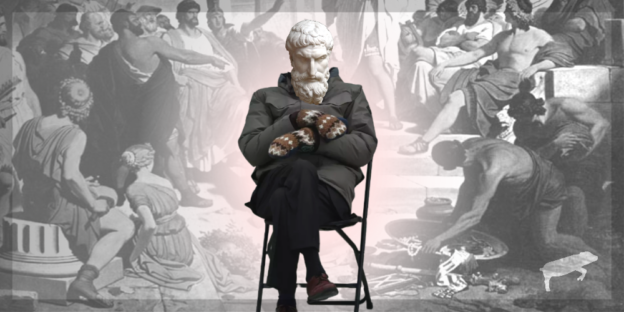
On “-Isms” and Pleasure Wisdom

On “-Isms” and Pleasure Wisdom

Epicureanismvs.Epicurean Philosophy

The Society of Friends of Epicurus has dedicated extensive dialogue to the suffix “ism” regarding its relevance to the Epicurean tradition. In the Epicurean spirit of  παρρησíα  (or “parrhēsíā) meaning frank speech” or “speaking candidly”, the ancient Greek language did NOT employ the “ism” when referring to the tradition of Epicurus (nor, for that matter, of any other ancient Greek philosophy). Thus, while the word can be employed for practical purposes, Epicureanism” does NOT quite compliment the nuance of “Epicurean Philosophy.

ISMs

The English suffix, “-ism” — according to BOTH common and academic usages — is employed to designate a distinctive “doctrine“, “theory“, “attitude“, “belief“, “practice“, “process“, “state“, “condition“, “religion“, “system“, or “philosophy“. According to this definition, it is NOT incorrect to add a simple “ism” at the end of the philosophy of Epicurus“; it should, appropriately and accurately, render the word “Epicureanism” (or even “Epicurism).

In more succinct terms, we can visualize “Epicureanismsimply as “Epicurean-philosophy“.

While this works for practical purposes, it may lead to several misconceptions:

  1. Bracketing the suffix “-ism” to a name often indicates devotional worship of an individual (consider the differences between the old, misleading usage of “Mohammedanism” versus the preferred, contemporary usage of “Islam). Epicureans do NOTworship Epicurus as a supernatural prophet, NOR as a manifestation of a transcendental ideal.
  2. Bracketing the suffix “-ism” can ALSO indicate contempt for an individual or system. Consider, for example, when “Marxism”, “Leninism”, “Stalinism”, and “Maoism” are used by critics and detractors of Marx, Lenin, Stalin, Mao, and many others. Thus, the word “Epicureanism” can be employed by critics and detractors of Epicurean philosophy as an indictment of Epicurus.
  3. In the modern era, “-ism” is frequently used to identify political typologies. Terms like “Monarchism”, “Liberalism”, “Conservatism”, “Communism”and “Fascism” express ideological systems that — contrary to Epicurean philosophy — presuppose the existence of an ideal state or utopia, organized according to the dimensions of a perfect, timeless principle.
  4. The suffix “-ισμός” (or “-ismós“) was rarely employed in ancient Greek; few examples of “-ism” (or “-ismós“) exist prior to New Latin, and the linguistic conventions of the modern era. In giving preference to the term “Epicurean philosophy”, we acknowledge the importance of privileging ancient Greek historical sources to the reliance upon Latin translations.

ISMVS

Our tradition of adding “-ism” to the end of words — in which we recognize distinctive “ideologies” — begins in the post-Classical period, corresponding to the Renaissance. Coming from the Latin “re-” (meaning “again”) and “nasci” (meaning “to be born”), this “Rebirth” resurrected the innovations and observations of Antiquity. The revival allowed scholars to adapt translations through the Latin language, using the Romanalphabet, sheathing many ancient Greek observations. Scholars began to liberally apply the suffix –ISMVS during this period of New Latin.

(I’m going to call the tradition — in which modern English-speakers partake — the “Ismism“, or, in other words, “the systemic practice of adding ‘-ism‘ to idea-expressing words”, sometimes as a celebration, sometimes as a derogation, sometimes as a religion, and sometimes as a political system. Due to the profound influence of Latin, and the linguistic conventions of the modern era, we ALL — in one way or another — have become dedicated Ismists.)

From the perspective of the contemporary world, the suffix –ISMVS (or “-ismus“) was first borrowed from the Old Latin language of the Romans, and later appropriated by post-Classical peoples as New Latin and Contemporary Latin. We find an abundance of “-ism” and “-ismus” in both Romance and Germanic language families. As with the Latin ISMVS, our contemporary suffix “-ism” is used to indicate distinctive “doctrines“, “theories”, “attitudes”, “beliefs”, “practices“, “processes“, “states“, “conditions“, “religions“, “systems“, and “philosophies“.

Here, however, is where we note a difference that our Mediterranean friends have often recognized: while the Greek language — like (for example) Celtic and Indic languages — has evolved from a common Indo-European root, it did NOT adopt Latin conventions the same way that Romance and Germanic languages have. Ancient Greek philosophers — perhaps, especially Epicurus — would NOT have thought of a “philosophy” as an “-ism”.

ize | ίζω | ízō |

We receive the Latin –ISMVS or “-ismus” from the ancient Greek “-ισμός” (“-ismós“), which, itself, is a bracketing of two other ancient Greek words, those words being “-ίζω” (“ízō“) and “μός” (“mós“). We’ll start with the former word. The suffix “-ίζω” (“-ízō“) was added to nouns to form new verbs. Let’s look at (x3) examples:

  1. canonize | κανονίζω | kanonízō
    κανών or “kann literally referred to a “reed”, and carried the connotation of a “measuring rod” or “standard”.
    + “-ίζω (“-ízō or “-ize“) rendered “κανονίζω“, “kanonízō” or “canonize” meaning “to make standard“.
  2. Hellenize | ἑλληνίζω | Hellēnízō
    ἑλλην or llēn literally referred to that which is “Greek”.
    + “-ίζω (“-ízō or “-ize“) rendered “ἑλληνίζω“, “Hellēnízō“, or “Hellenize” meaning “to make Greek“.
  3. synchronize | συγχρονίζω | súnkhronosízō
    σύγχρονος
    or “súnkhronos literally referred to “synchronous
    + “-ίζω (“-ízō or “-ize“) rendered “συγχρονίζω“, “súnkhronosízō“, or “synchronize” meaning “to sync“.

The key point with “-ίζω” (“-ízō“) — and our Modern English suffix “-ize” — is that we can turn any concept into a verb, or, in more philosophically interesting terms, we can ACTIVATE it.

μός | mós

The second suffix from which the ancient Greek “-ισμός” (“-ismós“) was bracketed is “μός” (“mós“). Contrary to the convention of ACTIVATING a word that represents a concept, adding “μός” (“mós“) ABSTRACTS an action. We can demonstrate this convention through (x3) other examples that translate well into Modern English:

  1. cataclysm |κατακλυσμός | kataklusmós
    κατακλύζω (kataklúzō) – literally meant “to wash away”.
    + “μός” (“mós“) rendered “κατακλυσμός“, “kataklusmós” or “cataclysm“, meaning a “great flood“.
  2. sarcasm | σαρκασμός | sarkasmós
    σαρκάζω” or “sarkázō literally, and figuratively meant “tearing apart” or “to tear off the flesh”.
    + “μός” (“mós“) rendered “σαρκασμός“, “sarkasmós” or “sarcasm“, meaning “(figuratively) tearing apart“.
  3. syllogism | συλλογισμός | sullogismós
    συλλογίζομαι (sullogízomai) literally meant “to compute” or “to infer”.
    + “μός” (“mós“) rendered “συλλογισμός“, “sarkasmós”, or “syllogism“, meaning an “inference“.

The key point with “μός” (“mós“) is that the ancient Greeks could turn any verb into a word that expressed an abstract concept, or, in more philosophically interesting terms, it could systematize activity into an idea.

ism | ισμός | ismós

The re-bracketing of the suffix “μός” (“mós“) appended with “-ίζω” (“ízō“) presents us with “-ισμός” (or “-ismós“) or the suffix “-ism“, a convention which systematizes a verb that has been activated from a noun. Very few examples exist in ancient Greek. A suitable example for English mono-linguists can be demonstrated in the word “Sabbath”:

  1. σάββατον | sábbaton literally means “the Sabbath” (borrowed from the Hebrew שבת or “shabát”)
    + “ίζω” (“-ízō or “ize“) σαββατίζω | sabbatízō means “to make, observe, or keep the Sabbath
    + “ισμός” (“ismós“) σαββατισμός | sabbatismós means “the state of keeping the Sabbath

UNLIKE the ubiquitous –ISMVS of Latin, and the overused “-ism” of Modern English, the ancient Greekισμός (or “ismós“) is almost NEVERused. The ancient Greeks did NOT shared our zeal for Ismism. When faced with the need to express a NEW word with FRESH meaning, the ancient Greeks built words from either [1] the names of people and objects they directly knew or observed, and [2] active forces they felt or experienced, but NOT as [3] abstract systems.

So, why NOT “Epicureanism“?

The philosophy of Epicurus recognizes that we EXPERIENCE NATURE DIRECTLY and NOT indirectly as an abstract system. Epicurean philosophy and the instruments with which humanity can make informed and ethical decisions — the sensation of an atomic reality, theanticipation of natural patterns, and the feelings of pleasure and pain — neither depend upon allegiance to a single leader, nor initiation into a secret society, nor longing for a golden age.

Christ’s resurrection would NOT be known without the Gospels.
Muhammad’s revelations would NOT be known without the Qur’an.

Even without the historical personage of Epicurus, human beings would still have sensed an atomic reality, anticipated the patterns of nature, and felt pleasure and pain, still have made mutual agreements, and still have formed friendships.

Without Jesus of Nazareth, Christians would NOT know to recite the Lord’s Prayer.
Without Muhammad, Muslims would NOT know to perform Salah to Mecca five times a day.

NATURE, itself, is so much LARGER, more important, and more fundamental than any one personage or tradition. Even without Epicurean Philosophy, humans would still have developed scientific intellects to their own advantage.

Epicureanism” (or, also, “Epicurism) carries a connotation – albeit very slightly – that the philosophy of Epicurus is just another doctrinal institution that advertises immaterial truths from an untouchable dimension. It is not quite as authentic to recognize serious seekers of pleasure as “Epicureanists” who follow “Epicureanism” as opposed to “Epicureans” who study “Epicurean philosophy“. Our endeavor rests within our own bodies; NATURE, itself, is the greatest teacher.

All that being said …

for practical purposes, there most isn’t anything inherently incorrect about preferring the term “Epicureanism; the “-isminnocuously identifies a “philosophy“. In Modern English, this does correctly indicate the philosophy of Epicurus, apart from any oath to a mythic person or principle.

Nonetheless, the employment of “Epicurean philosophy” over “Epicureanism” serves to keep our anticipations FRESH, to indicate to others that our interactions are bigger than disembodied souls paddling ideas back and forth in a court of Mind. It acts as a reminder that the path to wisdom is NOT a map that has been given to us from an Eternal Place of Perfection, but that we each carry a well-calibrated compass within ourselves to know the world and guide us to happiness.

DON’T call [my belief system] an –ism!

While the preference toward the phrase “Epicurean philosophy” may better reflect its ancient Greek origin, it should NOT indicate that the suffix “-ism” should be reserved as a derogation for non-Epicurean ideas, nor exclusively employed as a polemic toward Idealism. Even Epicurean philosophy, itself, incorporates the “-isms” of atomism, hedonism, naturalism, and materialism; these are most certain NOT idealistic.

Even ancient Greek opponents to Epicurean philosophy did NOT employ the “-ism”. Members of Plato’s Academy were “Academics”; members of Aristotle’s Lyceum with “Peripatetics”; members of Zeno’s Stoa were “Stoics”. It was only later that scholars began to employ the terms “Platonism”, “Aristotelianism”, and “Stoicism”.

Furthermore, this same acknowledgment applies to religious traditions:

The earliest rendering of the religion we refer to as “Judaism” was  יהדות  or “Yahadút”, from the Hebrew word  יהודי  (or Yhudá”) meaning “the Jewish people” and the suffix  ־ות  (or “-ót) meaning “the tradition of”. The ismed word that we employ — Judaism — is found in Maccabees 2 in the Koine Greek language by Hellenistic Jews, written around 124 BCE (over a thousand years after the foundation of Hebrew monotheism), rendered as  ιουδαϊσμός  (or “Ioudaismós”).

The word “Zoroastrianism” is first attested from 1854 as an anglicization of the ancient Greek Ζωροάστρης (meaning Zōroástrēs” or “Zoroaster”) borrowed from the Avestan word     or “Zarathustra”. Ancient Iranians referred to their religion as   orMazdayasna” translating to “worship of Mazda” (also romanized as “Mazdaism”). The wor   orMazda” both identifies the name of the Iranian Creator deity, and also, translates to “wisdom”.

The isming of the religion of post-Classical Arabs has been noted for its inadequacy, and identified in the contemporary era as being largely offensive to the Islamic populations. Until the 20th century, the monotheistic religion of  ٱلْإِسْلَام‎  (or al-Islām”) was identified by Europeans as “Mohammedanism” (or “Muhammadanism), inappropriately implying that the prophet Muhammad was divine himself, in the same way that Christians think of Jesus of Nazareth as divine.

People from the Punjab region of India refer to their religious tradition as  ਸਿੱਖੀ  (or Sikhī) anglicized to the English-speaking world as “Sikhism”. The word comes from the Sanskrit root  शिक्षा  or “śikṣā” meaning “to learn” or “to study”. (This recognition of the religious practitioner as a “student” is also found in the “Confucian tradition).

The same is true of “Hinduism”, an anglicization of the Sanskrit  सनातन धर्म  or “Sanātana Dharma” meaning “Eternal Order“. In fact, the word “Hinduitself was used by non-Indians to refer to people living around the Indus river. Ancient Indo-Iranian populations would have referred to themselves as आर्य or “Arya” (from which we get the term “Aryan“).

Jainism” is first attested from 1858 as an anglicization of the Sanskrit adjectiveजैन Jaina” which comes from the Sanskrit name for the 6thcentury BCE tradition  जिन  (or “Jina”). The word “Jina” is related to the verb  जि  meaning “to conquer”, coming from  जय  (or jaya”) meaning “victory”. The word “Jain” indicates a spiritualconqueror”.

Our rendering of “Buddhism” is an anglicization of the original Pali बुद्ध धम्म  (or “Buddha Dhamma“) meaning approximatelyThe Awakened One’s Eternal Law. The first recorded use of “Buddhism was in 1801, after Europeans romanized the spelling of Indic vocabulary.

There is NO direct Chinese equivalent to the word “Confucianism” since it has never been organized as a formal institution. The word was coined in 1836 by Sir Francis Davis, a British sinologist, and second Governor of Hong Kong who reduced the vast collection of ancient Chinese practices into a title named after the philosopher Kǒng Fūzǐ ( or “Master Kong”). While no single Chinese word or logogram represents the collection of beliefs and practices that developed from the teachings of Master Kong (anglicized as “Confucius”), the word  儒  (or “”) roughly translates as a “Man receiving instruction from Heaven” (also, a “scholar”), and is used to describe a student of Master Kong’s body of works.

The Taoists of ancient China identified the universal principle as or “Dào”, meaning “road”, “path” or “Way”. In China, the religious tradition is written 道教 or “Dàojiào” pronounced /’daʊ.ʨaʊ/ (or, for English mono-linguists, roughly transliterated asdow-chyow”). It was anglicized asTaoism” in 1838.

Shintoism”— the anglicized name for the native religion of Japanprovides an interesting example of an ismized tradition. The word “Shinto” is of Chinese origin, constructed from the Kanji logograms for the words  神 Shén”, (meaning “God”) and    Dào” (meaning “Way”) rendering  神道  or “Shéndào. However, Shinto populations do not employ this phrase as often as they do the Japanese  かむながらのみち  or “kan’nagara no michi”, (written in the Hirgana writing system) loosely translated as way of the divine transmitted from time immemorial”. Consequently, the word “Shintoism is the anglicization of two syllables from Japanese Kanji, inherited from ancient China’s Hanji logograms.

Christianity has been the dominant tradition of the post-Classical, and modern worlds; thus, it has avoided being reductively ismed (since the people who accused false traditions of being mere isms tended to be Christian, themselves). The word “Christianism” is occasionally used to express contempt for Christian fundamentalism (much like “Islamism” is used to indicate contempt for Islamic fundamentalism.)

Even early Christians did NOT refer to their tradition using the same vocabulary as do modern Christians. Like Taoists, they used the metaphor of της οδου (or “tês hodoû”) meaning “The Way“. A non-Christian, community in Antioch first coined the term  Χριστιανός  (or christianós“) to described the followers of The Way. Within 70 years, the early Church Father Ignatius of Antioch employed the term of  Χριστιανισμός  (or “Christianismós“) to refer to the Christianity.

Pleasure Wisdom

Regardless of a preference to “
Epicurean philosophy” versus “Epicureanism”, the insight of Epicurus’ philosophy demystifies nature and deflates the superstition of common religion. Epicurus anticipated the sciences of particle physics, optics, meteorology, neurology, and psychiatry. His logic was NOT one of theoretical axioms, but of a demonstrable hedonic calculus. Epicurus knew Virtue as a guide post to happiness, but NOT as happiness, itself.

Here, you will do well to tarry; here our highest good is pleasure.

Cheers, friends!

Further Reading:
Hiram’s “On Ismshttp://societyofepicurus.com/on-isms/


Works Cited

Barnhart, Robert K., ed., Barnhart Dictionary of Etymology, H.W. Wilson Co., 1988.

Beekes, Robert, Etymological Dictionary of Greek, Leiden, Netherlands, Brill, 2010.

Buck, Carl Darling, A Dictionary of Selected Synonyms in the Principal Indo-European Languages, University of Chicago, 1949, reprinted 1988.

de Vaan, Michiel, Etymological Dictionary of Latin and the other Italic Languages, vol. 7, of Leiden Indo-European Etymological Dictionary Series, Alexander Lubotsky ed., Leiden: Brill, 2008.

Fowler, H.W., A Dictionary of Modern English Usage, Oxford University Press, 1926.

Grose, Francis, A Classical Dictionary of the Vulgar Tongue, London, 1785; 2nd ed., London, 1788; 3rd ed., London, 1796; expanded by others as Lexicon Balatronicum. A Dictionary of Buckish Slang, University Wit, and Pickpocket Eloquence, London, 1811.

Hall, J.R. Clark, A Concise Anglo-Saxon Dictionary, Cambridge University Press, 1894, reprint with supplement by Herbert D. Meritt, University of Toronto Press, 1984.

Johnson, Samuel, A Dictionary of the English Language, London, 1755.

Klein, Dr. Ernest, A Comprehensive Etymological Dictionary of the English Language, Amsterdam: Elsevier Scientific Publishing Co., 1971.

Lewis, Charlton T., and Short, Charles, A New Latin Dictionary, Harper & Brothers, New York, 1891.

Liberman, Anatoly, Analytic Dictionary of English Etymology, University of Minnesota Press, 2008.

Liddell, Henry George, and Robert Scott, eds., Intermediate Greek-English Lexicon, Oxford University Press, 1883.

McSparran, Frances, chief editor, The Middle English Compendium, University of Michigan, 2006.

Room, Adrian, Place Names of the World, 2nd ed., McFarland & Co., 2006.

The Oxford English Dictionary, 2nd ed., Clarendon Press, 1989.

Watkins, Calvert, ed., The American Heritage Dictionary of Indo-European Roots, 2nd ed., Houghton Mifflin Co., 2000.

Weekley, Ernest, An Etymological Dictionary of Modern English, John Murray, 1921; reprint 1967, Dover Publications.

Whitney, William Dwight, ed., The Century Dictionary and Cyclopedia, New York: The Century Co., 1902