Category Archives: History

Superstition Ain’t the Way

N. H. BARTMAN


This essay has been translated into classic rock for easier comprehension. Find it here.

Skip to track …

INTRODUCTION: SUPERSTITION AIN’T THE WAY
· TRAMPLED UNDER FOOT

SIDE ONE: PHILOSOPHER’S GARDEN
· TAKE IT EASY
· THE BEST THINGS IN LIFE ARE FREE
· STAYIN’ ALIVE
· MIND GAMES
· HERE COME THE SUN

SIDE TWO: LOSING MY RELIGION
· PEOPLE ARE STRANGE
· BORN UNDER A BAD SIGN
· DREAM ON
· RAMBLE ON
· GREAT GIG IN THE SKY

SIDE THREE: DUST IN THE WIND
· YOU CAN’T ALWAYS GET WHAT YOU WANT
· ALL THINGS MUST PASS
· DON’T STOP ME NOW
· EVERYBODY HURTS
· DON’T FEAR THE REAPER
· WITH A LITTLE HELP FROM MY FRIENDS
· IN MY LIFE
· IMAGINE
· IN MY TIME OF DYING

SIDE FOUR: THE GRAND ILLUSION
· BLINDED BY THE LIGHT
· MAD WORLD
· GASLIGHTING
· DARK SIDE OF THE MOON
· ABRA-ABRACADABRA
· PARANOID

CONCLUSION: I CAN SEE CLEARLY NOW
· WON’T GET FOOLED AGAIN


SUPERSTITION AIN’T THE WAY

NOTE: Among all other Hellenistic schools, the Epicurean Garden boasts the greatest conceptual consistency as a philosophy, and the greatest historical consistency as an institution—after all, practical teachings that provide useful knowledge do not require revisions. To ensure that readers have been provided ancient source material, and not just paraphrasing from modern academics, each citation has been studiously documented.


INTRODUCTION: TRAMPLED UNDER FOOT

Superstition confounds nature’s goal of “complete happiness”.1 Magical thinking not only obstructs the creative capacity of an individual to achieve their best life2 , but it also challenges the ability of individualsto live as neighbors”.3 Mythic beliefs exacerbate our deepest fears, antagonize the benefits of one another’s fellowship”,4 and “delay the joy5 of the good life.

More than any other personality in the ancient world, Epíkouros championed the “sober calculation6 required to dispel delusion. He provided students with powerful tools to defend against manipulation and mythic deceit. He warns that “if one does not know the whole of nature, but obsesses over the myths”, then one cannot dissolve “the fear over the most important matters.7 However, if one is “rightly following the phenomena” then “the myth departs”.8

The Sage of the Garden explains that “one must study naturepurely, “as the phenomena requires,” without mythic speculations—one must leave “space for the voices of the facts9 in order to “gain a share of genuine tranquility”.10Writing to a student, he affirms that “a life of disorder and empty opinion does not sustain our need, which is moreover, for us to live imperturbably.11 Neither will the wise suffer the deceit of disruptive fictions, nor the duplicity of sanctimonious tyrants. The poet Lucretius orchestrates the Sage’s triumph against “the grinding weight of superstition”:12

Religion, so, is trampled underfoot,
And by his victory we reach the stars
.13

QVARE RELIGIO PEDIBVS SVBIECTA VICISSIM
OPTERITVR NOS EXAEQVAT VICTORIA CAELO.

The Garden epitomizes the “the method of investigation” against “empty opinion”.14 She champions a realistic ethics that applies a practical “measuring by comparison”,15 making “life pleasant” and dispelling “the greatest confusion [that] overtakes our minds”.16 Her founder, consumed “with passion for true philosophy17 saw superstition as sickness—as disease antagonizes the constitution of the flesh, so, too, does “void doctrine18 about reality disturb what is “healthy throughout the soul”.19 As Epíkouros writes, “without a study of nature”, one cannot enjoy “the pure pleasures”.20 One cannot enjoy “tranquility and firm faith21 without “knowledge” to dispel frightening falsehoods.

Assuredly, “when you believe in things that you don’t understand, then you suffer”. As regards “real knowledge”,22 the wise agree, simply speaking, “superstition ain’t the way”.23

SIDE ONE: PHILOSOPHER’S GARDEN

While “taking into account the goal that exists” according to “all of the self-evident facts”,24 Epíkouros observes that “animals, as soon as they are born” naturally suppress “their toil and […] instinctively avoid the pains”.25 Whereas “the feeling of pleasure” is “truly friendly”, so “pain” is innately “hostile”. The Sage observes “in every animal” that “choice and avoidance are distinguished26 by the beacon of pleasure. Since “the primary and innate good27 in animals is “pleasure”, he concludes that the “goal” of the human animal is to secure “the best life28 through the “pursuit [of] pleasure”,29the beginning and ending of living blessedly”.30

The Good31 of pleasure32 to which Epíkouros refers includes both “activities” that excite “joy” and inspire “cheerfulness” as well as the “centered” pleasures of mental “impassiveness” and physical “painlessness”.33 The “kinetic” delights of “action” include “the pleasures of flavor”, “the pleasure of the belly”,34Aphrodisian35 intercourse” (“O thighs for which I justly died!”),36hearing”, “appearances”, “the sight of sweet motions”,37 and the company of “those who share a like-mind”.38The wise”, as Epíkouros writes, “are likely to love the countryside” and “enjoy themselves more than others by theorizing”,39 delighting in “the search for truth”.40 Other pleasures include the serenity of being “just”,41confidence from coexisting with other people”,42 successful “management of one’s possessions”,43 as well as the peace of being “easily satisfied with few possessions”. Everyone is encouraged to pursue pleasure “according to [their] own preference”,44 by the grace of Nature “as does a god”.45

The Hēgemṓn46 adds to his personal list one potlet of cheese”.47 Even those inclined to the unforgiving “podium48 of politics, and those disposed toward the thrill of “Aphrodisia49 are positively encouraged to (responsibly) explore the “change throughout [their] flesh”,50 free from mythic shame, so long as they “neither harm nor be harmed”.51


TAKE IT EASY

The pursuit of “absolute happiness52 does not include “the pleasures of the debauched and those lying sick with enjoyment” but only those pleasures that cause “neither suffering throughout the body nor grieving throughout the soul”.53 Nature privileges “pure pleasures”, persuading us to “not in any way prefer the most food but the most delightful”.54 It is not drinking and following festivals, nor taking advantage of subordinates55 and women, nor an expensive multitude of fish or whatever fills an extravagant table that makes life pleasant, but sober calculation” and a consideration of “choice and avoidances.56 Were this not the case, rather, were it the case that “complete happiness57 could be obtained mindlessly, then “there would be no need for the study of nature.” Yet, if one fails to practice proper calculation, “everything will be full of foolishness and of confusion”,58 thus, one must “constantly reference the goal of natural pleasure59 in a realistic context to understand the rewards and “limits of the good life”.60


THE BEST THINGS IN LIFE ARE FREE

Epíkouros did not find explicit fault in a “luxurious lifestyle”, so long as it “inherits the natural benefit of the good61 and so far as it notdifficult62 to maintain—however, he did question the value of any such a lifestyle that requires the satisfaction of rare delights, constantly “behold[ing] a change in energy”.63 As the Hēgemṓn recognized, necessary comforts of life (like food, water, and, warmth) are provided by nature in abundance, when compared with unnecessary desires, like acquiring rare pieces of expensive art or dominating political movements, things notoriously difficult to procure. “Thanks [to] the blessed nature”, Epíkouros writes, “that has made the necessities obtainable, but the unobtainable, unnecessary.”64

The Sage concludes that the best life is the “cheapest and simplest life65 required to maintain “equilibrium”.66 He concludes that it is better “to have courage lying upon a bed of straw than to agonize with a gold bed and a costly table.”67 He observes that inexpensive “barley-bread and water deliver the greatest pleasure whenever anyone in need has consumed them”.68 He avoided those “pleasures that come from extravagance”, and cautioned against indulgence, “not because of” the pleasures themselves, “but because of the difficulties that follow them.”69Therefore adapt into a simple and not extravagant lifestyle as it forms an essential part of health,”70 and “spit on what is beautiful and those who vainly worship, when nothing produces pleasure”!71


STAYIN’ ALIVE

While “there is elegance in simplicity”, the possibility of living “a pleasant life” is threatened when constantly challenged by severe, physical insecurity, as with malnutrition. Nature is “preserved by pleasures” but “weak to what is evil”,72 thus “all the suffering” caused by the “poverty” of being unable to satisfy the body’s basic living needs must be “removed. The wisest among us will find a way to “be happy” even if “tortured”, as they continue living their best inner-life, but even so, mental “health does involve some care and effort for the body.”73

As Philódēmos writes, “when [health] is absent”, it “causes unspeakably more distress”.74 One need not neglect the health of the body as though it were “vain”, simply for the sake of “virtues”.75 The Sage observes an inseparable link between “the bellow of the flesh” and “the bellow of the soul” because “the whine of the flesh” burdens “the soul; while truly difficult to impede, it is more dangerous for a person day-by-day to disobey the dictation of Nature”.76 Epíkouros goes so far as to define the pleasure “of a god” in terms of physical satisfaction: even a god must prioritize maintaining relief from “the cry of the[ir] flesh”, suffering “neither hunger, nor thirst, nor shiver[ing]77 The wise are warm with pleasure, having dispelled “the Winter of the soul78. “For if the one who possesses the latter can hope to possess this happiness they would contend beyond even Zeus.”79 A mind subsists most soundly “in a healthy body”.80

Epíkouros observes that a healthy lifestyle requires that “we simultaneously laugh and philosophize, and manage a household and administrate the economic affairs and never let go of the language of the forthright philosophy.”81 Philódēmos reasons that we must afford “a leisurely retreat with one’s friends, and a most dignified income”.82 We cannot “gain mastery over the sirens” of suffering “in every physical condition, nor in every cultural context”,83 nor in every location, as with regions that are grossly inhospitable to human existence. A life consumed by constant, physical need due to insecurity challenges everyone’s ability to live happily.

Thus, a wise person benefits by prioritizing the satisfaction of natural needs, whereas a fool “is consumed by procrastination84 and negligence. As the Hēgemṓn writes, nature thrives when “persuaded”, but shrinks when “violated”.85 One must “choose” to satisfy nature by selecting healthy choices, “fulfilling her necessary desires, and not those that cause harm”.86 Indeed, we exercise virtues “not for their own sake,” but “just as medicine, for the sake of health”.87


MIND GAMES

While eliminating “suffering throughout the body88 is necessary to cultivate a good life, the health of the body, alone, does not guarantee the soundness of the mind (as with the case of the masses who suffer from “vain beliefs” that fall “into infinity”).89 Even for those with sculpted flesh, blessed with the gift of a healthy constitution, even they may lack “a stout heart that has no fear of death90 and suffer deeply from irrational fears. Epíkouros notes that “great stresses draw [life] short” and that the stress that is excessive will bring on death.”91Without cultivating a stable foundation, psychological suffering, by itself can devastate and otherwise healthy body.

The Epicurean school recognized that “the flesh tossed in a storm only [suffers the] present,” which only lasts so long, “but the mind [suffers] the past, the present, and the future92. Seeing that the most enduring “pains of [the] body are inferior” to the “psychological” torment of the mind, the ancient Epicureans rejoiced that “the greater pleasures are of the mind93. Thus, the resilience of the intellect allows us to manage our pain through the patience, and to relieve inner turmoil with reflection. Without “the continuous activity into [the] study of nature,”94 we risk becoming like “mindless men”,95 susceptible to the influence of fears and the frauds.

Supernatural apprehensions not only disrupt rational discourse, but they also provide despots with a unique point of access to many of those who subscribe to the fables of the poets”.96 The Sage writes, from out of the doctrines” of the multitude, “the greatest confusion overtakes our minds”.97 When this transpires, “everything becomes full of foolishness and of confusion”.98 One wrestles confusion over the unknown and struggles against friends, needlessly fomenting suspicion and distrust against neighbors — “politics is the worse foe of friendship”.99

Of those things that wisdom prepares for a full life of blessedness, by far the most important is the possession of friendship.”100 The confusion introduced by conspiratorial myths aggravates social discord. To avoid becoming an agent of ignorance, one must “not allow empty speech to disturb”, but should “look to the realities.101 Assuredly, the superstitions of the common people do not disturb one who is persuaded” against both “the myths of the gods102 and the death, confident that, beyond the blessing of memory, a person suffer “no existence after death”.103This dually applies to conspiratorial thinking in a modern age, those reductive, mythic hypotheses based upon clueless conjecture. As the Sage writes to a student, above all104

devote yourself to a consideration of the beginnings, and of infinity, and of the related things, further still, we reflect on account of the criteria [of sensation and anticipation] and of feelings, and not those [myths,] for above all, these [considerations must] be contemplated calmly on account of looking into the causes responsible for creation.

HERE COMES THE SUN

Epíkouros observed that one must “remove from oneself, to the extent that it is possible […] the fear of things that are not to be feared105 to receive happiness. One must “step over much of the myth”,106 and “not allow empty speech” about speculations and conspiracies “to disturb” them. One must “look to realities”,107 like observing that death is “unconsciousness108 or “anesthetization”, and that superstitious beliefs are based upon “false assumptions”.109 These realizations “will banish anything irrational110 as when one apprehends supernatural terrors from “the myths”,111 or supposes mortal things to survive mortality, or anticipates pain to exist during an anesthetized state, or fears the “real” existence “bodilessbodies,112which supersede Nature. Lucretius describes the first principle needed to overcome mythic deceit:113

This terror then and darkness of mind must be dispelled
not by the rays of the sun and glittering shafts of day,
but by the aspect and the law of nature;
the warp of whose design we shall begin with this first principle,
nothing is ever gotten out of nothing by divine power.114

Epíkouros teachers that there can be “no receiving the pure pleasures” of life without “a study of nature”. One must commit to dissolving the fear over the most important matters” if one is to overcome the paranoid imaginings “about the myths115 that enshroud the modern world.


SIDE TWO: LOSING MY RELIGION

While mythic complexes have provided answers to fears about death, dying, and despair, they have also spread irrational panic. Indeed, greatly has religion been able to persuade [all kinds] of evils.”116 Twenty centuries before Voltaire urged contemporaries to reject “absurdities” lest they lead to “atrocities”,117philosophers from the Epicurean school observed that vain beliefs118 about “the nature of reality119 challenge our ability to make practical decisions and pursue pleasure. “As it happens”, people commonly “neither perceive their own errors nor discern what is advantageous120 and thus,many great evils, concerning many matters occur as result of the worthless assumptions” can be “avoided as a result of the right concepts”. 121

More often, on the contrary, it is Religion122 breeds
Wickedness and that has given rise to wrongful deeds,
As when the leaders of the Greeks, those peerless peers, defiled
The Virgin’s altar with the blood of Agamemnon’s child123


PEOPLE ARE STRANGE

People “place themselves in such a situation so as not to take advice from anybody about anything at all” as concerns rational inquiry. Yet ironically, many maintain a “belief that nothing depends on man, but everything is controlled by the god. Then, at any rate they fall into the evils which the lack of forethought tends to inflict“.124 For example, “in times of distress” superstitious minds “turn their thoughts to religion much more earnestly,125 abandoning practical solutions. Then, “because of their apprehension to do nothing against the will of the gods, they fail to act,126 and “sometimes they cast their own cities into evils as well“. Lucretius laments: 

This was what was deplorable and above all
eminently heart-rending: when a person saw themself
enmeshed by the disease, as though they were doomed to death,
losing all spirit they would lie with sorrow-stricken heart,
and with their thoughts turned on death would surrender their life then and there
.127

Epíkouros teaches that “to become truly and unshakably whole”,128one must not pretend to philosophize, but really philosophize”, not pretend to study nature, but really study nature, “for we do not pretend to need health, but in truth [need] health”.129 To pursue “perfect happiness”,130 one must dissect the “false assumptions of the masses about the deities”, death, and desire.131


BORN UNDER A BAD SIGN

Epíkouros contends, frankly, that “divination is not real” and “regard[s] the predictions [as] nothing to us”.132 He affirms “that romance is not sent by god133 and rejects “the contrivances of the deplorable astrologers134 as well as the “the vain” and “empty” practice of “astrology”.135 Divinatory practices like astromancy,136 more commonly referred to as “astrology137 eliminate moral agency in human beings, posed as mere puppets of stellar mechanics. Yet a person’s future does not depend on “whether one was born in the Ram or the Twins, or in both the Fishes.”138

To enjoy the good life, a person cannot “become a slave of physical inevitability”, bereft of “the expectation of dignity” that comes with living beautifully. In a world without choice, neither would we be accountable for our injustices, nor responsible for our restraint. Epíkouros writes that “the one who says that everything happens by necessity cannot then bring a charge against the one who says that not everything happens by necessity; for the former affirms the latter happens by necessity.”139 On the other hand, divination requires humans to be puppets of fate.

Even if” an allegedly “divine” prediction turned out to be “real”, a wise person would continue to “regard the predictions [as] nothing to us”.140 “Wisdom does not at all deal by chance”.141 One does not become more proficient at playing the lottery, even if one happens to win the lottery.Consider it is better to calculate well being unlucky than to have irrationally good luck”.142 Otherwise, no learning occurs, no knowledge is gained, and no wisdom is advanced.

Prophecy is unreliable and inconsistent, yet it wields great power to confound those who observe it — hypnotism works, but only on those who believe. Many beliefs exacerbate “fears, largely” because they fail to address the source of their anxiety, aggrandizing “the remaining143 apprehensions. These include “fears about both aerial phenomena144 and unknown “things of the sky”, as with some ufologists, “and beneath the earth and generally in the Infinite”.145

DREAM ON

Writing about the visions we apprehend “in sleep”, Epíkouros concludes that “neither is the divine nature received nor [is] prophetic power” obtained, “but really”, dreams “are generated from an inundation of images.”146Moreover,” the Sage rejects augury and omens: “the signs are generated” as a result of pure “coincidence”; they “are not at all being delivered” by some supernatural force. “[N]o such divine nature commands” these intelligible events.147

RAMBLE ON

Even “more absurd”, concurs the critic Cicero, “are the fables of the poets”.148 Like prophets, they credit transcendental forces for having designed the products of their own, creative labor. “To these idle and ridiculous flights of the poets we may add the prodigious stories invented by the Magi,149 and by the Egyptians” who also entertained dreamy practices like oneiromancy150 along “with the extravagant notions of the multitude”.151 Some, like “the Stoics”, teases Philódēmos, “invent […] peculiar and impossible arguments” based upon their preferred allegories, having “seize[d] upon the mythical inventions of others”.152 In this case, students of the Stoa153 are accused of appropriating the “fables of poets” (like Hómēros and Hēsíodos).154 Later, their Roman descendants inflated the myth of Hēraklḗs (known to them as Hercules), and represented this fictional figure as a divine icon of their program.155

Although “the wise will rightly hold dialogue about” the nuances of “both music and poetry” among themselves, Epíkouros affirms that “they would not expend energy writing about poems”,156 publicly defending one interpretation over another. All such fictions are the products of human creativity. The fictions themselves are derivative of events that otherwise could be studied directly. Philódēmos writes, “I pass over orators and poets and all that kind of trash157 in favor of a study of nature. Lucretius advances brutal criticism against religious superstition:

Let us agree that he can call the earth
Mother of the Gods, on this condition
That he refuses to pollute his mind
With the foul poison of religion.158

As Philódēmos describes, generations (enchanted by the tales of “self-important theologians and poets159 about transcendental “tyrants” with “terrifying” power) came to adopt false histories, thereby injecting a series of distressing expectations into their worldview. Humans gain little benefit in believing that Eve committed the first sin by chewing fruit, or that Pandora unleashed evil by uncorking a jar, or that Zeus sent a deluge to kill the peers of Deucalion, or that the LORD conjured a storm to flood the contemporaries of Noah … or any number of other stories that mislead people toexpect great misfortunes” from the future. Were we to rely upon the “false assumptions of the masses“,160 that include myth into their worldview, it “would accomplish nothing161 but aggravate disturbance. We cannot treat insanity with allegory.

GREAT GIG IN THE SKY

As fears” flourish in the absence of real knowledge about real “phenomena162, Epíkouros distinguishes the “suspicions about death163 as “the most [seemingly] horrible”, since we know, with certainty, that life will end. Treating fear of death with myth fails to address the reality of grief. As one mistakes a placebo for ointment, so the proverbial rash worsens. In failing to face this “perpetual terror”, a superstitious mind suffers, “always expecting some164 fear of loss.

Epíkouros observes that the multitude suffers” and “grieves” predictable inevitabilities as a result of mythic misunderstandings, “which is” as he writes, “the worst evil”.165 The time over which the pain of loss is processed can be drastically lessened by accepting that death is a natural end, and, to those who are dead, death is literally nothing. If a person is to procure “the complete life”, they must “step over” that which is “a myth166 and dissolve their “fears about both […] death167 and the burden of “grief”.168 Otherwise, anguish “screws them out of the best life.”169

SIDE THREE: DUST IN THE WIND

The Epicureans of the Hellenistic world observed that “all people, including those with [a] good […] physique […] became skeletons in a short period of time, and in the end are dissolved into their elementary particles”.170 The stories of “all those who have been and those who will come to be in the world” will be lost “when it has been destroyed” and “no one will be remembered”.171 As each cosmos has “been generated out of the countless” particles, “in turn, each is to be dissolved”,172 including “both animals, and plants, and all the rest being observed”.173 Thus, of all afflictions that plague the peace of the soul, those fears related to death and dying are the most pervasive.

Not even those who are “worshipped and well-liked”, who seem to have “procured safety”, those “pronounced popular174, who command “power”,175 boasting a “brilliant reputation and great wealth176 can secure themselves against death, “since fortune, ruler of all people, is capable of taking [everything] away”.177 Indeed, “we all reside in an unfortified city in relation to death”.178 Practically, “there was no point procuring protection if a person” succumbs to “suspicion of those things from the sky and beneath the earth and generally in the Infinite.”179

YOU CAN’T ALWAYS GET WHAT YOU WANT

Angst is nothing new. Anguish is ancient—so, too are the principal sources of anxiety, “always intruding180 upon “the pleasures of the mind”.181 Turmoil itself is a feature of mortality. For most of human history, nearly half of all children died before their 10th birthday. To this day, disease holds the highest kill count in history. No political plot has ever been as deadly as tuberculosis. Modernity has only innovated upon anxiety; she did not invent it. The origins of dread precede the disasters of the contemporary era by an epoch — torment itself is prehistoric.

Human populations crashed during the paleolithic period after a series of unstoppable catastrophes and instances of environmental collapse. Until the contemporary period, tooth decay has been a leading cause of mortality. During the Peloponnesian War of the 5th-century BCE, an epidemic decimated over 25% of the Athenian population, including the prominent statesman Pericles. During the reign of Marcus Aurelius, the Antonine Plague killed millions, including the emperor’s adoptive brother (and co-ruler) Lucius Aurelius Verus. During the early medieval period, the Plague of Justinian (that lasted for two centuries), claimed the lives of tens of millions, both affluent and impoverished, famous and anonymous. The classical Maya civilization collapsed during an extended period of drought that instigated an agricultural crisis. Centuries after, the Black Death killed half of Eurasia. In the modern era, HIV/AIDS has claimed at least as many lives as the Black Death. Related, venereal disease has afflicted human relations and complicated human happiness for millennia; despite numerous advancements, over 1 million people contract curable STIs every day;182 in the span of one year, over 350,000 women die from cervical cancer.183 This brief paragraph only hints at the devastation that micro-organisms wreck upon the human body. These “enduring illnesses184 act as agents of death, and are among the greatest antagonists to human history, chief sources of historic anxiety


ALL THINGS MUST PASS

Managing fear of death is a key to happiness. “Remember”, urges the Epicurean philosopher Mētródōros, “that everything by nature is subject to death”,185 and while “it might be possible to furnish security against misfortune”, when it comes to death, “every human lives in a city without walls”.186 Truly, “every person, even if they should be stronger than the Giants, is transient in relation to life and death187 since “indiscriminately, we have all been infused with the fatal drug from birth”.188 Thus, “the most significant disturbance [to arise] within the souls [of] human beings is generated by […] perpetual terror”,189 by fearing the loss of friends, the pain of dying, and the state of being dead. This terror arrises “because of” their “being frightened of death”, and as a result, they are “unable to bear” the “burden of misfortune”.190 Death “truly” is the ultimate form of “necessity beyond human control”, thus a constant source of concern.191


DON’T STOP ME NOW

Yet while “necessity is evil […] there is no necessity to live with necessity”.192 For “necessity is not accountable, and [we] perceive luck [as] unreliable”.193 Becoming a “slave to physical inevitability” removes any “expectation of dignity”,194 forever “waiting for Godot”.195 Epíkouros affirms that “rarely is a sage disrupted by chance, but the greatest and most important matters are directed by reason throughout their lifetime.”196Luck is unreliable”—at most, “if one receives a paradoxical piece of good luck,” one might be “grateful to circumstances” and count their blessings.197 Otherwise, it would seem that “the whole of life is but a struggle in darkness”.198


EVERYBODY HURTS

The 2,100-year-old writings of the Philódēmos catalogue timeless suspicions about death that have historically darkened the mind—people naturally fear “the pains that come from loss199 and “the deprivation of good things200just as they principally threaten our pursuit of pleasure. In the context of being “gripped by illness”,201 like “those with heart disease202 who may become “unconscious in torpor and faintness”, some fear that they may “never again recover”,203 discouraged by “the whole decay from the peaks to old age”.204 Many obsessively dread an “untimely death”,205 condemned “to die young” before they advance their talents,206 enabling “enemies [to] rejoice over them”,207not leaving behind” a legacy208. Others are “distressed at not having left behind children209 so that “the fruits of [their] labors will” be devalued by “unworthy” and “wicked” people.210 Many fear that “parents or children or a spouse […] will be in dire straits on account of their death”.211 Some fear “dying abroad212, while others fear dying alone “on one’s bed […] rather than doing some doughty deed for even future generations to learn about.213 Conversely, others dread getting “killed like cattle in the lines of battle214 or dying “while fighting an enemy215 or fear “death at sea”,216 or “violently as a result of condemnation by a court or ruler”.217 Some “experience suffering at the prospect of not being remembered by anyone”,218 while others are “pained because [they are] going to be reviled”.219 Ineffectually, the masses are [either] fleeing death, sometimes as the greatest evil,” or else, they vainly imagine themselves to “prefer the repose in [Death] to living”.220


DON’T FEAR THE REAPER

Epíkouros reassures students that the state ofdeath in no way exists”, since “what has dissolved lacks perception; and that which lacks perception in no way exists for us”.221 Remembering this, students can avoid emotional paralysis when struck by mortality, neither fearing their own cessation, nor fearing the expiration of their loved ones. The Epicurean school denies any possibility that one could experience torment after death, since death is a state of “unconsciousness and non-existence”.222 For indeed, “to the [dead, death is nothing]”.223

This minimizes the misery of dying, reassuring us that “the peak of pain” exists for the absolute “briefest time224necessarily, the most excruciating, physical pains, those that are so severe that they lead to immediate death, are the most brief. By comparison, the rest of the pains, which are not so severe as to result in immanent death, are, by definition, survivable.

Even the superior torment “of the mind225 and “sorrow that weighs upon” the soul “on account of death226 can be slowly relieved with patience, introspection, and reflection. Epíkouros recommends that “we sympathize with the beloved [deceased] not by lamenting, but by reflecting”.227 Survivors find peace through the value of memory, and the therapeutic gratitude that contextualizes the “undying228 good of friendship. “Sweet [is] the memory of a friend who has died,”229 since pleasant remembrance “for those who died before their time had come230 eases the grief of loss.

WITH A LITTLE HELP FROM MY FRIENDS

The devastating pain of grief is significantly relieved by the blessing of friendship. Epíkouros exhorts us all to “be prepared” for death by bringing “together a fellowship of friends231 to support one another through the pain of loss, especially guaranteed losses, those of our mentors, parents, spouses, and every furry friend whom a person has every loved. In forming mutual bonds “with other people”, survivors “live pleasantly among one another keep[ing] steadfast faith”, thereby “engender[ing] the fullest intimacy”,232 sharing love during times of despair, so as to never suffer loss alone.

IN MY LIFE

One manages grief by honoring the memories of the deceased. By practicing gratitude, one reminds oneself of the powerful gift of love that is left after the loss of a loved one. “One must not spoil the present by yearning for the absent; but consider that also these [present] things were once of the [things for which] we wish.”233 Fittingly, it is love, from the memory of ones’ deceased friends that helps one endure sudden loss. Great loss can only come from the loss of a great love, yet no loss can lessen the greatness of the love that outlasts death.

Philódēmos offers consolation to those suffering sudden, unexpected loss, as when a parent loses a child, or a spouse loses their partner, seemingly “falling somewhat short of the best life”.234 Philódēmos asks survivors: “consider it irrational and incredible not if someone dies but if [one] endures for a certain length of time”, for “enduring all the way to old age really [is] a most prodigious thing”.235 Historically, most human lives have ended relatively shortly. Yet no life, no matter how short, need be wasted, nor lived ignobly, nor suffered without dignity. Nature enables living beings to “profit by one day as by eternity”,236 for “unlimited time contains pleasure” that is no less valuable “than that which is limited”.237 Nature’s goal is pleasure, not immortality. As Tolkien wrote, “’All we have to decide is what to do with the time that is given us’”.238

IMAGINE

As regards apprehensions about one’s own death, the Sage provides assurance that the experience of “death in no way exists for us”, given that “what has dissolved lacks perception; and that which lacks perception in no way exists for us”.239 The pain that is so severe that it leads to death is proportionally brief. After the loss of feeling, there can be no feeling of pain—nor can there be pleasure, nor bliss, nor relief; thus, there can be no incentive for suicide.Undoubtedly trivial are the greatest number of motives one might advance toward an exportation from life”.240

Meditating upon the real knowledge that Death is nothing to us creates [for] a mortal an enjoyable life, not [by] adding endless time, but [by] having been dispossessed of the yearning for immortality”.241 Philódēmos explains that in “avoiding a careless death, a person

is industrious because of the consequent doctrine based on the concept of the preservation of one’s goods. And since he does not cut short the long extent of his life, he always begins new activities and friendly attachments. And he attends to his own property as to how to administer it. Also, he reflects on former events in the belief that they may concern him in the future. And he treats with much care as many people as he can, and he is thankful to those who treated him kindly, in particular because he hopes that he will share in some goods with them or that he will receive some benefit by these same people again in the future242

Accepting the finality of mortality highlights the importance of preparing for the inevitable — for example, one can engage the practice of composing a living will (as did Epíkouros) to safeguard the continued happiness of those who survive the deceased, hoping to deter those who would harm them. It ispossible to take precautions243 against a number of potential misfortunes, such as preventing “a lot of indolence regarding financial matters” when it comes to succession and inheritance.244 In his will, Epíkouros ensured that his best friend, Hérmarkhos, a non-Athenian, would logistically inherit the Garden, circumventing typical stipulations by Athenian law. The Hēgemṓn also provisioned a clause to provide students with permanent access to the Garden. He emancipated his servants, and allocated resources for his friends’ children’s education (whose completion he would not have the pleasure of witnessing).

Before he died, the 2nd-century Epicurean Diogénēs of Oìnóanda commissioned a monument to the teachings of Epíkouros. Builders erected an 8-foot-tall, 260-foot wide stone stoa, surrounded by a portico, adorned with statues, etched with Epicurean teachings. It contained a survey of the wisdom of Epíkouros (as summarized by Diogénēs), as well as several Key Doctrines by the Hēgemṓn. Reflecting upon his own, impending death, the elderly Diogénēs writes,

Having already reached the sunset of my life (being almost on the verge of departure from the world on account of old age), I wanted, before being overtaken by death, to compose a [fine] anthem [to celebrate the] fullness [of pleasure] and so to help now those who are well-constituted. […] besides, love of humanity prompts us to aid also the foreigners who come here. Now, since the remedies of the inscription reach a larger number of people, I wished to use this stoa to advertise publicly the [medicines] that bring salvation. These medicines we have put [fully] to the test; for we have dispelled the fears [that grip] us without justification, and, as for pains, those that are groundless we have completely excised, while those that are natural we have reduced to an absolute minimum, making their magnitude minute.245

IN MY TIME OF DYING

When it comes to inevitable “sickness”, a wise person can address their fears of infirmity by planning to prevent becoming “irascible and hard to please and ill-tempered246 when deprived of sense faculties. Such a person “takes the greatest care of [their] health. And feeling confidence against illness and death, [they] endure with strength the therapies that can remove them.”247 By the Hellenistic period, ancient Epicureans had published a variety of scrolls on pain management and psychological health, including the scroll Theories about Disease248. Philódēmos explains that one should cultivate a robust “state of health249 and “be prepared […] from coexisting with other people”—yet when this is no longer possible, Philódēmos recommends that “the right management […] lies in this: in not feeling distressed about what one loses”.250

As the end of life approaches, so writes Philódēmos, one can choose to face death without fear, regret, and worry. The resilience of the intellect allows us to manage peak anxiety through the rejoicing of “the mind upon reliving the memory” of past pleasures. Even at the end of life, when faced with annihilation, “persons of sound mind” can recall their having “enjoyed everything” as “unconsciousness is taking hold of them”, allowing them to “expire […]undauntedly”,251 as “the old one anchors safely in the harbor that is retirement”, after “those good things that were once hoped for were captured” in memory “for safe charity”.252Even on “the day that is the last of life” despite pains “not abating in extremity of their greatness”,253 memories can bless the mind.

For those who pass due to diseases that afflict the mind, even then, bereft of memory, “we will try to make the end more excellent [than] the beginning; we should be taking the path into dawn; yet whenever we go so far as the end, [we should] enjoy ourselves equally.”254 In absence of this peace, confusion exacerbates the pain of dying and the fear of death. The promises of persuasive personalities, who reassure the intellect that we can escape death insults the human soul.

Diogénēs of Oìnóanda adds “as I have said before, the majority of people suffer from a common disease, as in a plague, with their false notions about things, and their number is increasing”.255

SIDE FOUR: THE GRAND ILLUSION

Charlatans thrive in a climate of fear.

Chiefly, swindlers target those vulnerable to mythic persuasion. As “false prophets256 spread myths in the ancient agora, so too do manicured politicians sell sound bites through modern speakers. Grifters, con-artists, and other malignant narcissists have prized and preferred to provoke gullible souls with superstition. They address the “public in the traditional patter of magicians257 as ridiculed by the ancient Epicurean author Loukianós. In an era characterized by disinformation and propaganda, cultivating tools against fraud is critical to living a good life.


BLINDED BY THE LIGHT

The FIRST science fiction writer, Loukianós of Samósata lambasted one such fraud who readily discerned that human life is swayed by two great tyrants, hope and fear, and that a man who could use both of these to advantage would speedily enrich himself”.258 The satirist documents an early instance of book-burning, instigated by a petulant zealot who took offense to theEstablished Beliefs” of Epíkouros. As Loukianós writes, the false prophet “greatly feared Epicurus […] seeing in him an opponent and critic of his trickery.”259 They continue:

he brought [the book] into the middle of the market-place, burned it on […] fig-wood just as if he were burning the man in person, and threw the ashes into the sea […] But the scoundrel had no idea what blessings that book creates for its readers and what peace, tranquillity, and freedom it engenders in them, liberating them as it does from terrors and apparitions and portents, from vain hopes and extravagant cravings, developing in them intelligence and truth, and truly purifying their understanding, not with torches and squills and that sort of foolery, but with straight thinking, truthfulness and frankness.260

Loukianós describes in high resolution an instance of trickery wrought by Alexander the False Prophet. In terms of the specific “ruse” the swindler employed, the Epicurean explains:

he contrived an ingenious ruse. Going at night to the foundations of the temple […] where a pool of water had gathered […] he secreted there a goose-egg, previously blown, which contained a snake just born; and after burying it deep in the mud, he went back again. In the morning he ran out into the market-place naked […] he congratulated the city because it was at once to receive the god in visible presence. The assembly […] had come running […] he ran at full speed to the future temple […] he asked for a libation-saucer, and when somebody handed him one, deftly slipped it underneath and brought up […] that egg in which he had immured the god […]. Taking it in his hands, he asserted that at that moment he held Asclepius! They gazed unwaveringly […] when he broke it and received the tiny snake into his hollowed hand, and the crowd saw it moving and twisting about his fingers, they at once raised a shout, welcomed the god, congratulated their city, and began each of them to sate himself greedily with prayers, craving treasures, riches, health, and every other blessing from, him. […] the whole population followed, all full of religious fervour and crazed with expectations.261

Ranking magical thinking among the greatest of evils (and sparing few words for those who perpetuate superstition), the satirist ridicules the “drivelling idiots262 and “thick-witted, uneducated fellows” who became willfully “deluded” by the charlatan’s “ruse”. The false prophet appealed to common expectations and misunderstandings. In doing so, the liar won the crowd.

Loukianós concludes that “the trick stood in need of […] Epicurus himself or Metrodorus, or someone else with a mind as firm as adamant toward such matters, so as to disbelieve and guess the truth”.263 Here again, an intellectual foundation, grounded in the reality of nature is needed to help guard against mythic deceit. By contrast, supernatural religions and mystical cults feed into the practice of myth and manipulation, doing little to relieve fear, and much to increase it.

MAD WORLD

The μῦθοι (mýthoi) or “myths” of the ancient world provided “plaguy scoundrel[s]”, “swindler[s]”,264 and “consummate rascals” (“greatly daring, fully prepared for mischief”,265practising quackery and sorcery”)266 with devious tools to exploit the superstitious sensibilities of those whom Loukianós‘ disparagingly referred to as “‘fat-heads’ and simpletons”.267 This was done to “line [the charlatan’s] purses fairly well at [the] expense268 of genuinely pious, yet tragically misguided believers. Lucretius orchestrates a mythic example — King Agamémnōn sacrifices his daughter Iphigéneia, to ensure that Ártemis would ordain their campaign:

More often, on the contrary, it is Religion269 breeds
Wickedness and that has given rise to wrongful deeds,
As when the leaders of the Greeks, those peerless peers, defiled
The Virgin’s altar with the blood of Agamemnon’s child270

History preserves an extensive list of violations and abuses by allegedly spiritual institutions. Whether sacrificing children (or marrying them), or dominating women, brutalizing neighbors, inciting mass slaughter, enslaving captives, persecuting foreigners, popularizing martyrdom, hosting crusades, organizing inquisitions, burning thinkers, drowning healers, hanging doctors, spinning lies, bombing medics, incinerating protestors …. Reality demonstrates how the agents of religious violence excuse themselves from observing “the nature of what is just”.271

This ancient, historical scheme developed over time. After millennia, myths that were once only shared around campfires were formalized by powers into social institutions. Many of those institutions facilitated the transfer of wealth from disadvantaged citizens to insulated priests. Many engaged in political manipulation by deceiving those politicians who based their process of decision-making on ecstatic visions, and not the study of nature. Many engaged in the abuse of the young, female “oracles” who had been trafficked to the temples. Many others, still, exploited their knowledge of natural events to manipulate their followers and gain influence.

In addition to exploiting with magical thinking, many institutions of religion have intertwined themselves with politics and government, growing empires, spreading propaganda, expanding colonies, stealing territory, justifying genocide, perpetuating slavery, pardoning rape, editing histories, robbing treasuries, defrauding economies, deceiving leaders, enchanting legislators —supernatural institutions and political states are two peas in a pod of power and deception.

Personalities like Charles Manson, Jim Jones, David Koresh, and Marshall Applewhite are not unique to the this era. Joseph Goebbels only innovated upon propaganda, he did not invent it. Leopold II was a mere rookie compared to the seasoned violence of Genghis Khan.

So it seems, people have … always been like this.

GASLIGHTING

The subterranean Ploutonia billowed with the deadly pneuma (or “breath”) of Kérberos, the three-headed, canine guardian of the underworld. The temples were named for their host, Ploútōn (better known as idēs) who ruled the ploútos, the great “wealth” from the substances that rest beneath the Earth’s surface. For mindless beasts and uninitiated supplicants, the mythic fumes of the temples were deadly—only clergy, due to their righteous piety and closeness to divinity had been graced with supernatural protection, inoculating the lethality of the dogs’ fumes.

Topographically, those sanctuaries were constructed above fault lines; their chambers trapped and flatulated volcanic gases. After centuries of habitation, some residents noticed—some vents triggered intoxication; some, convulsions; some, death. Some residents found ways to exploit their neighbors’ ignorance of this natural phenomenon. Strábōn elaborates on the specifics:

…the Plutonium, below a small brow of the mountainous country that lies above it, is an opening of only moderate size, large enough to admit a man, but it reaches a considerable depth, and it is enclosed by a quadrilateral handrail, about half a plethrum in circumference, and this space is full of a vapour so misty and dense that one can scarcely see the ground. Now to those who approach the handrail anywhere round the enclosure the air is harmless, since the outside is free from that vapor in calm weather, for the vapor then stays inside the enclosure, but any animal that passes inside meets instant death. At any rate, bulls that are led into it fall and are dragged out dead; and I threw in sparrows and they immediately breathed their last and fell. But the Galli, who are eunuchs, pass inside with such impunity that they even approach the opening, bend over it, and descend into it to a certain depth.272

To Strábōn, the ruse was obvious: the eunuch priests “hold their breath as much as they can”  so as to mechanically avoid ingesting toxic fumes until they have risen above them.273 The priests understood that some, lethal vapor must pool at the bottom of the cavern. Pliny the Elder records that “there is a place which kills all those who enter it. And the same takes place at Hierapolis in Asia, where no one can enter with safety, except the priest of the great Mother of the Gods.”275 In the center of this invisible, vaporous pool stood a raised landform from which a cleric spoke. Supplicants would encircle the stage like a captive audience. The theatre would proceed: a bull would be lead before the congregation into the breath of Kérberos. The terrific power of the underworld would then kill the unobservant beast. The devout priest, protected from the lethal vapors  would rise to the center, thus, demonstrating their power over death.

(As a supplement to this description .. and brief tangent … note that the institution to which we refer as “religion”, and the art to which we refer to as “theatre” were once indistinguishable. A fundamental function of ancient, stage-focused, stadium-seated theatre was to facilitate religion. Similarly, modern, stage-focused, stadium-seated religion employs theatre as a tool.)

By the Hellenistic period, rational minds penetrated the clerics’ contrivance. Many reasoned that the air we breathe must be made of several kinds of vapors that do not uniformly mix. Some rise, and some fall. “In other places there are prophetic caves, where those who are intoxicated with the vapour [that] rises from them predict future event”.274 Rising vapors (like the sweet-smelling, trance-inducing ethylene gas) flooded the sanctums of the oracles and induced visions. Falling vapors (like carbon dioxide) pooled at the bottom of the “Gates of Hell” in the “Holy City” of Hierápolis. Those vapors were suffocating. In small doses, hydrocarbon gases (like ethylene) could trigger visions. In higher doses, oracles could seize and convulse. In the highest doses, die.

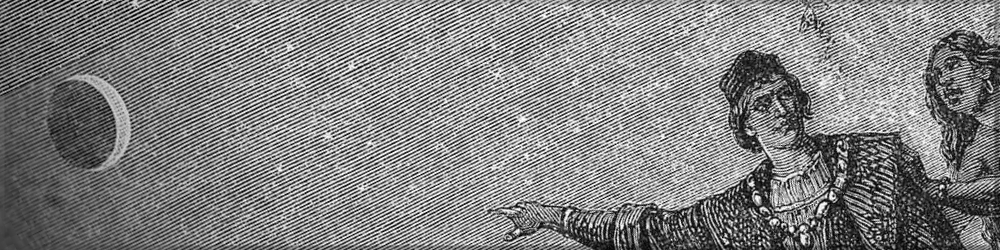
The ancient Greek clergy’s abuse of their neighbors’ fears and ignorance of natural phenomena reflects a pattern found throughout human history. Ancient priests misrepresented to their neighbors discernible, predictable phenomena and staged (literally) theatrical performances for the purpose of impressing the reality of their manipulative cult. This was not the first, nor the last time in history when clever figures in positions of power weaponized knowledge by exploiting the ignorance of others. Fifteen centuries later, a Genoan, sailing on behalf of the Spanish crown employed a similar ruse as did those ancient priests. This time, however, it was not the flatulence of the Earth, but rather, the dance of the sky — in this case, a lunar eclipse …


DARK SIDE OF THE MOON

Prior to February 29th 1504, Christopher Columbus faced an extremely precarious situation — he had been marooned for a year. All four caravels loaned to him by the Crown lay in ruin. Dozens were dead. Half the crew mutinied. To his despair (as many of his peers back home expected), Columbus’ final expedition, afforded to him with great reluctance, failed.

Only four years earlier, royal commissioner Francisco de Bobadilla delivered Columbus to the Crown in chains, having imprisoned him over tyranny and abuse of the Taíno people. Stripped of titles and authority, Columbus was afforded by King Ferdinand one, final opportunity. Yet again, far from of accomplishing his goal, Columbus was broke, stranded, and faced starvation.

As history records, the “Admiral” had brought a particular book with him: in particular, Columbus carried a recently-published copy of Alamach Perpetuus Cuius Radix est Annum by Abraham Zacuth, astronomer of the Portuguese court of King Don Manuel. “It was this very book that Columbus used to predict the eclipse of the moon which so terrified the [Taíno] in Jamaica that they became obedient to him, and furnished his party food.”276 This was the context in which Columbus extorted the indigenous people of Jamaica, who lacked appropriateknowledge about the meteoric”,277 and were susceptible to the manipulation of superstition. In this case, Columbus, aware that a lunar eclipse was immanent, convinced the Taíno people that the moon would be destroyed if the Taíno did not provide him with provisions. Columbus’ son, Ferdinand Columbus recorded the entire manipulation. He writes of …

the eclipse beginning at the rising of the moon, and augmenting as she ascended, the Indians took heed and were so frightened that with great howling and lamentation they came running from every direction to the ships, laden with provisions, praying the Admiral to intercede by all means with God on their behalf; that he might not visit his wrath upon them, promising for the future diligently to furnish all they stood in need of. To this the Admiral replied that he wished to converse somewhat with God, and retired while the eclipse lasted, they all the while crying out to him to aid them. And when the Admiral observed that the totality of the eclipse was finished and that the moon would soon shine forth, he issued from his cabin, saying that he had supplicated his God and made prayers for them, and had promised Him in their names that henceforth they would be good and use the Christians well, fetching them provisions na necessary things … From that time forward they always took care to provide what they had need278

The ruse worked. Columbus received his provisions, and survived until rescue. The Taíno population was exploited. Today, American citizens champion Columbus, having been raised on textbooks that never mention the Taíno nor the crimes of European explorers“.

Within decades of his arrival, ninety percent of the Taíno population was killed. Tens-of-thousands were murdered. An unknown many committed suicide. These deaths are partially indicative of the failure of religious institutions in correcting the abuses that occur as a direct result of exploiting knowledge and ignorance — in this instance, the Taíno were not the only targets of manipulation: the famous venture to the “New World” was not only an economic enterprise, but, notably, a religious mission, sanctioned by the Church. The religious mission benefitted from the fealty of monarchs, and encouraged the expansion of a colonial empire.

Mythic ambitions were stoked. Irrational fears were instigated. Narratives were established. Hopes were inflated. Fears were exploited. Devious personalities with selfish agendas descended upon the fearful like vultures, as also happened in Imperial Russia.


ABRA-ABRACADABRA

Alix, the Tsarina of the Romanov dynasty was enchanted by Rasputin upon their first meeting. “It had not been very difficult for that expert in human faces to see how much she needed him, how tormented she was by the misfortunes that had befall them”.279 At the age of six, she lost sister to diphtheria; her mother succumbed to the same disease one month later. Only three years later, her father, Grand Duke Louis IV died of a heart attack, “the greatest sorrow of her life”.280 For the rest of her days, she would be consumed with overwhelming fears of death.

(… as were easily shared by those over whom her family ruled … but that’s another essay).

She was not alone. Her husband, Tsar Nicholas II equally ached—without an heir, his family’s status was existentially threatened. Yet when their only son was finally born, their dread only increased: Alexei inherited his family’s “curse”. The “long-awaited prince was suffering from a fatal disease inherited […] haemophilia. His fragile blood vessels were unable to withstand the pressure of his blood.” Such cruel irony, Alix had suffered a decade of pregnancies that left her with significant health issues. Succession laws were brutal. She found little relief.

until she meets Rasputin. “Alix, who so wanted to believe in miracles”, “with a face tormented by sleepless nights” found comfort in a wandering monk, an alleged “miracle-worker” who had recently gained popularity among the peasantry. “Nicky” (the Tsar), desperate to provide his son with safety, suspended his disbelief in the traveller after witnessing a “miracle” — the unsuspecting monk eased his son’s suffering, a feat at which his educated doctors failed.

Indeed, seven years prior to the birth of Alexei Romanov, a chemist named Felix Hoffmann synthesized a new form of acetylsalicylic acid that revolutionized medical science. Within several years, Bayer registered this product as “aspirin”. The “wonder drug”281 was immediately implemented throughout the world to relieve pain, reduce fever, and treat disease. The product was so effective, so manageable, so safe, it was used to treat symptoms in children, children like Alexei Romanov, children suffering from chronic bleeding disorders, children being treated with blood-thinners (the very last thing a child with Alexei’s condition needed).

As a странник (strannik) or “wanderer”, Rasputin rejected treating disease with the medical science, so when the Tsar, against the recommendation of his doctors, took the advice of the wanderer and denied his son the “wonder drug”, Alexei’s condition improved. Granted, Rasputin did not understand the functional mechanism by which anticoagulants interacted with the body; what he did recognize was the measurable, psychological power that he now held over the Romanov family. They credited him with preventing the death of their son in whom they had placed all of their hopes and fears. They hoped for him to prevent the deprivation of their pleasures. When Nicholas went to the front in World War I, Alix was left in charge with Rasputin as her personal advisor (wherein he gave predictably terrible advice and abused his authority). Still, the Tsar’s daughters wore pendants with Rasputin’s picture. His presence in their bedroom was sanctioned, despite protests from a nursemaid. After all, he was a Saint.

He was also accepting bribes. He was also negotiating with sexual favors. He was also accused of numerous acts of rape. He was abusing the Russian peoples’ Christian superstitions. He was a functional catalyst for the same revolution that lead to the execution of the very family who looked to him in the first place to prevent death. Ironically, the Romanov family feared death. They feared the weight of insecurity. They gave a sinister personality access to their home, their children, and their minds. They bared their souls to a grifter who convinced them that he could prevent death. Rasputin taught that touching his body healed—indeed, this was his favorite line to use with prostitutes. In this regard, the members of the royal family were used, willingly. By comparison, many of their subjects, increasingly suspicious of authority, disenchanted with both an ineffective monarch and an oppressive church, saw through Rasputin’ mythic ruse.

(These anecdotes fail to capture the full complexity of each, nuanced history — readers are encouraged to pursue their curiosity accordingly — nevertheless, each example provides a clear depiction of the chaos that can result from inflating superstitious beliefs.)


PARANOID

Fear of death disrupts rational thinking and consumes the minds of the fearful. A conspirator need only appeal to their target’s fear of death, abuse their misunderstandings about nature, fabricate a false narrative (usually promising deathless rewards), and choreograph a performance that advances a hidden agenda. Examples of this relationship between fear, ignorance, and exploitation are not limited to the dusty pages of history — the modern world of industrialized warfare and mass media provides a variety of devastating examples. For the purposes of this investigation, five instances of irrational thinking and manipulation have been reviewed:

[I] Over 73,000 human beings are currently imprisoned in immigration detention centers across the sometimes-called “Land of the Free”. At least half of those individuals have no criminal records in any capacity, having never threatened the safety of their neighbors. Less than 4,000 of those 73,000 have committed violent crimes. The policy that lead to the imprisonment of well over 69,000 non-violent human beings was enthusiastically supported by over 77 million of their neighbors. This fact further exemplifies a foundational policy of a political group that now dominates every branch of government, at every level of government. The implementation of this policy, of imprisoning 69,000 (and counting) non-violent human beings was largely motivated by fear and fueled by propaganda. Millions were persuaded to believe that unknown strangers threatened them; one man promised to easily release people from this fear. In attempting to rid themselves of fear, the targets of propaganda exacerbate existing tensions. Fear lubricates the machinery of propaganda and exposes the intellect to paranoia.

[II] We find another example of fears stoked by nationalistic myths in the city of Minneapolis, where a population of Somali immigrants, who comprise a statistical minority in city’s metro area, has been demonized as a result of an authoritarian personality’s political agenda. Millions of prejudicial minds allowed this personality to exploit fear and ignorance to their own detriment. Despite the fact that Somali immigrants represent less than 3% of the metro population, millions of otherwise unconcerned Americans have been persuaded to fear them.

The same fears have been irrationally inflated against transgendered peoples (despite comprising less than 1% of a population of over 360 million human beings), and peoples of African ancestry (who have comprised less than 15% of the population for over a century). These political myths distract millions of people from reality by appealing to vain prejudices. Meanwhile, those same minds turn a blind eye to actual existential threats that contradict their mythic worldviews. 

[III] Generations of committed researchers, in nearly every scientific discipline, from nearly every country on the planet, working with decades of analysis, experimentation, and peer review, have conclusively determined that irrevocable changes to the Earth’s biosphere will lead to the displacement of 2 billion human beings and cause the deaths of hundreds of millions more. Unconditionally, these deaths will be the result of environmental mismanagement — despite this, tens of millions of Americans reject the methodical findings of decades of peer-reviewed research. How many Earthlings choose not to prepare for their own futures on their own planet? Despite this very real, very immanent threat, despite documented sea level rises throughout history, contractors continue developing coastal real estate, and the energy grid continues increasing carbon emissions. Short-sighted politicians continue abusing mythic propaganda by manipulating ignorant minds to advance personal agendas.

[IV] These criticisms against fear and ignorance apply even more fully toward the treatment of disease. Millions have been convinced that demonstrably-effective medical treatments are more threatening than deadly diseases. Until the 20th-century, nearly half of all children died before the age of ten from either disease, or conditions resulting from malnutrition. Vaccines changed everything. Indeed, most human parents throughout history have been burdened with witnessing the death of at least one of their own children. Yet, despite radical advances that have largely eliminated the primary antagonists of human history, millions refuse effective medical treatment and question the very vaccines that saved the lives of their ancestors. Recently, millions died from complications related to a pandemic in 2020, and many refused medical treatment (despite initially calling emergency services and demanding to be assigned a bed). Those people are now dead. They are unable to tell us if it was worth it.

[V] No mythic narrative has been as effective (and exploitable) in America as Christianity. Consequently, no political movement presents more of a risk than Christian Nationalism. Ideologically, millions of American Christians have been persuaded (by appeals to fear) to inflate a paranoid belief that their super-majority is being “persecuted”. This belief is maintained despite America boasting the largest Christian population in the history of the human species. Yet more American Christians than ever describe their belief system as being “threatened”. Despite their nationally-dominant, politically-encapsulating, massively-wealthy collection of institutions that boast hundreds of millions of followers across the country (and billions more globally), many in America believe the existence of their tradition is threatened. As a result, millions of fearful minds have thrown their support behind charlatans who care more for profit than piety.

Since ignorance and fear create vulnerabilities for deceitful swindlers, conspiratorial thinking has been exploited by tyrants throughout history to gain the favor of violent mobs and fuel political violence — so, today, does the “Department of War” invoke the mythic language of the Christian apocalypse to empower young Christians to support a “Holy War” against Islamic countries in Asia Minor. Many people without violent records (such as children in uniforms) can be convinced to commit acts of violence as a result of religious myths. When political figures require acts of violence to be committed, they profit by stoking superstitious flames. So long as a population glorifies supernatural belief, they render society susceptible to mythic manipulation. These prejudicial myths not only harm others; they also consternate the intellects of the deluded; a fearful mind disrupts the ability of the intellect to cultivate future security. Vanity allows the intellect to inflate meaningless fears (that Christianity will no longer be the dominant religion in America) while ignoring genuine, existential threats (like agricultural collapse).

When civic decisions are not grounded a shared, natural reality, the vain beliefs of others, informed by delusions, threatens the safety of their neighbors, and the preservation of their own union for the future. “The study-of-nature does not incline one to boast nor [be] contriving of speech nor against the education highly prized by the masses, but both fearless and independent according to one’s own good, [and] not to think highly over the affairs of the [masses].”282


I CAN SEE CLEARLY NOW

In an era characterized by propaganda and misinformation, the Epicurean method of investigation arms students with powerful tools against these threats. One’s “considerations” must be based “in a [world] of facts, versus those on a mere rumor”.283 Armed with her unadulterated rejection of magical thinking, the Epicurean school provides stormy souls with an alternative to the lazy skepticism of the contemporary era that is as unhelpful in dispelling ignorance as is the cheap metaphysics sold in bookstores (those metaphysics that have failed to prevent even a single child’s death). Epíkouros provides a method to navigate these confusions, for, “a sufficient method produces [helpful] thoughts about the nature of reality284 and requires nothing more than the devoted study of nature. The Sage grounds true statements with verifiable observations. In the absence of material verification (or falsification), groundless conjectures are easily commandeered to construct fear-based alternatives.

Fundamentally, all “conjectural things are contingent upon sensible” stimuli. Any “opinion” regarding nature can be “either true or false”. Yet in order “to be true, [it] must corroborate or not-contradict; but if not-corroborating or contradicting, [it] happens to be false. Hence, this has introduced285 the need to practice waiting for confirmation, instead of inventing a pseudodoxy”. Compared against a true belief, a pseudodoxyhas gone astray from the” natural reality “being experienced that perpetually exists”.286 In the case of what remains “to be confirmed or to be contradicted, either it will be confirmed” or contradicted.

Often, “some other [persuasive] motion in us”,287 such as the fear of death, “operates for another purpose” besides the “goal of natural pleasure”.288 On these occasions, conspiracies, myths, and superstitions thrive. Self-reflection gets “combined” with some another “creative application289 of the mind, and imbues those who speculate with the confidence to pass “judgment even if [they] were not [capable of] confirming or contradicting” with evidence. Thus “a pseudodoxy is generated.” 290 These “pseudodoxies” are generated by those who fail to acknowledge the reality of their own sensations. “If you contest every single one of the sense perceptions, you can neither judge the outward appearance nor can you affirm which of the sensations you, yourself say are deceptive according to the way in which the criterion operates.”291


WON’T GET FOOLED AGAIN

Mythic hopes and conspiratorial apprehensions deeply afflict the mind’s ability to reason. Our 50,000-year-old brain-systems are no less immune to mythic deceit than the 48,000-year-old brain-systems of the ancient Greeks. While many modern persons might dismiss ancient peoples’ apprehensions of volcanoes and lightning, many ancient people would dismiss some modern persons’ insistence that the Earth is flat, a widely-accepted notion by the 2nd-century BCE. Consider that the masses of both antiquity and modernity struggle to appreciate the behavior of CO₂ then the superstitious masses misunderstood CO₂ as the divine breathe of Kérberos; now the masses underestimate the impact of CO₂ on strengthening the observable greenhouse effect. Many more overlook the impacts of pollution, deforestation, and general environmental mismanagement. Tragically, many millions of people, blessed with the health, safety, education, and stability of an advanced economy, nevertheless exacerbate irrational apprehensions toward life-saving vaccines despite being truly blessed by the benefits of modern medicine, far, far too many fail to appreciate the blessing of science. Far too many have been programmed by myth, misunderstanding that material science spares most people from (what is otherwise a nearly universal human experience) suffering the deaths of children; in fact, as history records, nearly half of them. If one has been spared this tragedy, one might thank science.

When decisions that affect others are grounded in a matrix of mythic fears (and not our shared, natural reality) then the vain actions of others, informed by delusions, both threatens the safety of our neighbors and the preservation of their own union for the future. As he writes, “the study-of-nature does not incline one to boast nor [be] contriving of speech nor against the education highly prized by the masses, but both fearless and independent according to one’s own good, [and] not to think highly over the affairs of the [masses].” The tools we have developed to respond to all manner of diseases reinforces the confidence we can have in the Epicurean method. Epíkouros encourages students to choose practically, love peacefully, behave justly, and live fearlessly. This is best achieved by studying nature and cultivating friendship.

When it comes to our own futures, Epicurean history provides brave examples like Mētródōros, undaunted against both disturbances and death”,292 virtuous and awesome”.293 To achieve the goal of nature, the Sage of the Garden asks us to “study these and those things, for yourself, day and night, as with those like yourself, and at no time, neither awake nor in a dream will you be confounded, for no living person surrounded by immortal Good seems like a mortal creature.294 As has been spoken more eloquently elsewhere, “the only thing we have to fear is fear itself.” Here again, “when you believe in things that you don’t understand, then you suffer.”

Superstition ain’t the way.


1 Epíkouros, Epistle to Pythoklḗs 10.116

2 Epíkouros, Key Doctrine 20 (10.145)

3 Epíkouros, Key Doctrine 38 (10.153)

4 Epíkouros, Key Doctrine 37 (10.152)

5 Epíkouros, Vatican Saying 14

6 Epíkouros, Epistle to Menoikeús 10.129

7 Epíkouros, Key Doctrine 12 (10.143) | Vatican Saying 49

8 Epíkouros, Epistle to Pythoklḗs 10.104

9 Diogénēs Laértios, Lives 10.31; translated by N. H. Bartman

10 Epíkouros, Epistle to Pythoklḗs 10.96

11 Epíkouros, Epistle to Pythoklḗs 10.87

12 Lucretius, De Rerum Natura 1.63, translated by M. F. Smith (1969)

13 Ibid., 1.78-79, translated by Rolfe Humphries (1968)

14 Epíkouros, Epistle to Pythoklḗs 10.87

15 Epíkouros, Epistle to Menoikeús 10.129

16 Epíkouros, Epistle to Menoikeús 10.132

17 The fragment  catalogued by Usener as #457 corresponds with a citation from Porphyry (Letter to Marcella 31) and Seneca (Letters to Lucilius 8.7), who writes “PHILOSOPHIAE SERVIAS OPORTET, VT TIBI CONTINGAT VERA LIBERTAS”.

18 Epíkouros, Key Doctrines 29-30 (10.151)

19 Epíkouros, Epistle to Menoikeús 10.122

20 Epíkouros, Key Doctrine 12 (10.143) | Vatican Saying 49

21 Epíkouros, Epistle to Pythoklḗs 10.85

22 Epíkouros, Epistle to Menoikeús 10.124

24 Epíkouros, Key Doctrine 22 (10.146)

25 Diogénēs Laértios, Lives 10.137; translated by N. H. Bartman

26 Ibid.,10.34

27 Epíkouros, Epistle to Menoikeús 10.129

28 Epíkouros, Key Doctrine 20 (10.145)

29 Epíkouros, Key Doctrine 25 (10.148)

30 Epíkouros, Epistle to Menoikeús 10.128

31 ΤΑΓΑΘΟΝ | τἀγαθὸν (tágathòn) or “The Good” as ἡδονή (hēdonḗ, “pleasure”), the τέλος (télos,) or “goal” of life.

32 Epíkouros, On the Ethical End as cited by Diogénēs Laértios (Lives 10.6)

33 Epíkouros differs from the Kyrēnaíc hedonists, who questioned the benefit of equilibrium.

34 Metródōros’ Epistle to Timokrátēs (Usener fragment 409) is echoed by Athḗnaios (Deipnosophists 7.280A, 12.546F), Cicero (Against Lucius Calpurnius Piso 17.66), and Ploútarkhos (Against Kolṓtēs 2.1108C, 30.1125A).

35 i.e. sexual intercourse, the act of Aphrodite, from which we inherit the word “aphrodisiac”.

36 Philódēmos, Epigram 15, translated by W. R. Paton (1916-18)

38 Epíkouros, Vatican Saying 61

39 Epíkouros, “Words on the Wise” 10.120

40 Philódēmos, On Property Management 22.44, translated by Voula Tsouna (2012)

41 Epíkouros, Key Doctrine 17 (10.144)

42 Epíkouros, Key Doctrine 40 (10.154)

43 Philódēmos, On Property Management 16.36-37

44 Metródōros, Vatican Saying 51 was taken from a fragment from Metródōros to Pythoklḗs

45 Diogénēs Laértios, Lives 10.121; translated by N. H. Bartman

46 Epíkouros was the ἡγεμών (hēgemṓn) meaning “leader”, “guide”, or “founder” of the Garden.

47  Diogénēs Laértios, Lives and Opinions of Eminent Philosophers 10.11

48 Philódēmos, On Rhetoric 4, translated by Harry M. Hubbell (1920)

49 i.e. sexual intercourse, the act of Aphrodite, from which we inherit the word “aphrodisiac”.

50 Metródōros, Vatican Saying 51 was taken from a fragment to Pythoklḗs

51 Epíkouros, Key Doctrine 31 (10.151)

52 Epíkouros, Epistle to Pythoklḗs 10.116

53 Epíkouros, Epistle to Menoikeús 10.131

54 Epíkouros, Epistle to Menoikeús 10.126

55 This can also be translated as “servants” or “boys”, suggesting either a criticism of pederasty or slavery (or both). This may serve as an overall indictment against the objectification and indoctrination of those in subordinate positions.

56 Epíkouros, Epistle to Menoikeús 10.132

57 Epíkouros, Epistle to Pythoklḗs 10.116

58 Epíkouros, Key Doctrine 23 (10.146)

59 Epíkouros, Key Doctrine 25 (10.147)

60 Epíkouros, Key Doctrine 21 (10.146)

61 Epíkouros, Key Doctrine 7 (10.141)

62 Epíkouros, Epistle to Menoikeús 10.130

63 Diogénēs Laértios, Lives and Opinions of the Eminent Philosophers 10.136

64 Compare this sentiment contained in Usener fragment 469 to the Epistle to Menoikeús10.130.

65 Dioklḗs, Epitome III as documented by Diogénēs Laértios (Lives 10.10)

66 Diogénēs Laértios, Lives and Opinions of the Eminent Philosophers  10.136

67 Note the similarity of Usener fragment 207 with De Rerum Natura 2.34.

68 Epíkouros, Epistle to Menoikeús 10.131

70 Epíkouros, Epistle to Menoikeús 10.131

72 Epíkouros, Vatican Saying 37

73 Philódēmos, On Property Management 13.11-14

75 Usener fragment 116 captures a quotation from Ploútarkhos (Against Kolṓtēs 17.1117A) ↩︎

76 Usener fragment  200 is echoed in Vatican Saying 33

77 Vatican Saying 33 echoes Epíkouros’ recommendation to Menoikeús (10.135)

78 Epíkouros, Epistle to Menoikeús 10.128

79 Vatican Saying 33 echoes Epíkouros’ recommendation to Menoikeús (10.135)

80 Juvenal, Saurae IV  10.356

81 Epíkouros, Vatican Saying 41

82 Philódēmos, On Property Management 23.14-18, translated by Voula Tsouna (2012)

83 Diogénēs Laértios ,Lives and Opinions 10.9; translated by N. H. Bartman

84 Epíkouros, Vatican Saying 14

85 Epíkouros, Vatican Saying 21. Compare this paragraph against Epíkouros’ description of desire in the Epistle to Menoikeús: “Then as for the desires one must conclude then [1] the Natural exist, and [2] the Vain, and of the Natural then [3] the Necessary, but only the natural [are needed]; then of the necessary those necessary are [instrumental] to happiness, and to the lack of distress of the body, and to their own living” (Lives 10.127)

86 Epíkouros, Epistle to Menoikeús 10.138

87 Diogénēs Laértios, Lives 10.138

88 Epíkouros, Epistle to Menoikeús 10.131

89 Epíkouros, Key Doctrine 15 (10.144)

90 Juvenal, Saurae IV 10.356

91 The fragment catalogued by Usener (457) corresponds with a citation from Porphyry (Letter to Marcella 31) and Seneca (Letters to Lucilius 8.7) who writes “PHILOSOPHIAE SERVIAS OPORTET, VT TIBI CONTINGAT VERA LIBERTAS”.

92 Diogénēs Laértios, Lives 10.137

95 Philódēmos, On Choices and Avoidance 9, translated by Indelli and Tsouna-McKirahan (1995)

96 Cicero, De Natura Deorum 1.16, translated by C. D. Yonge (1877)

97 Epíkouros, Epistle to Menoikeús 10.132

98 Epíkouros, Key Doctrine 23 (10.146)

99 Philódēmos, On Rhetoric, fragment 19, translated by Harry M. Hubbell (1920)

100 Epíkouros, Key Doctrine 27 (10.148)

101 Epíkouros, Key Doctrine 37 (10.152)

102 Epíkouros, Epistle to Menoikeús 10.133

103 Philódēmos, On Rhetoric 5

104 Epíkouros, Epistle to Pythoklḗs 10.116

105 Philódēmos, On Property Management 4.23-30, translated by Voula Tsouna (2012)

106 Epíkouros, Epistle to Pythoklḗs 10.116

107 Epíkouros, Key Doctrine 37 (10.152)

108 Philódēmos, On Death 24.6-8, translated by W. Benjamin Henry (2009)

109 Philódēmos, On Piety 25.5-6, translated by Dirk Obbink (1996)

110 Epíkouros, Epistle to Hērodótos 10.81

111 Epíkouros, Epistle to Menoikeús 10.133

112 Epíkouros, Epistle to Hērodótos 10.67

113 These lines are repeated four times throughout De Rerum Natura; see 1.146-148, 2.59-61, 3.91-93, and 6.39-41.

114 Lucretius, De Rerum Natura 1.146-150, translated by H. A. J. Munro (1860)

115 Epíkouros, Key Doctrine12 (10.143) | Vatican Saying 49

116 Lucretius, De Rerum Natura 1.101, translated by N. H. Bartman, from “TANTVM RELIGIO POTVIT SVADERE MALORVM”.

117 Voltaire warns against the political implications of superstitious belief, writing: “Certainement qui est en droit de vous rendre absurde est en droit de vous rendre injuste” (Questions sur la Miracles 412).

118 Epíkouros, Key Doctrine 15 (10.144)

119 Epíkouros, Epistle to Hērodótos 10.45

120 Philódēmos, On Frank Criticism 1, translated by David Konstan (1980)

121 Philódēmos, On Choices and Avoidance 9, translated by Indelli and Tsouna-McKirahan (1995)

122 Other translators employ “superstition” as their preferred translation of RELIGIO. Lucretius, however, uses both RELIGIO and SUPERSTITIO as near synonyms, versus healthy PIETAS.

123 Lucretius, De Rerum Natura 1.82-85, translated by A. E. Stallings (2007)

124 Philódēmos, On Choices and Avoidance 7, translated by Indelli and Tsouna-McKirahan (1995)

125 Lucretius, De Rerum Natura 3.53-54, translated by H. A. J. Munro (1860)

126 Philódēmos, On Choices and Avoidance 8

127 Lucretius, De Rerum Natura 6.1230-1234; translated by H. A. J. Munro (1860)

128 Epíkouros, Epistle to Pythoklḗs 10.87

129 Epíkouros, Vatican Saying 54

130 Philódēmos, On Piety 13.7-8, translated by Dirk Obbink (1996)

131 Epíkouros, Epistle to Menoikeús 10.124

132 Diogénēs Laértios writes that “he also takes everything prophetic as wrong, and as in the Little Epitome, he so affirms, ‘Divination is not real, but even if real,” we should “regard the predictions [as] nothing to us.’” (Lives and Opinions of the Eminent Philosophers 10.135)

133 “…so writes Diogénēs” of Tarsós the Epicurean (c. 2nd-century BCE) “in the twelfth” book Epitome of the Ethical Doctrines of Epíkouros” (Diogénēs Laértios, Lives 10.118).

134 Epíkouros, Epistle to Pythoklḗs 10.93

135 Epíkouros, Epistle to Pythoklḗs 10.113

136 Astromancy, from ἄστρον (ástron, “[sky] glower”) and μαντεία (manteía, “divination”), literally “star-prophecy”.

137 Epíkouros, Epistle to Pythoklḗs 10.113

138 Philódēmos, Epigram 28 (translated by W. R. Paton, 1916-18), there he goes, dissin’ astrology since 69 BCE.

139 Epíkouros, Vatican Saying 40

140 Diogénēs Laértios, Lives 10.118; translated by N. H. Bartman

141 Usener fragment 489 echoes the Epistle to Menoikeús 134 and Key Doctrine 16. ↩︎

142 Epíkouros, Epistle to Menoikeús 10.135

143 Epíkouros, Epistle to Hērodótos 10.81

144 Epíkouros, Key Doctrine 10 (10.142)

145 Epíkouros, Key Doctrine 13 (10.143)

146 Epíkouros, Vatican Saying 24

147 Epíkouros, Epistle to Pythoklḗs 10.115

148 Cicero, De Natura Deorum 1.16, translated by C. D. Yonge (1877)

149 !!! Practitioners of the Mazdayasni religion of Persia are popularly known as Zoroastrians, however, this designation creates a complication (as does referring to “Islam” by the now-obsolete term “Mohammedanism”). Mazdayasna centers around the worship of Ahura Mazda—Zarathustra (Hellenized as “Zōroastrēs”) was merely a prophet of Mazda.

150 Oneiromacy is the practice of allegedly scrying knowledge of future events from dreams.

152 Philódēmos, On Signs and Inferences 38.8-12, translated by by Philip and Estelle de Lacey (1941)

153 The ancient, Athenian Stoics gathered at ἡ ποικίλη στοά (ē poikélē stoá), the “Stoa Poikile” or “Painted Porch”.

155 According to Diogénēs Laértios, “Kleánthēs” the 2nd Stoic scholarch, “was called a second Hēraklḗs” by Zēnṓn, the first scholarch (Laértios 7.170). Seneca writes a tragedy of Hercules, exploring themes like perseverance and fate (Hēraklḗs Raging). Epíktētos makes numerous allusions to Hēraklḗs in Discourses (1.16, 2.16, 3.22, 3.24, 3.26, 4.10).

156 Epíkouros, “Words on the Wise” 10.120

157 Epíkouros, On Anger 31.21-24

158 Other translators employ “superstition” as their preferred translation of RELIGIO. Lucretius, however, uses both RELIGIO and SUPERSTITIO as near synonyms, versus healthy PIETAS.

159 Philódēmos, On Piety 71.1-12, translated by Dirk Obbink (1996)

160 Epíkouros, Epistle to Menoikeús 10.124

161 Philódēmos, On Piety 71.1-12

162 Epíkouros, Key Doctrine 10 (10.142)

163 Epíkouros, Key Doctrine 11 (10.142)

164 Epíkouros, Epistle to Hērodótos 10.81

165 Epíkouros, Key Doctrine 10 (10.142)

166 Epíkouros, Epistle to Pythoklḗs 10.116

167 Epíkouros, Epistle to Hērodótos 10.81

168 Epíkouros, Key Doctrine 10 (10.142)

169 Epíkouros, Key Doctrine 20 (10.145)

170 Philódēmos, On Death 30.1-5, translated by W. Benjamin Henry (2009)

171 Ibid., 36.25-26

172 Epíkouros, Epistle to Hērodótos 10.73

173 Ibid., 10.74

174 Epíkouros, Key Doctrine 7 (10.141)

175 Epíkouros, Key Doctrine 14 (10.143)

176 Philódēmos, On Choices and Avoidance 5, translated by Indelli and Tsouna-McKirahan (1995)

177 Philódēmos, On Death 24.35-36

178 Ibid., 32.27

179 Epíkouros, Key Doctrine 13 (10.143)

180 Epíkouros, Epistle to Hērodótos 10.81

181 Diogénēs Laértios, Lives 10.137; translated by N. H. Bartman

182 Harfouche, et al. “Estimated global and regional incidence and prevalence of herpes simplex virus infections and genital ulcer disease in 2020”. Sexually Transmitted Infections. 2025 May 19, 101, 4, 214-223.

184 Epíkouros, Key Doctrine 4 (10.140) | Vatican Saying 3

185 Mētródōros, Vatican Saying 10

186 Mētródōros, Usener fragment 339, translated by N. H. Bartman (2025)

187 Philódēmos, On Death 37.23-25, translated by W. Benjamin Henry (2009)

188 Mētródōros, Vatican Saying 30

189 Epíkouros, Epistle to Hērodótos 10.81

190 Philódēmos, On Death 39.6-7

191 Epíkouros, Epistle to Menoikeús 10.133

192 Epíkouros, Vatican Saying 9

193 Epíkouros, Epistle to Menoikeús 10.133

194 Epíkouros, Epistle to Menoikeús 10.134

195 Beckett, Samuel. Waiting for Godot. Faber & Faber, 2006.

196 Epíkouros, Key Doctrine 16 (10.144)

197 Philódēmos, On Death 38.24

198 Lucretius, De Rerum Natura 2.54, translated by Bailey (1910): “OMNIS CVM IN TENEBRIS PRAESERTIM VITA LABORET”

199 Philódēmos, On Death 2.15-16

200 Ibid., 2.10-11

201 Ibid., 2.13-14

202 Ibid., 5.1

203 Ibid., 5.4-6

204 Ibid., 9.4-5

205 Ibid., 12.2

206 Ibid., 13.15

207 Ibid., 20.3-4

208 Ibid., 22.10

209 Ibid., 22.10-11

210 Ibid., 23.7-14

211 Ibid., 25.2-6

212 Ibid., 26.10

213 Ibid., 28.2-4

214 Ibid., 28.37-29.2

215 Ibid., 29

216 Ibid., 32.32-33

217 Ibid., 33.37-34.3

218 Ibid., 35.1-2

219 Ibid., 36.31

220 Epíkouros, Epistle to Menoikeús 10.125

221 Epíkouros, Key Doctrine 2 (10.139) | Vatican Saying 2

222 Philódēmos, On Death 28.15-16

223 Diogénēs of Oìnóanda, Fragment 73, translated by M. F. Smith

224 Epíkouros, Key Doctrine 4 (10.140) | Vatican Saying 3

225 Diogénēs Laértios, Lives 10.137, translated by N. H. Bartman

226 Philódēmos, On Choices and Avoidance 10, translated by Indelli and Tsouna-McKirahan (1995)

227 Epíkouros, Vatican Saying 66

228 Epíkouros, Vatican Saying 78 echoes the Epistle to Menoikeús 130

229 Usener fragment 213 corresponds with two, separate attestations, one by Ploútarkhos (It Is Impossible to Live Pleasantly in the Manner of Epíkouros 28.1105D) and one by Seneca (Letters to Lucilius 63.7).

230 Epíkouros, Key Doctrine 40 (10.154)

233 Epíkouros, Vatican Saying 35

234 Philódēmos, On Death 38.20, translated by W. Benjamin Henry (2009)

235 Ibid., 37.40

236 Ibid., 38.18-19

237 Epíkouros, Key Doctrine 19 (10.145) | Vatican Saying 22

238 Tolkien, J. R. R. The Lord of the Rings: The Fellowship of the Ring. George Allen & Unwin, 1954, 60.

239 Epíkouros, Key Doctrine 2 (10.139) | Vatican Saying 2

240 Epíkouros, Vatican Saying 38

241 Epíkouros, Epistle to Menoikeús 10.124

242 Philódēmos, On Choices and Avoidance 22, translated by Indelli and Tsouna-McKirahan (1995)

243 Philódēmos, On Death 23.13-14, translated by W. Benjamin Henry (2009)

244 Philódēmos, On Property Management 15.10-12, translated by Voula Tsouna (2012)

245 Diogénēs of Oìnóanda,  Fragment 3, translated by M. F. Smith

246 Philódēmos, On Choices and Avoidance 10

247 Ibid., 23

248 Diogénēs Laértios, Lives 10.28, translated by N. H. Bartman

249 Philódēmos, On Death 2.12-13, translated by W. Benjamin Henry (2009)

250 Philódēmos, On Property Management 4.23-30

251 Philódēmos, On Death 39.15-24

252 Epíkouros, Vatican Saying 17

253 Epíkouros, Epistle to Idomeneus according to Diogénēs (Lives 10.22) or Hérmarkhos according to Cicero.

254 Epíkouros, Vatican Saying 48

255 Diogénēs of Oìnóanda, Fragment 3, translated by M. F. Smith

256 Loukianós of Samósta. Alexander the False Prophet 1, translated by A. M. Harmon (1936).

257 Ibid. 7

259 Ibid. 47

261 Ibid. 13-14

262 Ibid. 20

263 Ibid. 17

264 Ibid. 32

265 Ibid. 8

266 Ibid. 6

267 Ibid.. 32

269 Other translators employ “superstition” as their preferred translation of RELIGIO. Lucretius, however, uses both RELIGIO and SUPERSTITIO as near synonyms, versus healthy PIETAS.

270 Lucretius, De Rerum Natura 1.82-85, translated by A. E. Stallings (2007)

271 Diogénēs Laértios, Lives 10.152, translated by N. H. Bartman

272 Strábōn, Geōgraphiká 3.4.14

274 Pliny the Elder, Naturalis Historia 2.95

277 Epíkouros, Epistle to Pythoklḗs 10.95

279 Radzinsky, Edvard. The Rasputin File. Anchor Books, 2001.

281 Jeffreys, Diarmuid. Aspirin: The Remarkable Story of a Wonder Drug. Bloomsbury, 2005.

282 Epíkouros, Vatican Saying 44

283 Diogénēs Laértios, Lives 10.34, translated by N. H. Bartman

284 Epíkouros, Epistle to Hērodótos 10.45

285 Ibid. 10.34

286 Ibid. 10.50

287 Ibid. 10.51

288 Epíkouros, Key Doctrine 21 (10.146)

289 Epíkouros, Epistle to Hērodótos 10.51

291 Epíkouros, Key Doctrine 23 (10.146)

292 Diogénēs Laértios, Lives 10.23, translated by N. H. Bartman

293 Usener fragment 387, preserved by Philódēmos reflects a sentiment expressed by Lucretius in De Rerum Natura 6.68.

294 Epíkouros, Epistle to Menoikeús 10.135


WORKS CITED

Bergreen, Laurence. Columbus: The Four Voyages, Viking, 2011.

Buxhoeveden, Baroness Sophie. The Life and Tragedy of Alexandra Feodorovna, Empress of Russia. Longmans, Green and Co, 1928.

Cases, Bartolomé de Las Casas. Brevísima relación de la destrucción de las Indias [or “A Short Account of the Destruction of the Indies”], 1552.

Cicero. De Natura Deorum. Translated by C. D. Yonge, Harper & Brothers, 1877.

Diogénēs of Oìnóanda. The Epicurean Inscription. Translated by M. F. Smith. Bibliopolis 1993

Guthrie, Kenneth Sylvan. Numenius of Apamea: The Father of Neo-Platonism. G. Bell and Sons, 1917.

Eleroy, William. The Authentic Letters of Columbus. Field Columbian Museum, vol. 1, no. 2, 116.

Epíkouros. “Fragments”. Translated by N. H. Bartman, Leaping Pig Publishing, 2026, TWENTIERS.COM/FRAGMENTS.

Epíkouros. “Key Doctrines”. The Hedonicon: The Holy Book of Epicurus, 2023, 1-4.

Epíkouros. “Vatican Sayings”. Translated by N. H. Bartman, Leaping Pig Publishing, 2025, TWENTIERS.COM/VATICAN-SAYINGS.

Fleming, Candace. The Family Romanov: Murder, Rebellion, and the Fall of Imperial Russia. Anne Schwartz Books, 2014.

Jeffreys, Diarmuid. Aspirin: The Remarkable Story of a Wonder Drug. Bloomsbury, 2005.

Laértios, Diogénēs. The Lives and Opinions of Eminent Philosophers, Book 10: The Life of Epíkouros. Translated by N. H. Bartman, Leaping Pig Publishing, 2025, TWENTIERS.COM/BIOGRAPHY.

Loukianós of Samósta. Alexander the False Prophet. Translated by A. M. Harmon, Loeb Classical Library, 1936.

Lucretius. De Rerum Natura. Translated by H. A. J. Munro, Deighton, Bell and Co., 1860.

Lucretius. On the Nature of the Universe. Translated by Ronald Melville, Clarendon Press, 1997.

Lucretius. On the Nature of Things. Translated by Cyril Bailey, Clarendon Press, 1910.

Lucretius. On the Nature of Things. Translated by M. F. Smith, Sphere Books, 1969.

Lucretius. The Nature of Things. Translated by A. E. Stallings, Penguin Classics, 2007.

Lucretius. The Way Things Are. Translated by Rolfe Humphries, Indiana University Press, 1968.

Mann, Charles C. 1491. Vintage Books, 2006.

Pfanz, H., Yüce, G., Gulbay, A.H. et al. “Deadly CO2 gases in the Plutonium of Hierapolis (Denizli, Turkey)”. Archaeological and Anthropological Sciences, vol. 11, pages 1359–1371, 2018.

Philódēmos. Epigrams. Paton, W. R. The Greek Anthology: Volume I. Loeb Classical Library, 1916.

Philódēmos. On Choices and Avoidance. Translated by Giovanni Indelli and Voula Tsouna-McKirahan, Bibliopolis, 1995.

Philódēmos. On Death. Translated by W. Benjamin Henry, Society of Biblical Literature, 2009.

Philódēmos. On Frank Criticism. Translated by David Konstan, Society of Biblical Literature, 1980.

Philódēmos. On Property Management. Translated by Tsouna, Society of Biblical Literature, 2013.

Philódēmos. On Rhetoric. Translated by Harry M. Hubble, Conn. Academy of Arts and Sciences, 1920.

Philódēmos. On Signs and Inferences. Translated by Philip and Estelle de Lacey, The American Philological Association, 1941.

Pliny the Elder. The Natural History of Pliny, Volume 1. Taylor and Francis, 2018.

Radzinsky, Edvard. The Rasputin File. Anchor Books, 2001.

Smith, Douglas. Rasputin: Faith, power, and the Twilight of the Romanos. Farrar, Straus and Giroux, 2016.

Strábōn. Geography. Harvard University Press, 2005.

Svendsen, Ann Kristin. "White Nights In Guyana: Leadership, conformity and persuasion in Jonestown and Peoples Temple". Alternative Considerations of Jonestown and Peoples Temple. San Diego State University, 2013.

The Hedonicon: The Holy Book of Epicurus. Twentiers Version. Leaping Pig Publishing, 2023.

The Holy Bible: New Revised Standard Version. Zondervan, 1989.

Tolkien, J. R. R. The Lord of the Rings: The Fellowship of the Ring. George Allen & Unwin, 1954.

Twentiers: Hogs from the Herd. Leaping Pig Publishing, 2026, TWENTIERS.COM.

Usener, Hermann. Epicurea. Lipsiae, 1887.

Voltaire. Questions sur la Miracles. Geneva, 1765.

Zinn, Howard. A People's History of the United States. HarperCollins Publishers, 2015.

Holy Shit: The Elements of Epicurean Psychedelia

Disclaimer: the ideas and opinions presented below are reflective of the author and may or may not be shared by other members of the Society of Friends of Epicurus.

PART I: THE ATOM PROPHET

Prior to ingesting psilocybin mushrooms at the age of 20, my theological positions were categorically Kyrēnaíc — as with “Theódōros, known as the atheist”, I “utterly rejected the current belief in the gods” whether they be Olympians, the Stars, or the Trinity (Laértios, Lives and Opinions of Eminent Philosophers 2.86, 2.97). Like The Atheist, I, too “denied the very essence of a Deity” (Cicero, On the Nature of Gods 23). I was equally “great at cunning up anything with a jest”, happily reducing holy stories to hoary myths, lampooning the paradoxically pregnant virgin, teasing the tyranny of a childish creator, and “using vulgar names” for embarrassing social phenomena that appeared (to me) to be plagues upon the rational world, like hordes of superstitious rats, marching to the tune of their petty pipers (Laértios 4.52). I viewed the faithful as flocks of lost sheep following false shepherds. I rejected the religious experience as, at best, a benign delusion, and, at worse, untreated psychosis.

Then the blue meanies hit.

“Door of Perception” from an unpublished diary (June 2009).

I walked through the doors of perception ecstasis. My pulse increased and I felt warm, bursting with energy. Euphoria erupted with uninhibited joy, giddiness, and laughter. Outside, I felt as though I was walking on clouds and dissolving into the Earth. Back inside, my trip peaked. I saw trails behind moving objects. I had intense closed-eye visuals memories came to life; patterned lattices appeared. I began to see, eyes wide open, a warped reality, a curved, moving field of vision. I was overwhelmed by a sudden, intense sensation. I opened […] the unfiltered brain, raising the gates to flood my mind with sensation. (Unpublished Diary, June 2009)

The symptoms of the psychedelic experience, from the ancient Greek ψυχή (psykhḗ or “soul”) and δῆλος (dḗlos or “visible”), are exquisitely unique and reliably illuminating, if such insights can be apprehended — the flood of perceptual fluctuations that engulfs the ego often inundates the analytical faculties. Consequently, should one hope to return from the abyss triumphant, with the gift of bliss and the reward of wisdom, the intellect must stretch its reach, wielding an extended net of metaphor to capture the juicy insights swimming around it.

Half-aware, half-asleep, my sensation turned to insight. I was drifting through bubbles of different eyes altered states of consciousness. As I entered each bubble, I saw from a different mind possibilities of the unfiltered human mind. I saw from a different time as my own context hid with the realm of possibilities. The ordered chaos allowed me see as other people from other times and places. I even encountered that which I do not believe in or reject. I reveled at the windows open in my mind. I had the wonderment of a child. I loved everything that I witnessed, and those who were watching with me I loved as well. I heard my thoughts change, creatively toward the philosophical …

“The Realm of Psyches” from an unpublished diary (June 2009)

As sometimes happens, four grams of fungus triggered an existential deconstruction that challenged a host of perceptual certainties and inspired a journey to the edge of the soul.

I thought of the ancient Greek Sophists, and the egocentric predicament that evaded Descartes, Locke, and Kant. As I swept through more bubbles, I repeated a mantra, “It’s all relative; it’s all right; everything is in relation to everything else.” It is through an interface that we perceive the world, and we have faith that we perceive accurately. The world stimulates our bodies and then our thoughts; the external reveals itself to the internal. […] We cannot afford to limit ourselves to our own interface. We must transcend our own limitations. Falling asleep, I repeated the mantra, “All right, it is all right…”

The next morning, the tone of my theology transformed from the dismissive scorn of a faithless Kyrēnaíc to the confident assurance of a pious Epicurean, an “Atom-Prophet” observant of the material divinity within. While I was still unconvinced by popular expressions of faith, still suspicious of religious institutions, still scornful of magical thinking, dismissive of superstitious beliefs, and derisive of supernatural myths, I became convinced of a universal spirituality, a primal faith that conforms to physics, driven by chemical ecstasy, ritualized across innumerable cultures, each featuring the same symptoms of the psychedelic experience.

The impression of that event shines in my mind like a holy relic, a splinter from the true cross of ecstasy. I returned from the psychedelic realm with a gift of bliss and sacred testimony, having communed with the kaleidoscopic source of experience, liberated from vain, intellectual inflexibilities. Before that event, I reduced the religious experience to a mere neurological disturbance; but as an Epicurean, I elevate that experience to a neurological blessing. Far from being an empty construct the requires dismissal, the “divine nature” is palpable. The meanings of mythic metaphors become evident as the conditioned realm of assumptions and prejudices dissolves into void. The psychedelic sacrament cleansed my mind of toxic opinions and purged me of rage. I was kissed by blessed psilocybin, who left me with a lasting euphoria.

The founder of the Epicurean tradition defends this material form of ὁσιότητος (hosiótētos) “piety” while criticizing the misunderstandings of the masses and their misleading myths. He maintains that the “true” gods are “not the same sort the masses consider” who “continuously pray for cruel” punishments “against one another” (Epíkouros, Epicurea 388). It is not the godless Kyrēnaíc, “but the one who adheres to the masses’ doctrines about the deities” who is truly “impious” (Epistle to Menoikeus 123). “For pious is the person who preserves the […] consummate blessedness of God” versus those who ask “in prayer” for “things unworthy of the supposed indestructibility and complete blessedness” of the divine (Philódēmos, On Piety, Col. 40.9-13 and Col. 10.2-5). “Such a person we honour for his piety, whereas the other we despise as manifestly depraved” (Ibid., Col 41.1-5). Any other, incoherent “definition of piety […] gives a strange impression, partly of jealousy, and partly of hostility” (Ibid., Col. 65.7-11).

In essence, Epicurean theology affirms that “God” is neither employed as an administrator in cosmic government, nor appointed as a magistrate to establish metaphysical jurisprudence. “The gods” neither probe the universe for life like interstellar anthropologists, nor prey upon shapely bachelorettes, nor worry themselves with weather forecasts. True piety observes the divinity found in nature, in forming bonds, cultivating friendship, and securing tranquility through peaceful relations. “Piety appears to include not harming” (Ibid., Col 47.5-8). Indeed, “piety and justice appear to be almost the same thing” (Ibid., Col. 78.10-12). In the Epicurean tradition, piety is an acknowledgement that god does not direct the human drama. A true deity neither fulfills vain wishes like a genie, nor practices divination like a sorcerer, neither seeking power from a fear of death, nor seeking fickle approval to gain favor. They are neither omnipotent nor omniscient, neither causative nor administrative, but only exhilarative, inter-generational sources of inspiration from which the rituals of religion have been formed.

PART II: PARTY ANIMALS

And with regard to festivals and sacrifices and all such things generally, it must entirely be acknowledged that he acted in accordance with what he believed and taught and that he faithfully employed oaths and tokens of good faith and he kept them. (Philódēmos, On Piety, Col. 51.3-11)

While the Sage of the Garden is distinguished for his critical commentary against hypocritical beliefs and mythic deceit, he nevertheless contributes volumes of reflections on spiritual wisdom and religious practice, faithfully exhorting a friend to “consider the deity an incorruptible and blessed figure” (Laértios 10.123). Philódēmos records Epíkouros as having “loyally observed all forms of worship” since he “enjoined upon his friends to observe them, not only on account of the laws, but for physical reasons as well. For in On Lifecourses he says that to pray is natural…” (On Piety, Col. 26.5-14). Philódēmos later affirms:

He shared in all the festivals […] joining in celebrating the festival of the Choes and the […] Mysteries and the other festivals at a meagre dinner, and that it was necessary for him to celebrate this feast of the twentieth for distinguished revelers, while those in the house decorated it most piously, and after making invitations to host a feast for all of them. (Col. 28.18–Col. 29.10)

The public festivals that Philódēmos names include both “the festival of the Choes” or “the Pouring”, the second day of the three-day-long, flower-and-wine holiday of Anthestḗria, celebrated on the twelfth day of the eponymously-named month of Anthestēriōn (from ἄνθος or ánthos meaning “flower”), as well as τά Μυστήρια (tá Mystḗria) or “the Mysteries” — it is unclear whether Philódēmos means μυστήρια τ’άττικα (mystḗria t’áttika Col. 28.27-28) “the Attic” (perhaps Eleusían) Mysteries versus μυστήρια τ’άστικα (mystḗria t’asti “the Urban Mysteries” or “City Dionýsia” held during the month of Elaphēboliōn (mid-March-to-April), known for its theatrical competitions, reminiscent of contemporary fringe festivals. By extension, Epíkouros may also have observed the adjacent Dionysian festival of Λήναια (Lḗnaia) from ληνός (lēnós meaning “wine-press”) in honor of Dionýsios Lēnaíos (“of the wine-press”), celebrated in Epíkouros’ birth-month of Gamēliṓn, from γαμηλίᾰ (gamēlía) meaning “marriage” (mid-January-to-February). The Lesser Mysteries may also have been patronized by Epíkouros and his friends, which also transpire during the month of Anthestēriōn. These holidays share many of the same wedding, drinking, parading, and feasting features as Anthestḗria.

A number of contemporary scholars have attempted to reconstruct a portrait of the central rituals that defined these holidays including a wedding procession, a symbolic pageant, a symbolic marriage, performances, drinking games, dancing, an animal sacrifice, and the filling feast that followed. Among them, Henri Jeanmarie orchestrates the following scene:

[T]he procession was led by a flute player, followed by basket bearers in white dresses, with flowers in the baskets. Others carried the perfumed altar, then there followed the maritime cart containing the God. Next there came a flute player and participants carrying flower wreaths raised high, so that they formed a kind of arc or superstructure. Under this walked the sacrificial bull, decorated with white ribbons. The procession also included masked men dressed up as women, fertility demons and satyrs. […] Upon arrival at the sanctuary the procession met with the Basilinna or queen, and her fourteen priestesses who received Dionysos in the wagon. | Those participants who performed the secret rituals in the sanctuary dedicated to Dionysos in the Marshes, comprised a group of fourteen priestesses called gerarai (“the Venerable Ones”), the holy herald, and the Basilinna, who was the wife of the Archōn Basileus, the priest of Dionysos, who during his year of service was responsible for many of the older religious ceremonies […] during the ritual […] the animal sacrifice was also performed […] When the women’s rituals in the Marshes were finished, Dionysos then married the Basilinna, who, as already stated, was the wife of the Archōn Basileus. He presided over the festival, and played the role of the God in the hieros gamos […] After having fetched the bride, the colorful procession walked through the city […] Meanwhile women and men stood outside the doors and on the terraces of their houses, carrying lighted torches in their hands and watching the procession as it passed by. (Håland 406-409)

In a letter to his friend and co-founder Polýainos, Epíkouros insists that “Anthestḗria too must be celebrated”, beginning with [DAY 1] Πιθοίγια (Pithoígia) the “Casket-Opening” during which “libations were offered from the newly-opened jars to the god of wine” and “all the household, including servants or slaves [joined] in the festivity of the occasion” — so long as that person was “over three years of age…” (Encyclopædia Britannica 103). Pithoígia resembles in many ways the Celtic tradition of Samhain, as well as its Christian analogue, All Hallow’s Eve save that Pithoígia is set amidst the floral scenery of Anthestēriṓn (mid-February-to-March), just in time for the wine to have reached its intended perfection as the flowers of next year’s harvest begin to bloom. Participants, within fragrant “rooms […] adorned with spring flowers” would, expectantly, open their tall πίθοι (píthoi, “jars of wine”) anticipating the prize within — symbolically, the jars represent the “grave-jars” of the deceased: fumes from the the previous season’s vintage escape like the vapors of the departed, liberated from their dark tombs. The souls of the dead are mythologized to have escaped the underworld to torment the living. “To protect themselves from the spirits of the dead,” as was the Attic tradition, Athenians were seen “chewing ‘ramnon’, leaves of Hawthorn, or white thorn, and were anointing themselves and their doors with tar” (Psilopoulos, Goddess Mystery Cults and the Miracle… 268).

As noted by Philódēmos (On Piety), the following day of Anthestḗria was designated [DAY 2] Χοαί (Khoaí) or Choës meaning “The Pouring” — naturally, the “pouring of the cups” would follow the “opening of the jars”. Fortunately, for our survey, “literary testimony [of] the second day, the Choes” “is explicit” (Prolegomena to the Study of Greek Religion 39). The day is “dedicated to a hieros gamos, a wedding of the Gods”. It famously featured a “drinking contest, to celebrate the arrival of the God” (Greek Festivals, Modern and Ancient 406). Despite “the drinking contest, the flower-wreathed cups”, the family feasts, “and the wedding of Dionysos, all joyful elements of the service of the wine-god, the Choes was a dies nefastus, an unlucky day” that demanded pious observance (Prolegomena 39). “On the part of the state this day was the occasion of a peculiarly solemn and secret ceremony in one of the temples of Bacchus, which for the rest of the year was closed.” (“Anthesteria”, Encyclopedia Brittanica). It is within this context that the Hegemon affirms “it is necessary to make mention of the gods” (Philódēmos, On Piety, Col. 30.28-29). Epíkouros provides us with the following appeal:

Let us sacrifice to the gods […] devoutly and fittingly on the proper days, and let us fittingly perform all the acts of worship in accordance with the laws, in no way disturbing ourselves with opinions in matter concerning the most excellent and august of beings. Moreover, | let us sacrifice justly, on the view that I was giving. For in this way it is possible for mortal nature, by Zeús, to live like Zeús, as it seems. (Epistle to Polýainos)

One example of a “sacrifice” to which he alludes might be found in the libations offered during the final day of Anthestḗria [DAY 3] Χύτροι (Khýtroi), an ancient predecessor of Día de los Muertos, the Day of the Dead. “The third day was explicitly dedicated to the spirits of the dead” (Greek Festivals, Modern and Ancient 413). Practitioners would offer the contents of their χύτραι (khýtrai) or “[cooking] pots” to Hermes Chthónios, a deity of the ancient underworld — here, Hermes fulfills the role of a classical psychopomp whose function it is to guide departed souls through the unfamiliar terrain of the afterlife. The pots of pious devotees would contain a porridge called πανσπερμία (panspermía or “all-seeds”), a warm “meal of mixed grains” (A Companion to Greek Religion 336). Such a sacrifice, characterized by personal abstinence and modest renunciation, would have exemplified Epikouros’ conception of αὐταρκείας (autarkeías) or autarky, meaning “self-sufficiency”, “self-reliance”, or “independence” (a notable ἀρετή or aretḗ, meaning “virtue” or instrumental good). Epicurean autarky is further characterized as a freedom from vain desires. The Master writes that “we praise the [virtue of] self-sufficiency not so that one might be in want of things that are cheap and plain, but so we can have confidence with them” knowing that the best things in life, like friendship, are free (Epicurea U135b).

Beyond his participation in the traditional civic festivals and cults of the Athenian polis, Epíkouros established a number of sect-specific holidays for friends and future students. As recorded in his Last Will, the observances he recommends include:

…an offering to the dead thereupon for both my father and my mother and my brothers, and for us the practice having been accustomed to celebrate our [Epíkouros and Metródōros’] birthday of each year on the Twentieth of Gamēliṓn, and so long as an assembly comes into being each of the month celebrate on the Twentieth to philosophize for us in order to respect both our memory and Metródōros’. And then celebrate the day of my brothers for Poseideṓn, and then celebrate that of Polyainos for Metageitniṓn exactly as we have been doing. (Lives and Opinions of Eminent Philosophers 10.18)

The Epicurean practice of ritualizing the anniversary of one’s birthday will strike us as a familiar celebration, yet in ancient Greece, “birthdays” were unrecognized outside of Persia. The historian Hēródotos records that “of all the days in the year, the one which they” the Persians “celebrate most is their birthday. It is customary to have the board furnished on that day with an ampler supply than common” (Customs of the Persians 1.133). It was even traditional to prepare pastries or cakes, for they ate “little solid food but abundance of dessert, which is set on table, a few dishes at a time” (Ibid.). Birthdays for Epicureans signify “the blessedness of having come into existence, for having become part of Nature’s vast and awesome realities” (A Companion to Horace 329). Epíkouros writes that “the wise will have gratitude for friends both present and absent alike through both word and through deed” (Laértios 10.118). In treating our friends’ birthdays as holidays (“holy days”), we observe a classical expression of piety.

“Homoousian” from an unpublished diary entry (June 2009).

While birthdays provided celebrants with an opportunity to toast the living, days of remembrance provided celebrants with an opportunity to venerate the dead. Epíkouros reserves a number of days in memoriam — he sets aside funds to provide resources for memorials for his father, his mother, and commemorations for his brothers on a day in Poseideṓn (mid-December-to-January), as well as his two, deceased best-friends, Polýainos on the 6th of Metageitniṓn (mid-August-to-September) and Metródōros on his own birthday of Gamēliōn 20th (mid-January-to-February). Polýainos’ day likely overlapped the festival of Metageítnia (for which the month was named), a a feast commemorating the legendary migration of Apollo Metageitniṓn, holy patron of migrants (an analogue for the modern personification of Lady Liberty). Apollo Metageitniṓn may have been a sympathetic icon for members of the Athenian Garden, many of whom were migrants from Lámpsakos or refugees to Athens.

Memorial cults in the ancient world were usually observed on the death-days of the deceased (not the days of their birth), so it is possible that Polýainos died on the 6th of Metageitniṓn (P.Herc. 176). At the same time, hero cults celebrate the birthdays of the figures of their veneration annually, and the Hegemon presents his school as such. Epíkouros neither establishes a funerary cult to support the ghosts (in which he did not believe) of his fallen friends, nor a mortuary cult to ritualize their internment. Instead, he prescribes a hero cult for himself and his friends in the hope that future students might learn from their lives and benefit by emulating their examples. In addition to the obligatory feast that crowns each festival, days of remembrance provide devotees with opportunities to clean gravesites and decorate votives.

In addition to participating in civic festivals and private rites, Epíkouros formally establishes the celebration of Eikas (or “The Twentieth”) the so-called “Philosopher’s Sabbath”, the unifying Epicurean holiday, a symposium, open to friends, associates, and acquaintances, set on the 20th day of each month. Several ancient inscriptions, carved in stone preserve the name of an older cult known as οἱ Εἰκαδεῖς (oì Eìkadeîs), those bound by the mythic hero Εἰκαδεύς (Eìkadeús), worshipped as a manifestation of Apollo Parnessiós (a form of Apollo who resides on Mt. Parnassós, surrounded by muses and strumming a lyre). The Eìkadeîs, too, worshipped their patron on the 20th day of each month; indeed, a deity cult would observe its patron god monthly, whereas a hero cult would celebrate their heroes annually: a “monthly cult was reserved for divinities” (The Cambridge Encyclopedia to Epicureanism 24). Thus, in establishing a monthly practice for his tradition, Epíkouros was “moving as close to the gods as was humanly possible” (Diskin Clay, Paradosis and Survival: Three Chapters in the History of Epicurean Philosophy 97). Indeed, “the festival for which the Epicureans were best known [was] established on the Apollonian day”. “The date, the twentieth of the month, was an interesting choice by Epicurus. For that was a sacred day to the celebrants of Apollo at Delphi and it was also the day on which initiation rites were held at the Temple of Demeter in Eleusis” (Hibler, Happiness Through Tranquility: The School of Epicurus 18). In organizing monthly gatherings, Epíkouros was explicitly providing initiates with a non-supernatural alternative to the predominant cults that ritualized transcendence and resurrection. “In derision, the enemies of the Master named his cult Eikadistai which is from the Greek word for the twentieth” (Ibid. 18).

Epíkouros and his καθηγεμώνες (kathēgemṓnes) “co-guides” or “co-founders” established a school that moonlit as a naturalistic hero cult with religious undertones. They provided an alternative to the dominant superstitions that circulated among the masses and founded a tradition that welcomed the unwelcome. Ancient Epicureans expressed their piety by hosting feasts, participating in festivals, attending pageants, patronizing theatrical sanctuaries, venerating the living (i.e. anthropolatry), memorializing the dead, committing to a study of nature, exercising peaceful relations, honoring friendships, and meditating upon the visualizations of divinities, divinities like Ζεύς (Zeús), whose name is derived from a prehistoric word for the archetypal god of the day sky, Dyēus. (As an interesting historical sidenote, Zeus was frequently epitomized by the epithet Ζεύς Πατήρ or Zeús Patér, from which we inherit “Jupiter”, a continuation of the proto-Indo-European phrase “Dyēus Phtḗr” meaning “Sky Father”.)

PART III: BY ZEUS!

Epíkouros published a number of treatises on theology, including Περὶ Ὁσιότητος (Perì Hosiótētos or “On Piety”) and Περὶ Θεῶν (Perí Theôn or “On Gods”). In his texts, the Gargettian encourages worship of the gods while maintaining the validity of atomic physics and highlighting the emptiness of the supernatural. Elsewhere in his texts, the Sage of the Garden conducts a survey of religious history, provides an evaluation of the efficacy of rites and rituals, and he reflects upon the nature of the profound mental impressions that have inspired thousands of years of pious devotion. While these masterpieces have been lost, his ideas have been preserved by Philódēmos’ similarly-named works “On Piety” and “On Gods”, in addition to Metródōros’ Περὶ Μεταβολής (Perì Metabolês or “On Change”), and a work by Demḗtrios of Lakōnía entitled Περὶ τοῦ Θεοῦ Μορφῆς (Perì toû Theoû Morphēs or “On the Form of a God”), within which the form and physics of the divine depictions are further deconstructed.

These texts preserve a variety of theological attitudes, characterized by flexibility and fluidity, compatibility and coherence. Casually, the authors shift between polytheism, henotheism, kathenotheism, qualified monotheism, monolatry, and thealogy. They observe infinite deities, patronizing some, revering others, preferring these, ignoring those, favoring the feminine, venerating the masculine, and honoring the conceptual unity that the multiplicity of gods compliment. Each of these theological positions exhibit coherence between the variations in our internal understandings of blessedness as they have been “manifest” (as Demḗtrios of Lakoniá suggests) to the mind’s eye. The deities are expressions for the divine nature, paragons of the divine nature, and participants in the divine nature. At times, their names are invoked reverently, as when Philódēmos offers a “drink in honor of Zeus the Savior(On Death 3.32) while at other times, their literary forms are employed as purely poetic devices, as when Philódēmos summons “Aphrodite” and “Andromeda”, or when Diogénēs of Oìnóanda patronizes “father Zeus” (153) and swears “in the name of the twelve” (128). Hermarkhos records the Hegemon as having exercised this same practice: “Concerning metaphor, he made use in human fashion of the connection with the (divine) entity” (Against Empedoklḗs). The Epicurean sages demonstrate themselves to be skillful rhetoricians who shift their tone appropriately, casually, creatively, technically, and frankly. As Epíkouros writes, “Only the wise will rightly hold dialogue about […] poetry” (Lives and Opinions of Eminent Philosophers 10.120).

When he isn’t dropping the names of gods as idioms (e.g. NH ΔIA, Nḗ Dία or “By Zeus!”) and expletives (e.g. ΠΑΙΑΝ ΑΝΑΞ, Paián Ánax meaning “Lord Paian!” compared with our swear “Jesus Christ!”), Epíkouros is describing a collective group of θεῶν (theṓn) “of [the] deities” in the genitive plural (Epistle to Menoikeus 124, 133, 134; Vatican Saying 65). Elsewhere we find the word “deities” as θεοὺς (theoùs) in the accusative plural (Ep. Men. 123, 139), θεοῖς (theoîs) in the dative plural (Ep. Men. 123), and θεοὶ (theoì) in the vocative plural (Ep. Men. 123). Epíkouros employs the singular word “deity” as θεὸς (theòs) in the nominative (135, U338), θεόν (theón 121, 123, 134) in the accusative, and θεῷ (theôi 134) in the dative, both with and without a definitive article (“the” deity versus simply “deity”). Three times in the Epistle to Menoikeus, Epíkouros employs the masculine pronoun “him” when referring to “the deity” in the accusative (αὐτὸν or aútòn), dative (αὐτῷ or autōî), and genitive declensions (αὐτοῦ or autoú 123). Concurrently, throughout his abridgment on meteoric phenomena, Epíkouros employs feminine expressions for “the divine nature”, found in the nominative (θεία φύσις or ḗ theía phýsis, Ep. Pyth. 97, 117) and accusative forms (τὴν θείαν φύσιν or tḗn theían phýsin 113).

Jesus Christ! I find myself refreshed by the flexible means with which Epíkouros expresses divinity. I am equally encouraged by the possibility of an inclusive, intelligible approach to spirituality, independent of incoherent myths and tyrannical clerics. Such a congenital expression of piety compliments my continued observation that religious establishments and mythic narratives have been artificially fabricated. The larger story of human history reflects a tale of animals who developed histories, cultivated civilizations, and generated religious icons over vast periods of time, all due to the simple swerve of tiny, cosmic threads.

“Poesis” from an unpublished diary (June 2009)

According to Cicero, Epíkouros “alone first founded the idea of the existence of the Gods on the impression which nature herself hath made on the minds of all men” (On the Nature of Gods 26). “For what nation, what people are there, who have not, without any learning, a natural idea, or prenotion, of a Deity?” According to the Gargettian, pre-historic humans first conceived of divinities as sublime psychological icons encountered during dreams and meditations (On Nature 12). The Pyrrhonian skeptic Sextus Empiricus preserves Epíkouros’ historical thesis: “The origin of the thought that god exists came from appearances in dreams” as well as godlike examples manifest among “the phenomena of the world” (Adversus Mathematicos 9.45-46). Far from being prophetic symbols θεόπεμπτος (theópemptos) “sent by the gods” (Diogénēs of Oìnóanda, fr. 9, col. 6), the delightful visions are, most immediately, mental representations apprehended from a “constant stream of” materially-bondable “images” (Laértios 10.139). Ancient humans’ internal encounters with these untroubled forms created deep impressions in their minds. The devotees developed conventions to celebrate the symbols of their insights. Traditions were cultivated and pious practice flourished, as did dramatic myths and misunderstandings. Eventually, “self-important theologians” and deluded priests diluted beliefs about the divine and perverted piety with a fog of fear (Philódēmos, On Piety, Col. 86A 1-2). God, himself, was assigned disturbing duties and became enlisted in the service of religious autocrats.

Contrary to the chilling myths championed by “self-important theologians”, the true nature of the divine knows no need to direct the production of the human drama. Epíkouros recognizes that “it is foolish to ask of the gods that which we can supply for ourselves” (Vatican Saying 65). The true benefits of worship are enjoyed by worshippers, not by the fantastic objects of our obeisance. Humans conceive of gods and goddesses as being kind, confident, and self-reliant; in practicing these virtues, we cultivate our own happiness: “Anyone who has these things […] can rival the gods for happiness” (Vatican Saying 33). Philódēmos exhorts us to “imitate their blessedness insofar as mortals can” and “endeavor most of all to make themselves harmless to everyone as far as is within their power; and second to make themselves so noble” (On Piety Col. 71.16-19, 23-29). Therefore, a correct understanding of theology and religious practice is integral to cleansing oneself of the turmoil that is symptomatic of magical thinking. Millennia later, the American diplomat Benjamin Franklin recycles this ancient aphorism in his publication Poor Richard’s Almanack, suggesting that “God helps them that helps themselves.”

PART IV: ALL PARTICLES GO TO HEAVEN

To rationally explore concepts like divinity and prayer, Epíkouros defines a standard of knowledge that is grounded in atomic interactions — “the criterion of truth [includes] the sensations and preconceptions and that of feeling” (Laértios 10.31). The Gargettian defines the divine nature (“the gods” or “God”) as being presented by the mental προλήψις (prolēpsis) “impression” of μακαριότητα (makariótēta) “blessedness”, also described as τελείαν εδαιμονίαν (teleían eùdaimonían) “perfect happiness”. The gods of Epíkouros are primarily θεωρητούς (theōrētoús 10.62, 135) “observed” or “contemplated” as φαντασίαν τ διανοί (phantasían tḗi dianoíai) “visualizations” or “appearances [in] the mind” (10.50). Epíkouros affirms that the gods μὲν εἰσιν (mèn eísin 123) “truly exist” yet are only “seen” or “reached” through an act of λόγῳ (lógoi 10.62, 135) “contemplation”, “consideration”, “reasoning”, “reckoning”, or “logical accounting” (10.62, 135). He observes that the mental φαντάσματα (phantásmata) or “appearances” of the gods arise κ τς συνεχος πιρρύσεως τν μοίων εδώλων (èk ts synekhoús èpirrū́seōs tn homoíōn eidṓlōn) “from a continuous stream of similar images” that leave impressions upon the mind. The divine impressions are generated from the coalescence of “similar images” through a process of ὑπέρβασις (hypérbasis) “sublimation”. The images the intellect apprehends have been ποτετελεσμένωι (ápotetelesménōi) “rendered” to human souls in human forms, inspiring, perpetually-healthy, perfectly-happy people.

Having reviewed the psychiatric evidence of memory against the criteria of knowledge (exemplified by the Epicurean canon), Epíkouros explains that the functional “coherence” or “resemblance” between internal φαντάσματα (phantásmata) “appearances” and external τος οσί (toís ousí) “reality” (or literally, “the beings”) requires an initial impulse to complete a sequence of successive impacts, ultimately yielding a perception in the mind, “since we could not have sought the investigation if we had not first perceived it” (Laértios 10.33). A sensible τύπος (týpos) “impression” initiates a perceptual relay through various pathways in the soul — the sense organs are stimulated by acoustic ῥεύμᾰτᾰ (rheúmata) or “currents”, olfactory ὄγκοι (ónkoi) or “hooklets”, and visual είδωλα (eídōla) or “images” “impinging [upon] us [as] a result of both the colorful realities and concerning a harmonious magnitude of like morphologies”. The μαχυμερέστερον (makhymerésteron) “marching army of particles” (Dēmḗtrios of Lakonía, On the Form of a God 21) enter “the face or the mind” […] yielding an appearance and an [affective] sympathy as a result of the observing” (10.49-50). The earliest people who experienced these visions assumed “the object of thought as a thing perceived in relation to a solid body […] understanding perception that can be grasped by corporeal sensation, which they also knew to be derived from a physical entity [i.e. nature].” (Philódēmos, On Piety, Col. 15.8-18). Thus, “the gods” were born, and forms of worship developed to venerate their appearance.

Mental phantasms can be instigated passively through the indiscriminate mechanism of sensation, either externally, through the trigger of touch, or internally, “in respect of slumbers” when the mind is least encumbered by daily disturbances. They can also be summoned intentionally, through a directed act of contemplation, involving τινὰς ἐπιβολὰς τῆς διανοίας (tinàs épibolàs tḗs dianoías) “some applications of the intellect” like μνήμην (mnḗmēn) “memory”. Dēmḗtrios of Lakōnía elaborates that the representations in the mind are caused both as those memories manifest” through focus, “and also” by the physical impulse of “pre-existing [bodies] that, upon [striking] the mind produce constructive cognition” (On the Form of a God 12). Because of this, mental representations of religious figures can be summoned through meditation as readily as when gazing upon a the body of a physical icon. In prayer, the supplicant manually retrieves the mental impressions of blessed impulses from memory. Depictions of divinity have been “apparent” (and readily-available) to most people for millennia — the fields of the Earth are filled with statues, votives, frescoes, mosaics, murals, metalwork, jewelry, pottery, and architecture that glorify the divine. Each civilization peppers its conception of divinity with fresh colors, shapes, and stories just as each culture ritualizes a contemplative path to care for the health of the soul. In doing so, each group creates a cultural matrix into which subsequent generations are enmeshed. Concurrently, each tradition preserves its own, procedural means by which to make the contents of their psykhḗ become dḗlos.

When a supplicant prays, meditates, concentrates, reflects, or generally applies directed focus toward the memory of the “form” of “blessedness”, they generate a mental image “as if” practitioners were literally ἐν εἰκόνι (én eìkóni) “in the presence” of a physical “representation”, “portrait”, or “icon”. As with the memory of “brightness”, “loudness”, “softness”, and “sweetness”, the mental “appearance” of a divine form arises κ τς συνεχος πιρρύσεως τν μοίων εδώλων (èk ts synekhoús èpirrū́seōs tn homoíōn eidṓlōn) “from a continuous stream of similar impulses” received from abroad. To further isolate the genesis of our conceptions, we can trace the atomic crumbs of cognition to their energetic source. In the case of divine entities, we discover that our representations have been conditioned through our experiences with human nature combined with the congenital preconception of blessedness. As with the preconception of δίκαιος (díkaios) “justice”, the mental prototype of a “god” functions as an organizing principle and can act as a standard against which real-world examples can be evaluated — an alleged divinity who punishes and terrorizes neither meets the definition of “blessed” nor of “just”, and cannot, by definition, be “a god”. So long as a personal conception of divinity coheres with the definition of “blessedness”, it can be considered to be a god. Thus, an endless collection of divinities can be perceived, in a variety of forms, supported by the infinity of particles.

The intelligible form of a god appears to us, as does each, conceptual formation in the mind, as τὸ ὄν (tò ón) “a being” or “an entity” (Philódēmos, On Piety 1892, 66a 11). According to Epíkouros, each “entity” can be conceived of as an individual ἑνότης (henótēs) “unity” or “union” composed of many other particles that coalesce together to form representational σύγκρισεις (sýnkriseis) “compounds” in the mind. As Metródōros writes, each νότητα διότροπον (henótēta idiótropon) “distinctive unity” also exists as a “compound made up of things that do not exist as numerically distinct” (On Change; in Philódēmos, On Piety, Col. 4.13-15). Epíkouros clarifies, “unified entities” in the mind exhibit one of two constitutions — some “are perfected out of the same elements and others from similar elements” (On God; in Philódēmos, On Piety Col. 8.14-17) The φύσεις (phýseis) “natures” or “constitutions” of all of these “unified entities” are therein grouped according to the origin of their birth, either from a single source, or having coalesced from multiple sources  ἐξ ὑπερβάσεως τν μεταξύ (èx hyperbáseōs tôn metazù Col.12.8-9) “as a result of transposition” during traversal “between” the source and its representative conception in the mind. If the mental form of an entity is composed of particles that only originate from a single source, Epíkouros says that they are all αὐτή (autḗ) “the same” in constitution — “the same” form is one that reflects a numerically-singular entity in one’s environment. By contrast, Epíkouros says that the appearances composed of particles coming from multiple sources are only superficially ὁμοία (homoía) “similar” because they are only related insofar as their composition as an array of εἴδωλα (eídola). Besides their shared form as bundles of images, they have different origins that combined during conception.

To demonstrate this constitution, visualize a dog. The appearance of this dog is a mental representation. It was previously impressed upon your mind when dog-particles travelled from a dog through spacetime and impacted your eyes. The resulting dog-form is a bundle of distinct particles that correspond κατ’ ἀριθμόν (kat’ arithmón) “in number” to the measurable proportions of “that same”, furry creature in reality. Your representation is composed of particles whose φύσεις (phýseis) “origins” are all αὐτή (autḗ) “the same” — your internal perception of a “dog” is uncontaminated from the particles of other, distinct objects. The generative flow of images reflects the activity of the original body, and a dog is not confused for another form (e.g. when dog-forms coalesce with human-forms in our imagination, we picture werewolves).

Next, visualize a god (any god. Take your pick. Any such forms will do.) Like the dog-form, your god-form is a mental image. Like the dog-form, the god-form is also apprehended by the intellect. Like the dog-form, the god-form too was initially triggered by impulses “received from abroad”. However, unlike the mental aggregate that constitutes your impression of a “dog”, your impression of a “god” is a ὑπέρβασις (hypérbasis), a “superimposition” of at least two different bodies of εἴδωλα (eídola) that are only superficially ὁμοία (homoía) “similar” insofar as their material composition as a picture in the mind. The compound nature of these images enables their being φθαρτον “indestructible”. By comparison, after the death of a dog (and the end of that dog’s eídola), that dog’s form can only be retrieved from memory — we are left with the impressions that a mortal creature gave us of itself during its limited lifespan. The forms of the gods, however, are not at risk of dissolution because they do not have a single source that is subject to death — the sources of the god-forms are unending, undying, and limitless, the infinite soup of particles that is constantly interlacing before our very souls. In this regard, “the form of god” is neither a simple body (like a particle), nor a regular compound (like a dog), but is a sort of irregular compound. Neither compound is a simple body (i.e. a particle), and both are combinations of simple bodies, but unlike the mental form of “a dog”, the mental form of “a god” is not composed of particles that are κατ ριθμν (kat’ árithmòn) “numerically-identical” to their source, but rather, the form of “a god” is composed of particles that are καθ μοείδειαν [kath’ hòmoeídeian] “similar in consistency” such that they can become enlaced to imagine new forms — the image of a human mixes in the mind with the concept of perfect happiness, as well as other notions, like agelessness to form the idea of “God”. Epíkouros explains ος μν κατ ριθμν φεσττας (oús mèn kat’ árithmòn hyphesttas) “on one hand” the forms of the gods appear to be “subsisting by number”, as though each on is a “unified entity”; “but on the other hand” ος δ καθμοείδειαν (oús mèn kath’ hòmoeídeian) it is also the case that the gods are formed from multiple sources due to their substantial existence “as a consistency” or “similarity” of images that produce “a common appearance”, or “likeness” (Laértios 10.139).

In the case of the specific characteristics of the form of a god, our mind seems to universally apprehend any given representation of the divine nature ἀνθρωποειδῶς (anthrōpoeidṓs) “as-a-human-idol” or “anthropomorphically” (Ibid. 139). Granted, they are not “to be considered as bodies of any solidity […] but as images, perceived by similitude and transition” (Cicero, On the Nature of the Gods 28). “We do not find the calculation” so writes Demḗtrios, “that any other shape” besides that “of the human” could qualify as a blessed and incorruptible being.” Indeed, the gods “are granted to be perfectly happy; and nobody can be happy without virtue, nor can virtue exist where reason is not; and reason can reside in none but the human form” (Ibid.). Philódēmos writes that “we have to infer from the appearances” of their characteristics. Indeed, the form of a god is “conceived as a living being” (On Gods III, Col. 10):

One must believe with Hermarchus that the gods draw in breath and exhale it, for without this, again, we cannot conceive them as such living beings as we have already called them, as neither can one conceive of fish without need in addition of water, nor birds [without additional need] of wings for their flight through the air; for such [living beings] are not better conceived [without their environment] .

Philódēmos further reflects on the dwelling-place of the gods:

[E]very nature has a different location suitable to it. To some it is water, to others air and earth. In one case for animals in another for plants and the like. But especially for the gods there has to (be a suitable location), due to the fact that, while all the others have their permanence for a certain time only, the gods have it for eternity. During this time they must not encounter even the slightest cause of nuisance… (On Gods III, Col. 8).

The Epicurean scholarch Apollódōros, the “Tyrant of the Garden” infers that that “the dwellings” of the infinite gods “have to be far away from the forces in our world”, not necessarily by distance, but impalpability (On Gods III, Col. 9). The ghostly forms of the gods transcend the perils of our perishable plasma through a perpetual replenishment of spectral particles, motes, most minor and minute, as the most minuscule molecules of the human mind.

Philódēmos acknowledges that the deities possess perception and pleasure. Their behavior is recognizably human-like, finding delight in thought and conversation:

we must claim that the gods use both voice and conversation to one another; for we will not conceive them as the more happy or the more indissoluble, [Hermarchus] says, by their neither speaking, nor conversing with each other, but resembling human beings that cannot speak; for since we really do employ voice, all of us who are not disabled persons, it is even the height of foolishness that the gods should either be disabled, or not resemble us in this point, since neither men nor gods can create utterances in any other way. And particularly since for good men, the sharing of discourse with men like them showers down on them indescribably pleasure. And by Zeus one must suppose the gods possess the Hellenic language or one not far from it, and that their voices in expressing rationalist are clearest(Philódēmos, On Gods III, Col. 13)

The innumerable forms of the deities seem to be enjoying the greatest-possible happiness, a perfect happiness, that which cannot be heightened by excess. They seem ceaselessly-satisfied, savoring friendship and pleasure, “for it is not possible for them to maintain their community as a species without any social intercourse” (Philódēmos, On Gods, fr. 87). Unburdened by the undue responsibilities of celestial governance, astral adjudication, and cosmic corrections, the holy inhabitants of the mind are wholly self-reliant. Perfectly prudent, they privilege the preservation of their own peace above other obligations. As living figures, they seemingly breathe; as social figures, they seemingly converse; as intelligent figures, they seemingly reflect; as blessed figures, they live without fear, paragons of imperishability and models of ethical excellence.

Demḗtrios notes that, “when we say in fact the God is human-shaped” we should remember that God is not actually human (On the Form of a God 15). Velleius explains in On the Nature of the Gods that god “is not body, but something like body; nor does it contain any blood, but something like blood” (28). Though, he adds,“these distinctions were more acutely devised and more artfully expressed by Epicurus than any common capacity can comprehend”. They are, nonetheless, “real”, “unified entities”, even as appearances in the mind.

In order that he might “realize” his own “fulfillment”, scrutinizing the forms of these “beings surpassing [περβαλλουσν or hyperballousōn] in power [δυνμει or dynámei] and excellence [σπουδαιότητι or spoudaiótēti]”, who equally “excel [περέχον or hyperékhon] in sovereignty [γεμονίαν or hegemonían]”, Philódēmos infers that:

that of all existing things, [the divine nature] is the best [ριστον or áriston] and most holy [σεμνότατον or semnótaton, “dignified” or “revered”], most worthy of emulation [ξιοζηλωτότατον or áxiozēlōtótaton, “enviable”], having dominion over all good things [πάντων τῶν ἀγαθῶν κυριευόντα or pántōn tōn agathṓn kurieúonta], unburdened by affairs [πραγμάτευτον or pragmáteuton], and exalted [ψηλόν or hypsēlon, “sublime” or “proud”] and great-minded [μεγαλόφρονα or megalóphrona, “noble” or “generous”] and great-spirited μεγαλόψυχον or megalópsykhon, “magnanimous”] and ritually pure [γιον or hágion, “sacred”] and purest [γιοτατον or àgiōtaton, “holiest”] and propitious [ῑ̔́λεων or hī́leōn, “blameless”]. Therefore they say that they alone strive after the greatest form of piety and that they hold […] the purest views as regards the ineffable [φραστον or áphraston, “inexpressible” or “marvelous”] pre-eminence [περοχήν or hyperokhēn, “superiority”] of the strength [σχύος or ìskhúos, “power”] and perfection [τελειότητος or teleiótētos, “completeness”] of the divine [toû theíou] […] [Epíkouros] advises not to think [God] bad-tempered (as he is thought), for example, by the poets. (On Piety, Col 45.2-30).

PART V: THE MYSTERIES

It might seem counter-intuitive for an atomist to have embraced categorical mysticism, but history is unequivocal, “in Epíkouros’ case” his capacity to entertain mystical practices “is shown by his eagerness for sharing in των Ἀθήνησιν μυστηρίων (tōn Athḗnēsin mystḗríōn) the mysteries at Athens” (Philódēmos, On Piety, Col. 20.6-11). Both friends and opponents attest to this point, including Timokrátēs, the former Epicurean and estranged brother of Mētródōros, who implicates the Hegemon of having engaged in μυστικὴν ἐκείνην (mystikēn hekeínēn) “mystical fraternizations” at night (Laértios 10.6). Epíkouros rejects any inerrant interpretations of the mythic fictions, but still, he committed to attendance. From the attestations provided by Philódēmos, Epíkouros recognized the practical psychological (or spiritual) benefits from the induction of a mystical experience. Indeed, the “mind-manifesting” features of psychedelia provide a bridge to support an image-based conception of “the deities” as described by the Gargettian, otherwise only privately manifest to the mind’s eye. Epíkouros establishes this coherence with his theory of knowledge. His observations laid a framework with which to explain the dynamics of religious ecstasy, divine madness, and psychedelic mysticism.

We inherit the word “mystery” (μυστήριον or mystḗrion) from the verb μύω (mýō) meaning “close” or “shut”, as in “shutting [one’s eyes]”. Therein, the μύστης (mýstēs) “initiate” or “mystic” is one who seeks to minimize external disruptions and maximize the conscious absorption of internal phenomena (parenthetically, we also inherit the words “myopia” and “myopic” from μύω or mýō). The rituals in which the mýstēs participates are called μυστήρια (mystḗria) the “Mysteries”, and the qualities of the private ceremonies and the ecstatic visions for which mystics anticipated are described as μυστικός (mystikós) “mystical”.

Though the language of mysticism is Greek, the family of practices and altered states to which it refers are universal. Ecstasy can be elicited via trance, auto-hypnosis, contemplation, prayer, meditation, sex, fasting, dancing, music, focused breathing, and through chemical induction by means of an entheogen (Pahnke 1962). The analytical contents of these exercises might be further illuminated by concepts like “the Perennial Philosophy” of Aldous Huxley, the “religious experience” of William James, the “collective unconscious” of Carl Jung, and the “universal myths” of Joseph Campbell — these seem to me, in particular, to be reasonable attempts by devoted thinkers to map the territory of the human mind.

“Psyche-Soma” from an unpublished diary (June 2009).

Religious institutions also offer helpful analogues against which we can compare and contrast both ancient mystería as well as modern psychedelia. Consider the variety of rituals and beliefs that contribute to visionary experiences, such as the Orthodox practices of “théōsis” and “apothéōsis”, or the Roman Catholic process of “deification” or “divinization”, as well as the corresponding practice of ἡσυχασμός (hēsykhasmós) “inward stillness” established by the the Desert Monastics from which apothéōsis it received. Hesychasm corresponds with the contemplatio “contemplation” of the early Christian Fathers of the Church — incidentally, the word contemplatio is a translation of θεωρία or theōría, the same word that Epíkouros employs to refer to the traditional means by which the deities manifest — of those Church Fathers, several of them dually identified as Platonists or Neo-Platonists. Like the Christians whom they inspired, the Neo-Platonists developed the practice of Theoria as a means of engaging divinity. Whereas Christians sought “the presence of God”, so Neo-Platonists sought union through ἕνωσις (hénōsis) “two from one” with the “Monad”, “the One”, or “the Absolute”. Incidentally, Neo-Platonism, itself, is a partial, Academic re-branding of Hindu Vedanta by the founder of Neo-Platonism, Ammṓnios Sakkás, a possible, Indian mystic named from the ancient Śākya clan (from which the Brahmin family of Siddhartha Guatama hailed, eight centuries earlier).

The Neo-Platonic ἕνωσις (hénōsis) provides a direct conceptual link between visionary Greek and Indian wisdom traditions. A similar parallel exists between the Greek θεοφάνεια (theopháneia) “appearance of a deity” and the Dharmic दर्शन (darśana) “sight of a divinity”. Other constructs that presents similar (though not identical) examples, including the Hindu notions of प्रज्ञा (prajñā) “insight” and विद्या (vidya) “knowledge”, the Buddhist term बोधि (boddhi) “enlightenment”, which corresponds with the Chinese word 見性 (kenshō), and the Japanese word 悟り (satori). It may be further helpful to compare the “divine madness” of Plato (Phaedrus 244-245; 265a–b) with the “enlightenment” constructs of the Indian subcontinent, including समाधि (samādhi), मोक्ष (mokṣa), and निर्वाण (nirvana). We also find some correspondence with the Sufi practice of مراقبة (Murāqabah) “observance”, as well as the γνῶσις (gnōsis) from various Gnostic sects. Many of these traditions that achieved mystical states through psycho-physical exercises also incorporated entheogens (from ἔνθεος or éntheos, “possessed by a god”) that trigger chemognosis (from χυμεία or khymeía, “art of mixing alloys” or “alchemy” that leads to divine γνῶσις or gnôsis, “[secret] knowledge”).

While the aforementioned practices and states of consciousness are not at all identical, nor even completely translatable, they help exemplify some of the ways in which traditions have been shared and re-formulated since pre-history. In addition to the earlier-mentioned link between “Jupiter” and the proto-Indo-European god “Dyēus Ph₂tḗr” meaning “Sky Father”, we see ancient examples with the Pyrrhonists, who adopted the wisdom of the ancient Indian अज्ञान (Ajñana) mendicants and re-branded it to the ancient world as “Skepticism”. In return मध्यमक (Madhyamaka) Buddhists’ borrowed the epistemological methods of the Pyrrhonists. The late Academics’ synthesized the philosophy of Plátōn with Hindu Vedanta and sold the entire program as “Neo-Platonism”. Centuries earlier, it seems that Greek materialists borrowed atomism from their वैशेषिक (Vaiśeṣika) counterparts in India. (The dimensions of these historical traditions have been explored more thoroughly elsewhere, and readers are encouraged to expand on these ideas and properly delve into each tradition on its own accord.)

Each of these traditions shares levels of correspondence with τά Μυστήρια ( Mystḗria) or “the Mysteries” that help reconstruct the particularities of those religious experiences that would been contemporaneous with Epíkouros (of which, there were many). The Eleusían mysteries were the most popular (of which Plátōn was fond), followed closely by the Dionysian mysteries (mentioned earlier) — and Orphic cults (of which Pythagóras was fond). The Orphic cult later inherited the Dionysian tradition, and heavily influence the context in which the Christian resurrection deity emerged. The Mysteries in which Epíkouros participated would have exposed him to psychedelic phenomena — even if, hypothetically, he never induced the mind-bending experience within himself, he would have heard the testimony of others, either from their own experiences, or popular lore. The visions that would have become activated under the influence of an entheogen would have corresponded with symbolic pageantry ritualizing the creation of life, the passage of the soul, the changing of seasons, the inevitability of death, the transition of the self, and the resurrection of the soul from the underworld through a mystery, shared only with the τελεστής (telestēs) meaning “initiator” or “priest” (Col. 32.11-12).

Anthestḗria and the Urban Mysteries are dedicated to Dionýsios (or Bákkhos, celebrated by the Romans during Bacchalania), so the Dionysian Mysteries may have been Epíkouros’ preferred mystery. As he relates to mysticism, Dionýsios is a transformational deity whose metamorphic powers ferment cheap grapes into rich wine and transmute simple produce into palliative potions — simultaneously, the soul of the initiate undergoes a procedural, psychiatric process of transformation that subjectively mirrors the seasonal procession of death and rebirth, animated through the subjective sense of having been psychologically reborn. The Mysteries celebrate this primordial nature that echos from the depths of the soul.

The Orphic tradition can be examined at length elsewhere, but in summary, the cult of Orphism ritualized the creation of humanity from the bodies of the recently-annihilated Titans and the soul of the recently-deceased Dionysos, son of Zeus. “In the later classical period, the Dionysus cult was adopted and adapted into the Orphic mysteries of death and rebirth, where Dionysus symbolized the immortal soul, transcending death” (Metzner). Later writers equated Orphism with the Pythagorean school. Both traditions influenced Plátōn, as they share the common belief in μετεμψύχωσις (metempsýkhōsis), “the-process-after-incarnation” or “reincarnation.” This theme of rebirth is central to the Mysteries. The Orphic cult also shares significant topical consistency with the resurrection deity of early Christianity both deities are sons of a supreme God, both deities are killed by an ancient evil force, both deities are resurrected in spirit. 

The Eleusían Mysteries were the most popular in ancient Athens, and may well have been the tradition in which Epíkouros may have ingested a holy sacrament. Like its counterparts, the Eleusían Mysteries developed from much earlier cults likely corresponding with Minoan and Mycenaean civilizations. The cult may originally have patronized Demeter, envisioned as a poppy goddess: “For the Greeks Demeter was still a poppy goddess, | Bearing sheaves and poppies in both hands”, thus, reinforcing a connection between psychoactive substances, ecstasy, and the formalization of religious rituals (Thekirtos VII 157). In Eleusis: Archetypal Image of Mother and Daughter, “Karl” Kerényi interprets the Eleusían Mysteries as having featured a sort of “epiphany”, “not as a vision for common eyes” but “visible only to the blind man in the hour of his death” (85). According to his personal translation of Plátō’s Phaídros, “the beatific vision” of “a goddess” transports an initiate “into a state of eternal beatitude” (95). As he writes, “divine apparitions” could “be induced by magical ceremonies” (114). According to Karl, a sacramental “pharmaceutical” was ingested to trigger “a real seeing, not as a subjective illusion”. He further speculates that this “pharmaceutical” involved an initiate needing to “drink the kykeon” to “attain a state of epopteia, of ‘having seen,’ by his own inner resources” (113).

The Elysian Mysteries were of two — the Lesser Mysteries took place during Anthestēriōn under the direction of the ἄρχων βασιλεύς (árchōn basileús) “lord sovereign” who would initiate “mystics” into the cult. The Greater Mysteries took place in Boedromin (mid-September-to-October). Michael Cosmopoulos orchestrates the following scene:

On the first day [agrymós], the fifteenth of Boedromion, the Archon Basileus summoned the people in the Poikile Stoa. […] On the second day [élasis], the sixteenth […] the mystai proceed to either Piraeus or Phaleron, where they purified themselves by washing a piglet in the water of the sea […] On the third day, the seventeenth of Boedromion, there may have been sacrifices int eh Eleusionion under the supervision of the Archon-Basileus […] The fourth day and last day of [public] festivities in Athens was called Epidauria or Asklepieia […] it may have celebrated the introduction of the cult of Asklepios in Athens. […] On the fifth day, the nineteenth of Boedromion, a grandiose procession (pompe] took the hiera from Athens back to Eleusis. The procession started from the Eleusinion and proceeded through the Panathenaic Way and the Agora to the Dipylon Gates and from there followed the Sacred Way back to Eleusis. The mystai and their sponsors were dressed in festive clothes, crowned with myrtle wreaths, and held branches of myrtle tied with strands of wool (the “bacchos”). […] at the head of the procession were the priests and the Priestesses Panageis carrying the Hiera is the kistai […]Next in turn were the mystai and their sponsors. At the end of the procession were placed the pack animals with the supplies needed fo rhte long trip. The procession followed the modern highway from Kerameikos to the Sacred Way, up to the sanctuary of Aphrodite, where it turned toward the hill and the lakes of the Rheitoi before reaching the sea by the bridge. From that point the Sacred Way followed the modern highway once more. | During the procession two events took place: the krokosis would occur after the mystai crossed the bridge and consisted of tying a krokos, a ribbon of saffron color, around the right hand and the left leg of each mystes. This wen ton until the sunset, and then the pompe continued by torchlight. […] The second event took place on the bridge of the river Kephissos, where the initiates were harassed and insulted. […] Once the procession reached the sanctuary of Eleusis, Iakhos was received ceremoniously at the court. For the rest of the night the initiates sang and danced in honor fo the Goddess. The dances traditionally took place around the Kallichoron well and were meant to cheer the grieving goddess. […] Ont he following day (the twentieth of Boedromion) several sacrifices too place […] during the day the initiates fasted […] The fast came to an end with the drinking of the kykeon, the special potion of the Eleusinian Mysteries.” (18-19)

The Hegemon demonstrates that one need not suspend disbelief in atomic principles to enjoy the pleasure of the ritualism of the Mysteries. From textual fragments, Epíkouros enjoyed fellowship, celebration, procession, and self-reflection during these mystical ceremonies. Simultaneously, he rejected any literal interpretations of the mythic pageant. He may have appreciated the acknowledgement of change and the inevitability of death, while disregarding the proposition of the immortality of the human soul. Nonetheless, he participated in the rituals, including drinking kyken, an allegedly god-manifesting sacrament.

“Teonanacatl” from an unpublished diary (June 2009).

PART VI: THE SACRAMENT

Was Epíkouros tripping? Did his floor start rippling some 30 minutes after ingestion? Did tiny bits of light in the dark trigger complex, kaleidoscopic, visual geometric patterns?

Since the 1950s, a number of notable anthropologists, ethnobotanists, ethnomycologists, and chemists, including Albert Hoffman, who first synthesized the contemporary entheogen known as lysergic acid diethylamide (LSD) have specifically presented the Greek sacrament of kykeōn used in Eleusian ceremonies as the chemical instigator that made the mind visible. ΚΥΚEΩΝ (κυκεών or kyken) comes from the ancient Greek verb κυκάω (kūkáō) meaning “[it] stirs” or “[it] mixes”—it also carries the connotation of a mixture that “confuses” and “confounds”. Kyken was thus employed when referring to a “potion”, “tonic”, “elixir”, or “mixed beverage”. We find a number of mentions of this substance in ancient texts.

In the Homeric Hymn to Dēmḗtēr, written between the 8th-and-7th-centuries BCE, the queen Metáneira “offered her [Demeter] a cup, having filled it with honey-sweet wine” (206):

Then she ordered her [Metáneira] to mix some barley and water
with delicate pennyroyal [mint], and to give her that potion to drink.
So she made the kukeôn and offered it to the goddess, just as she had ordered. (208-210)

The queen’s potion is accepted “for the sake of the ὅσια” or hósia, the “sacred” or “holy” rite whereupon a sacrifant initiates a “relationship” with the aforementioned deity wherein a supplication of χάρις (kháris) “thanks” or “grace” might be exchanged (211).

In The Iliad, “fair-tressed” Hekamḗdē mixes “a potion”. As further described:

Therein the woman, like to the goddesses, mixed a potion for them with
Pramnian wine, and on this she grated cheese of goat’s milk with
a brazen grater, and sprinkled thereover white barley meal;
and she bade them drink, when she had made ready the potion.

ἐν τῷ ῥά σφι κύκησε γυνὴ ἐϊκυῖα θεῇσιν
οἴνῳ Πραμνείῳ, ἐπὶ δ᾽ αἴγειον κνῆ τυρὸν
κνήστι χαλκείῃ, ἐπὶ δ᾽ ἄλφιτα λευκὰ πάλυνε,
πινέμεναι δ᾽ ἐκέλευσεν, ἐπεί ῥ᾽ ὥπλισσε κυκει. (Iliás 11.638–641)

In The Odyssey, Hómeros describes “all the baneful wiles” of the goddess Kírkē, a vengeful sorceress who “will mix thee a potion, and cast drugs into the food…” (Odýsseia 10.289-290; Murray 1919). Before spiking the punch, she:

made for them [a potion] of cheese and barley-meal and yellow honey
with Pramnian wine;

σφιν τυρόν τε καὶ ἄλφιτα καὶ μέλι χλωρὸν
οἴνῳ Πραμνείῳ ἐκύκα· (Odýsseia 10.234-235)

The various kykenes were composed “of mixtures” that usually included barley, cheese, and wine, but could also include, as is twice described by Hómeros in the foundational myths of the Hellenic people, an unknown adulterant. While the alcohol present in wine is known to produce mild states of euphoria and shades of bliss, it is utterly dissimilar to the intense, mystical dissolution that entheogens produce leading to visions of divine beings.

One compound to have been responsible for the psychedelic affects of kyken was an active alkaloid from the ergot fungus Claviceps purpurea that produced visions, speechlessness, and euphoria (symptoms otherwise with religious ecstasy). At the Mas Castellar site in Girona, Spain, “Ergot sclerotia fragments were found inside a vase along with remains of beer and yeast, and within the dental calculus in a jaw of a 25-year- old man, providing evidence of their being chewed” (Juan-Stresserra 70). However, outside of sterile conditions, ingestion of the ergot fungus risks ergotism, a debilitating conditions caused by toxic molds. Raw ergot may have been unreliable in inducing desired visionary experience. Still, given the frequency of ingestion and the length of time over which this tradition was practiced, it is possible that, on occasion, proper chemical conditions could be facilitated to induce a euphoric visionary experience to orchestrate the myths of the Mysteries through the mycodegradation of barley or rye.

If ergot presents too much instability, opium is another candidate for a possible mystery sacrament: “It seems probable that the Great Mother Goddess who bore the names Rhea and Demeter, brought the poppy with her from her Cretan cult to Eleusis and it is almost certain that in the Cretan cult sphere opium was prepared from poppies” (Kerenyi 25). As Taylor-Perry describes, “there is ample iconographic and literary evidence linking poppy capsules not only with Demeter but also specifically with Eleusis” (121). A the same time, the sedating effects of opiates may not necessarily reflect the vivid experiences of psychedelia. Nonetheless, both induce a sense of euphoria and are have been demonstrated to stimulate hallucinations.

Ethnomycologists Valentine Pavlovna and Robert Gordon Wasson began fieldwork in 1956 on Mesoamerican rituals involving psilocybin mushrooms (Psilocybe mexicana) or teonanácatl, from the Nahuatl teotl (“god”) + nanácatl (“fungus”) — note the linguistic correspondence between teonanácatl and βρῶμα θεόν (brṓma theón), an ancient Greek reference to mushrooms, being the “food of the gods”. Wasson’s research later fueled speculations that these chemicals were ingested during rituals to commemorate the Eleusían Mysteries. They co-authored a The Road to Eleusis: Unveiling the Secret of the Mysteries with Albert Hofmann, a Swiss chemist — widely known for being the first person to synthesize and ingest lysergic acid diethylamide (LSD) as well as isolating and synthesizing the principal component in psychedelic mushrooms, psilocybin and psilocin — who further reinforces these claims. In Food for Centaurs (1960) and The Greek Myths (1964), Robert Graves suggests that Amanita muscaria, the “fly agaric” mushroom was an added ingredient to the sacramental beverage. Terence McKenna makes a similar claim in Food of the Gods (1992). “The original cult of Dionysus almost certainly had its origins in the mushroom cults of ancient Crete” (Russell 103). “Among the Greeks mushrooms were apparently called” ‘food of the gods’ (broma theon), while the neoplatonic philosophy porphyry (ca. 233-309 CE) called them ‘nurslings of the gods’ (theotrophos)” (Russell 82).

Coherent with Epikouros’ approach of providing multiple explanations for unusual phenomena, I would like to share the following proposition: whether ergot, or poppy, or mushrooms, or wine infused with psychoactive mints, the insistence of Epíkouros on participating in the Mysteries is a reflection of his recognizing the pleasurable feeling associated with ingesting psychedelics. One of the most identifiable symptoms of the psychedelic experience are complex visual forms, kaleidoscopic shapes, intricate geometric lattices, patterned space, multi-textured surfaces, shifting contours, oscillating color, and complex entities — these visual images are deeply impressive, and considering the results of Timothy Leary’s Marsh Chapel Experiment, the anticipation one possesses of communing with a deity, when under the influence of psychedelics, seems to reliably produce the internal perception that a deity or divine state is present.

We should keep in mind that Epíkouros recommends restraint and sobriety as the rule and cautions against indulgence. Epíkouros dismisses “Bacchant revelers” as those who “rave like lunatics”, indicating a balanced approach with respect to intoxicants, composed yet compelled, rational yet enthusiastic (Philodemus, On Piety, Col. 19.9-12). Given the sacrament that would have been featured in the Mysteries was psychoactive (at least with wine), it would be historically anomalous for an Athenian who participated in the Mysteries to have been unfamiliar with altered states. It would have been even stranger for a person to have found no correspondence between the sacrament, the cult, and the mystical experience. The ubiquity with which entheogens have been documented through the ancient world leads me to believe, quite simply, that ancient Epicureans liked tripping as much as the rest of us.

PART VII: FUN GUYS

You won’t see me at Sunday School, but I do share in most of the “traditional festivals and sacrifices” of our society. I practice remembrance on Memorial Day and exercise gratitude on Thanksgiving. I enjoy the festivities of St. Patrick’s Day and liberation on Cinco de Mayo. I find Día de los Muertos to be beautiful, and compelling, and I will never stop dressing-up for Halloween. I extend kindness and generosity in the name of patrons like Lady Liberty and Father Christmas. I support local Spring fringe festivals and the artists who host them, who explore the breadth of the human soul on-stage, and induce a communal catharsis. We further celebrate Thespis, ancient patron of theatre. You might even find me in a dark room, listening to Pink Floyd, having ingested fungus to induce the same state as did Greek mystics thousands of years ago.

None of these activities require our suspension of disbelief in mythical characters or genuine enthrallment with political propaganda. It’s a blessing to spend time with friends, regardless of the reason. I enjoy decorating a Christmas tree without indulging the nativity myth. I find the darkness and the candles of midnight mass to be beautiful, even if the rest of the program disgusts me. Springtime feels naturally rejuvenating, and I mean to celebrate it, but I feel no need to complicate that pleasure by mythologizing seasonal necromancy. Prayer, meditation, contemplation, and confession each provide practical utility in the form of psychological healing. That measurable healing that reliably occurs supersedes any superpowers supposed to be available. The true “secret” of “the secret of the Mysteries” is that mysticism itself is a totally-natural phenomena. It is repeatable, measurable, and, by-definition, literally manifest to the mind’s eye. The Mysteries represent a “fantastic mental application”, analogous to a waking dream, that can be used like a tool to induce the same visionary experiences that have been documented in nearly every wisdom tradition on the planet, both esoteric and institutional.

Like Epíkouros, I reject taking the myths of my own culture literally … otherwise, one could be lead to think that God is measurably weak, having failed to stop the escalation of authoritarian regimes … and every mass act of violence in my adult life. Like Epíkouros, I express particular frustration with any practices that target the finances of needy people, so astrology, in particular, is fraudulently detestable (nonetheless, the same, useless form that failed to provide meaningful answers 2,330 years ago). Whether it is 305 BCE or 2025 CE, history records the masses of human beings searching for answers in all of the wrong places. A robust, philosophical system is required to ground an individual against the confusion and turmoil of cultural insanity, and provide them with psychological tools to confront the universal fear of death. Even when immersed in a society defined by science and technology, the masses continue to revert to superstitious myths, even despite a dozen-or-so years of education.

For this reason, a material description of the religious experience is a requirement. Without a standard of knowledge, the difference between inspiration and delusion is relative. Without a standard based in nature, all propositions are merely temporary speculations. The symptoms of spirituality, used irresponsibly, can be exploited to reinforce false mythologies. When used properly, it unleashes the mind at large and allows one to interface with the full symphony of nature, overcoming the myths that are created by our misunderstandings.

Centuries of critics have been categorically wrong in charging against Epicureans that we deprive good and just men of the fine expectations which they have of the gods sincere and sonorous prayers” simply because we reject mythic expressions of religious faith that are incoherent, dangerous, emotionally-immature, and psychologically-irresponsible (On Piety Col. 49.19-25). We reject cosmic narcissists, holy puppeteers, ghostly voyeurs, and divine strategists. The existence of any of these mythic super-beings would imply that a supernatural force every day fails to prevent inexhaustible violence — or else, it means that our lives are so utterly meaningless that inexhaustible violence is insignificant on a theological scale — here lies the danger against which Epíkouros warned: the representation of “God” spread by many today is capricious, partisan, and despotic. In this regard, many popular conceptions of “God” do not meet the Epicurean qualification for a truly blessed being. When presented as a crusader, a chess master, a politician, or a monarch, “God” seems more like a monster, more like an ancient trickster of tragic poets than a divine icon of blessedness. Like those tragic poets, the authors who incite these conceptions combine multiple, unrelated preconceptions together to form paradoxical divinities who cause trouble and suffer pain — and they profit from it. The mythic texts of frauds are filled with examples of “gods” behaving badly. We do not hold these chimeras to be gods.

After my psychedelic experience, I am compelled to defend piety, especially against those who would pervert it into a political narrative or a pyramid scheme. “Spirituality” has been appropriated, and those who have appropriated it risk alienating many of us who wrestle with genuine turmoil, and have been disenchanted by myths: Belief in an ever-present spirit will not calm someone suffering from paranoia. Faith in an otherworld will not reassure someone suffering from suicidal ideation. In my state of psychedelic euphoria, the immediacy of life and death was manifest, and the importance of making the most of the only time I have became immanently clear. The significance of kindness and the value of friendship became central. The smallness of prejudice and the breadth of the universe was embodied. I became conspicuously aware of the uselessness of rage and the blessing of tranquility. That mystical experience triggered by a handful of mushrooms cleansed my mind and reaffirmed a commitment to pursue true happiness.

Doubt me if you will!

… but eat 4 grams of blue meanies, I promise … I promise, the obviousness of the relationship between entheogens and the prehistoric formation of religion will become immanently clear. (Use responsibly). Now, if I might make a final recommendation:

Turn onto philosophy, tune into nature, and drop out of myth.

Your Friend,
EIKADISTES
Keeper of Twentiers.com
Editor of the Hedonicon

“The Aquarium” from an unpublished diary (June 2009)

Works Cited

Bartman, N. H . “The Life of Epíkouros: A Translation for Twentiers.” Academia.Edu, Leaping Pig Publishing, 21 May 2025, www.academia.edu/129436319/The_Life_of_Ep%C3%ADkouros_A_Translation_for_Twentiers.

Bennett, J. W., and Ronald Bentley. “Pride and prejudice: The story of ergot.” Perspectives in Biology and Medicine, vol. 42, no. 3, Mar. 1999, pp. 333–355, https://doi.org/10.1353/pbm.1999.0026.

Davis, Gregson. A Companion to Horace. Blackwell, 2010.

Chilton, C. W. Diogenes of Oenoanda: The Fragments. A Translation and Commentary. Published for the University of Hull by Oxford University Press, 1971.

Clay, Diskin. Paradosis and Survival: Three Chapters in the History of Epicurean Philosophy. University of Michigan Press, 2001.

Cicero, Marcus Tullius, et al. Cicero on the Nature of the Gods. 1872.

Cosmopoulos, Michael B. Bronze Age Eleusis and the Origins of the Eleusinian Mysteries. Cambridge University Press, 2015.

Dēmḗtrios of Lakonía. “On the Form of God.” Translated by N. H. Bartman, Twentiers, 5 Apr. 2025, twentiers.com/form-of-god/.

Diogénēs, and Martin Ferguson Smith. Supplement to Diogenes of Oinoanda the Epicurean Inscription. Bibliopolis, 2003.

Empiricus, Sextus. Against the Physicists. Against the Ethicists. Translated by Robert Gregg Bury, Heinemann : Harvard University Press, 1953.

Empiricus, Sextus. Outline of Pyrrhonism. Translated by Robert Gregg Bury, Harvard University Press, 1990,

Encyclopædia Britannica, 9th ed., vol. 2, Adam & Charles Black, 1875-1889.

Epíkouros, et al. The Hedonicon: The Holy Book of Epicurus. Translated by N. H. Bartman et al., 1st ed., Leaping Pig Publishing, 2023.

Festugière, A. J. Epicurus and His Gods (Épicure et Ses Dieux). Translated by C.W. Chilton. Harvard University Press, 1970.

Fish, Jeffrey, and Kirk R. Sanders. Epicurus and the Epicurean Tradition. Cambridge University Press, 2015.

Franklin, Benjamin. Poor Richard’s Almanack. 1731.

Graves, Robert. Food for Centaurs: Stories, Talks, Critical Studies, Poems. Doubleday, 1960.

Graves, Robert. The Greek Myths. Penguin Books, 1955.

Håland, Evy Johanne. Greek Festivals, Modern and Ancient: A Comparison of Female and Male Values. Volume 2. Cambridge Scholars Publishing, 2017.

Harrison, Jane Ellen. Prolegomena to the Study of Greek Religion. 1908.

Herodotus. “Customs of the Persians.” Herodotus: 1.131-140, www.thelatinlibrary.com/historians/herod/herodotus3.html. Accessed 14 Sept. 2025.

Hibler, Richard W. Happiness Through Tranquility: The School of Epicurus. University Press of America, 1984.

Homer, and Murray, A. T. The Illiad. Harvard University Press, 1928.

Homer, and Murray, A. T. The Odyssey. Harvard University Press, 1919.

Homeric Hymn to Demeter, uh.edu/~cldue/texts/demeter.html. Accessed 13 Sept. 2025.

Huxley, Aldous. The Doors of Perception. Liese, Andreas. OUTSIDE THE BOX, 2025.

Karl Kerenyi. Dionysos: Archetypal image of Indestructible life, Part I. The Cretan core of Dionysos myth. Princeton University Press, 1976,

Kerényi, Karl. Eleusis: Archetypal Image of Mother and Daughter. Transl. from the German by Ralph Manheim. Pantheon Books Div. of Random House, 1967.

Leary, Timothy. The Psychedelic Experience. Citadel Press, 2024.

Lee, Earl. From Bodies of the Gods: Psychoactive Plants and the Cults of the Dead. Park Street Press, 2012.

Logeion.Uchicago.Edu, logeion.uchicago.edu/. Accessed 13 Sept. 2025.

McKenna, Terence. Food of the Gods: The Search for the Original Tree of Knowledge: a Radical history of plants, Drugs, and Human Evolution. Bantam Books, 1992.

Metzner, Ralph. Green Psychology: Transforming Our Relationship to the Earth. Inner Traditions/Bear, 1999.

Miedaner, Thomas, and Hartwig Geiger. “Biology, genetics, and management of ergot (Claviceps spp.) in Rye, sorghum, and Pearl Millet.” Toxins, vol. 7, no. 3, 25 Feb. 2015, pp. 659–678, https://doi.org/10.3390/toxins7030659.

Ogden, Daniel. A Companion to Greek Religion. Wiley, 2010.

Pahnke, Walter N. Drugs and Mysticism: An Analysis of the Relationship between Psychedelic Drugs and the Mystical Consciousness. 1963. Harvard University, PhD dissertation.

Philodemus, and Dirk Obbink. Philodemus on Piety. Clarendon Press : Oxford University Press, 1996.

Plato. “Phaedrus.” Complete Works, edited by John M. Cooper, Hackett Publishing, 1997.

Psilopoulos, Dionysious. Goddess Mystery Cults and the Miracle of Minyan Prehistoric Greece. Cambridge Scholars Publishing, 2023.

Rinella, Michael A. Pharmakon: Plato, Drug Culture, and Identity in Ancient Athens. Bloomsbury Academic, 2010.

Ruck, Carl, et. al. Mushrooms, Myth and Mithras: The Drug Cult That Civilized Europe. City Lights Publishers, 2021.

Samorini, Giorgio, “The Oldest Archeological Data Evidencing the Relationship of Homo Sapiens with Psychoactive Plants: A Worldwide Overview”. Journal of Psychedelic Studies, vol. 3, issue 2, 2019.

Taylor-Perry, Rosemarie. The God Who Comes: Dionysian Mysteries Revisited. Algora pub.lishers, 2003.

Twentiers, twentiers.com/. Accessed 13 Sept. 2025.

Warren, James, ed. 2009. The Cambridge Companion to Epicureanism. Cambridge, UK: Cambridge University Press, 2009.

Webster, Peter. “Mixing the Kykeon.” ELEUSIS: Journal of Psychoactive Plants. New Series 4, 2000, https://www.psychedelic-library.org/Mixing%20the%20Kykeon%20Final%20Draft.pdf

White, Stephen. Diogenes Laertius. Cambridge University Press, 2021.

Wiktionary, The Free Dictionary.” Wiktionary, en.wiktionary.org/. Accessed 13 Sept. 2025.

Life in Epicurean Communities

“Epicurus, however, in a single household, and one of slender means at that, maintained a whole host of friends, united by a wonderful bond of affection. And this is still a feature of present day Epicureanism.” From Cicero’s On Ends

Epicurus and the Founders

Epicurus was born in an Athenian settlement in the island of Samos in the late 4th century BC. One ancient biography mentions he was of noble birth although it is also stated that he started out sustaining himself financially as a school teacher, which would indicate that he was of modest means in his early life. He started practicing philosophy at an early age, either 12 or 14, depending on the source. He and his family ended up leaving Samos and moving to different cities as a result of the chaos in the Greek world that followed the death of Alexander the Great. During his travels he would study philosophy under different teachers and would eventually build his own philosophical system inspired by the long dead founder of atomism, Democritus. Epicurus promoted the following worldview: the universe is made of atoms and void and subject to the laws of physics without divine intervention, the world can be understood through an empiricist epistemology, and pleasure, pursued intelligently and ethically, is the goal of life.

His first converts were of his own family: his three brothers and a slave named Mys. During his travels, he met other men who would play an enormous role in his life, most notably Metrodurus, Hermarchus and Polyaenus. Together, this group of friends would create the philosophical school that would become known as the Garden. Unlike what is often assumed, Epicurean philosophy is not just the work of a single man. While Epicurus was the founder of the school that bears his name, the writings of these co-founders would be considered foundational by Epicureans throughout the centuries.

By the time Epicurus with his friends settled in Athens, he had a strong enough network to start competing with the other major philosophical schools of Plato and Aristotle. As the Epicureans gained converts and financial support, they were able to purchase property, a garden, in the outskirts of Athens where the community would be able to live and practice their philosophy. This is where the name of the Epicurean school, the Garden, comes from.

Who Were the Epicureans?

The Garden welcomed people from all walks of life. Unlike other philosophers of the time, Epicurus encouraged the practice of philosophy at any age:

“Let no one delay the study of philosophy while young nor weary of it when old. For no one is either too young or too old for the health of the soul”

One major feature of the Garden was its acceptance of marginalized people. In the Epicurean community, slaves practiced philosophy along with legally free men. The ancient biographer Diogenes Laertius mentions Epicurus’ kindness toward his own slaves in his Lives of the Eminent Philosophers, and informs us that they studied philosophy with him.

It should be noted that in antiquity there was no concept of abolishing slavery. It was considered an inevitable part of a functioning economy, much like wage labor is today. However, within this context, the Epicureans were among those who most strongly called for slaves to be treated humanely. The doxography on the Epicurean wise man in Diogenes Laertius’ biography states the following:

“Nor will he punish his servants; instead he will pity them and pardon any who are of good character.”

Women were also accepted in the community and discussed philosophy along with men. This was unusual for this period where women enjoyed few rights. Among the Epicureans one could find married couples as well as a class of women called hetaerae. These hetaerae, a term often translated as “courtesans”, were considered in ancient Athens to be in a different category than married women or prostitutes. They enjoyed much more freedom in their interpersonal relationships than the average Greek married woman, who was subject to the extremely restrictive societal norms of the time. However, they were financially dependent on male providers, who often competed for their attention. They also tended to be well read and knowledgeable in subjects such as poetry, art or philosophy. One of them, Leontion, is known to have written a treatise defending Epicureanism. The relative freedom of women in the Garden was considered scandalous by traditionally minded intellectual elites. The Roman politician and writer Cicero expressed a mixture of admiration and shock at Leontion’s practice of philosophy:

“…even the courtesan Leontion ventured to write against Theophrastus? She did so, it is true, in a neat and Attic style, but still—. Such was the license assumed by the Garden of Epicurus…”

Epicurean communities had an open door policy and did not only welcome converts. According to the Epicurean philosopher Philodemus it was a common practice to welcome non members to their banquets.

By the time it reached Rome, Epicureanism became a strong presence among certain sectors of the Patricians, the Roman elites. However, the philosophy seems to have also become popular among the not so elite Plebeian classes if we are to believe the aristocratically minded Cicero who mocks the philosophy for appealing to what in his mind were the uneducated common people.

Moral Improvement 

How did a convert to Epicureanism practice philosophy in the Garden?  One important facet of being an Epicurean was learning the teachings of the school. What is the nature of the cosmos? How do we obtain reliable knowledge? What is the best way of life as a human being? These teachings were not just about learning philosophical theory for its own sake. Understanding the universe we live in and human nature was crucial to flourishing and living better lives. For example, learning that natural phenomena such as thunder and earthquakes have rational explanations is meant to protect us from fears caused by superstitions. Learning that we do not need to be rich or famous to be happy helps us overcome the longing for those unnecessary things which are out of our reach and be content with what we have. To this end, study and memorization were techniques used to better integrate these teachings. 

Another major objective of a student in Epicureanism was to become a more ethical and wiser person by cultivating virtues and overcoming vices. Much of the Epicurean literature focused on describing negative personality traits and developing therapeutic methods to overcome them. For example, among the surviving scrolls of Philodemus, we find titles such as On Anger, On Flattery and On Arrogance. This literature presents us with philosophical arguments as well as vivid images of people subject to these emotions, often considered irrational and harmful, in order to persuade readers to work on morally improving themselves.

This aim of achieving wisdom was also achieved by interacting with other members of the community in a practice called Frank Speech. Epicureans were expected to help each other in overcoming personality flaws and becoming better people. This encouraged not only a form of truth telling meant to improve one another’s behavior, but the admission of one’s own flaws in a way that reminds us of Catholic confession. The bonds of friendship encouraged in the Garden required trust and honesty while giving out criticism or praise. This was a difficult balancing act. For example, the two extremes of arrogance and a lack of self-confidence were to be overcome. One had to be careful to express honest criticism without being mean spirited. It was also important to take into account everyone’s unique personality. For instance, you will not talk to someone who is of gentle disposition in the same way you would someone who has a more aggressive personality. Philodemus elaborates on questions such as these in his treatise, On Frank Speech.

Within the Epicurean communities there was a hierarchy between teachers, more advanced in wisdom, and students in philosophy. This hierarchy was not based on social class, which sometimes led to tensions when the student was of a higher social status than the teacher.  A teacher was seen as a sort of doctor of the soul whose role it was to cure students and occasionally other teachers of their vices by mastering different techniques of Frank Speech. This required experience and a capacity to lead by example and inspire trust, as such a position was never a given and had to be earned. This also necessitated, on occasion, the recognition of one’s own faults and shortcomings, as even the sage is still human.

Feasts and Friendship

Epicureans had a strong sense of community and for them this was absolutely central to living a good life. The Garden was not just a place for serious philosophical meditation and moral self improvement. It was also a community that encouraged its followers to enjoy life and find comfort in friendship. The welcoming nature of the Garden was exemplified by the motto inscribed at its entrance. The Roman Stoic philosopher Seneca describes what it is like to be welcomed there:

“When you arrive to Epicurus’ Garden and see what is written there – HERE, GUEST, WILL YOU BE ENTERTAINED: HERE PLEASURE IS THE HIGHEST GOOD – then the keeper of the house will be ready to receive you and, being hospitable and kind, will serve you a plate of porridge and a generous goblet of water and say to you ‘Is this not a fine welcome?’ ‘These gardens,’ he will say, ‘do not stimulate appetite; they appease it. They do not give drinks that make one thirstier, but quench thirst with its natural remedy, which comes free of charge. This is the pleasure in which I have lived to old age’”

This quote emphasizes the spirit of moderation and contentment within the community.  This is not to say that luxury was excluded from the good life; rather that it is something that we must learn to live without and is to be appreciated on occasion. As Epicurus writes in his Letter to Menoeceus:

“Therefore, becoming accustomed to simple, not extravagant, ways of life makes one completely healthy, makes man unhesitant in the face of life’s necessary duties, puts us in a better condition for times of extravagance which occasionally come along, and makes us fearless in the face of chance”

It was an Epicurean tradition to organize feasts and celebrations meant to strengthen the bonds of friendship, the most famous of which is the celebration of the 20th of the month in honor of Epicurus and his close friend and co-founder of the Garden, Metrodorus. This feast and others like it were occasions for celebration and the expression of the sense of brotherhood that existed within the different Garden communities that had spread across the Mediterranean. Seneca quotes Epicurus:

“Look to your dinner companions rather than your dinner, for feeding without a friend is the life of a lion or a wolf”

The different celebrations commemorating the founders of the Epicurean school and members of the early community could be considered of religious significance. A hero worship of a sacred nature became an institutionalized practice among members of the Garden, not unlike the worship of religious founders such as Jesus or the Buddha. In a sense, Epicureans aspired to godhood, not literally becoming immortal after death, as was the belief of some ancient Greek and Roman Mystery religions, but by aspiring to match the wisdom and happiness of the Gods in this lifetime to the degree that is possible in our mortal condition. For this reason, the gods, who according to the teachings of the school were wise and happy beings devoid of the cruelty and destructive passions portrayed in the myths, were worshipped as role models. Epicurus encouraged the worship of the gods not only in the private setting of the Epicurean community, but also in the public sphere. Philodemus quotes Epicurus in his treatise On Piety:

“Again: ‘let us sacrifice to the gods’, he says, ‘piously and well, as is appropriate, and let us do everything well according to the laws, but let us do so not disturbing them at all with our opinions on the topic of those who are best and most majestic’”

Other than the founders of the school and the gods, friendship itself could be considered an object of worship within the Garden. Epicurus referred to friendship as an immortal good and the expression of feelings towards friends could sometimes resemble the deference one might show to a divinity. Epicurus describes a mutual display of affection in one of his letters to his disciple Colotes:

“For as if you had adored what we were then saying, you were suddenly taken with a desire, proceeding not from any natural cause, to come to us, prostrate yourself on the ground, embrace our knees, and use all those gestures to us which are ordinarily practiced by those who adore and pray to the Gods. So that you made us also, reciprocally sanctify and adore you.”

Friendship was celebrated both in life and in death. The passing of a friend was an occasion for mourning and grief but also for festivities and celebration of the deceased person’s memory. Epicurus, in the following quote, encourages us to be grateful towards those who impacted our lives and are no longer with us :

“Sweet is the memory of a dead friend.”

A Community of Support

More than a space where people could get together to practice philosophy, cultivate virtue and celebrate life, the Garden was there to help its members in times of need. Epicureans took friendship seriously and could count on each other for support in a hostile world. Those suffering from illness were cared for. On one occasion, while Athens was subject to starvation caused by siege warfare, the Garden assured the well being of its members. According to the ancient historian Plutarch:

“At this time also, we are told, the philosopher Epicurus sustained the lives of his associates with beans, which he counted out and distributed among them.”

Support could also be political. According to Plutarch, Metrodorus once travelled far to advocate for the safety of a friend who had been arrested while serving as a courtier. It should be noted that in general, it was recommended that the followers of Epicurus avoid politics. However, this recommendation was not a prohibition and circumstances could lead one to pursue a political career. Philodemus wrote a treatise titled On the Good King According to Homer, to Piso, his Roman patron and father-in-law of Julius Caesar, where he gives advice on how to be a good ruler. It was not unheard of for Epicureans to hold positions in politics, though this was the exception rather than the rule.

The central role played by friendship in Epicurus’ philosophy also had an economic element. Epicureans with access to financial means were expected to look out for their friends in need, and be generous with their wealth and cultivate a spirit of philanthropy. In his treatise On Property Management, Philodemus lays out what kind of attitude a philosopher should have towards wealth. Regarding one’s personal finances, a wise man should reject both the extremes of asceticism and greed. He must be neither a beggar nor a miser. It is important to secure your own long-term financial security but beyond that have a detached attitude towards wealth. Epicurus sums up this attitude in one of his Vatican Sayings:

“It is impious to love money unjustly, and shameful to do so justly; for it is unfitting to be sordidly stingy even if one is just”

Rather than save excessive riches beyond one’s needs, an Epicurean should share his wealth with his friends, even after his death in the form of inheritance if he is without children. If he finds himself in financial difficulties, he will make sure that any cuts in his expenses will affect him rather than his friends. Epicurus expresses this approach in another Vatican Saying:

“When the wise man is brought face to face with the necessities of life, he knows how to give rather than receive – such a treasure of self-sufficiency has he found.”

Of course one had to be careful with all sorts of opportunists, flatterers and parasites who would feign friendship in order to take advantage of someone’s generosity. Philodemus wrote a work called On Flattery dealing with this subject.

In regards to what are the best sources of income for an Epicurean philosopher, this comes in the form of gifts in compensation for teaching philosophy. It should be noted however, that he will not sell his ideas and ask for money, but rather accept tokens of gratitude from those who appreciate him. There are other acceptable sources of income, but the most inhumane ones, such as warfare or prostitution, are excluded. In an unfortunate passage however, Philodemus does justify slavery arguing that manual labor is not fitting for a philosopher. While we should remember that Philodemus’ target audience were members of the Roman ruling elites such as his patron Piso and that he does call for the humane treatment of slaves in other passages, this is a troubling statement.

Not all Epicureans, however, were opposed to manual labor as part of a philosophical life. Diogenes of Oinoanda imagines a utopian society in which everyone adopts Epicurean values:

“But if we assume it to be possible, then truly the life of the gods will pass to men. For everything will be full of justice and mutual love, and there will come to be no need of fortifications or laws and all the things which we contrive on account of one another. As for the necessities derived from agriculture, since we shall have no slaves at that time (for indeed [we ourselves shall plough] and dig and tend [the plants] and [divert] rivers and watch over [the crops) (…) such activities, [in accordance with what is] needful, will interrupt the continuity of the [shared] study of philosophy; for [the] farming operations [will provide what our] nature wants.”

Spreading the Epicurean Gospel

Already during the lifetime of Epicurus, the Athenian Garden was not the only Epicurean community to exist and its members were constantly in contact with each other. Throughout the centuries, Epicurean communities appeared in the three continents surrounding the Mediterranean and later became, along with Stoicism, one of the main philosophies adopted within the Roman Empire. 

They used multiple methods to spread their ideas. In an era where no printing technology existed, the only method to preserve the teachings of the school, other than memorization, was copying Epicurean treatises by hand. A surviving papyrus written by the Epicurean Demetrius Lacon informs us of techniques used to avoid errors while copying treatises which could lead to distortions in the understanding of essential doctrines.

Another method used to spread the ideas of the Garden was to write short summaries of the key doctrines in the form of letters and collections of maxims in order to make them accessible to those whose lives were too busy to read the longer writings of the school. It also served as memory-aids to help remember essential teachings.

Travelling and networking with powerful people to gain support among the elites was another approach. For example, Philodemus moved to Italy and befriended Piso. This led to a patron-client relationship which helped establish an Epicurean community in Naples and supported the Epicurean library in Herculaneum which housed many papyrus scrolls, some of which have been partially preserved until this day.

Philodemus and other Epicureans in Italy started writing texts intended for a Roman audience and adapted to this new cultural context. For example, the first philosophical treatises written in Latin were from the Epicureans Amafinius and Rabririus. However, the most successful of them all was the epic poem written by Lucretius. Lucretius explains why he thought poetry was a good way to spread these ideas:

“Since this philosophy of ours often appears somewhat off-putting to those who have not experienced it, and most people recoil back from it, I have preferred to expound it to you in harmonious Pierian poetry and, so to speak, coat it with sweet honey from the Muses.”

Another way to publicize the Garden was visually, for example with statues of the founders. A character in one of Cicero’s dialogues states the following in regards to Epicurean memorabilia:

“Still, I could hardly forget Epicurus, even if I wanted to. The members of our Epicurean family have his likeness not only in paintings, but even engraved on their cups and rings.”

Of all the Ancient Mediterranean philosophical schools, the Garden is the one that left behind the most archeological evidence, including statues of the founders, epitaphs, papyri and a wall with inscriptions found in modern Turkey. This wall, which was built in the city of Oinoanda in the 2nd century AD and displayed in the public square for everyone to see, contains what remains of an Epicurean treatise written by a local philosopher named Diogenes of Oinoanda.

Conclusion

Epicureanism has often been considered a precursor to modern Secular Humanist and Atheist movements, but one can wonder if Epicureanism could not be considered a religion, with its founding fathers, its icons, and its community of life. Many practices of its adherents such as feasts, worship and confessions remind us of Christianity. 

Although in many ways Epicureanism can be seen as a salvation religion, promising happiness to those who join, in others, it subverted established religious traditions. The Epicurean gods did not interfere in human affairs and common features of religion such as miracles and a belief in an afterlife were very forcibly rejected. While pondering this question, it is important to remember that during pagan Antiquity there was no notion of a strict separation between the religious and the secular as there is today. These were, after all, men and women of their times.

It is unclear whether Epicurus himself imagined his teachings reaching beyond the cultural context of Ancient Greece, but by the time of the Roman Empire, Diogenes of Oinoanda expressed universalist aspirations:

“For, while the various segments of the earth give different people a different country, the whole compass of this world gives all people a single country, the entire earth, and a single home, the world.”

 *

Sources:

The Epicurus Reader: Selected Writings and Testimonia (Hackett Classics)

Diogenes Laertius, Lives of the Eminent Philosophers (Oxford University Press)

Cicero, On Ends (Cambridge University Press)

Lucretius, On the Nature of Things (Hackett Classics)

Lucius Annaeus Seneca, Letters on Ethics (The University of Chicago Press)

The Epicurean Inscription (Bibliopolis)

https://www.english.enoanda.cat/the_inscription.html 

Catherine Wilson, Epicureanism: A Very Short Introduction (Oxford University Press)

Voula Tsouna, The Ethics of Philodemus (Oxford University Press)

Les Epicuriens (La Pleiade)

Renée Koch Piettre, Comment Peut-on Etre Dieu?: La Secte d’Epicure (Belin)

Ciciero, On the Nature of the Gods 

https://oll.libertyfund.org/titles/cicero-on-the-nature-of-the-gods

Plutarch, Against Colotes 

http://www.perseus.tufts.edu/hopper/text?doc=Perseus%3Atext%3A2008.01.0397%3Asection%3D17

 http://www.perseus.tufts.edu/hopper/text?doc=Perseus%3Atext%3A2008.01.0397%3Asection%3D33

Plutarch, Life of Demetrius

http://penelope.uchicago.edu/Thayer/E/Roman/Texts/Plutarch/Lives/Demetrius*.html 

On “-Isms” and Pleasure Wisdom

On “-Isms” and Pleasure Wisdom

Epicureanismvs.Epicurean Philosophy

The Society of Friends of Epicurus has dedicated extensive dialogue to the suffix “ism” regarding its relevance to the Epicurean tradition. In the Epicurean spirit of  παρρησíα  (or “parrhēsíā) meaning frank speech” or “speaking candidly”, the ancient Greek language did NOT employ the “ism” when referring to the tradition of Epicurus (nor, for that matter, of any other ancient Greek philosophy). Thus, while the word can be employed for practical purposes, Epicureanism” does NOT quite compliment the nuance of “Epicurean Philosophy.

ISMs

The English suffix, “-ism” — according to BOTH common and academic usages — is employed to designate a distinctive “doctrine“, “theory“, “attitude“, “belief“, “practice“, “process“, “state“, “condition“, “religion“, “system“, or “philosophy“. According to this definition, it is NOT incorrect to add a simple “ism” at the end of the philosophy of Epicurus“; it should, appropriately and accurately, render the word “Epicureanism” (or even “Epicurism).

In more succinct terms, we can visualize “Epicureanismsimply as “Epicurean-philosophy“.

While this works for practical purposes, it may lead to several misconceptions:

  1. Bracketing the suffix “-ism” to a name often indicates devotional worship of an individual (consider the differences between the old, misleading usage of “Mohammedanism” versus the preferred, contemporary usage of “Islam). Epicureans do NOTworship Epicurus as a supernatural prophet, NOR as a manifestation of a transcendental ideal.
  2. Bracketing the suffix “-ism” can ALSO indicate contempt for an individual or system. Consider, for example, when “Marxism”, “Leninism”, “Stalinism”, and “Maoism” are used by critics and detractors of Marx, Lenin, Stalin, Mao, and many others. Thus, the word “Epicureanism” can be employed by critics and detractors of Epicurean philosophy as an indictment of Epicurus.
  3. In the modern era, “-ism” is frequently used to identify political typologies. Terms like “Monarchism”, “Liberalism”, “Conservatism”, “Communism”and “Fascism” express ideological systems that — contrary to Epicurean philosophy — presuppose the existence of an ideal state or utopia, organized according to the dimensions of a perfect, timeless principle.
  4. The suffix “-ισμός” (or “-ismós“) was rarely employed in ancient Greek; few examples of “-ism” (or “-ismós“) exist prior to New Latin, and the linguistic conventions of the modern era. In giving preference to the term “Epicurean philosophy”, we acknowledge the importance of privileging ancient Greek historical sources to the reliance upon Latin translations.

ISMVS

Our tradition of adding “-ism” to the end of words — in which we recognize distinctive “ideologies” — begins in the post-Classical period, corresponding to the Renaissance. Coming from the Latin “re-” (meaning “again”) and “nasci” (meaning “to be born”), this “Rebirth” resurrected the innovations and observations of Antiquity. The revival allowed scholars to adapt translations through the Latin language, using the Romanalphabet, sheathing many ancient Greek observations. Scholars began to liberally apply the suffix –ISMVS during this period of New Latin.

(I’m going to call the tradition — in which modern English-speakers partake — the “Ismism“, or, in other words, “the systemic practice of adding ‘-ism‘ to idea-expressing words”, sometimes as a celebration, sometimes as a derogation, sometimes as a religion, and sometimes as a political system. Due to the profound influence of Latin, and the linguistic conventions of the modern era, we ALL — in one way or another — have become dedicated Ismists.)

From the perspective of the contemporary world, the suffix –ISMVS (or “-ismus“) was first borrowed from the Old Latin language of the Romans, and later appropriated by post-Classical peoples as New Latin and Contemporary Latin. We find an abundance of “-ism” and “-ismus” in both Romance and Germanic language families. As with the Latin ISMVS, our contemporary suffix “-ism” is used to indicate distinctive “doctrines“, “theories”, “attitudes”, “beliefs”, “practices“, “processes“, “states“, “conditions“, “religions“, “systems“, and “philosophies“.

Here, however, is where we note a difference that our Mediterranean friends have often recognized: while the Greek language — like (for example) Celtic and Indic languages — has evolved from a common Indo-European root, it did NOT adopt Latin conventions the same way that Romance and Germanic languages have. Ancient Greek philosophers — perhaps, especially Epicurus — would NOT have thought of a “philosophy” as an “-ism”.

ize | ίζω | ízō |

We receive the Latin –ISMVS or “-ismus” from the ancient Greek “-ισμός” (“-ismós“), which, itself, is a bracketing of two other ancient Greek words, those words being “-ίζω” (“ízō“) and “μός” (“mós“). We’ll start with the former word. The suffix “-ίζω” (“-ízō“) was added to nouns to form new verbs. Let’s look at (x3) examples:

  1. canonize | κανονίζω | kanonízō
    κανών or “kann literally referred to a “reed”, and carried the connotation of a “measuring rod” or “standard”.
    + “-ίζω (“-ízō or “-ize“) rendered “κανονίζω“, “kanonízō” or “canonize” meaning “to make standard“.
  2. Hellenize | ἑλληνίζω | Hellēnízō
    ἑλλην or llēn literally referred to that which is “Greek”.
    + “-ίζω (“-ízō or “-ize“) rendered “ἑλληνίζω“, “Hellēnízō“, or “Hellenize” meaning “to make Greek“.
  3. synchronize | συγχρονίζω | súnkhronosízō
    σύγχρονος
    or “súnkhronos literally referred to “synchronous
    + “-ίζω (“-ízō or “-ize“) rendered “συγχρονίζω“, “súnkhronosízō“, or “synchronize” meaning “to sync“.

The key point with “-ίζω” (“-ízō“) — and our Modern English suffix “-ize” — is that we can turn any concept into a verb, or, in more philosophically interesting terms, we can ACTIVATE it.

μός | mós

The second suffix from which the ancient Greek “-ισμός” (“-ismós“) was bracketed is “μός” (“mós“). Contrary to the convention of ACTIVATING a word that represents a concept, adding “μός” (“mós“) ABSTRACTS an action. We can demonstrate this convention through (x3) other examples that translate well into Modern English:

  1. cataclysm |κατακλυσμός | kataklusmós
    κατακλύζω (kataklúzō) – literally meant “to wash away”.
    + “μός” (“mós“) rendered “κατακλυσμός“, “kataklusmós” or “cataclysm“, meaning a “great flood“.
  2. sarcasm | σαρκασμός | sarkasmós
    σαρκάζω” or “sarkázō literally, and figuratively meant “tearing apart” or “to tear off the flesh”.
    + “μός” (“mós“) rendered “σαρκασμός“, “sarkasmós” or “sarcasm“, meaning “(figuratively) tearing apart“.
  3. syllogism | συλλογισμός | sullogismós
    συλλογίζομαι (sullogízomai) literally meant “to compute” or “to infer”.
    + “μός” (“mós“) rendered “συλλογισμός“, “sarkasmós”, or “syllogism“, meaning an “inference“.

The key point with “μός” (“mós“) is that the ancient Greeks could turn any verb into a word that expressed an abstract concept, or, in more philosophically interesting terms, it could systematize activity into an idea.

ism | ισμός | ismós

The re-bracketing of the suffix “μός” (“mós“) appended with “-ίζω” (“ízō“) presents us with “-ισμός” (or “-ismós“) or the suffix “-ism“, a convention which systematizes a verb that has been activated from a noun. Very few examples exist in ancient Greek. A suitable example for English mono-linguists can be demonstrated in the word “Sabbath”:

  1. σάββατον | sábbaton literally means “the Sabbath” (borrowed from the Hebrew שבת or “shabát”)
    + “ίζω” (“-ízō or “ize“) σαββατίζω | sabbatízō means “to make, observe, or keep the Sabbath
    + “ισμός” (“ismós“) σαββατισμός | sabbatismós means “the state of keeping the Sabbath

UNLIKE the ubiquitous –ISMVS of Latin, and the overused “-ism” of Modern English, the ancient Greekισμός (or “ismós“) is almost NEVERused. The ancient Greeks did NOT shared our zeal for Ismism. When faced with the need to express a NEW word with FRESH meaning, the ancient Greeks built words from either [1] the names of people and objects they directly knew or observed, and [2] active forces they felt or experienced, but NOT as [3] abstract systems.

So, why NOT “Epicureanism“?

The philosophy of Epicurus recognizes that we EXPERIENCE NATURE DIRECTLY and NOT indirectly as an abstract system. Epicurean philosophy and the instruments with which humanity can make informed and ethical decisions — the sensation of an atomic reality, theanticipation of natural patterns, and the feelings of pleasure and pain — neither depend upon allegiance to a single leader, nor initiation into a secret society, nor longing for a golden age.

Christ’s resurrection would NOT be known without the Gospels.
Muhammad’s revelations would NOT be known without the Qur’an.

Even without the historical personage of Epicurus, human beings would still have sensed an atomic reality, anticipated the patterns of nature, and felt pleasure and pain, still have made mutual agreements, and still have formed friendships.

Without Jesus of Nazareth, Christians would NOT know to recite the Lord’s Prayer.
Without Muhammad, Muslims would NOT know to perform Salah to Mecca five times a day.

NATURE, itself, is so much LARGER, more important, and more fundamental than any one personage or tradition. Even without Epicurean Philosophy, humans would still have developed scientific intellects to their own advantage.

Epicureanism” (or, also, “Epicurism) carries a connotation – albeit very slightly – that the philosophy of Epicurus is just another doctrinal institution that advertises immaterial truths from an untouchable dimension. It is not quite as authentic to recognize serious seekers of pleasure as “Epicureanists” who follow “Epicureanism” as opposed to “Epicureans” who study “Epicurean philosophy“. Our endeavor rests within our own bodies; NATURE, itself, is the greatest teacher.

All that being said …

for practical purposes, there most isn’t anything inherently incorrect about preferring the term “Epicureanism; the “-isminnocuously identifies a “philosophy“. In Modern English, this does correctly indicate the philosophy of Epicurus, apart from any oath to a mythic person or principle.

Nonetheless, the employment of “Epicurean philosophy” over “Epicureanism” serves to keep our anticipations FRESH, to indicate to others that our interactions are bigger than disembodied souls paddling ideas back and forth in a court of Mind. It acts as a reminder that the path to wisdom is NOT a map that has been given to us from an Eternal Place of Perfection, but that we each carry a well-calibrated compass within ourselves to know the world and guide us to happiness.

DON’T call [my belief system] an –ism!

While the preference toward the phrase “Epicurean philosophy” may better reflect its ancient Greek origin, it should NOT indicate that the suffix “-ism” should be reserved as a derogation for non-Epicurean ideas, nor exclusively employed as a polemic toward Idealism. Even Epicurean philosophy, itself, incorporates the “-isms” of atomism, hedonism, naturalism, and materialism; these are most certain NOT idealistic.

Even ancient Greek opponents to Epicurean philosophy did NOT employ the “-ism”. Members of Plato’s Academy were “Academics”; members of Aristotle’s Lyceum with “Peripatetics”; members of Zeno’s Stoa were “Stoics”. It was only later that scholars began to employ the terms “Platonism”, “Aristotelianism”, and “Stoicism”.

Furthermore, this same acknowledgment applies to religious traditions:

The earliest rendering of the religion we refer to as “Judaism” was  יהדות  or “Yahadút”, from the Hebrew word  יהודי  (or Yhudá”) meaning “the Jewish people” and the suffix  ־ות  (or “-ót) meaning “the tradition of”. The ismed word that we employ — Judaism — is found in Maccabees 2 in the Koine Greek language by Hellenistic Jews, written around 124 BCE (over a thousand years after the foundation of Hebrew monotheism), rendered as  ιουδαϊσμός  (or “Ioudaismós”).

The word “Zoroastrianism” is first attested from 1854 as an anglicization of the ancient Greek Ζωροάστρης (meaning Zōroástrēs” or “Zoroaster”) borrowed from the Avestan word     or “Zarathustra”. Ancient Iranians referred to their religion as   orMazdayasna” translating to “worship of Mazda” (also romanized as “Mazdaism”). The wor   orMazda” both identifies the name of the Iranian Creator deity, and also, translates to “wisdom”.

The isming of the religion of post-Classical Arabs has been noted for its inadequacy, and identified in the contemporary era as being largely offensive to the Islamic populations. Until the 20th century, the monotheistic religion of  ٱلْإِسْلَام‎  (or al-Islām”) was identified by Europeans as “Mohammedanism” (or “Muhammadanism), inappropriately implying that the prophet Muhammad was divine himself, in the same way that Christians think of Jesus of Nazareth as divine.

People from the Punjab region of India refer to their religious tradition as  ਸਿੱਖੀ  (or Sikhī) anglicized to the English-speaking world as “Sikhism”. The word comes from the Sanskrit root  शिक्षा  or “śikṣā” meaning “to learn” or “to study”. (This recognition of the religious practitioner as a “student” is also found in the “Confucian tradition).

The same is true of “Hinduism”, an anglicization of the Sanskrit  सनातन धर्म  or “Sanātana Dharma” meaning “Eternal Order“. In fact, the word “Hinduitself was used by non-Indians to refer to people living around the Indus river. Ancient Indo-Iranian populations would have referred to themselves as आर्य or “Arya” (from which we get the term “Aryan“).

Jainism” is first attested from 1858 as an anglicization of the Sanskrit adjectiveजैन Jaina” which comes from the Sanskrit name for the 6thcentury BCE tradition  जिन  (or “Jina”). The word “Jina” is related to the verb  जि  meaning “to conquer”, coming from  जय  (or jaya”) meaning “victory”. The word “Jain” indicates a spiritualconqueror”.

Our rendering of “Buddhism” is an anglicization of the original Pali बुद्ध धम्म  (or “Buddha Dhamma“) meaning approximatelyThe Awakened One’s Eternal Law. The first recorded use of “Buddhism was in 1801, after Europeans romanized the spelling of Indic vocabulary.

There is NO direct Chinese equivalent to the word “Confucianism” since it has never been organized as a formal institution. The word was coined in 1836 by Sir Francis Davis, a British sinologist, and second Governor of Hong Kong who reduced the vast collection of ancient Chinese practices into a title named after the philosopher Kǒng Fūzǐ ( or “Master Kong”). While no single Chinese word or logogram represents the collection of beliefs and practices that developed from the teachings of Master Kong (anglicized as “Confucius”), the word  儒  (or “”) roughly translates as a “Man receiving instruction from Heaven” (also, a “scholar”), and is used to describe a student of Master Kong’s body of works.

The Taoists of ancient China identified the universal principle as or “Dào”, meaning “road”, “path” or “Way”. In China, the religious tradition is written 道教 or “Dàojiào” pronounced /’daʊ.ʨaʊ/ (or, for English mono-linguists, roughly transliterated asdow-chyow”). It was anglicized asTaoism” in 1838.

Shintoism”— the anglicized name for the native religion of Japanprovides an interesting example of an ismized tradition. The word “Shinto” is of Chinese origin, constructed from the Kanji logograms for the words  神 Shén”, (meaning “God”) and    Dào” (meaning “Way”) rendering  神道  or “Shéndào. However, Shinto populations do not employ this phrase as often as they do the Japanese  かむながらのみち  or “kan’nagara no michi”, (written in the Hirgana writing system) loosely translated as way of the divine transmitted from time immemorial”. Consequently, the word “Shintoism is the anglicization of two syllables from Japanese Kanji, inherited from ancient China’s Hanji logograms.

Christianity has been the dominant tradition of the post-Classical, and modern worlds; thus, it has avoided being reductively ismed (since the people who accused false traditions of being mere isms tended to be Christian, themselves). The word “Christianism” is occasionally used to express contempt for Christian fundamentalism (much like “Islamism” is used to indicate contempt for Islamic fundamentalism.)

Even early Christians did NOT refer to their tradition using the same vocabulary as do modern Christians. Like Taoists, they used the metaphor of της οδου (or “tês hodoû”) meaning “The Way“. A non-Christian, community in Antioch first coined the term  Χριστιανός  (or christianós“) to described the followers of The Way. Within 70 years, the early Church Father Ignatius of Antioch employed the term of  Χριστιανισμός  (or “Christianismós“) to refer to the Christianity.

Pleasure Wisdom

Regardless of a preference to “
Epicurean philosophy” versus “Epicureanism”, the insight of Epicurus’ philosophy demystifies nature and deflates the superstition of common religion. Epicurus anticipated the sciences of particle physics, optics, meteorology, neurology, and psychiatry. His logic was NOT one of theoretical axioms, but of a demonstrable hedonic calculus. Epicurus knew Virtue as a guide post to happiness, but NOT as happiness, itself.

Here, you will do well to tarry; here our highest good is pleasure.

Cheers, friends!

Further Reading:
Hiram’s “On Ismshttp://societyofepicurus.com/on-isms/


Works Cited

Barnhart, Robert K., ed., Barnhart Dictionary of Etymology, H.W. Wilson Co., 1988.

Beekes, Robert, Etymological Dictionary of Greek, Leiden, Netherlands, Brill, 2010.

Buck, Carl Darling, A Dictionary of Selected Synonyms in the Principal Indo-European Languages, University of Chicago, 1949, reprinted 1988.

de Vaan, Michiel, Etymological Dictionary of Latin and the other Italic Languages, vol. 7, of Leiden Indo-European Etymological Dictionary Series, Alexander Lubotsky ed., Leiden: Brill, 2008.

Fowler, H.W., A Dictionary of Modern English Usage, Oxford University Press, 1926.

Grose, Francis, A Classical Dictionary of the Vulgar Tongue, London, 1785; 2nd ed., London, 1788; 3rd ed., London, 1796; expanded by others as Lexicon Balatronicum. A Dictionary of Buckish Slang, University Wit, and Pickpocket Eloquence, London, 1811.

Hall, J.R. Clark, A Concise Anglo-Saxon Dictionary, Cambridge University Press, 1894, reprint with supplement by Herbert D. Meritt, University of Toronto Press, 1984.

Johnson, Samuel, A Dictionary of the English Language, London, 1755.

Klein, Dr. Ernest, A Comprehensive Etymological Dictionary of the English Language, Amsterdam: Elsevier Scientific Publishing Co., 1971.

Lewis, Charlton T., and Short, Charles, A New Latin Dictionary, Harper & Brothers, New York, 1891.

Liberman, Anatoly, Analytic Dictionary of English Etymology, University of Minnesota Press, 2008.

Liddell, Henry George, and Robert Scott, eds., Intermediate Greek-English Lexicon, Oxford University Press, 1883.

McSparran, Frances, chief editor, The Middle English Compendium, University of Michigan, 2006.

Room, Adrian, Place Names of the World, 2nd ed., McFarland & Co., 2006.

The Oxford English Dictionary, 2nd ed., Clarendon Press, 1989.

Watkins, Calvert, ed., The American Heritage Dictionary of Indo-European Roots, 2nd ed., Houghton Mifflin Co., 2000.

Weekley, Ernest, An Etymological Dictionary of Modern English, John Murray, 1921; reprint 1967, Dover Publications.

Whitney, William Dwight, ed., The Century Dictionary and Cyclopedia, New York: The Century Co., 1902

Metrodorus’ Epistle to Timocrates

Timocrates of Lampsachus was both the brother of Metrodorus (one of the founders of Epicureanism), as well as an apostate of the first Epicurean community–although not a lethal enemy like the archetypal Judas. Because of their ties of blood, Timocrates was quoted as saying “that he both loved his brother as no one else did and hated him as no one else.”

Their differences were made public in epistles that they addressed to each other, which later circulated among many who either followed the teachings of the school, or were opponents interested in the gossip and the controversy. Metrodorus also wrote one work against his brother, and Timocrates a polemic against Epicurus entitled Delights.

Only fragments from third parties citing these sources survive. Here, I will cite passages from Metrodorus’ Epistle to his brother Timocrates, and will try to interpret the meager–yet essential and useful–content that is available.

The Belly Argument

It seems clear that Timocrates’ enmity with the Epicureans stemmed from not accepting that pleasure is the end that our nature seeks, although many sources cite the center of the controversy as being Metrodorus’ insistence that the belly is the “criterion” of all that contributes to the good life. Some people have argued that the attribution of this was done by enemies of Epicureanism to discredit the philosophy–and in fact they did use this to mock the Epicureans. But the “belly argument” is attested many times, and the epistles between the two brothers were circulated widely enough that it seems clear that many contemporaries and later commentators were aware of the main details of the controversy.

Let’s therefore assume that Metrodorus indeed argued that “the seat of good is the belly“, as he is credited. And let’s also assume that the first Epicureans very carefully chose their words so that they convey the intended meaning–as this is what they were known for, and we also know they criticized the unclear and flowery speech of poets and rhetors. We have no reason to suppose that Metrodorus was speaking poetically to generate confusion. What did he mean by this? One extant proverb may help to shed light on this.

What cannot be satisfied is not a man’s stomach, as most men think, but rather the false opinion that the stomach requires unlimited filling. – Vatican Saying 59

The Epicurean Inscription from Diogenes’ Wall is another source to help us interpret the belly passage. It taught that “desires that outrun the limits fixed by nature” are among the three “roots of all evils, and unless we cut them off, a multitude of evils will grow upon us“. And Principal Doctrine 20 establishes that it is up to the mind to understand the limits set by nature and to tame the flesh. VS 21 says that “we should not force nature, but gently persuade her“.

Here, we begin to see a way in which the belly might be a “criterion” (or measuring stick) by which nature guides us. The belly teaches us that we only need so much nutrition, so much food, and no more. If we over-eat, our belly lets us know via lethargy, tiredness, fatigue, or sleepiness. If we eat too little or fail to eat, it lets us know via pangs of hunger. It literally growls like a wild beast. Similarly, we only need a natural measure of friends and community, a natural measure of wealth, etc. Not too much, not too little. And it is nature that sets these limits.

It is interesting that the belly was described as a “criterion” by Metrodorus–if we take this to be true and not an invention of enemies of the School. In our epistemology, the Canon (criteria of truth) includes pre-rational faculties which furnish raw data from nature with no rational input: hearing, taste, seeing, pleasure and pain, etc. I think that what Metrodorus was arguing is that we must pay attention to the pain and pleasure of the belly as guides from nature so that we may better understand the limits set by nature, and realize how easy to procure the natural and necessary pleasures are.

The belly argument also reminds us of Nietzschean and Freudian conceptions of the human animal as inhabited by a multitude of irrational drives and instincts vying for control over the chariot of our bodies and our lives. We are rational animals, but that is not all that we are.

The founders taught that we should care about our state of mind while eating. Epicurus compres eating alone to the behavior of lions and wolves, and told his followers to care as much about who they ate with as they did about what they ate.

Our opinion about our belly, and our relationship with it, helps to define how happy and satisfied we are with life overall. Many eating and health disorders are tied to people’s psychological states, philosophy of life, and sense of self-worth. But does it not make sense that healthy eating also correlates to healthy psychological states, a healthy philosophy of life, and a healthy sense of self-worth?

This may be pure coincidence, but it’s an interesting side note: we know today (although the ancients could not have known this) that it is in the belly that the “happiness hormones” like serotonin and anandamide are manufactured by our bodies, and that the bacteria in our gut play a crucial role in our habitual state of happiness or depression.

One final note, which occurred to me while watching animal documentaries, and which I want to note here, is that the belly is the main instigator to action and behavior among animals. Mating usually happens seasonally, but appetite is an ongoing drive.

The “Need” to Save Greece

“It’s not necessary to try to save Greece or to get from her crowns of wisdom; what is needed is to eat and to drink, Timocrates, without harming the belly while we bring it joy”. – Metrodorus’ Letter to Timocrates

The above passage seems indicative of some of the objections that Timocrates presented against Epicurean doctrine. He seems to have advocated ideals like patriotism, and vain pursuits like fame or glory. Perhaps he called for the teaching of philosophy in the public sphere? Epicurus banned the practice of public sermons in favor of private ones after angry Platonists exiled him from the island of Lesbos, his ship wrecked and he nearly died. Timocrates’ points seem to be related to the “need” for acceptance and praise from common people in the city. The Timocrates affair may have inspired the following quotes:

I have never wished to cater to the crowd; for what I know they do not approve, and what they approve I do not know.

To speak frankly as I study nature I would prefer to speak in oracles that which is of advantage to all men even though it be understood by none, rather than to conform to popular opinion and thus gain the constant praise that comes from the many. – Vatican Saying 29

As you grow old you are such as I urge you to be, and you have recognized the difference between studying philosophy for yourself and studying it for Greece. I rejoice with you. – Vatican Saying 76

An anarchic and libertarian spirit sustained the early Epicurean community, which seems to have had a strict policy of separation of philosophy and state! Epicurus was not a philosopher of the polis, but of his own self-sufficient community. He did not trust public education (as we see in VS 76). One can make a strong argument that the early Epicureans raised and educated their own children in the Garden, and that modern Epicureans should also create their own educational establishments–like Michel Onfray did recently in France.

From the exchange between the two brothers, it also seems that Timocrates was making arguments in general defense of the virtues that were part of Greek cultural convention:

Besides, they would not buy for a penny the lot of all the virtues (if they’re) cut off from pleasure. – Metrodorus’ Epistle to Timocrates

On Public Life

While the “Live unknown” adage attributed to the early Epicureans is easily and often misinterpreted as a call to live a monastic life–which it was not–, the Timocrates affair may furnish some insight into the instances where Epicureans decried a life in public. Timocrates, on the other hand, seems to have defended the desire for the acceptance of common people, even of strangers. This desire is neither natural nor necessary, according to Epicurean ethics.

On this last point, Diogenes of Oenoanda in his Wall Inscription had this to say:

Diogenes states that the “sum of happiness is our disposition, of which we are masters”, by which he argues against choosing a career in military service–which produces dangers to our lives and health–or public speaking–which produces nervousness and insecurity.

Summary

From all these considerations, we may conclude that the some of the main controversies related to Timocrates’ apostasy had to do with the following points:

  1. Metrodorus defended the doctrine that pleasure is the end that our own nature seeks; Timocrates rejected this view, and was defending traditional Greek virtues instead, which were often considered as empty virtues by the Epicureans. Timocrates was ready to sacrifice his happiness in the altar of politics like so many people do still today.
  2. Metrodorus saw the need to defend the focus on natural and necessary pleasures as a path to happiness and self-sufficiency; Timocrates was arguing in favor of patriotism, fame, glory, and other vain ideals that are neither natural (although patriotism may be) nor necessary. Furthermore, these ideals may require huge sacrifices from us. The “need” for “saving Greece” seems to indicate fantasies of carrying out epic, (self-) sacrificial, and/or heroic deeds for a cause, or for fame, or for an imagined collective.
  3. Metrodorus’ ethical focus is on making sure that we are secure and have control over our lives, our space, and our circumstances. Because of this, the teaching of Epicurean philosophy happened in a private, intimate, safe and informal setting, among friends–not in the agora. Timocrates may have argued that desiring to have a public life (or perhaps teaching in public in order to be recognized for one’s wisdom) was natural and/or necessary.

There is one final question we should ask: Why was this controversy turned into such an important public affair? Epistolary literature was a means to promote Epicurean doctrine in the early years. I believe that the controversy between the two brothers serves as a lesson in who can be an Epicurean and who can not be one. It seems like the main doctrinal point on which even brothers can not reconcile is that pleasure is the end. But this has many ramifications for public versus private life, for our choices and avoidances, for our choice of career, and in many other areas of life.

Further Reading:

The 17 Scholarchs and the Empress

Natural Community Versus Polis

Swinish Herds and Pastafarians: Comedy as an Ideological Weapon

The following piece was originally written for classics publication Eidolon.

Go ahead. Try us for thirty days. If you don’t like us, your old religion will most likely take you back. — Gospel of the Flying Spaghetti Monster

One of the newest international religious movements today requires its faithful to wear a pasta strainer on their heads and, on occasion, to dress up as pirates — as this couple did for the first Pastafarian wedding in New Zealand. The members of the Church of the Flying Spaghetti Monster posit an afterlife in a paradise island that features pirates, strippers and a beer volcano. Naturally, eating spaghetti and meatballs constitutes a sacrament.

Pastafarianism is a parody religion invented in recent years to make the point that the supernatural claims at the heart of most faiths are mutually contradictory. If we’re going to act as if they’re all just as plausible as each other for the sake of political correctness, then we might as well treat the idea that the Creator is a flying intergalactic nebula of noodles and meatballs — and its hosts of pirates — with the same undeserved respect we afford all other unempirical beliefs.

The roles played and tactics used by secularist comedians and philosophers in the ancient and modern worlds are similar enough that one finds some continuity in their narratives, arguments, and identities. The so-called “New Atheism” is not new. It went through a period of arrested development, but its infancy can be located in dusty scrolls written by ancient intellectuals.

Both the old Epicurean tradition and the modern secular movement have had to deal with thorny issues of free speech, religious privilege, and diversity. They have employed similar tactics in their respective culture wars, including comedy as a weapon against authoritarianism and backwardness. They’ve also both faced persecution for said weaponry. More specifically, the modern practitioners of Pastafarianism are engaging in the kind of disruptive and insightful satire that ancient Epicureans were known for.

The Church of FSM is not the first parody religion in history. At times, the ancient Epicureans also seem to treat their legitimately recognized philosophical tradition as a kind of parody religion, the first inkling of which is their own designation of the Canon as the “book that fell from the heavens”. The Canon was the main piece of foundational writing of Epicurus of Samos, which established the materialist standard of truth based on empirical observation. Epicureans’ love of the Canon was such that their intellectual enemies joked that the Canon had fallen from heaven. The Epicureans seized on this mockery and began jokingly referring to it that way: the Canon had indeed fallen from heaven! It was the atomist Bible, the philosophical Quran. The designation stuck.

Later on, in the first century BCE, the Roman Epicurean poet Lucretius produced didactic and amusing caricatures of his contemporaries’ beliefs that still resonate. After asking why Jove hurls bolts of lightning at innocent people and not at sinners, and why the god should waste his efforts directing fire at deserts and other isolated regions, Lucretius goes on to mock the idea of divine origins of lightning:

Or, as the clouds pass by, does he climb down onto them, that he may aim his bolt close-range?

Lucretius, De Rerum Natura VI.402–403

Needless to say, the tactic of mockery is still in use today among the New Atheists, and there is no shortage of Christians, Muslims and animists who attribute weather phenomena and plagues to an angry, vindictive god.

In the second century CE, Syrian satirist Lucian of Samosata authored a satirical exposé of Alexander of Abonoteichus, a false pagan prophet who profited handsomely from giving obscure oracles to wealthy patrons. His antics are reminiscent of those of Christian televangelists and snake-handling cults of our day. In order to impress people, Alexander walked around carrying a snake and foamed at the mouth, which Lucian explained by accusing the prophet of chewing herbs containing saponin.

Lucian’s work, titled Alexander the Oracle-Monger, constituted the closest thing to our generation’s Religulous for the people of the late Roman Empire. It also nearly cost Lucian his life. Alexander, as it turns out, was not only vindictive but also two-faced — he showered Lucian with favors while plotting to have him killed for mocking his cult. Lucian narrates the event towards the end of his work, in the sixth paragraph before the ending:

When I intended to sail, he sent me many parting gifts, and offered to find us […] a ship and crew — which offer I accepted in all confidence. When the passage was half over, I observed the master in tears arguing with his men, which made me very uneasy. It turned out that Alexander’s orders were to seize and fling us overboard; in that case his war with me would have been lightly won. But the crew were prevailed upon by the master’s tears to do us no harm. “I am sixty years old, as you can see,” he said to me; “I have lived an honest blameless life so far, and I should not like at my time of life, with a wife and children too, to stain my hands with blood.” And with that preface he informed us what we were there for, and what Alexander had told him to do.

When Lucian attempted to bring charges against the false prophet, the Roman senators convinced him to abandon the entire matter. Many of the senators were not only clients of the prophet, but also fearful of retaliation from his mobs of followers. Lucian gathered stories about Alexander’s fraudulent practices until the prophet died in old age, at which point he published the satire. The false prophet got away with attempted murder.

Fun fact: it is in this work that Lucian invented the tradition of literally calling out bullshit. At the beginning of Alexander the Oracle Monger, Lucian makes the very first reference to bull crap in literary history when comparing Alexander’s fraudulent and evil practices to “the unspeakable filth that three thousand oxen could produce in many years”:

You, my dear Celsus, possibly suppose yourself to be laying upon me quite a trifling task: “Write me down in a book and send me the life and adventures, the tricks and frauds, of the impostor Alexander of Abonutichus” […] if you will promise to read with indulgence, and fill up the gaps in my tale from your imagination, I will essay the task. I may not cleanse that Augean stable completely, but I will do my best, and fetch you out a few loads as samples of the unspeakable filth that three thousand oxen could produce in many years.

Lucian’s narrative is peppered with affectionate words of praise for Epicurus and his legacy, and the work was allegedly written as an act of Epicurean solidarity. From this introductory paragraph, we get another picture of the cheerful cultural milieu of the Epicureans. It depicts a kind of “culture of comedy” advanced by Epicureans like Lucian — who, in addition to being funny, was known as a brilliantly engaging and entertaining narrator. His close associates, like the one Celsus mentions here, enjoyed listening to his stories so much that they wanted a record for their ongoing amusement and that of future generations.

Going back to the original tale of religious immunity and privilege, we see that it resonates with contemporary and recent events. Consider, for example, the Catholic Church’s predatory practices and dodging of the judicial system for generations, which has also inspired much satire. Another parallel could be the violent Islamic attacks and intimidation against cartoonists at Charlie Hebdo and authors like Salman Rushdie. These conflicts show the tension between comedy and authoritarian religions, where (perhaps excessive and undeserved) respect is channeled toward certain persons or symbols. Even when our societies do enshrine the right to blaspheme within broader guarantees of freedom of expression, there are communities under the sway of authoritarian religions that may coerce the state into annulling those guarantees — if only temporarily.

Some may argue that it’s precisely because of these dangers that one must artfully employ parrhesia, which translates as “frank criticism” or “frank speech”. Parrhesia was initially a power reserved for free Greek citizens, but Epicurean philosophers turned it into a tool for constant self-betterment and education. Philodemus of Gadara taught that “philosophy heals through frank criticism.”

In his scroll On Frank Criticism, Philodemus mentions that philosophers employed two forms of therapeutic parrhesia. On the one hand, private criticism cleanses the human character and purges bad habits and diseases of the soul. On the other hand, public criticism helps emancipate people from blind traditions, societal conventions, and false views that are degrading and generate suffering. The idea was to diagnose a disease of the soul for treatment. Parrhesia could be unpleasant, like bad medicine, particularly when the recipient was wealthy or arrogant. The Epicureans were known for softening the medicine with “suavity”, a virtue of soft and gentle speech. Comedy can also help to lubricate parrhesia’s harshness.

In the modern LGBTQ community, parrhesia can take the form of “reading” someone. Although it can sometimes be demeaning, at other times it can genuinely serve to therapeutically humiliate or demonstrate a weakness or flaw of character: the arrogance and empty insinuation of moral superiority of a preacher, the lying tendencies of a politician, the insecurities of a bigot. Societies need to appoint clowns who look from the outside and deflate hypocrisies with mockery and frankness. Drag queens frequently perform this role in the West, as their Two-Spirit gender-variant counterparts did in pre-contact Native American cultures. The LGBTQ community also employs parrhesia in another way: the process of coming out of the closet. This practice not only creates the opportunity of authenticity for the person coming out, but forces greater authenticity on the rest of society.

The use of various forms of parrhesia is one of the threads that unites secular activists and their allies. Creationism and notions of divine intervention in nature were as large of a concern to pagans and secularists as they are today. Modern Pastafarians have built an entire circus of parody around the inane, absurd beliefs in divine creation that persist into the 21st century.

A note here will help to illustrate the different attitudes adopted by progressive secular communities and regressive religious ones, as exemplified by ancient Epicureans and contemporary Muslims. The pig is considered dirty and insulting in the Islamic tradition, whereas the Epicureans accepted the pig as a symbol for the pleasant life of a hedonist. In the villa of Herculaneum, Philodemus and his Epicurean community prominently displayed a sculpture of a pig. The poet Horace jokingly asserted that he was “a fat pig of Epicurus’ den.” The comparison of Epicureans with pigs seems to have started out as an insult by enemy schools inspired by the Epicureans’ love of pleasure.

Their cheerful affirmation in poetry and sculpture of being a swinish herd, even up to the adoption of the pig as a formal symbol as we see in Herculaneum, together with their designation of their Bible-like Canon as “the book that fell from heaven”, demonstrates the Epicureans’ cheerfulness and willingness to not take themselves too seriously. This seems to have been a proud cultural trait of the Epicureans. It is impossible to imagine Muslims so easily and jokingly assuming epithets like “pig”.

“Scratch any cynic and you will find a disappointed idealist.”— George Carlin

This quintessential cultural difference characterizes both the modern and ancient culture wars between secularists and religionists. We may argue that it goes back to Democritus, the precursor of Epicurus who was known as the “Laughing Philosopher” for making cheerfulness his key virtue and for the way in which he mocked human behavior. The tradition of the laughing philosophers had to start with the first atomist: materialism liberates us from unfounded beliefs to such an extent that it renders absurd the beliefs and the credulity of the mobs.

Epicureans and Cynics have continued this tradition. Atheist comedian George Carlin — who was in fact a Philosophy major — is one of the most recent and most brilliant examples of a laughing philosopher. He employed comedy and frank criticism in a manner that was blasphemous, disruptive, and liberating. He did not reserve his bad medicine for religion alone. His rant against the bankers, many years prior to the 2008 banking collapse, was nearly prophetic.
The phenomenon of parody religions is quite popular today among militant atheists. Pastafarians worship the Flying Spaghetti Monster and, as a form of protest against and commentary about the excesses of religious privilege, have in recent years been involved in controversies for insisting on having their official picture IDs taken with pasta strainers and requesting that their faith be legitimized via census.

As we’ve seen, ancient Epicureans also often behaved like a parody religion and used Pastafarian-like tactics. But the political intentions behind their disruption took a second seat behind the educational, philosophical, and comedic value of their cultural output. In the “Isle of the Blessed” passage from True History, Lucian invents and describes in great detail a paradise. He sends all the Epicureans and kindred spirits to his version of heaven, in the center of which is a sacred Well of Laughter, but refuses to admit members of enemy schools by comically depicting how they failed to find the isle. Aristotelians, on their way to the Isle of the Blessed, stopped and were perplexed at how it was possible for such a thing to exist. Stoics were busy scaling the hill of virtue. Lucian uses wit to expound the Epicurean doctrine of how relying too much on logic, or setting goals other than pleasure, can hinder human happiness.

Similarly, some Pastafarians will temporarily put all joking aside and argue that their cult does present some legitimate philosophical points concerning who carries the burden of proof with regards to religious claims, and how every single unprovable supernatural assertion is just as valid as the creation myth that we find in the Bible.

There is great tension in Europe as a result of the rise of Islamic extremism, and many Westerners are looking to an idealized past for a shared identity and solidarity. Although Epicurus was not an atheist, many secularists frequently look to Epicurus for a role model. As a result, this Greek humanist hero is making a comeback, as attested by the proliferation of Epicurean blogs and memes on social media. The wise man of Samos has even been replicated in effigies made with 3D printers — a highly personalized, futuristic sculptural tradition that has begun in our generation. Perhaps that is a symptom of how Epicurus is being reimagined for future generations by modern humanists.

We need culture heroes to uphold the values of Western civilization and free expression. Epicurus and the tradition of laughing philosophers provide a deep-rooted cultural well that satisfies the strong desire that many Westerners feel to re-imagine their identities in line with strong scientific and secular principles.

Pastafarians and the New Atheists have appropriated many of the methods and discourse that Epicureans initially proposed and used. Lucretius’ arguments about how the gods didn’t make this imperfect world for humans are still used today. Today’s so-called culture wars, expressions of which we find in both New Atheism and parody religions, are in many ways a continuation of the ancient conversations, identities, tactics, and narratives of the Epicureans, and more broadly of the laughing philosophers.

Parrhesia and comedy are not the only tools in the Epicurean toolkit. There is also suavity, the virtue of gentle and kind speech that Epicureans were known for, and it is here that the Epicureans might have something to add to New Atheism, helping people to find the balance between militancy and ataraxia — the peace of mind and stable pleasure that was the ultimate goal of Epicurean therapy. Frank speech is the sign of us being free citizens. But there are many ways of saying something, and sometimes the utility of our words is sacrificed in their harshness.

Further Reading:
Lucian: Selected Dialogues (Oxford World’s Classics)

Philonides of Laodicea: Epicurean Missionary to the Middle East

_map_antiochSyria is suffering. One of the most prominent of the evils that assail her is ISIS. Religious fanaticism has sparked sexual slavery, crucifixions, decapitations, warfare, and a refugee crisis that is finally forcing everyone to see the humanity and vulnerability in the midst of the carnage. But Syria might have had an entirely different history if its people had preserved the teachings brought there over 21 centuries ago by a secular humanist missionary known as Philonides.

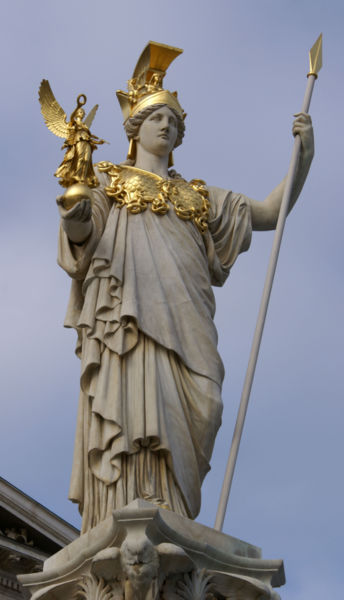

Hailed by NewEpicurean.com as an unsung hero, Philonides of Laodicea (200-130 BCE) was sent to Syria by the Scholarch of the Epicurean Garden in Athens to convert Asians to the naturalist philosophy of the atomists, marking a curious time in Hellenistic history when Greek humanists were sending secularizing missionaries to the Middle East.

He lived in the Seleucid court and greatly influenced the royal family there, converting some to Epicureanism, and kept a vast library of philosophical works. There, he taught philosophy to Antiochus IV Epiphanes, and according to Life of Philonides—a Herculaneum scroll—he converted Antiochus’ nephew King Demetrius I Soter. Together with his company of scholars, he helped to bring about the Hellenistic Era in Judea and was so highly esteemed that he was employed as ambassador, and stone monuments were erected to him. The brilliant satyrist Lucian of Samosata would eventually emerge from the Syrian communities of Epicurean philosophers that were nurtured in this environment.

Philonides was a prolific scholar, publishing more than a hundred books and collecting writings for the royal library. It was thanks to his work that, according to Norman DeWitt in his St. Paul and Epicurus, Antioch would eventually become a major center of Epicureanism. In this book, DeWitt demonstrates that many of the writings of St. Paul can be understood as a reaction against Epicurean teachings, and that Saul of Tarsus was so familiar with these teachings that he must have studied the philosophy in depth at one point.

Jewish students were exhorted “to master Torah so as to be able to answer the Epicurean”. – Norman DeWitt

Philonides lived during the generation that saw the rise of the Macabees, which inaugurated two decades of battle between fanatical Judaism and the Hellenizing forces in Judea. He also lived during the generation that saw the Hellenized Saducees—who, like the Epicureans, denied the afterlife–become one of the prominent Jewish sects. There is much speculation on how much Epicurean philosophy may have influenced their doctrine, particularly their denial of an afterlife. The fact that later Jewish tradition would use the term apikorsim as a derogatory word for Pagans bears testimony on the challenge posed by the intellectual life that Philonides sparked in the region.

It’s a sad irony that today, the Middle East—and Syria, in particular—is still inundated with superstition, fear-based religious fanaticism and violence. Its history and its present would have been much more glorious and peaceful if it had kept and fiercely defended Philonides’ secular ethics.

An Epicurean Year

As part of an effort to continue to produce memes and content that are relevant to the happenings at different stages of the year, Society of Epicurus is joining the initiative of the Epicurus page known as An Epicurean Year. According to its proponent, “the purpose here is to create a rotation of Doctrines, Sayings, other topics and issues to help anyone integrate Epicurean Philosophy into their lives through continuous study and practice” within the Gregorian calendar.

I have gone beyond his initial proposal and added a few celebrations. “An Epicurean year begins in February … because Epicurus’ birthday is in “Gamelion”, which corresponds (more or less) to February”.

Epicureans are known to celebrate the 20th of every month as a “feast of reason”, which is why every 20th defaults to a celebration known as eikas, or “twentieth” in honor of the request made in Epicurus’ will.

JANUARY 20th. “A Feast of Brotherhood”. In his final testament, Epicurus requested that his followers “celebrate, as I have been in the habit of doing myself, the day consecrated to my brothers, in the month of Poseideon”–whichi corresponds to December-January.

FEB 6. Aphrodisia: feast of Aphrodite Urania, the patroness of the Gardens, embodiment of pleasure, and Muse of astronomy and cosmology.

FEB 12. Charles R. Darwin birthday. We celebrate him because his intellectual and scientific legacy contributed greatly to replacing inherited superstition with the study of nature.

FEB 16th. Foundation Day of the Society of Friends of Epicurus.

FEB. 20th. The Birth of the Hegemon (our high holiday: Epicurus’ birthday).

MAR. 20th. “A Feast for Happiness!”, as the UN has declared this to be the International Day of Happiness.

MAR 21th. SoFE celebrates Horace Day. The literary Legacy of Horace, a self-proclaimed “pig of Epicurus’ den”, is celebrated as part of World Poetry Day.

APR 13th. Hitchens – Jefferson Day, a secular holiday proposed by a blogger, where humanist books should be exchanged as gifts.

APR. 20th. This usually also falls around Earth Day, so it’s a celebration of this Earth. At SoFE, we also memorialize our friend Jesús Guevara on this day.

JUNE 20th. Midsummer Feast / Pride.

Pallas Athena

Pallas Athena, Goddess of Philosophy

AUGUST 20. A Feast of Wisdom: the Panathinaia, the Festival of Athena, the Goddess of Philosophy is celebrated in Hellenismos around early August.

AUGUST 24. HERCULANEUM DAY. On this date in the year 79 of Common Era, Mount Vesuvius erupted and the library in Herculaneum was covered in volcanic ash. Epicurean scrolls from the Villa of the Pisos (which contained Philodemus of Gadara’s library) have since been recovered and deciphered. On this day, we celebrate the continued existence of our wisdom tradition by studying and discussing the Philodeman scrolls.

SEPTEMBER 20th. Polyaenus Day. In his final will and testament, Epicurus instituted the celebration of a day consecrated to the memory of his friend Polyaenus, one of the founders of Epicureanism, “in the month of Metageitnion–which corresponds to August-September in our calendar. Polyaenus was known for using potent and efficient proverbs that were full of wisdom, and for the clarity and power of his communication in general.

OCTOBER 19. Philodemus’ library was discovered on this date in 1752.

NOVEMBER 20. SoFE joins World Philosophy Day on the third Thursday in November (formally) and on the closest 20th in November (informally).

DEC 20th. HumanLight, the Humanist Solstice celebration which is embraced by the American Humanist Association and others. At SoFE, we celebrate the Promethean values of the Enlightenment on this “Festival of Lights”.

Please visit the original page for An Epicurean Year for more details on the project.