Category Archives: Ethics

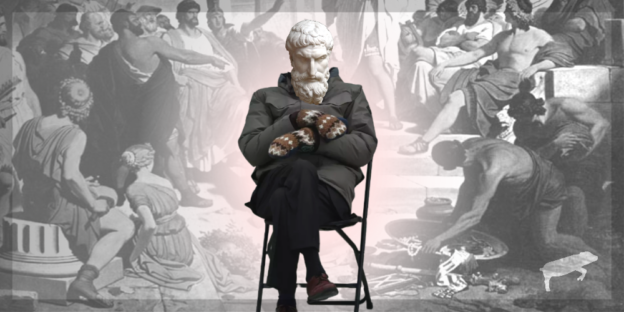
Modified from "Pericles's Funeral oration" by Philipp Foltz (1852)

We Got Beef: A Disembowelment of the Dialectic, Politics, and Other Organs of Bullshit


“Rhetoricians might flatter flies with honey,
but politicians feed flies bullshit.”
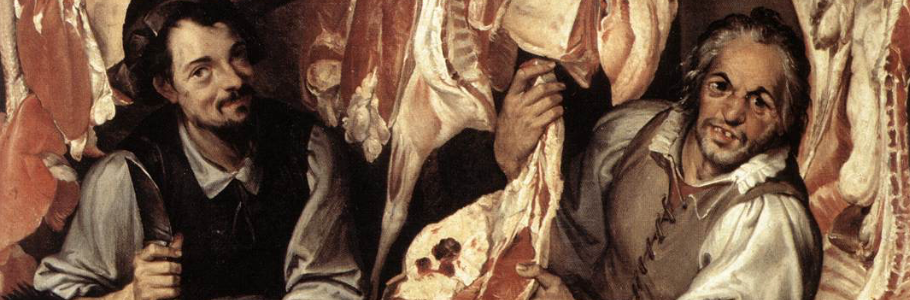

Modified from “The Butcher’s Shop” by Gabriele Passerotti (1580)

WE GOT BEEF

A DISEMBOWELMENT OF THE DIALECTIC,
POLITICS, AND OTHER ORGANS OF BULLSHIT


I have a bone to pick with rhetoric.

Here’s the heart of the issue: talk is cheap. People chew fat in political chats without purpose — no learning occurs, no truth is shared, no friendship is found. Everyone misses the meat of the matter. Opinions are skin-deep. Debate rarely disembowels delusion. Too often, rhetoricians and orators enlist themselves in the service of manipulation. After all, “the end of rhetoric is to persuade in a speech” and not to validate truth with evidence (Philódēmos, On Rhetoric, I, col. 3). Their art does not “depend on arguments from physical facts” because “their art is a power of persuasion” (Ibid., II, 12, col. XIX). For instance, it is agreeable to suppose that honey attracts more flies than vinegar — true, but as a student of nature and pupil of the Garden (so guided to treat politics with suspicion), I observe that nothing attracts so many flies as bullshit.

Those who study in the rhetorical schools are deceived. They are charmed by the tricks of style, and pay no attention to the thought, believing that if they can learn to speak in this style they will succeed in the assembly and court of law. But when they find that this style is wholly unfitted for practical speaking they realize that they have lost their money.
(Epíkouros, Against the Rhetoricians)

The rhetorical τέχνη (tékhnē, “technique”) of the sophists provides a technical method without practical application; at the same time many practical orators enjoy success, and wield influence without technically possessing any teachable skills, having mastered neither art nor science. Dialecticians may enjoy sagacious reputations, but may also lack receptivity, perspective, and may provide people with impractical, ineffective advice. Both educated rhetoricians and natural orators present dangers as agents of persuasion — dialecticians turn the practical benefits of philosophy into abstractions; rhetors misuse the art of prose for manipulation; orators’ aptitude for practical persuasion lacks a foundation in natural ethics.

Each of the rhetorical arts and practices fails to ground themselves in nature. As human agents of manipulation, professional persuaders fail to refer to the natural “goal” of “living blessedly” (Laértios 10.128). Each of these tools can be appropriated to service a political agenda. Only the true philosophy provides students with the tools they need to understand reality and pursue happiness. To quote the lead character from a favorite, adult cartoon, “Everyone wants people they like to be right. That’s why popular people are fucking dumb” (Rick and Morty, Season 3, Episode 4). As Epíkouros teaches, “the purest security is possible by means of the peace and the withdrawal from the masses”, never by chasing their satisfaction (Key Doctrine 14).

Modified from artwork by Kasten Searles for “The Queen’s Gambit” from the Arkansas Times, March 2024

THE PRISON OF POLITICS

Unlike other schools, the Garden rejects politics as a valid field of inquiry and remonstrates the rhetorical tools that support the political ambitions of professional persuaders. As φιλοσοφία (philosophía) is the “love of wisdom”, so politics is antithetical to friendship and wisdom. While Epíkouros does not dismiss civic engagement, he warns against pursuing a political career. Such a pursuit requires either subservience to wealthy interests, or else, submission to popular opinion, or engagement with senseless gossip. The most effective politicians are not those who are the most educated, for “some come out of the schools worse than when they went in” (On Rhetoric, I, 35, 1 ff.=Suppl. 19.13 ff.), but those who are best at “studying what pleases the crowd and practicing” (Ibid., I, 45, 13 ff.=Suppl. 23, 20 ff.) In this way, through pleasing speech, an otherwise unskilled narcissist “can become skilled in politics” (Ibid.).

Political narratives, in particular, are uniquely dubious. Self-promoting orators spoil healthy discourse by drawing people into pointless debates. Rhetoricians excel at erecting scarecrows. Argumentative puppets present themselves as prime cuts of intelligence, yet many are without substance. Popular speakers are incentivized to sell unpalatable policies for the sake of their own enrichment. Politicians dress the inedible entrails they cook with zest. They spice lies to hide their rancid flavor. They sew empty arguments from skin and bones. Debates are dressed for taste, and, as mentioned, rarely dissect the meat of the matter. Dialectical discourse is dangerous. Rhetoric and oratory are ineffective at verifying true statements and, more importantly, impractical at cultivating friendships. As Philódēmos acknowledges, “Politics is the worst foe of friendship; for it generates envy, ambition and discord.” (On Rhetoric, II, 158, fr. XIX).

In speaking of a “free life”, Epíkouros affirms that it

is not possible to be acquired by a lot of money [made] through an unscrupulous means [nor] is without servility to the mob or authority, rather [it] acquires everything [it needs] in continuous abundance; nevertheless if [one did procure] any money by chance, then the latter can be easily distributed to those nearby for goodwill. (Vatican Saying 58)

In this essay, I mean to review rhetoric, dissect dialectic, purge politics, and oust the aura of oratory. We will skim the fat from inference by demonstrating the dangers of logical induction. As Epíkouros teaches, we “must liberate ourselves, out of the prison [built] upon circular” proceedings, social programming, indoctrination, senseless gossip, “political” affairs”, and other practices that sacrifice the testimony of the senses for persuasive story-telling (Vatican Saying 58). “If you contest every single one of the sense perceptions, you can neither judge the outward appearance nor can you affirm which of the sensations you, yourself say are deceptive according to the way in which the criterion operates” (Key Doctrine 23).
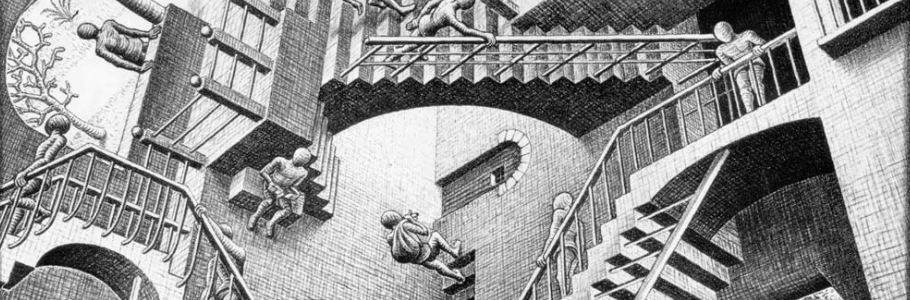
“Relativity” by M. C. Escher (1953)

UNFOUNDED INFERENCE

Epicureans reject both philosophical “reasonings in the form of Aristotelian syllogisms or inductions” as well as “other dialectical procedure(s)”  (On Irrational Contempt 2). As Polýstratos writes, those persuaded by such procedures “are fools who construct their argument solely on the basis of the conviction of others” and not through empirical investigation (Ibid.). “[B]y the dialectical means mentioned, one cannot deliver the soul from fear and anxious suspicion” because the conclusions of the rhetor, the orator, and the dialectician are not founded on physics (Ibid.). The dialectic is rejected “for want of qualification” as a reliable criterion of knowledge, for the Epicureans “suppose the study of nature provides the proper space for the voices of the facts” (Laértios 10.31). The only valid testimony is from the senses — speculation, hearsay, assumption, induction, and conjecture are inferior practices to the process of confirming hypotheses with evidence. “We shall say that the one who infers thus fails because he has not gone through all appearances well, and indeed that he is corrected by the appearances themselves” of real things (On Signs). When “divorced [from] the real phenomena”, then reality gets “cast out of the whole study of nature and then flows from a myth” (Laértios 10.87).

By contrast, Epicureans employ “the method of analogy”, observing nature, inferring hypotheses, and substantiating with evidence. “For there is no other correct method of inference besides this” (Philódēmos, On Signs). Sophistic rhetoric further confounds the process of substantiating hypotheses with observation. By contrast, evidence justifies the demonstrable truth of statements. Otherwise, flawed methods lead to self-defeating conclusions. “For the arguments that they devise to refute the [Epicurean] method of analogy contribute to its confirmation. […] It is the same in other cases, so that as a result they refute themselves.” (Ibid.). As pertains to professional persuaders, rarely are politicians and scientists the same people.
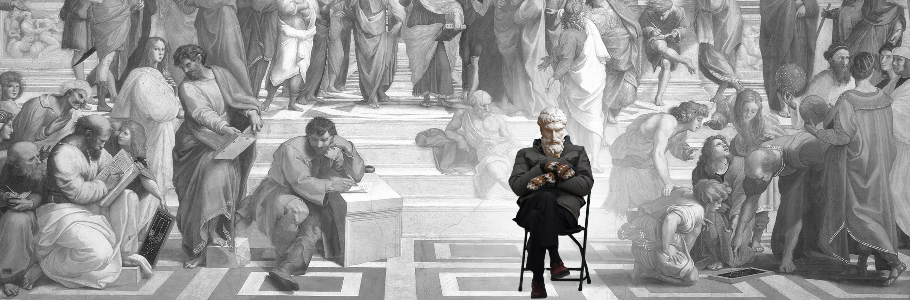
Modified from “The School of Athens by Rafael (1509-11)

DIABOLECTICIANS

Unlike other philosophers, Epíkouros does not recognize the dialectic as a distinct branch of philosophy (Laértios 7.41). Rather, he recognizes the dialectic as a mere method, which, by itself, cannot arrive at the “truth” it seeks to find. Speaking of the Epicurean Garden, Diogénēs reports that “she has withdrawn the Dialectic [and] rejects it for want of qualification;” for the Epicureans “suppose the [study of] natural [phenomena] provides [the proper] space for the voices of the facts.” (Ibid., 10.31). Epíkouros called “the Dialecticians totally toxic” (Ibid., 10.8) and later refers to “dialectic” as being “pretentious” (Epistle to Hēródotos 10.72). Contemporaneously, “Metródōros wrote […] Against the Dialecticians” (Laértios 10.24). He was documented “ridiculing those who consider the dialectic method more accurate” (On Rhetoric, II, 45, col. XLV). Philódēmos positively identifies the position of “the dialectician” as “a position which we refute” (Ibid., I, 190, col. IX; I, 191, col. X). Polýstratos writes that dialectical reasoning is based purely upon the false premises of dialectician’s “own conviction” (On Irrational Contempt 2). Instead, “one must, for the sake of oneself” observe nature to determine the truth of statements (Epistle to Hēródotos 10.72). Otherwise, as Philódēmos notes, “those who use dialectical reasoning do not know that they are shamefully refuting themselves” (On Signs).

For a demonstration of the dialectic in action, consider the following exampe, courtesy of the American, two-party political system: Suppose the Pink Team asserts that ‘An asteroid is coming! We need funds to stop it!’ The Yellow Team responds: ‘There is no asteroid. You just want money.’ Fortunately, everyone is a respectable, patient, educated dialectician, and everyone agrees to the wise rules of their admirable methodology. They proudly reach a compromise: ‘After extensive consideration, we have determined that there is a chance that an object, perhaps, in this case, an asteroid, of indeterminate size, mind you, may enter a region of spa —’

SLAM. That was the sound of nature crushing their dialectic.

Modified from “Asteroid Crashing into a Primordial Earth” by Don Davis / NASA (1991).png

THE RACKET OF RHETORIC

“[T]o practice rhetoric is toilsome to body and soul, and we would not endure it. [Rhetoric] is most unsuitable for one who aims at quiet happiness, and compels one to meddle more or less with affairs, and provides no more right opinion or acquaintance with nature than one’s ordinary style of speaking, and draw the attention of young men from philosophy”
(Philódēmos, On Rhetoric, II, 52, col. 38., II, 53, col. L).

Rhetoric is a technique, an art of prose. Therein, Epicureans “do not claim that rhetoric is bad in itself” (Ibid., II, 142, fr. XIII). Simply, that rhetoricians “are like pilots, who have a good training but may be bad men.” Rhetoric is a weapon that any trained person can learn to wield. Even “the perfect orator” need not “be also a good man and a good citizen” as “in the case of any other art;” for example “a good musician may be a villain” (Ibid., II, 127, fr. XIII=II, 75, fr. XIII.). The 19th-century, French author Flaubert cautions, “Il ne faut pas toucher aux idoles: la dorure en reste aux mains” or “You shouldn’t touch idols: a little gold always rubs off” (Madame Bovary 3.5) — we receive this phrase as “never meet your heroes“. Indeed, were “the greatest rhetors [to] accomplish all they wish […] then they would be tyrants.” (On Rhetoric, II, 151, fr. VIII).

“To tell the truth,” so writes Philódēmos, “the rhetors do a great deal of harm to many people”, by defending the art of manipulation (Ibid., II, 133, fr. IV). He documents that rhetoricians “were not in good repute at the very beginning” as far as “in Egypt and Rhodes and Italy” (Ibid., II, 105, fr. XII). Hermarkhos claims that “rhetors [do not] deserve admiration”. “Moreover the rhetors charge for the help they give, and so cannot be considered benefactors” (Ibid., II, 159, fr. XX). By contrast, “the philosophers give their instruction without cost” (Ibid.). “Metrodorus teaches in regard to rhetoric that it does not arise from a study of science” (Ibid., II, 193, fr. 2). “The end of rhetoric is to persuade in a speech”, designed to disregard nature as is convenient. “It is clearly proven that the art of the rhetor is of no assistance for a life of happiness” (Ibid., I, 250, XVIII).
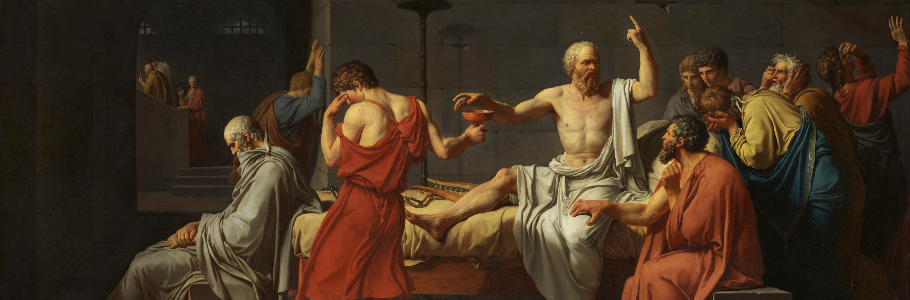
Modified from “The Death of Socrates” by Jacques-Loius David (1787)

STUPID SOPHISTS

If he knew that he could not […] become a philosopher […] he might propose to teach grammar, music, or tactics. For we can find no reason why anyone with the last spark of nobility in his nature should become a sophist…” (Ibid., II, 54, col. 39., col, LI).

The Epicurean critique against rhetoric is dually applied to and principally exhibited by a method that they refer to as sophistic (also referred to as “panegyric” or “epideictic” rhetoric). In general, people “are led astray by sophists and pay them money merely to get the reputation for political ability” (Ibid., II, 46, col. 33). It has been grossly easy for rich orators to persuade poor laborers to fund their schemes. Philódēmos observes that “sophistical training does not prevent faulty speech” (Ibid., I.182, col. I—I, 186, col. V). In fact, “some do not care at all for what they say” so long as it accomplishes their rhetorical goal, regardless of the greater goal of life (Ibid., I, 244. col XIII). “And when they do praise a good man they praise him for qualities considered good by the crowd, and not truly good qualities” (Ibid., I, 216 col. XXXVa, 14).

“[I]t follows that”, as is the case with other forms of technical rhetoric “those who possess this ability [of sophistic rhetoric] have acquired it without the help of scientific principles” (Ibid., I, 136, 20=Suppl. 61, 19). “[R]hetorical sophists” are known “for wasting their time on investigation of useless subjects, such as […] the interpretation of obscure passages in the poets”, as when civic policy is guided by mythic texts (Ibid., I, 78, 19 ff.=Suppl. 39, 5 ff). Compared against the philosophers, “the instruction given by the sophists is not only stupid but shameless, and lacking in refinement and reason” since it does not take into account the goal of life, nor commit to a devoted study of nature (Ibid., I, 223, fr. III). Instead, sophistic rhetoric appeals to authority and tradition by means of equivocation, obfuscation, and exploitation of ignorance.
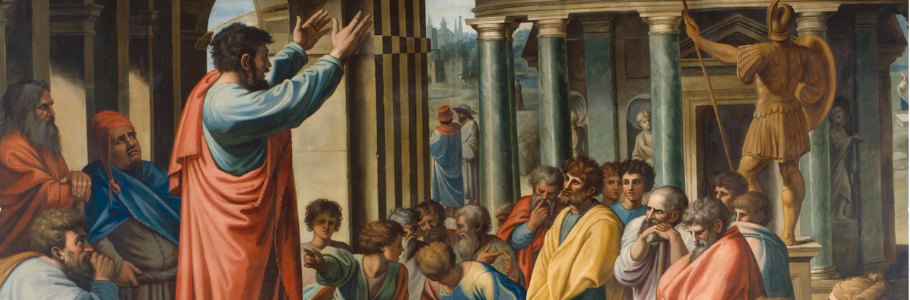
“Paul Preaching in the Areopagus” by James Thornhill (1729-31)

CULTIVATING IGNORANCE

Often, obfuscation “is intentional”, as is the case “when one has nothing to say, and conceals the poverty of his thought by obscure language that he may seem to say something useful” as with equivocation (Ibid., I, 156, col. XIII). Other times, we observe “unintentional obscurity [that] arises from not mastering the subject, or not observing the proper formation […] and in general from failure” (Ibid., I, 158, col. XVI). Obscurity in discourse also arises “from ignorance of the proper meanings of words, their connotation, and the principles on which one word is to be preferred to another” (Ibid., I. 159, col. XVII). In these cases, the success of an orator corresponds not with knowledge, nor coherence, but with a practical ability to persuade a mob. “Most, if not all [of] the arguments do not prove what they claim to prove even if the premises be granted.” (Ibid., I, col. 5). “The worst class of arguments are those which act as boomerangs and demolish the position of the disputant” (Ibid. I, 4, col. I=Suppl. 4, 17).

For example, suppose that a sophist means to convince a legislative body to support a piece of legislation, but they lack meaningful substance. It behooves them to appeal to their audience’s preferences — moderates appreciate an appeal to custom (e.g. it’s the way it is); traditionalists appreciate an appeal to myth (e.g. it’s the way it’s always been); legalists appreciate an appeal to authority (e.g. it’s the law); populists appreciate an appeal to popularity (e.g. it’s what we want); economists appreciate an appeal to wealth (e.g. it’s profitable); bleeding-hearts appreciate an appeal to empathy (e.g. have a heart); ignorant people appreciate an appeal to simplicity (e.g. they’re trying to confuse you). The most ignorant are the most gullible, easy prey for skilled sophists. (Intentional obfuscation is masterfully exemplified by the “Chewbacca Defense” from the October 7, 1998 episode of South Park. The “Chewbacca Defense” leads to an irrelevant conclusion based on non-sequitur speech and a red herring.)

Modified from a screenshot of “Chef Aid,” South Park, season 2, episode 14, Comedy Central, 1998

EMPTY ORATORY

Philódēmos spends the better part of On Rhetoric distinguishing rhetoric as a technical art versus legislative and judicial oratory, which he identifies as a practical skill. He writes:

The practical skill acquired by observation is not called an art by the Greeks except that sometimes in a loose use of language people call a clever woodchopper an artist. If we call observation and practice art we should include under the term all human activity.
(Ibid., I, 57, 23 ff.=Suppl. 29, 15 ff.)

There is a “division between the different parts of rhetoric (i. e. sophistic and practical rhetoric) which was made by Epicurus and his immediate successors (Ibid., I, 49, 14 ff.=Suppl. 25, 15 ff.). Unlike sophistic, Philódēmos suggests that one “could find reason for pursuing practical rhetoric”, even though this form of oratory does not qualify as a formal art (Ibid., II, 54, 41). Unlike sophistic methods of argumentation, practical oration (the ambassadorial oratory of diplomats, the deliberative oratory or legislators, the forensic oratory of lawyers) provides practical utility: “thousands of [Greeks] have been useful ambassadors, were prudent in their advice, were not the cause of disaster, did not speak with an eye to gain, and were not convicted of malfeasance in office.” (Ibid., II, 224, col. XIX). In these cases, “some do succeed by means of natural ability and experience without the aid of rhetoric” (Ibid., I, 47, I ff.=Suppl. 24, 10 ff.). They are less concerned with trying “to classify and describe metaphors” instead of trying to give “practical working instructions” (Ibid., I, 171, 2, col. XII).

Still, even without methodical manipulation, oratory does not guarantee happiness, and provides no moral direction. It allows fools without skill to run offices that benefit from skill. Popularity insulates celebrities from the consequences of their actions. Oratory is the favored tool of talentless politicians whose only object is the advancement of destructive pursuits.

By contrast against the empty promises, unhelpful eloquence, and practical lies of orators, Philódēmos argues for παρρησία (parrēsía, “frank” or “free speech”), explaining that it is truly καλή φράσις (kalḗ phrásis), “lovely phrasing” or “beautiful speech” (On Rhetoric, I, 149 IV). Epíkouros commits to using “ordinary expressions appropriately, and not express oneself inaccurately nor vaguely, nor use expressions with double meaning” (Ibid., I,161, Col XIX). Ornate oratory might promote popularity, but rarely does it reduce anxiety.

Modified from a screenshot from “They Live” by John Carpenter (1988)

POLITICAL PROGRAMMING

Rhetoricians might flatter flies with honey, but politicians feed flies bullshit.

Epicurus believed that there was no art of persuading large bodies of men; that those who are not rhetoricians sometimes are more persuasive than the rhetoricians; that those trained in panegyric are less able to face the tumult of the assembly than those who have no rhetorical training; that Epicurus spoke of arts, and said that those acquainted with them were benefited, but did not mean that this enabled them to attain the end; if anyone possesses the power of persuasion it is responsible for evil and not for good.
(On Rhetoric, I, 99, 5b=Suppl. 48, 15)

While the arts of persuasion are discouraged, even then, Epicureans evaluate the dialectic and rhetoric above political discourse. “[W]e declare [politics not] to be an art “ (Ibid., Section II-a). Politicians are famously dishonest because “a clever man without studying the technical works of the sophists can study some sophist’s speech and so learn to imitate them.” (Ibid., I, 130. col. XXIX). Command does not require comprehension. “They certainly leave no place for any science…” (Ibid., I, 49, 14 ff.=Suppl. 25, 15 ff.). Indeed, “Delivery depends, too, on natural endowment, beauty of voice, grace of body” (Ibid., Col. XV). The job of “the statesman” is only to “discover the inherent political arguments” corresponding to “what appears true to the crowd” and then to manipulate them to the best of their ability (On Rhetoric, I, 209. col. XXVIII). As conditions change, one politician can advance murderous schemes, while another need to only wear the wrong-colored outfit to incite widespread, public ridicule. “There is no method by which one can” reliably “persuade the multitude, either always or in the majority of cases”, so pursuing politics is akin to delaying your own happiness (Ibid., II, 120, fr. XIX). Usually, success in politics requires either “a lot of money made through unscrupulous means” or “servility to the mob or authority” (Vatican Saying 67). Neither of those conditions are conducive to happiness.

To sum up; by no means should the philosopher acquire political experience, or rhetoric of that sort. It is evident that it is the height of folly to say that a study of nature produces a ἕξις [“habit”] of political oratory, especially since they introduce into the scheme of philosophy example andenthymeme” (On Rhetoric, II, 35, col. 38).

Philódēmos identifies those arguments that appeal to prejudice, traditional paradigms, historical precedence, and common belief as being “vain” (Ibid., I, 286, col. VII). They are “mere padding [to] provoke applause”, all “because the multitude is foolish” (Ibid., II, 39, col. XLI, I. 14). It is equally foolish that those “in political speeches use syllogism and induction which the dialecticians pride themselves on using” (Ibid., I, 286, col. VII). Therefore:

“[The wise] will [not] meddle in politics […] nor will they tyrannize; nor will they bark like a Cynic, […] and they will serve jury duty, and they will leave behind writings, but will not make public endorsements, and they will take precautions for their possessions” (Laertios 10.119).

Modified from “Departure of Odysseus from the Land of the Phaeacians” by Claude Lorrain (1646)
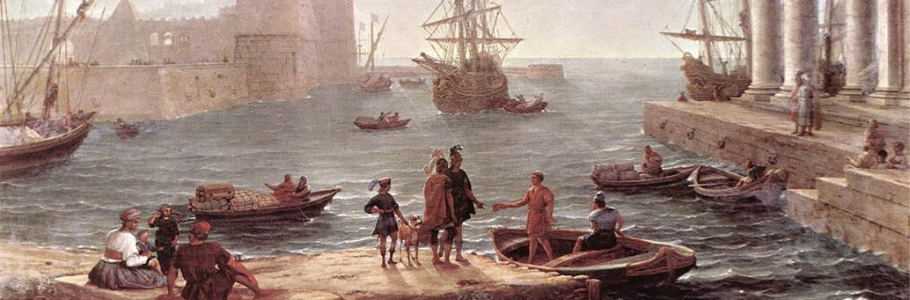
THE HARBOR OF PHILOSOPHY

“But this does not apply any more to philosophy”, nor does it apply to “the Epicureans who refrain from such things” (Ibid., II, 144, fr. II). “Philosophy is more profitable than epideictic rhetoric, especially if one practices rhetoric in the fashion of the sophists (Ibid., I, 225, fr. I). “To tell the truth”, so Philódēmos boasts, “philosophers gain the friendship of public men by helping them out of their troubles.” (Ibid., II, 133, fr. IV). He explains, “they live in peace and justice and tried friendship; those whom they find opposed to them they quickly soften” (Ibid., II, 160, XXI-XXV. II, 162, fr. XXVII). As mentioned, the Epicureans pride themselves on παρρησία (parrēsía, “free speech”). “In speaking one should not resort to ignoble rhetorical tricks, these have less effect than a straight-forward character” (Ibid., II, 126, fr. VI). Since the public tends to prefer comfortable lies, “it is better not to receive public preferment” (Ibid., II, 154, fr. XII.). Philosophers “help their country” not by patronizing the public, but “by teaching the young […] to act justly even if there are no laws, and to shun injustice as they would fire.” (Ibid., II, 154, fr. XIII.).

The primary resource that preserves the Epicurean deconstruction of oratory comes from Philódēmos in his book On Rhetoric. In this book, Philódēmos distinguishes technical rhetoric from practical oratory. He provides a critique of political speech and reviews the dialectic against the Epicureans’ method by analogy that anticipates the modern, scientific method.

Of chief concern, Philódēmos contrasts arts (like dialectic and rhetoric) against practical oratory and political speech, which are not teachable arts. “An art”, he writes “cannot be attained by one who has not studied it, and doing this regularly and certainly and not by conjecture.” He further explains that “this definition applies both to […] grammar and music”. He later adds “architecture, ship-carpentry, navigation, painting”, which all “had methods in olden time” (Ibid., I, 137, col. 33I.21). He concludes, “On the basis of this definition we declare sophistic to be an art” (Ibid., Section II-a). Here again, “That statement ‘He is a good rhetor’ simply means that he is experienced and skilled in speaking”, not that he is a good person. “For as we say ‘good rhetor’ we say ‘good artist’ meaning ‘skillful’” (Ibid., II, 234, col. XXXV).
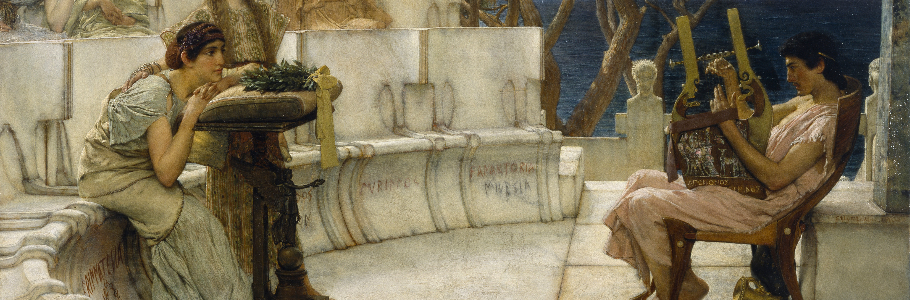
Modified from “Sappho and Alcaeus” by Sir Lawrence Alma-Tadema (1881)

VARIETIES OF DISCOURSE

“One cannot even say that all rhetors adopt one style”, since orators alter their deliveries to suit the disposition of their audience (Ibid., I.152, Col. VIII). In On Rhetoric, our friend Philódēmos provides an overview of the various types of rhetoric and oratory, in addition to reviewing the positions of the Peripatetics and Stoics. In The Art of Rhetoric, Aristotélēs distinguishes rhetoric by three domains of persuasion: [I] deliberative or symbouleutic (e.g legislative), [II] forensic (e.g. judicial), and [III] epideictic (e.g. charismatic speeches) types (Technē Rhētorikē). A later Peripatetic adds [IV] enteuctic (e.g. ingratiation) as a fourth category. Conversely, the Stoics refer to epideictic rhetoric as [V] enconmiastic (e.g. eulogistic). Philódēmos also identifies [VI] ambassadorial (e.g. diplomatic) oratory and [VII] eristic (e.g. controversial). While ambassadorial, deliberative, and forensic styles of oratory exemplify practical oratory, the precision of rhetoric qualifies it as a technical art. Unlike practical oratory, technical rhetoric is exemplified by epideictic, rhetoric, also called [VII] panegyric (e.g. pageantic) and/or [VII] sophistic (e.g. deceptive).

As regards dialectic, Philódēmos offers professional respect (especially when compared against the profession of politics, the practice of oratory, and the art of rhetoric). He elaborates:

For the method of question and answer is necessary not only in philosophy and education, but often in the ordinary intercourse of life. The method of joint inquiry frequently demands this style. Moreover this method is adopted by the rhetor in the assembly as well as in the court of justice. (On Rhetoric, I, 241, col. XI).

While Philódēmos rejects the dialectic as a criterion of knowledge for “lack of qualification”, he accepts the general procedure as a logical tool, and acknowledges its applications in both technical rhetoric and practical oratory. In this way, “the rhetor is like the dialectician” (Ibid., II, 42, col. 30, I. 12.). The varieties of discourse are defined further at the end of this essay.

Modified from “Trilogy of the Desert: Mirage” by Salvador Dalí (1946)

THE MIRAGE OF SUCCESS

False illusions of success encircle us. Salary is not a reflection of skill. Popularity is not a mirror of value. Wealth cannot enrich friendship. Power cannot procure safety. Usually, these things produce antithetical effects: success incentivizes corruption, popularity rewards dishonesty, wealth challenges friendship, and power instigates insecurity. In his Key Doctrines, Epíkouros warns, “If for every occurrence you do not constantly reference the goal of natural pleasure, but if you suppress both banishment of pain and pursuit of pleasure to operate for another purpose, your reasonings and practices will not be in accordance” (25).

Wishing to be worshipped and well-liked, people procured security from people so long as they can be pronounced popular. And if so then indeed they were safe since such a lifestyle inherits the natural benefit of the good. If, however, they procured no safety, then they did not receive that for which they initially strove. (Key Doctrine 7)

Philódēmos provides us with a further warning in On Rhetoric as well as an example of when politicians, wishing to be popular, failed to procure safety:

“[M]any statesmen have been rejected by their fellow citizens, and slaughtered like cattle. Nay they are worse off than cattle, for the butcher does not hate the cattle, but the tortures of the dying statesmen are made more poignant by hatred” (Ibid., I, 234, col. V).

Based on these factors, Hermarkhos calls those who willfully pursue a career in rhetoric “insane”. They rarely achieve the goal of nature that such wealth and popularity is meant to secure. He affirms that “’It is better to lose one’s property than to keep it by lawsuits which disturb the calm of the soul‘” (Ibid., I, 81, 3ff.=Suppl. 40, 23 ff). For “it is much better to lose one’s wealth if one can not keep it otherwise, than to spend one’s life in rhetoric” (Ibid., I, 235, col. VI). Epíkouros summarizes, “Better for you to have courage lying upon a bed of straw than to agonize with a gold bed and a costly table” (Usener, Epicurea 207).

Modified from “Landscape with Farmhouses and Palm Trees” by Camille Pissarro (1853)

LIVE UNKNOWN

“[L]et us be content”, writes Philódēmos, “to live the quiet life of a philosopher without claiming a share in the ability to manage a city by persuasion” (On Rhetoric, I, 234, col. IV). Nothing secures a pleasant life so much as friendship, and nothing guarantees a life of pain so much as politics. Philosophy is more valuable that rhetoric because the “philosophy that teaches us how to limit our desires is better than rhetoric which helps us to satisfy them.” (Ibid., II, 150, fr. VII)

Philosophy is more profitable than epideictic rhetoric, especially if one practices rhetoric in the fashion of the sophists […]. The philosopher has many τόποι [“topics” or “positions”] concerning practical justice and other virtues about which he is confident; the busybody (i. e. the rhetorician) is quite the opposite. Nor is one who does not appear before kings and popular assemblies forced to play second part to the rich, as do rhetors who are compelled to employ flattery all their lives. (Ibid., I, 225, fr. I).

Escape notice and live! So writes Philódēmos, every “good and honest [person] who confines [their] interest to philosophy alone, and disregards the nonsense of lawyers, can face boldly all such troubles, yea all powers and the whole world.” (Ibid., II, 140, fr. XII). He observes:

“inspired before the same loud clamor, some will strive with the effort of Apollophanes [the Stoic] to advance wonderfully to the podium, but others, having landed in [philosophy’s] harbor and with hopes offered them that ‘not even the venerable flame of Zeus would be able to prevent them taking from the highest point of the citadel’ a life that is happy, afterwards, in spite of opposing winds….” (P.Herc 463)

Modified still from Star Wars: Andor, “Rix Road” (Season 1, Episode 12, November 23, 2022).

A GALAXY CLOSE TO HOME

If you will humor me, and entertain the possibility that I might attempt to “rightly hold dialogue about both music and poetry” (Laertios 10.120), consider that many of these points have been artfully orchestrated by writer and director Tony Gilroy in the television series Star Wars: Andor. One character in the fiction, the galactic senator, Mon Mothma, highlights the perils of propaganda (and political office) by exposing a dangerous, manufactured narrative: her dissent in politics has made her a target, and her agency as an orator is being suppressed. She redresses the Senate one, final time before withdrawing to a base, hidden deep in a distant forest:

The distance between what is said and what is known to be true has become an abyss. Of all the things at risk, the loss of an objective reality is perhaps the most dangerous. The death of truth is the ultimate victory of evil. When truth leaves us, when we let it slip away, when it is ripped from our hands we become vulnerable to the appetite of whatever monster screams the loudest. (Season 2, Episode 9)

In this fiction, diplomatic puppets defend and regurgitate loaded propaganda, having been convinced that a small, non-violent protest was actually an uprising. Only the survivors of the massacre, who heard the screams and saw the bodies for themselves know the truth. Similarly, Epíkouros advises that there “is a need to take into account […] all of the self-evident facts, according to which we refer our opinions”. Otherwise, “if not everything will be full of foolishness and of confusion” (Key Doctrine 22). Otherwise, one might be mislead to excuse genocide in the name of “security”. Otherwise, one might be mislead by political pundits and influential personalities to defend an armed mob of triggered, masked agents, deputized by a corrupt system to act with impunity. In the drama, one stormtrooper even shoots a woman in the face.

Trust your physical feelings and the force of nature. Lies are impractical. Propaganda is self-destructive. Oratory can be sinister. Principally, they target those who dismiss evidence and embrace superstition. It is dangerously easy to compel gullible minds to commit acts of violence through persuasive speech. Indeed, the modern-French philosopher Voltaire (heavily influenced by the propositions of the Epicurean school) observed that “Certainement qui est en droit de vous rendre absurde est en droit de vous rendre injuste” (Questions sur la Miracles 412). “Those who can make you believe absurdities can make you commit atrocities.” Persuasion is dangerous, and we rightly treat the instruments by which it spreads with scorn.

No deceptive speeches, manipulative oratory, lofty dialectic, nor rhetorical bullshit will convince a wise person to doubt their own eyes, discard their own feelings, and abandon their own study of nature. I invite you to see with your own eyes. Your life likely depends on it.


INDEX

Modified from “The Butcher’s Shop” by Gabriele Passerotti (1580)

    • Technical rhetoric includes epideictic, encomiastic, and panegyric or sophistic types. Philódēmos teaches that these methods of rhetoric are true arts.
    • Practical oratory includes ambassadorial, deliberative (or symbouleutic), and forensic types. Statesmen employ these methods for practical functions.
    • Political discourse “in this respect […] may fittingly be compared to the art of prophecy” (Ibid., I, 31, 3 ff.=Suppl. 17, 20 ff.). It is sometimes practical.
    • The Dialectic is a systemic, but deeply flawed method of reasoning privileged by
    • Socratics, Megarians, Academics, Peripatetics, and Stoics.
    • The Method by Analogy refers to the empirical reasoning of the Epicureans, which draws inferences from observations that can then be tested.
    • Philódēmos mentions several other rhetoric types, including the entuectic and eristic types that are not explicitly categorized, and may be synonyms or subsets.

  • AMBASSADORIAL ORATORY – πρεσβευτικός (presbeytikós). This practical form of oratory is employed by dignitaries and diplomats. Ambassadorial oratory is the ability “to be able to persuade in diplomatic negotiations by speech, not by power or bribes or dignities or anything else an ambassador might possess” (Philódēmos, On Rhetoric, II, 217, col. XIII).

  • DELIBERATIVE ORATORY – συμβουλευτικά (symbouleutiká) is also known as “symbouleutic” oratory. This practical form of oratory is used by legislators. It “gives advice only on matters affecting the common welfare, and that this advice is not the product of the sophistic art, but of [something] quite a different…” (Ibid., I, 211. Col. XXX.19).

  • EPIDEICTIC RHETORIC – ἐπιδεικτικός (epideiktikós, “demonstrative”, “performative”). This is an art of study regarding “charming speeches” (Ibid., II, 244, col. XLII). It is also called “encomiastic” by Stoics (Laértios 7.142). It is far less profitable than philosophy “especially if one practices rhetoric in the fashion of the sophists” (Ibid., I, 225, fr. I.).

  • ENCOMIASTIC RHETORIC – ἐγκωμιαστικός (enkōmiastikós, “eulogistic” or “laudatory”) is rhetoric ἐπαίνους καὶ ψόγους (epaínous kai psógous) “of praise and blame”. “Furthermore, no one can believe encomiasts, because they praise bad men” (Ibid., 220, col. XXXIXa). Stoics called epideictic oratory “encomiastic” (Laértios 7.142)


  • ERISTIC SPEECH – ἐριστικός (eristikós, “eager for strife”). “Dialectic and eristic may be arts…” , however, the Epicurean school evaluates them as forms of persuasion, unconcerned with the validity of their statements as they correspond to reality (Ibid., I, 57, 23 ff=Suppl. 29, 15 ff.). Eristic speech is provocative and controversial.

  • FORENSIC ORATORY – δίκανικα (díkanika, “judicial”). Philódēmos compares the practicality of forensic oratory with “deliberative” and “ambassadorial” oratory (Ibid., I, 134, col. XXXI). Practically, forensic oratory is employed in courts of law in the form of criminal defense.

  • PANEGYRIC RHETORIC – πανηγυρικός (panēgyrikós, “assembly” speech). This form of rhetoric is synonymous with sophistic rhetoric. “Now we have already treated in a previous section the idea that sophistic or panegyric or whatever it may be called […] may be easily called rhetoric.” (Ibid., II, 234. col. XXXV.). Epíkouros writes that the wise “will not πανηγυριεῖν (panēgyrieîn)” or “make public speeches” (Laértios 10.120).

  • POLITICAL DISCOURSE – πολιτικός (politikós, “of the city”). Politics, by itself, is not an art. By itself, the “political faculty” is empty. It is not a technique, nor a method, but more like “prophecy”. “No man was able […] to impart to his contemporaries or to posterity [the principles of politics]” without the rhetorical arts of the philosophers (Ibid., I, 139, col. XXXIV). “[T]echnical treatises of rhetoricians […] are useless for producing the political faculty”, which does not require training (On Rhetoric, I, 64, II frr.=Supple. 32, 19 ff.).

  • PRACTICAL ORATORY – Practical forms of oratory (for example, speeches employed by dignitaries, deliberations employed by legislators, and defenses employed by lawyers) are distinguished from technical rhetoric (epideictic or enconmiatic, and panegyric or sophistic). Practical oratory is not considered an art that can be learned, only a practice that can be repeated, like civic speech, legislative debate, judicial defense, and diplomatic counsel. “Epicurean authorities hold that sophistic rhetoric does not perform the task of practical and political rhetoric” (Ibid., I, 119, 28 = Suppl. 59., 1e4. I, 120, 10= Suppl, 60, 6).

  • SOPHISTIC RHETORIC – σοφιστική (sophistikḗ). Sophistic is an art of epideixis, and of the arrangement of speeches, written and extemporaneous.” (Ibid., II-c). “Sophistic style is suited to epideictic oratory and written works, but not to actual practice in forum and ecclesia” (Ibid., III, 134. fr. V). Indeed, “the training given by the sophists does not prepare for forensic or deliberative oratory” (Ibid., II, 131, fr. I). “Sophistic can “persuade men to become villains. And when they do praise a good man they praise him for qualities considered good by the crowd, and not truly good qualities” (Ibid., I, 216 col. XXXVa, 14).

  • TECHNICAL RHETORIC – τεχνικός (tekhnikós, “technical”) refers to methods of oratory that properly fit the Epicurean definition of an “art” (or “technique”), including epideictic and sophistic methods. Technical rhetoric offers methods (as is the case with any true art) that can be taught, and reproduced to achieve the same result. “Two sciences produce the same result.” (Ibid., I, 4, co. I=Suppl. 4, 17.). However, compared against the study of nature, “technical rhetoric has never advanced anyone” (Ibid., I.192, col. XI).

  • THE DIALECTICδιαλεκτική (dialektikḗ). Before the idealistic Hegelians and materialistic Marxists, the “dialectic” was privileged by Socratics, Megarians, Academics, Peripatetics, and Stoics, who defined it as “the science of conversing correctly where the speeches involve question and answer — and hence they also define it as the science of what it true and false and neither” (Laértios 7.42). The Epicureans reject the dialect as being incapable of verifying “truth” because it assumes that “truth” is capable of being reasoned without reliance upon physical evidence. Most of the dialecticians encouraged political participation as a necessity to existential satisfaction; Epicureans outright reject political office.

  • THE METHOD BY ANALOGY καθ᾽ ὁμοιότητα τρόποϛ (ho kath’ homoiotēta tropos, “method according to similarity”) anticipated the modern, scientific method by several millennia. Epíkouros accepted that inferences must comport with observation and abide by nature. We must “create an analogy that corresponds with what we see“ (On Nature, Book 11, III, b5-12).” [W]e shall not be prevented from making inferences, provided that we use the method of analogy properly” (On Signs). And “we say that the method of analogy is a sound method of inference, with this condition, that no other appearance or previously demonstrated fact conflicts with the inference” (Ibid.).

For additional commentary, please see “Reasonings About Philodemus’ Rhetoric

For more on deliberate misrepresentation, please see “On Bullshit” by Dr. Harry Frankfurt

Clipped version of “Saint Epicurus” by Genevra Catalano (2023)

Be well and live earnestly!

Your Friend,
EIKADISTES
Keeper of Twentiers.com
Editor of the Hedonicon

Pleasure and Prudence in the Dhammapada

As we strive to maintain a synoptic view of the field of philosophy, so as to neither narrow the scope of our awareness nor limit the expression of our understanding, the Society of Friends of Epicurus pursues a commitment to inter-disciplinary study and cross-cultural analysis. Evaluating of our own beliefs against other wisdom traditions helps contextualize personal practice, and further illuminates a larger spectrum of spirituality. In particular, we have found it profitable to compare and contrast Epicurean Philosophy against the various traditions of बौद्ध धर्म (Buddha Dhamma), the “Law of the Awakened One”, represented to us in English as “Buddhism“. In particular, SoFE has explored the Mahāyāna Buddhist tradition as preserved by the famous Lotus Sutra. Other essays include reflections on Nichiren and Japanese Buddhism, as well as an essay on the Epicurean-like tradition of Charvaka, a hedonistic school of Indian materialism that outright rejected reincarnation and dismissed mystical practices.

As a supplement to our explorations on the Mahāyāna traditions, I wish to explore the Indian Theravāda tradition as preserved by an ancient text called the DHAMMAPADA:

“If all of the New Testament had been lost, it has been said, and only the Sermon on the Mount had managed to survive these two thousand years of history, we would still have all that is necessary for following the teachings of Jesus the Christ. The body of Buddhist scripture is much more voluminous than the Bible, but I would not hesitate to make a similar claim: if everything else were lost, we would need nothing more than the Dhammapada to follow the way of the Buddha.” (Eknath Easwaran, The Dhammapada 13).

The ancient धम्मपद (Dhammapada) is a collection of sayings attributed to Siddhartha Gautama, the बौद्ध (Buddha) or “Awakened One”. “Dhammapada means something like ‘the path of dharma’— of truth, of righteousness, of the central law that all of life is one” (Ibid. 14). The Dhammapada, itself is the second book of the Khuddaka Nikāya, the “Minor Collection”, the last of five nikāyas (or “volumes”) of the Sutta Piṭaka, the “Basket of Discourse”, the second of three divisions of the Tipiṭaka, the “Triple Basket”, the scriptural canon of Theravāda (“school of elders”).

The Theravāda school, founded in the 3rd-century BCE and found today in Sri Lanka, Myanmar, Thailand, Laos, and Cambodia, represents an earlier tradition that proposed a “Middle Way” between the “Eternalism” of the Brahmin religion that proposes the existence of an eternal आत्मन् (ātman) or “self”, versus the “Annihilationism” of Ajita Kesakambalī’s hedonistic school of Chārvāka (which is much more similar to Epicurean Philosophy). Buddha rejected (almost) all metaphysical propositions and described the true nature of one’s being as anattā, the “non-self”, lacking permanency. All knowledge is validated by two paramana or “proofs”, [1] pratyakṣa or “perception” and [2] anumāna or “inference”. Perception and inference are due to the six āyatana or “sense objects” of sight, sound, odor, taste, touch, and thought.

The criteria Buddha accepted lead him to conclude that reality is a changing, experiential aggregate, composed of [1] the elemental forms (rūpa), solid earth, cohesive water, mobile gas, warm fire, and empty space, [2] sensuous feeling (vedanā), [3] mental cognition (saṃjñā), [4] willful determination (saṅkhāra), and [5] consciousness (vijñāna). Natural patterns are observed, but propositions about them are are dismissed as meaningless speculations. Beings migrate through numerous planes of existence (ascending to heavens and descending to hells). One’s directionality at death reflects their कम्म (kamma) or moral causality. As they refine their kamma or “moral causality”, they get closer to the goal of निब्बान (Nibbāna). The goal of life is Nibbāna the end of दुक्ख (dukkhā) or “suffering” and release from संसार (saṃsāra), the cycle of rebirths caused due to one’s avijjā or “ignorance” of अनिच्चा (anicca) or “impermanence”. To achieve the goal of life, one must follow the Noble Eightfold Path according to the dhamma or “law” taught by Buddha to achieve the “extinguishment” of suffering: [1] Right Resolve, [2] Right Speech, [3] Right Conduct, [4] Right Livelihood, [5] Right Effort [6] Right Mindfulness, [7] Right Meditation, and [8] Right view that death is not the end. There are also a variety of blissful entities called Devas, who inhabit emotional “planes of existence”. Each realm is defined by the disposition of its inhabitant. The devas, themselves, are also working toward the goal of Nibbāna.

By contrast, the younger Mahāyāna school was cultivated by Nāgārjuna (c. 150-250 CE) who developed the highly influential Madhyamaka school of Buddhist philosophy (possibly influenced by Pyrrhonism through the works of Sextus Empiricus; Pyrrhonism, itself, was likely inspired by Sañjaya Belaṭṭhiputta, the founder of Ajñāna, a competitor of early Buddhism). Many other influential Buddhists helped spread the religion, such as Bodhidharma to China and Padmasambhāva to the Tibetan Plateau. The epistemology of Mahāyāna differs from its predecessor. In this school, all objects lack independent existences. Objects only meaningfully exists within the continuum of the mind. Physical phenomena is dismissed as माया (māyā), “magic” or “illusions”, and the appearance of the natural world is understood to be an ephemeral dream. Reality is fundamentally शून्यता (śūnyatā) or “emptiness”. All things lack a स्वभाव (svabhāva) or “independent nature” (as was used by the atheistic Chārvāka to refer to the physical nature of reality). The only “real” existence is consciousness. The energetic activities of nature are simply objects that exist within the mind, including the “body” and the “self”, which are also just temporary illusions within the continuous citta-santāna or “mindstream”.

A variety of mythic beings inhabit the various realms of existence according to Mahāyāna Buddhists, from gods to hungry ghosts. Heavens are idealized as Pure Lands, each of which is inhabited and ruled by its respective बोधिसत्त (bodhisattva). Buddha is treated as a universal deity, and other “Buddhas” are acknowledged to exist besides Shakyamuni (Gautama Buddha). “Buddhahood” is available to everyone and the achievements of Siddhārtha are not as emphasized as is the Buddha-nature, itself. To achieve Nirvāṇa, one must pursue the altruistic path of the bodhisattva, who works for the benefit of all beings by helping others achieve bodhi or “enlightenment”, and not simply one’s own enlightenment. Thus, the path of the Mahāyāna bodhisattva involves going beyond the Eightfold Path of the arhat to devote themselves toward practicing Buddhism for the benefit of all beings before finally achieving a state of Nirvāṇa. This continuous mission is thought to extend beyond an individual’s life into their future lives.

The Epicurean school overwhelmingly inhabits the opposite end of the philosophical spectrum. Our hedonistic school of indeterministic atomism proposes that reality exists independent of the mind. The universe is made of bodies and void. Bodies are either particles that can neither be created nor destroyed, or compounds that are composed of particles. All compound objects are subject to the forces of dissolution. Both space and the particles that move through it are infinite in number and eternal in time. The mind is a compound structure associated with a living animal, and can be located within the body. All knowledge begins with [1] sensation (aisthesis) caused by the interaction of external particles with our sensory organs. We detect pleasurable or painful [2] feelings (pathē) associated with the various sensations. Through repeated stimulation, we form [3] anticipations (prolepsis) about the patterns of nature.

The Earth, Sun, Moon, planets, and other linked objects comprise a kosmos in a spatially-infinite void with infinite kosmoi. All kosmoi are made of atoms. The seeds of life are everywhere. The gods are perfect figures in the mind, natural forms, imagined as indestructible humanoids, apprehended during dream-states, relative to our natural preconception of “blessedness”. Though, as was the case with the Buddhist schools, our Founder is also romanticized as having been god-like. Unlike the otherworldy goal of the Buddhists, we seek to achieve a godlike state of pure pleasure during our singular life, a disposition of imperturbable joy, free from physical pain and mental anguish. The practice of prudence will lead the wise person to the good life. We achieve such a life by calculating the advantages of every situation based on their possibility to provide stable, long-term pleasure. Actions are judged according to their consequences. There are no “eternal” ethical rules. There are, however, Key Doctrines written by Epíkouros that should be studied in order to minimize pain and maximize the pleasure of the good life.

While many of these positions are mutually-exclusive, the behaviors that compliment each traditions are universal. We find correspondence between a number of Buddhist and Epicurean attitudes: both traditions treat life with a sense of urgency, seek to organize healthy priorities, practice choice and avoidance, privilege the pursuit of knowledge, exercise discipline, and acknowledge the emptiness of political reputation. Both traditions warn against the consequences of greed, and caution against the vanity of power. Both encourage us to emulate role models, cultivate confidence, reject dishonesty, pursue study, exercise virtue, practice peace, reject empty ritual, and care for the health of the mind through contemplation. 

The following passages from the Dhammapada exemplify these SHARED points of agreement:

  1. There are those who do not realize that one day we all must die. But those who do realize this settle their quarrels. We have been born once, twice then we will not exist; it was fated for the eon [beyond] that we will no longer be; but you who are not the master-of-tomorrow delay the rejoicing; then a life is consumed by procrastination, and each one of us dies without leisure.” (Vatican Saying 14)
  1. Those who mistake the unessential to be essential and the essential to be unessential, dwelling in wrong thoughts, never arrive at the essential. No one who perceives what is evil prefers it for themself, but they are seduced by a good when a greater evil itself was pursued.” (Vatican Saying 16)
  1. Those who know the essential to be essential and the unessential to be unessential, dwelling in right thoughts, do arrive at the essential. Therefore adapt into a simple and not extravagant lifestyle as it forms an essential part of health and you will exercise the necessary [things] of life [that] make a person resolute and if you approach extravagant things after intervals it makes us stronger and you procure fearlessness against Luck.” (Epistle to Menoikeus 131)
  1. The foolish and ignorant indulge in heedlessness, but the wise one keeps his heedfulness as his best treasure. …you have taken time to devote yourself to thoughts concerning nature against those that are ignorant and [can now] behold an eon ‘both things as they are, things as they will be, and things before they are’ [as the poets say]” (Metródōros, Vatican Saying 10)A wise [person] combines about the necessities, more knowledge to share than to receive; they have discovered so great a treasure as that of [self-sufficiency].” (Vatican Saying 44)
  1. Just as one upon the summit of a mountain beholds the groundlings, even so when the wise man casts away heedlessness by heedfulness and ascends the high tower of wisdom, this sorrowless sage beholds the sorrowing and foolish multitude. But nothing is more welcome than to hold the lofty and serene positions well fortified by the learning of the wise, from which you may look down upon others and see them wandering all abroad and going astray in their search for the path of life, see the contest among them of intellect, the rivalry of birth, the striving night and day with surpassing effort to struggle up to the summit of power and be masters of the world.” (Lucretius, De Rerum Natura 2.3-13)
  1. Ere long, alas! this body will lie upon the earth, unheeded and lifeless, like a useless log. We have been born once, twice then we will not exist; it was fated for the eon [beyond] that we will no longer be; but you who are not the master-of-tomorrow delay the rejoicing; then a life is consumed by procrastination, and each one of us dies without leisure.” (Vatican Saying 14)
  1. Fools of little wit are enemies unto themselves as they move about doing evil deeds, the fruits of which are bitter. The ungrateful [essence] of the soul produces within a greedy animal an endless [craving] for a lifestyle of varieties.” (Vatican Saying 69)
  1. Ill done is that action of doing which one repents later, and the fruit of which one, weeping, reaps with tears. One cannot escape detection who secretly disturbs the pact one agreed upon with another neither to harm nor to be harmed, nor to trust that one will escape detection, even if ten thousand times the one present escapes detection. For until one’s reduction to nothingness one cannot suppose that one will ever escape detection.” (Key Doctrine 35)
  1. Well done is that action of doing which one repents not later, and the fruit of which one, reaps with delight and happiness. The greatest fruit of justice is tranquility.” (Vatican Saying 80)
  1. The fool seeks undeserved reputation, precedence among monks, authority over monasteries, and honor among householders. The disturbance of the soul cannot be ended nor true joy created either by the possession of the greatest wealth or by honor and respect in the eyes of the mob or by anything else that is associated with or caused by unlimited desire.” (Vatican Saying 81)
  1. Should one find a man who points out faults and who reproves, let him follow usch a wise and sagacious person as one would a guide to hidden treasure. It is always better, and never worse, to cultivate such an association. The worship of the wise is a great good to you who will worship.” (Vatican Saying 32)
  1. Just as a solid rock is not shaken by the storm, even so the wise are not affected by praise or blame. For we practice all of this in order to neither suffer nor dread. When once then this has come to pass because of us, we dispel the whole Storm of the Soul...” (Epistle to Menoikeus 128)
  1. He is indeed virtuous, wise and righteous who neither for his own sake nor for the sake of another (does any wrong), who does not crave for son, wealth, or kingdom, and does not desire success by unjust means. The disturbance of the soul cannot be ended nor true joy created either by the possession of the greatest wealth or by honor and respect in the eyes of the mob or by anything else that is associated with or caused by unlimited desire.” (Vatican Saying 81)
  1. Better than a thousand useless words is one useful word, hearing which one attains peace. Better than a thousand useless verses is one useful verse, hearing which one attains peace. (101-102) One must not pretend to study philosophy, but really study philosophy; for we do not pretend to need health, but in truth [really need] health.” (Vatican Saying 54)
  1. Better it is to live one day virtuous and meditative than to live a hundred years immoral and uncontrolled. “The same time [satisfies] both [in terms] of generation of the greatest good19 and of deliverance [from evil].” (Vatican Saying 42) The sensible person profits from one day they would by eternity.” (Philódēmos, On Death)
  1. Hasten to do good; restrain your mind from evil. He who is slow in doing good, his mind delights in evil. … anyone who is capable of restraint can bring that which is blessed in oneself by having preserved reasoning” (Usener fragment 485; Porphyrious, Letter to Marcella 29)
  1. Just as a trader with a small escort and great wealth would avoid a perilous route, or just as one desiring to live avoids poison, even so should one shun evil. [The] youthful part of [yourself, in regard to its] salvation, guard the [precious] part of life and preserve all of those things that are sullied by the raging desires.” (Vatican Saying 80)
  1. Neither in the sky nor in mid-ocean, nor by entering into mountain clefts, nowhere in the world is there a place where one may escape from the results of evil deeds. One cannot escape detection who secretly disturbs, that pact one agreed upon with another neither to harm nor to be harmed, nor to trust that one will escape detection, even if ten thousand times the one present escapes detection, for until one’s reduction to nothingness one cannot suppose that one will ever escape detection.” (Key Doctrine 35)
  1. Neither in the sky nor in mid-ocean, nor by entering into mountain clefts, nowhere in the world is there a place where one may will not be overcome by death. Some prepare throughout life for the [good] Life [in spite of the drug of death, yet] indiscriminately we have all been infused with the deadly drug from birth.” (Mētródōros, Vatican Saying 30)
  1. One who, while himself seeking happiness, oppresses with violence other beings who also desire happiness, will not attain happiness hereafter. One who, while himself seeking happiness, does not oppress with violence other beings who also desire happiness, will find happiness hereafter. (131-132) One [who is] untroubled, oneself, [is] also, for another, undisruptive.” (Vatican Saying 79)
  1. Neither going about naked, nor matted locks, nor filth, nor fasting, nor lying on the ground, nor smearing oneself with ashes and dust, nor sitting on the heels (in penance) can purify a mortal who has not overcome doubt. There was no point procuring protection from people if a person starts suspicion of those things from the sky and beneath the earth and generally in the Infinite.” (Key Doctrine 13)Impious then is not the one who rejects the deities of the masses, but the one who adheres to the masses’ doctrines about the deities. For [their] assertions are not impression but false assumptions of the masses about the deities.” (Epistle to Menoikeus 123-124)
  1. If one holds oneself dear, one should diligently watch oneself. Let the wise man keep vigil during any of the three watches of the night. [The] youthful part of [yourself, in regard to its] salvation, guard the [precious] part of life and preserve all of those things that are sullied by the raging desires.” (Vatican Saying 80)
  1. Good is it to see the Noble Ones; to live with them is ever blissful. One will always be happy by not encountering fools. The worship of the wise is a great good to you who will worship.” (Vatican Saying 32)
  1. The idler who does not exert himself when he should, who though young and strong is full of sloth, with a mind full of vain thoughts — such an indolent man does not find the path to wisdom. Neither should one who is new [to this world] hesitate to love wisdom, nor should an elder begin to grow tired loving wisdom. For no person is either unripe nor too ripe to be healthy throughout the[ir] soul.” (Epistle to Menoikeus 122)
  1. If by renouncing a lesser happiness one may realize a greater happiness, let the wise man renounce the lesser, having regard for the greater. …sometimes we step over many pleasures, since at such times more difficulties follow us from these; and we consider of the pleasures many pains better, whenever our greater pleasure follows many times these pains we endure.” (Epistle to Menoikeus 129)
  1. Entangled by the bonds of hate, he who seeks his own happiness by inflicting pain on others, is never delivered from hatred. One cannot be fearless [if] one causes [others to be] fearful.” (Usener fragment 537)
  1. [D]isciples of […] ever awaken happily who day and night delight in the practice… (296-301) Therefore, these and those things study for yourself, day and night, and with those like yourself, and at no time neither awake nor in a dream will you be confounded, for no living person surrounded by immortal Good seems like a mortal creature.” (Epistle to Menoikeus 135)
  1. Four mistfotunes befall the reckless man who consorts with another’s wife… (309-310) The wise will not have intercourse with a woman so far as the laws forbid so affirms Diogénēs [of Tarsós] in the Epitome of the Ethical Doctrines of Epíkouros” (Diogénēs Laértios, Lives and Opinions of Eminent Philosophers 10.118)
  1. If for company you find a wise and prudent friend who leads a good life, you should, overcoming all impediments, keep his company joyously and mindfully. Of those things that wisdom prepares for a full life of blessedness, by far the most important is the possession of friendship. The same knowledge that created confidence concerning both the fact that nothing terrible is eternal nor even enduring, and also in the same observations perceives that security is predominately perfected by friendships.” (Key Doctrines 27-28)
  1. Good is virtue until life’s end, good is faith that is steadfast, good is the acquisition of wisdom, and good is the avoidance of evil. For [it is] neither drinking and following festivals nor taking advantage of servants and women nor an expensive multitude of fish nor of however much else fills an extravagant table that makes life pleasant, but sober calculation and examining the cause of each choice and avoidance, and expelling the [masses’] doctrines, from out of these the greatest confusion overtakes our souls.” (Epistle to Menoikeus 132)
  1. One should not despise what one has received, nor envy the gains of others. The monk who envies the gains of others does not attain to meditative absorption. One must not spoil the present by yearning for the absent; but consider that also these [present] things were once of the [things for which] we wish.” (Vatican Saying 35)

While similarities are abundant, we find many passages that exhibit dissimilar attitudes, illustrating conceptual incompatibility between the systems, particularly in each traditions’ position on ethics and death. Theravāda Buddhism recommends a much more restrictive lifestyle than Epíkouros intended, much more reminiscent of the restrictive laws of the biblical books of Deuteronomy and Leviticus. Compared with Epicurean sensualism, Theravāda Buddhism is positively ascetic. Much of the voluminous Tipiṭaka contain lists of rules for monks (भिक्खु or bhikkus) and nuns (भिक्षुणी or bhikkunīs), supposing that the path to wisdom is necessarily monastic (as though a church were to have prescribed the restrictions of the Desert Fathers for everyone seeking God). Theravāda Buddhism presents a strict path of renunciation that involves the displacement of the self from personal affections and attachments.

The first book of the Pāli Canon is a code of conduct for monastics. To note a few rules:

  • Sexual intercourse leads to complete expulsion from the monastic community. (Pārājika 1)
  • Masturbating warrants correction. (Saṅghādisesa 1)
  • Holding hands with another person warrants correction. (Saṅghādisesa 2)
  • Marriage proposals warrant correction. (Saṅghādisesa 5)
  • Huts not built to the Buddha’s design specifications warrant correction. (Saṅghādisesa 6)

Epíkouros presents a very dissimilar approach to spirituality from these sexless Jedi: “We must simultaneously laugh and philosophize, and manage a household and administrate the economic affairs and never let go of the language of the forthright philosophy” (VS 41).

Differences are equally abound between Buddhist and Epicurean views on death (thanatology) and the afterlife (or explicit lack thereof). While both traditions acknowledge the inevitability of death, the Buddhist doctrine of कम्म (kamma) necessitates that an ethical component of the human aggregate survives the dissolution of the rest of the human frame. A moral quality of this component, which is cultivated throughout the life of the previous human aggregate, determines the manner in which this component becomes embodied in its next human form. Epíkouros unequivocally opposes this idea: “We have been born once, twice then we will not exist; it was fated for the eon [beyond] that we will no longer be…” (Vatican Saying 14).

Noticeably, the two traditions provide incompatible depictions of pleasure. The Dhammapada describe काम (kāma) (or “sense pleasure”) in the negative, exclusively linking “pleasure” with a state of recklessness and spiritual abandon in which one acts out of ignorance. Early Buddhists did not (as was also the case with Greek Kyrenaics) recognize “mental impassiveness” as a form of “pleasure”, and, instead, framed physical pleasures as being excessive and indulgent. By contrast, Epíkouros explicitly recognizes pleasure as the goal in life. He further acknowledges that the good life cannot be enjoyed after that life has ended. Pleasure is the happy goal in life, and it is categorically opposed to practices that are ignorant, reckless, and indulgent.

Additionally, each tradition provides noticeably different evaluations of friendship. The Epicurean tradition privileges friendship as a natural and necessary desire, as well the principle means of securing a happy life; conversely, the Buddhist tradition treats interpersonal bonds as unnecessary attachments that inevitably lead to suffering. This interpretation is contextualized within a larger paradigm that views desire as being painful (and thus, undesirable). For the atom prophets, the satisfaction of desires is a necessary practice to be enjoyed as we advance upon the path to wisdom. For Theravada monks, it is necessary to vanquish desire. For the sages of the Garden, the good life cannot be enjoyed without cultivating robust friendships and enjoying the fruits of companionship; for the monks of the forest, the best life is lived in total isolation.

These DIFFERENCES are illustrated with the following passages.

  1. Just as a storm throws down a weak tree, so does Mara overpower the man who lives for the pursuit of pleasures… “…we [Epicureans] say the goal is Pleasure…” (Epistle to Menoikeus 131)
  1. Just as rain does not break through a well-thatched house, so passion never penetrates a well-developed mind. [A wise person] will be more affected by passions, but [this] will not be an impediment toward their wisdom” (Diogénēs Laértios, Lives and Opinions of Eminent Philosophers 10.117)
  1. Do not give way to heedlessness. Do not indulge in sensual pleasures. Only the heedful and meditative attain great happiness. Neither can I, for one, possess what I know to be The Good by diminishing the pleasures of flavor, nor by diminishing the [pleasures] of Aphrodisian [intercourse], nor by diminishing the pleasures of hearing, nor even by diminishing the [pleasures] of appearance as far as the sight of sweet motions.” (Diogénēs Laértios, Lives and Opinions of Eminent Philosophers 10.6)
  1. The Destroyer brings under his sway the person of distracted mind who, insatiate in sense desires, only plucks the flowers (of pleasure). “[W]e say Pleasure is the beginning and ending of living blessedly” (Epistle to Menoikeus 128)
  1. As a bee gathers honey from the flower without inuring its color or fragrance, even so the sage goes on his alms-round in the village. The greatest fruit of self-sufficiency is freedom.” (Vatican Saying 77)
  1. Let none find fault with others; let none see the omissions and comissions of others. But let one see one’s own acts, done and undone. “For all {wise men} both love {their students} alike in accord with the worth of each and see their faults alike” (Philódēmos, On Frankness Col. Mb)
  1. Of all the fragrances — sandal, tagara, blue lotus and jasmine — the fragrance of virtue is the sweetest. “I spit upon pleasures that come from extravagance not because of them, but because of the difficulties that follow them.” (Epíkouros, Usener fragment 181)
  1. The good renounce (attachment for) everything. The virtuous do not prattle with a yearning for pleasures. The wise show no elation or depression when touched by happiness or sorrow. “Furthermore, for the sake of pleasure we choose the virtues, not for their own sake, [but] just as medicine, for the sake of health.” (Diogénēs Laértios, Lives and Opinions of Eminent Philosophers 138) “One must value what is beautiful, and the virtues, and such manners if they produce pleasure; but if they do not produce pleasure, one must bid them farewell” (Usener fragment 70)
  1. But those who act according to the perfectly taught Dhamma will cross the realm of Death, so difficult to cross. The [cessation called] death, in no way [does it exist] for us; for that which has dissolved lacks perception; but what lacks perception in no way [exists] for us.” (Key Doctrine 2)
  1. Giving up sensual pleasures, with no attachment, let the wise man cleanse himself of defilements of the mind. Nevertheless it will always be beneficial to offer friendship just as [it will always be beneficial]  for us to plant seeds in the earth, thus [friendship] itself cultivates those communities that [work together to] perfect the pleasures.” (Diogénēs Laértios, Lives and Opinions of Eminent Philosophers 10.120)
  1. Inspiring are the forests in which worldlings find no pleasure. There the passionless will rejoice, for they seek no sensual pleasures. Great stresses draw [life] short, and such times [provide] no great abundance.” (Usener fragment 447)”The peak of pleasure is the excision of all pain; and wherever pleasure is, for the time that it is, there is neither discomfort, nor distress, nor both” (Key Doctrine 3)
  1. Some are born in the womb; the wicked are born in hell; the devout go to heaven the stainless pass into Nibbana.We have been born once, twice then we will not exist; it was fated for the eon [beyond] that we will no longer be…” (Vatican Saying 14)
  1. … upon dissolution of the body that ignorant man is born in hell.…in the [clutches of ignorance], we were forever expecting some, perpetual terror [waiting for our souls after death], as if also to heed [some persuasive illusion] to the myths.” (Epistle to Herodotos 81)
  1. Easy to do are things that are bad and harmful to oneself. But exceedingly difficult to do are things that are good and beneficial.Thanks [to] the blessed nature that has made the necessities obtainable, but the unobtainable, unnecessary.” (Usener fragment 469)
  1. … The righteous live happily both in this world and the next.And truly also, of the whole amalgamation that is being dissolved, it is being removed [as] the soul is being dispersed and no longer possess the dynamics [of the sensations] themselves, just as [a] sensation has not been procured.” (Epistle to Herodotos 65)
  1. Seek no intimacy with the beloved and also not with the unloved, for not to see the beloved and to see the unloved, both are painful. Therefore hold nothing dear, for separation from the dear is painful. There are no bonds for those who have nothing beloved or unloved. From endearment springs grief, from endearment springs fear. From him who is wholly free from endearment there is no grief, whence then fear? From affection springs grief, from affection springs fear. From him who is wholly free from affection there is no grief, whence then fear? From attachment springs grief, from attachment springs fear. From him who is wholly free from attachment there is no grief, whence then fear? (210-214)And the most beautiful [feeling] is produced by meeting the earliest of those [friends] who share a like-mind and [also that feeling] is produced with great speed [upon meeting the earliest of those friends].” (Vatican Saying 61)
  1. One should give up anger, renounce pride, and overcome all fetters. Suffering never befalls him who clings not to mind and body and is detached. “…one must say that natural [anger] is not an evil, […] it is a good thing to submit to the natural kind of anger.” (Philódēmos, On Anger, Col. 38)
  1. Your life has come to an end now; You are setting forth into the presence of Yama, the king of death. No resting place is there for you on the way, yet you have made no provision for the journey!It might be possible to furnish security against misfortune, but against [that] of death every human lives in a city without walls” (Mētródōros, Vatican Saying 31)
  1. Unchastity is the taint in a woman…“…As long as you neither disregard the laws, nor dismiss those reasonably established customs, nor distress any of the neighbors, nor damage your flesh, nor deplete what is necessary, do as you please according to your own preference…” (Mētródōros, Vatican Saying 51)
  1. Of all the paths the Eightfold Path is the best; of all the truths the Four Noble Truths are the best; of all things passionlessness is the best: of men the Seeing One (the Buddha) is the best. This is the only path; there is none other for the purification of insight. Tread this path, and you will bewilder Mara.” (273-274) I shall abide by the words of Epicurus, according to whom I have chosen to live.” (An Epicurean oath as recorded by Cicero in On the Nature of Good and Evil)
  1. Cut off your affection in the manner of a man plucks with his hand an autumn lotus… Of those things that wisdom prepares for a full life of blessedness, by far the most important is the possession of friendship” (Key Doctrine 27).
  1. A tamed elephant is led into a crowd, and the king mounts a tamed elephant. Best among men is the subdued one who endures abuse.

    Great stresses draw [life] short, and such times [provide] no great abundance. For the stress that is hyperbolic will bring on to death.” (Usener fragments 448 and 457)
  1. Cut off the five, abandon the five, and cultivate the five. The monk who has overcome the five bonds is called one who has crossed the flood. If you contest every single one of the sense perceptions, you can neither judge the outward appearance nor can you affirm which of the sensations you, yourself say are deceptive according to the way in which the criterion operates.” (Key Doctrine 23)
  1. Nothing is better for a holy man than when he holds his mind back from what is endearing. To the extent the intent to harm wears away, to that extent does suffering subside. And the most beautiful [feeling] is produced by meeting the earliest of those [friends] who share a like-mind and [also that feeling] is produced with great speed [upon meeting the earliest of those friends].” (Vatican Saying 61)
  1. Like water on a lotus leaf, or a mustard seed on the point of a needle, he who does not cling to sensual pleasures — him do I call a holy man. Moreover, in the Kanon, Epíkouros is reckoning [that] the criterion of truth is the sensations and preconceptions and that of feeling” (Diogénēs Laértios, Lives and Opinions of Eminent Philosophers 10.31)
  1. He who, having abondoned sensual pleasures, has renounced the household life and become a homeless one has destroyed both sensual desire and continued existence — him do I call a holy man. Nevertheless the wise person will marry and will make children, so Epíkouros [affirms] in Puzzles and On Nature.” (10.119)
  1. He who, casting off human bonds and transcending heavenly ties, is wholly delivered of all bondages — him do I call a holy man. The same knowledge that created confidence concerning both the fact that nothing terrible is eternal nor even enduring, and also in the same observations perceives that security is predominately perfected by friendships.” (Key Doctrine 28)
  1. He who, having case off likes and dilikes, has become tranquil, is rid of the substrata of existence and like a hero has conquered all the worlds — him do i call a holy man.
    “[The wise person] will also be opinionated and will not be puzzled” (10.119)
  1. He who in every way knows the death and rebirth of all beings, and is totally detached, blessed and enlightened — him do I call a holy man. We have been born once, twice then we will not exist; it was fated for the eon [beyond] that we will no longer be; but you who are not the master-of-tomorrow delay the rejoicing; then a life is consumed by procrastination, and each one of us dies without leisure.” (Vatican Saying 14)
  1. He who knows his former births, who sees heaven and hell, who has reached the end of births and attained to the perfection of insight, the sage who has reached the summit of spiritual excellence — him do I call a holy man. There was no dissolving the fear over the most important matters if one does not know the whole of Nature, but who worries about the myths; since without an inquiry-of-origins there was no receiving the pure pleasures.” (Key Doctrine 12)

Though the traditions present conflicting frameworks, the ethical model exemplified by each traditions’ wise person reflects a larger pattern of human piety. As preserved in Chapter Six (“The Wise Person”), the Buddhist arhat and the Epicurean sage share many traits: both are contemplative, steadfast, disciplined, restrained, confident, self-reliant, knowledgable, considerate, patient, and peaceful. They exemplify self-control and exhibit masterful independence from vain desires. They reject wealth and status as unreliable means of achieving happiness. They lead minimalistic lifestyles, and prefer the setting of the natural world.

“Nevertheless the [Epicurean] wise person will marry and will make children”, and pursue pleasure, and feel anger at injustice, and reap the benefits of friendship; by contrast, the Buddhist arhat (in accordance with the example of their founder) abandons their role as a family member, rejects pleasure, and privileges the isolation of a life lived in solitude.

In general, stronger parallels exist between Buddhist ethics and epistemology and the Greek philosophies of Cynicism and Pyrrhonism; the skepticism of Pyrrho, itself, was likely inspired by the philosophy of Ajñana during the Indian campaign. Though an Indian competitor to early Buddhism, Ajñana nevertheless expresses similar attitudes in treating external constructs with suspicion, from Vedic orthodoxy to the possibility of obtaining happiness. “The pessimistic Hēgēsías of Kȳrḗnē, a Kyrenaic, despite his materialism, may also have been influenced by Buddhist missionaries to Kyrene and Alexandria. Each of these philosophers rejected the comfort of external pleasures and treated the proposition of atomism with suspicion.

As is the case with the majority of wisdom traditions originating from the Indian subcontinent, Buddhism shares many of the metaphysical doctrines of the Orphic Mysteries of Greece — those Mysteries heavily influenced Epíkouros’ philosophical opponents, the Pythagoreans and Platonists. The dharmic traditions of India teach that a piece of the human aggregate undergoes a पुनर्भव (punarbhava) or “re-birth” after the dissolution of the human frame; the corresponding goal of life then becomes overcoming the exhausting cycle of re-births. This belief is later echoed by Pythagoras and his teacher Pherekýdes of Syrios, who introduced the idea of μετεμψύχωσις (metempsýkhōsis) or “reincarnation” to Greek philosophy. Plato was heavily inspired by this, and reproduces this narrative as his Myth of Er in the Republicafter his death, Er witnesses the souls of the deceased proceed through a transmigration as they simultaneously lose their memories of the afterlife. These philosophical traditions patronized the Mysteries that mythologized the procession of life and death, the passing of the seasons, and the return of Spring; concurrently, they orchestrate this narrative by inducing a subjective ego death following the ritualistic ingestion of psychedelic chemicals (that helped inspire those Mysteries centuries earlier). The Indian traditions employed methods to induce similar, visionary experiences, thus, again, we see a noticeable contrast against Epicurean mortality.

Nevertheless, each tradition represents a unique expression of a ubiquitous human psychology. We find similarities and dissimilarities anytime we seek coherence between difference expressions of human piety and religious practice. The Epicurean and Theravāda traditions stand in stark contrast when it comes to the behavioral restrictions, evaluating pleasure, managing friendship, and embracing wisdom. At the same time, both traditions share an exercising of virtue, a criticism of popular religion, a commitment to setting healthy priorities, and a devotion to study. The means by which each tradition practices differ, but the behavioral goal of providing a sense of calm to devotees during this life is universally shared.

I hope that this brief evaluation has provided you with useful insight into the larger landscape of human spirituality. May we never become lost the vanity of our own valleys.

(… also, a rather productive thread on this topic can be found on EpicureanFriends. Former Buddhists have weighed-in on the topic, and feedback and personal testimony is very welcome. This essay was produced by a non-Buddhist, and topics contained herein may not be treated with the nuance they deserve. Elsewhere, discussions on this topic are being facilitated by the Society of Friends of Epicurus during monthly Eikas meetings on Discord. Curious minds are always welcome!)

Be well and live earnestly!

Your Friend,
EIKADISTES
Keeper of Twentiers.com
Editor of the Hedonicon

Commentaries on Metrodorus

Happy and Peaceful Eikas to all! Every month on or around the 20th, members of the Society of Friends of Epicurus gather in memory of the two main founders of our School, Epicurus of Samos and Metrodorus of Lampsacus. But while most students of philosophy have at least a basic familiarity with the first founder, very few people have even heard of his best friend. This series means to raise the profile of Metrodorus of Lampsacus, as I recently did with Colotes and Leontion.

  1. The First Ancestor of the Twentiers – a rough outline of the biography of the co-founder of the Epicurean Garden, Metrodorus of Lampsacus, and some notes on the tribe-building and soul-healing projects of the founders
  2. Metrodorus the Mystes – a commentary on Vatican Saying 10 and Metrodorus’ Epistle to Timarchus, which explores the intersection between Hellenistic mystery religions and the practices of the first Epicureans
  3. Mithras the Syrian – an exploration of the intersection between Zoroastrianism and the Epicureans (supplemented by The 22 Excellent Books on Empedocles), and also how the first Epicureans propagated wholesome human values by retelling stories of sacred friendship
  4. Metrodorus the Autarch: a theory and practice of self-rule – on Metrodorus’ self-sufficiency and economics, supplemented by Epitome On Wealth
  5. Metrodorus the Communicator – a commentary on Metrodorus’ efforts to reform his native language
  6. Epistle to Timocrates – a commentary on the controversies between Metrodorus and his brother
  7. The Activities of Vatican Saying 41 – a detailed elaboration of what I consider to be Metrodorus’ most important teaching, which connects theory and practice, and initiates us into the wisdom of the Epicurean laughing philosophers

The essays on Timocrates and VS 41 had been written previously, but I have added them here for the sake of convenience and easy reference, so that all of my commentaries on Metrodorus will be easily found in one place.

Additional Notes on the Belly

I do not wish to conclude this essay series without addressing the issue of the belly in Metrodorus’ philosophy. After re-reading these last two essays and the one on autarchy–since the belly prepares us for self-sufficiency by teaching us about the limits of our desires–, I developed one additional possible theory for why Metrodorus says “the seat of good is the belly” in his Epistle to Timocrates. In Mithras the Syrian I mention:

… the wisdom of PD 5 evolved into VS 41 when he attempted to connect theory and praxis. Metrodorus may have asked: “By what signs do I know that I’m living pleasantly?”, and answered with laughter …

Following the logic of this led me to think about the anatomy of laughter. Might Metrodorus not have been referring to laughter when he said that pleasure begins in, or has its seat in, the belly? Laughter (the “sign” or evidence of pleasure in the body) is a movement or tremor within the body that expels air suddenly. The lungs are constantly at work with the movement of breath, and their activity is mostly unconscious: the movement of laughter, on the other hand, requires the incitement of some pleasant motivation and originates in the belly. I invite you to observe this in your own laughter. It seems to me that the muscles of the belly, just under the lungs, must contract in order for laughter to take place. And so, the “seat of pleasure” might, among other things, be a reference to how the belly expresses pleasure in the form of laughter.

I unfortunately had to experience the grief of losing my oldest brother Junior on April 28th from cancer. During this experience, I took notice of how the belly also has a role in the anatomy of crying: air is expelled by the muscles of the belly and tremors take place there. Both crying and laughing have huge therapeutic benefits. It seems that much of the emotional wisdom within the body is found in the belly, or that many of our feelings are processed in the belly in some way.

Non-Epicurean philosophers have independently taken notice of the role of the belly. In Thus Spake Zarathustra, Nietzsche asserts that spirit is a stomach and acknowledges that much of what we associate with mental or “spiritual” states is really a series of organic and chemical signals that often originate in the belly. The belly has a role in stabilizing and centering the body in many contemplative and martial arts wisdom traditions. In Lie-zi’s Garden of Pleasure (in the parallel sayings section titled “The Belly as a Point of Reference”), I noted the importance of the belly in the distinction that Taoists make between the internal (which renders us self-sufficient and whole) and the external, and I invited students to read Chapter 12 of the Tao Te Ching.

Racing through the field and hunting make the mind wild. Searching for precious goods leads astray. Therefore, the sage attends to the belly, and not to what he sees. He rejects the latter and chooses the former. – Tao te Ching 12

Here, the appeal to the belly helps to keep us grounded and stable.

Other Literary Updates

In addition to the Metrodorus series, I published essays on other companions of the Hegemon and Metro in recent months:

Commentary on Leontion the Epicurean

Commentary on Colotes of Lampsacus

Nathan recently published A Hymn to Hedone, The Life of Epíkouros: A Translation for Twentiers and an expansive translation of the fragments of Book 2 from On Nature.

If you value this content, please consider supporting my work on Patreon or Substack.

Hymn to Hēdonḗ

Happy Jul’ Eikas and Merry Moon Landing!

I celebrate today to combat a plague of hopelessness, a similar plague as described by Lucretius in the final stanzas of De Rerum Natura, a spiritual plague characterized by the “heart-rending” despair of those “with sorrow-stricken” souls, who surrender hope as their “thoughts turned on death“. Like the Plague of Athens in 430 BCE that claimed 25% of the Athenian population, and like the Roman Civil War of 49 BCE that lead to a permanent dictatorship, plagues and political violence once again imperil our expectations and poison our minds with despair.

In Kashmir, a territorial dispute between two nuclear powers (perhaps now three) threatens to disrupt the flow of water from the Indus River that nourishes 90% of Pakistan’s crop yield, endangering nearly 250 million people. In Texas, a preventable measles outbreak reminds us that “whenever any refused to attend their own sick, killing neglect soon after would punish them” (De Rerum Natura 6.1238). We observe a similar, selfish attitude among Christian zealots who deny life-saving treatments to their own children. In Gaza and Ukrainesometimes you might see lifeless bodies of parents above their lifeless children, and then the reverse of this, children giving up life above their mothers and fathers” (Ibid. 6.1251). Slavery has not only expanded in the States, but Global Estimates of Modern Slavery count nearly 50 million people living without freedom. Sexual abuse of children is rampant, and Jeffrey Epstein and his cohort of political monsters represent only a small fraction of the abuse; most monsters hide within the cozy confines of church. Not even sanctuaries are safe. Our shepherds have become butchers: “All the holy sanctuaries of the gods too death had filled with lifeless bodies” (Ibid. 6.1267). The democratic institutions we formerly prized have been disemboweled and drained. In Florida, we anticipate a year of deaths from storms. Fear of Zeus returns. Clouds darken, and the light dims.

It is midnight, and we must build our own fire.

I mean for this meditation to act as an instrument of hope, a confident reminder of the importance of education, the value of advancement, and the significance of perseverance. When faced with death, Mētródōros indicates that we should continue to live with confidence and cheer, neither abandoning hope, nor capitulating to fear (VS47):

“We meet at a college noted for knowledge, in a city noted for progress, in a State noted for strength, and we stand in need of all three, for we meet in an hour of change and challenge, in a decade of hope and fear, in an age of both knowledge and ignorance.
(John Kennedy, Address at Rice University 1962)

I recite Kennedy’s Address at Rice University as a remedy against political despair; as we did in the 60s, we yet again find ourselves facing the savage works of war, executed throughout the seas and lands, provoked by the proverbial lords of battle. Yet again, we face preventable annihilation … and, yet again, I am reassured by both the fond love that Mother Nature strikes into the breasts of all people, as well as the voices of those who encourage us to advance “the best of our energies and skills”, and remind us that there is “new knowledge to be gained, and new rights to be won”. May we seek to accept these challenges “for the progress of all people”.

Surrounded by orcs on all sides, Tolkien reminds us, through the voice of a wise, old wizard: “There are other forces at work in this world, Frodo, besides the will of evil.“

We experience the force of goodness in the form of pleasure, not only with physical delights, but, more importantly, through the pleasures of freedom, forming bonds, securing peace, and cultivating love. These pleasures are only achievable through our innate compulsion to pursue a more pleasant existence, an existence that is properly defined through the study of nature:

“[C]ondense, if you will, the 50,000 years of man’s recorded history in a time span of but a half a century. Stated in these terms, we know very little about the first 40 years, except at the end of them advanced man had learned to use the skins of animals to cover them. Then about 10 years ago, under this standard, man emerged from his caves to construct other kinds of shelter. Only five years ago man learned to write and use a cart with wheels. Christianity began less than two years ago. The printing press came this year, and then less than two months ago, during this whole 50-year span of human history, the steam engine provided a new source of power. Newton explored the meaning of gravity. Last month electric lights and telephones and automobiles and airplanes became available. Only last week did we develop penicillin and television and nuclear power, and now if America’s new spacecraft succeeds in reaching Venus, we will have literally reached the stars before midnight tonight.

[…] If this capsule history of our progress teaches us anything, it is that man, in his quest for knowledge and progress, is determined and cannot be deterred. […]

[…] For the eyes of the world now look into space, to the Moon and to the planets beyond, and we have vowed that we shall not see it governed by a hostile flag of conquest, but by a banner of freedom and peace. We have vowed that we shall not see space filled with weapons of mass destruction, but with instruments of knowledge and understanding.

[…] We set sail on this new sea because there is new knowledge to be gained, and new rights to be won, and they must be won and used for the progress of all people. […]

We choose to go to the Moon. We choose to go to the Moon in this decade and do the other things, not because they are easy, but because they are hard, because that goal will serve to organize and measure the best of our energies and skills, because that challenge is one that we are willing to accept, one we are unwilling to postpone, and one which we intend to win, and the others, too.” (John Kennedy, Address at Rice University 1962)

We have met overwhelming challenges before, and we will meet them again.

Pleasure motivates us, guides us, and rewards our pursuit of knowledge. In honor of the pleasure of education and achievement, I have composed a Prayer to the Goddess of Pleasure this Moon Landing Day, and have provided (my best attempt at) a translation, transposed into both English and ancient Greek. The structure of this poem is based on an Orphic Hymn to Zeus (provided below). Herein, the feeling of “pleasure” has been personified as a Blessed Queen, Beloved and Fearless. The icon of our devotion is Cheerful, Thoughtful, Faithful, Confident, and Fair. She calms, comforts, and fulfills. She dispels anxiety, eases anguish, lessens restlessness, satisfies need, and treats torment. Our conception of the Divine Pleasuress disposes us toward a blessed existence, practical, principled, and peaceable, full of friendship. The spirit of pleasure knows no pain. Nowhere in the metakósmios will we find a happier being than Hēdonḗ.

May she serve to remind us of the achievable goal of life in this petulant period.

Your Friend,
EIKADISTES
Keeper of Twentiers.com
Editor of the Hedonicon


Aphrodite by Genevra Catalano (2022)

Aphrodite by Genevra Catalano (2022)

AN EPICUREAN HYMN TO HĒDONḖ

PLEASURESS Blessed, PLEASURESS Incorruptible, to this, truly, we
are disposed, testimony, both liberating and therepeutic;
Oh, Queen, because of your divine image, the good life was disclosed,
flavor, fragrance, radiance, warmth, oh, Goddess Fruitful,
and the immortal good of friendship, oh, Mother Bountiful;
PLEASURESS of the GARDENS, prudent, principled, peaceable,
All-Mother, Source-of-all, and End-of-all,
Common-to-All, Motivating, Smile-Loving, Nurse of Love,
Faithful, Fearless, Beloved, Nourishing PLEASURESS;
Hear me, LEADERESS: permit, then, immaculate painlessness,
peace, and, Goddess, also, immaculate impassiveness.

Ἡδονή μακαρία Ἡδονή ἀφθαρτε τήνδε τοι ἡμεῖς
μαρτυρίαν τιθέμεσθα λυτήριον ἠδὲ θερᾰπευτικήν·
ὦ βᾰσῐ́λῐσσᾰ διὰ σὴν εἰκόνᾰ θεία ἐφάνη τὸν ᾰ̓γᾰθόν βῐ́ον
γεῦσῐς εὐωδία καλή θέρμη ὦ θεὰ πολῠ́φορβος
καὶ ᾱ̓θανᾰ́τη ᾰ̓γαθή φῐλῐ́ας ὦ μήτηρ καρποφορος·
Ἡδονή ἐν κήποις φρόνιμη καλή δῐκαία
Παντογένεθλ’ ἀρχὴ πάντων πάντων τε τέλᾱ
Ποθεινοτάτη φιλομμειδής ἐρωτοτρόφος Πάνδημον
πῐστή ἄφοβε φῐ́λῐε φυτάλιε Ἡδονή·
κλῦθί μευ ἡγεμόνη δίδου δ’ ᾰ̓τᾰρᾰξῐ́ᾱν ἄμεμπτον
εἰρήνην τε θεὰν καὶ πλούτου ἀπονῐ́ᾱν ἄμεμπτον.

Hēdonḗ makaría, Hēdonḗ áphtharte, tḗnde toi ēmeîs
martyrían tithémestha lūtḗrion ḗdè therapeutiiḗn.
Basílissa dià sḗn eikóna theía ephánē tòn agathón bíon,
geûsis euōdía kalḗ thérmē, ṓ theà polýphorbos,
kaì athanátē ágathḗ philías ṓ mtēr karpophóros.
Hēdonḗ èn Kēpois, Phrónimē, Kal, Dikaía,
pantogénethl’ árkhē pántōn, pántōn te teleutḗ,
Pándēmon Potheinotátē Philommeidḗs Erōtotróphos,
Pist Áphobe Phílie Phytálie Hēdonḗ;
klythí meu Hēgemónē dídou d’ aponían ámempton
eìrnēn te theàn kaì ploútou ataraxían ámempton.

(translations by N. H. Bartman)


ORPHIC HYMN 15 (TO ZEUS)

Zeus invaluable, Zeus imperishable, here, you see, we [bear]
testimony: you [are] to be reverred, delivering and pre-eminent.
Oh, King — by your lead it was revealed on this account, divine,
Earth, Goddess, Mother, mountains and resounding cliffs,
both sea and all, as high as heaven, positioned within,
Zeus Timekeeper, sceptered, thundering, wild,
All-Generator, beginning of all, and end of all,
Earthquaker, Increaser, Purifyer, All-Shaker,
Flashing, Thundering, Electrifying, Nourishing Zeus;
Hear me, One-of-Changing-Form, permit, then, immaculate health,
and peace, Goddess, and immaculate magnificence of wealth.

Ζεῦ πολυτίμητε, Ζεῦ ἄφθιτε, τήνδε τοι ἡμεῖς
μαρτυρίαν τιθέμεσθα λυτήριον ἠδὲ πρόσευξιν.
ὦ βασιλεῦ, διὰ σὴν κεφαλὴν ἐφάνη τάδε θείᾱς,
γαῖα θεὰ μήτηρ ὀρέουσᾰ θ’ ὑψηχέες ὄχθοι,
καὶ πόντος καὶ πάνθ’, ὁπόσ’ οὐρανὸς ἐντὸς ἔταξε
Ζεῦ Κρόνιε, σκηπτοῦχε, καταιβάτα, ὀμβριμόθυμε,
παντογένεθλ’, ἀρχὴ πάντων, πάντων τε τελευτή,
σεισίχθων, αὐξητά, καθάρσιε, παντοτινάκτα,
ἀστραπαῖε, βρονταῖε, κεραύνιε, φυτάλιε Ζεῦ ·
κλῦθί μευ, αἰολόμορφε, δίδου δ’ ὑγίειαν ἀμεμφῆ
εἰρήνην τε θεὰν καὶ πλούτου δόξαν ἄμεμπτον.

Zeú polytímēte, Zeú áphthite, tḗnde toi ēmeîs
martyrían tithémestha lytḗrion ḗdè próseuxin.
basileû, dià sḗn kephalēn ephánē táde theías ,
gaîa theà mtēr oréousa th’ hypsēkhées ókhthoi,
kaí póntos kaí pánth’, opós’ oúranòs éntos étaxe
Zeú Krónie, skēptoúkhe, kataibáta, ombrimóthyme,
pantogénethl’, árkhē pántōn, pántōn te teleutḗ,
seisíkhthōn, auzēntá, kathársie, pantotinákta,
ástrapaeîe, brontaèe, keraünie, phytálie Zeú;
klythí meu, aìolómorphe, dídou d’ ygíeian ámemphē
eìrnēn te theàn kaì ploútou dóxan ámempton.

(translations by N. H. Bartman)

Five contemplations on the gods: A path to community and friendship (part 5)

Continued from:

FIRST CONTEMPLATION: THE GODS

SECOND CONTEMPLATION: UTOPIA

THIRD CONTEMPLATION: THE SAGE

FOURTH CONTEMPLATION: THE FRIEND

FIFTH CONTEMPLATION: THE DEPARTED

Quote: Fragment from On the Gods by Philodemus[1]

Even if the gods’ community as a species is aloof from the supplying of things of practical help in order to motivate their companionship, their friendship communicates their feelings. For it is not possible for them to maintain their community as a species without any social intercourse. And indeed even amongst us, weak as we are, and needing from our friendship in addition things of practical help, no longer does our friendship to our friends we have lost provide practical help; and nonetheless our admiring reverence for characters which are peers of our own itself binds us together in affection, even in the highest degree. However, the gods also accept from each other what supplies their own needs, even though they are able to provide these things for themselves, just as we human beings sometimes do from those who have the same things as ourselves.

Commentary: divine friendship

In this passage, Philodemus is describing the lifestyle of the gods and how they interact with each other. Just like humans, they live in communities and have friends. What makes them different from us is that they do not share in our weakness, and do not need friendship to offer a sense of security by taking care of each other if they are sick, help them in case of financial difficulties, etc. And yet, the gods still choose to have friends. In fact they will even go as far accepting “from each other what supplies their own needs”, which seems to mean that they provide each other with gifts of some sort, perhaps a kind of nutrition that maintains their immortality, much like the ambrosia from the gods of myth, even though they can obtain it by themselves. The friendly gesture of gift exchange seems to serve a more psychological purpose, contributing to their blissfulness.

In order to make this clear, we can think of Epicurean friendship as having three levels (according to David Armstrong): (1) Friendships based on virtue, trust and mutual utility. (2) Friendships based on our strong natural desire for affection and open self-expression. This is only achievable after accomplishing the first kind of friendship. (3) God-like friendship, satisfying a desire for affection and open self-expression, apart from all consideration of utility.

This third type of friendship is mainly accessible to the gods, but only accessible to humans after the death of a friend once the mourning for our loss of them is over and we come to enjoy their memory. This is because once a loved one is dead, they no longer contribute to our basic needs beyond the psychological wellbeing acquired from the good memories. This helps us answer a question about why it is that Epicureans worship gods that do not intervene in human affairs, bestow favors, etc. The same could be said about our dead friends: why honor them when they are no longer there to serve our needs. This is because they fulfill a psychological need, even though they are no longer with us and in fact they don’t exist as their souls have been annihilated with their bodies.

However, they still exist in our memories, and this is why Epicurus referred to friendship as an immortal good, because even in death, they continue to impact us and they contributed in making us who we are. Remembering our friends is not a passive activity. This is why Epicurus set up rituals and festivities to commemorate his dead friends, Metrodorus and Polyaenus, as well as his parents and brothers.

Practice: friendship beyond death

First lesson: grieve for the loss of your friends. For Epicureans, friends can include family members as well, as is demonstrated by his devotion to his parents and brothers. He advises us not to suppress our emotions when faced with the loss of loved ones. The ancient writer Plutarch writes the following about the Epicureans: “They disagree with those who would do away with grief and tears and lamentation at the death of friends, and say that an absence of grief that renders us totally insensible stems from another great evil: hardness or a passion for notoriety so excessive as to be insane.”[2]

Second lesson: cultivate the good memories of your dead friends. After the grieving period which will vary from person to person, keep the flame of your friendship alive. They are a part of your life and nothing can take that away. This does not mean that you have to think about them all the time but every now and then, take a moment to bring up the pleasant times spent with that person in your mind and be thankful for the happiness they brought and continue to bring.

Third lesson: develop rituals to honor your friends. You might have kept photos, presents, letters from your lost friends. These are now sacred objects. It might be a good idea to develop some symbolic gestures and rituals to honor your friend. Perhaps there is a favorite song you shared. Perhaps you can listen to that music on your friend’s birthday. Or maybe you can just close your eyes and bring back a specific memory to your mind’s eye. There are countless ways to commemorate your loved ones.

Forth lesson: remember that the divine nature of friendship transcends life and death. This is how you become eternal. This is not just the final lesson of this Fifth Contemplation but of all five contemplations combined.

This is how you become a god. Atheists and other nonbelievers in supernatural religions are often asked this question: if there is no supernatural god ordering the universe and giving us purpose, if all that exists are atoms, molecules, forces, “stuff”, then all is without meaning. With no higher purpose, everything is empty, we are all alone. Many atheists bite the bullet and fall into nihilism. An Epicurean rejects this mode of reasoning entirely. We are not alone and without purpose. Life has meaning. Once we have a friend who acknowledges our existence and our value and we recognize them in return, and are committed to continue doing so for the long term, we become godlike. As Epicurus said to his friend and disciple Colotes, “go about as one immortal in my eyes, and think of me as immortal too.

CONCLUSION

And now we see the connection between the two ideas mentioned in the beginning of our introduction: philosophizing with a like-minded friend and living as a god among men. It is through friendship that we realize the highest ideal of the philosophical life.

Through the five contemplations, we have progressively descended from the domain of the gods outside our world, to a hypothetical utopian society, to the Epicurean communities of sages from the past, to the gesture of reverence between to philosopher friends, to culminate with the memories of lost friends conjured up in our minds.

An atheist could argue that we could very much have come up with much of the same philosophy without any reference to gods that probably do not exist in the first place.[3] This may be the case. But in response to that, we could say that by invoking the divine as a concept, we are invoking something that has the highest value to us, beyond just atoms and void.

When describing Epicurean philosophy, people often refer to it as a materialist philosophy that rejects the supernatural and divine providence, or a hedonistic philosophy defending a life of pleasure, albeit a modest reasonable pleasure defined as an absence of suffering of the body and tranquility of the mind. But these descriptions are incomplete and give us a very limited scope of what the philosophy is really about. By putting the gods front and center in their function as role models and comparing the immortality of the gods to that of the relationship between friends, it might be most accurate for us to conclude that Epicureanism is first and foremost a religion of friendship.

Notes:

[1] Quote from article Utility and Affection in Epicurean Friendship by David Armstrong.
[2] From Plutarch, That Epicurus actually makes a pleasant life impossible. Quote from http://www.attalus.org/translate/epicurus.html
[3] Many modern Epicureans consider themselves atheists and think that modern Epicureanism no longer has any use for any conception of the divine. This article was intended to give an alternative to this perspective by rethinking what we understand as being divine. For more on this debate, read The Third Way to Think about the Epicurean Gods.

Five contemplations on the gods: A path to community and friendship (part 4)

Continued from:

FIRST CONTEMPLATION: THE GODS

SECOND CONTEMPLATION: UTOPIA

THIRD CONTEMPLATION: THE SAGE

FOURTH CONTEMPLATION: THE FRIEND

Quote: Fragment of a letter by Epicurus to Colotes [1]

You, as one revering my remarks on that occasion, were seized with a desire, not accounted for by my lecture, to embrace me by clasping my knees and lay hold of me to the whole extent of the contact that is customarily established in revering and supplicating certain personages. You therefore caused me to consecrate you in return and demonstrate my reverence… Go about as one immortal in my eyes, and think of me as immortal too.

Commentary: friendship, the key that unlocks godhood

We now reach the core of Epicurean godhood, the ultimate manifestation of what it truly means to be divine. In this scene depicted in one of Epicurus’ letters meant to be read by his community, he portrays one of his closest disciples, Colotes, showing reverence for him and he in turn returns the favor. This gesture goes beyond a simple sign of appreciation; it has religious value. This scene would become immensely popular with later Epicureans when recounting the hagiographies of their tradition. Enemies of Epicureans would mock the over the top gestures of affection that existed within these communities.

At first, what we see is an overzealous disciple overcome with a fanatical need to worship his guru. After all, Epicurus could be seen as something of a spiritual master akin to Jesus or the Buddha. However, this gesture seems to have caught Epicurus off guard at first, as it refers to Colotes’ “desire, not accounted for by my lecture”. But then, Epicurus mirrors the action directed to him by his disciple by returning that gesture back at him. He turned what could have been an awkward moment into a philosophical lesson, but also into a symbolic scene that would be remembered by future practitioners of his philosophy.

Epicurus has often been criticized putting himself too much at the center of his philosophy. He has often been viewed as greedy for attention and fame. After all, why would he institute in his will an annual day to celebrate him (and Metrodorus) after his death, as well as a monthly celebration of himself and his best friend every twentieth of the month during his lifetime in his honor, the famous Eikas gatherings? All of this is only partly true. It would be more accurate to see Epicurus as a sort of “first among equals”. Epicurus did not found his philosophy alone, but with the aid of Metrodorus, Poyenus, Hermarchus and others. His annual celebration from his will is supposed to be in conjunction with funerary rites honoring his parents and brothers, showing his devotion to his family. And the monthly Eikas celebrations honor both him and his closest friend Metrodorus as a pair. Other friends such as Polyaenus and Pythocles were also honored after their deaths. By associating the honoring of his friends with religious rituals normally meant to celebrate gods and important individuals that are elevated to a status of godhood, he is placing friendship at the center of his philosophy of happiness.

This association of friendship with godhood is made obvious by the final part of the quoted fragment: “Go about as one immortal in my eyes, and think of me as immortal too”. How does this work? After all, unlike gods, our loved ones are notoriously mortal and losing them is a source of suffering. In what way can our friendships make us immortal? This will be the subject of the Fifth Contemplation.

Practice: building friendships

First lesson: take measures to make friends. In his Treatise On Choices and Avoidances, Philodemus says: “Since he does not cut short the long extent of his life, he always begins new activities and friendly attachments”. He adds: “He will treat with much care as many people as he can, and be thankful to those who have treated him kindly, in particular because he hopes that he will share in some goods with them or that he will receive some benefits by these same people in the future…”[2]. Here it seems we are beyond the restricted circle of close friends, engaging with society at large. This is what Epicureans might mean by practicing philanthropy. There is something here resembling enlightened self interest. We benefit others and we benefit in return. There is something transactional about this kind of relationship. But this is just a first step. What starts as something based on utility can become something more intimate. “Every friendship is an excellence in itself, even though it begins in mutual advantage.”[3] Being socially active will lead to developing more affectionate ties over time.

Second lesson: show your gratitude and generosity to the friends you have. Gratitude is one of the core values of Epicurean philosophy, especially with one’s friends. An Epicurean will be generous with his friends, willing to sacrifice his own comfort in order to make his friend’s feel good. Even when financially struggling, he will prefer to increase his own frugality than lack generosity for his friends. He will care for them when they are sick, give aid when they are struggling financially, protect them when they are in danger and under extreme circumstances, even sacrifice his life. He will also give them counsel and advice, with honesty, even if that means telling hard truths. Epicurus says: “When the sage contends with necessity, he is skilled at giving rather than taking — such a treasury of self-reliance has he found.”[4]

Third lesson: contemplate the divine nature of your friendships. While it is necessary and even useful to interact with society at large, it is among our closer friends that we find refuge, where we feel secure, where we come the closest to experiencing the imperishability of the gods. It is somewhat ironic that it is the possibility of being vulnerable with our friends that contributes to making us invulnerable. Epicurus, while addressing Metrodorus said: “I write this not for the many, but for you; each of us is enough of an audience for the other.”[5] Our friends bring us a feeling of confidence: “The same judgment produces confidence that dreadful things are not everlasting, and that security amidst the limited number of dreadful things is most easily achieved through friendship.”[6] Friends play a role similar to what a god would for many religious people. Just as they turn to a divine being in times of crisis, an Epicurean will turn to a friend.

Forth lesson: develop rituals with your friends. One way in which we can show our appreciation for a friend and celebrate a friendship is to come up with traditions you share exclusively with the person(s). As you get to know someone and spend time with them, you may find yourself repeating a very specific and semi-regular activity with that person. Perhaps you go to the same music festival every year, or go camping once a month, or some other special occasion. Perhaps you enjoy a certain drink socially, like yerba maté. Birthdays and anniversaries would be excuses for such rituals. Epicurus placed these celebrations of friendship as the center of his philosophical practice, as is made clear with the importance of Eikas, the monthly gathering every 20th of the month in honor of his relationship with Metrodorus, his closest friend.[7] This friendship, modeled on the gods, has strong symbolic value that has been celebrated for generations of Epicureans, and is a template of what a divine friendship should look like.

Notes:

[1] From Plutarch’s Against Colotes. Quote from http://www.attalus.org/translate/epicurus.html
[2] Philodemus, On Choices and Avoidances, published by Bibliopolis. See Hiram Crespo’s article https://societyofepicurus.com/reasonings-about-philodemus-on-choices-and-avoidances-part-i/
[3] Vatican Saying 23. Quote from https://monadnock.net/epicurus/vatican-sayings.html
[4] Vatican Saying 44. Quote from https://monadnock.net/epicurus/vatican-sayings.html
[5] Seneca, Letters to Lucilius. Quote from http://www.attalus.org/translate/epicurus.html
[6] Principle Doctrine 29. Quote from https://monadnock.net/epicurus/principal-doctrines.html
[7] See article from Hiram Crespo: https://societyofepicurus.com/eikas-and-ancestral-reverence/

Five contemplations on the gods: A path to community and friendship (part 3)

Continued from:

FIRST CONTEMPLATION: THE GODS

SECOND CONTEMPLATION: UTOPIA

THIRD CONTEMPLATION: THE SAGE

Quote: Wall inscription of Diogenes of Oinoanda, fragment 125 – 126 [1]

For when images of persons who are far away from our sight invade our mind, they cause the greatest disturbance. But if you examine the whole matter carefully, you will learn that the images of persons who are not present are of precisely the same kind as those of persons who are present. For although the images are perceived not by the senses, but by the mind, they have the same power, as far as in them lies, for persons who are present as when they existed with those other persons present also. Therefore, with regard to these matters, mother, be of good heart: do not reckon the visions of us to be bad; rather, when you see them, think of us daily acquiring something good and advancing further in happiness. For not small or ineffectual are these gains for us which make our disposition godlike and show that not even our mortality makes us inferior to the imperishable and blessed nature; for when we are alive, we are as joyful as the gods, knowing that death is nothing to us; and when we dead, we are without sensation… Think of us then, mother, as always joyful in the midst of such good things and show enthusiasm for what we are doing.

Commentary: the sage is equal to a god

These fragments of a letter to a mother, quoted in Diogenes’ wall inscription, are attributed to Epicurus[2]. In it he reassures his mother who fears for his safety because of visions of her son, probably in a dream, which she took to be a bad omen. As is implied in the letter, Epicurus reminds his mother Chaerestrate (who was a priestess) that interpreting dreams or visions of any kind as having any kind of prophetic value is superstition and that there is nothing to fear.

After reassuring his mother of the nature of these images, he recommends she turn these manifestations to her advantage and visualize positive things regarding her son. Here we see a common exercise in Epicureanism: “placing before the eyes”, a kind of visualization technique meant to help us achieve virtue and overcome vice[3] for the sake of living pleasantly.

In this case, Epicurus is making the claim that thanks to philosophy, his mother has nothing to worry about, for he has already achieved the best of all possible lives. Thanks to his wisdom, he has learned to be content with little, and does not need much to live a satisfying life. Thanks to his friends’ support, he feels safe in case he is lacking in basic needs.

Even if something bad was to happen and he was to die, he does not fear death. Death is the absence of sensation. There is no suffering in being dead. There is no punishment in the afterlife. Thanks to his gratitude for the good memories of his past, he is secure in having lived a good life. He says: “Misfortune must be cured through gratitude for what has been lost and the knowledge that it is impossible to change what has happened”[4]. One could retort that even if Epicurus’ mother could be reassured about the happiness of her son, she may still fear losing him and never seeing him again. We will address this later.

Practice: envision the life you want to live and try to make it reality

First lesson: envision the life of a sage. After the dwellings of the gods and utopia on Earth, we reach the third phase in our quest for godhood: the community of sages. We are now beyond mere thought experiments and are much closer to history with the existence of Epicurean communities that existed around the Mediterranean for over five centuries.

What is a sage? For all intents and purposes, sages are equal to gods, though to be fair, they are not quite at that level as they are somewhat more vulnerable, subject to misfortune and obviously, mortal. However, they are better prepared than most for misfortune, as Diogenes points out: “Chance can befall us and do harm, but rarely; for it does not have fuel, like fire, which it may lay hold of. So Epicurus, having regard to these matters, refused to remove chance from things entirely–for it would have been rash and incompatible with philosophical respectability to give a false account of a matter so clear and patently obvious to all–, but not a few occurrences he called only small. As then the disposition of the wise man can represent the accidental happening in this way, so, it seems, it seldom operates dominantly, as the son of Neocles (Epicurus) says: «It is seldom that chance impedes the wise man: it is reason which controls and controlled the greatest and most important matters »”[5]. Wisdom is the highest achievement possible for a human and being wise is our way to mirror the life of the blessed and immortal beings.

Second lesson: make yourself worthy in the eyes of a sage. The Stoic philosopher Seneca, in a letter to his friends Lucilius, quotes Epicurus: “We need to set our affections on some good man and keep him constantly before our eyes, so that we may live as if he were watching us and do everything as if he saw what we were doing”[6]. Aside from having some wise person to look up to, be it an Epicurean philosopher or some friend of family member we know and admire, we must try to become better ourselves, and improve our lives.

Third lesson: rethinking what it is you really desire. If what you desire is fame, wealth, power and the like, you will fail in your pursuits. Even if you succeed, you will still fail. Rethink what is important in your life. There are very few things we really need: food, shelter, health and a few moderate luxuries to give life some flavor. Some extravagant pleasures, if they are fortunate to come across our path, such as vacations to foreign countries or refined food for example, can be appreciated and add good memories we can appreciate in the future, though they are not necessary. Most importantly, whatever the experiences are, whether modest or extravagant, make sure you share them with loved ones.

Forth lesson: aim to live a complete life. In his treatise On Death, Philodemus expresses this best: “But the sensible man, having received that which can secure the whole of what is sufficient for a happy life, immediately then for the rest of his life goes about laid out for burial, and he profits by one day as he would by eternity, and when the day is being taken away, he neither considers the things happening to him surprising nor goes along with them as one falling somewhat short of the best life, but going forward and receiving in a remarkable manner the addition provided by time, as one who has met with a paradoxical piece of good luck, he is grateful to circumstances even for this”[7]. From a psychological perspective, Philodemus unveils to us how a human, mortal as he is, can match the immortality of the gods: “he profits by one day as he would by eternity”. However, this is no reason to neglect our finances, health, diet, etc. While ready to die at any moment, the sage expects to live a long life. A healthy life is another way to imitate the gods.

Notes:

[1] Quote from M. F. Smith’s work, The Epicurean Inscription. See https://www.english.enoanda.cat/the_inscription.html
[2] There is some disagreement amongst scholars on whether this quote is from Epicurus but we will tentatively accept this hypothesis in order to move forward. What matters here is this is an Epicurean quote.
[3] https://societyofepicurus.com/ethics-of-philodemus-moral-portraiture-and-seeing-before-the-eyes/
[4] Vatican Saying 55. From https://monadnock.net/epicurus/vatican-sayings.html
[5] https://www.english.enoanda.cat/the_inscription.html
[6] From Seneca, Letters to Lucilius. Quote from http://www.attalus.org/translate/epicurus.html
[7] Philodemus, On Death, published by Society of Biblical Literature. See Hiram Crespo’s article https://societyofepicurus.com/reasonings-about-philodemus-on-death/

Five contemplations on the gods: A path to community and friendship (part 2)

Continued from:
FIRST CONTEMPLATION: THE GODS

SECOND CONTEMPLATION: UTOPIA

Quote: Wall inscription of Diogenes of Oinoanda, fragment 56[1]

So we shall not achieve wisdom universally, since not all are capable of it. But if we assume it to be possible, then truly the life of the gods will pass to men. For everything will be full of justice and mutual love, and there will come to be no need of fortifications or laws and all the things which we contrive on account of one another. As for the necessities derived from agriculture, since we shall have no slaves at that time for indeed we ourselves shall plough and dig and tend the plants and divert rivers and watch over the crops…, and such activities, in accordance with what is needful, will interrupt the continuity of the shared study of philosophy; for the farming operations will provide what our nature wants.

Commentary: Human Society

This passage is from the wall inscription of Diogenes of Oinoanda, a 2nd century CE Epicurean philanthropist and philosopher from Anatolia (today called Turkey). It imagines a utopian society where humankind as a whole achieves Epicurean wisdom. Before we continue, keep in mind that this is yet another thought experiment, not a political project. While what we see here resembles a kind of libertarian socialist utopia, in reality Epicureans were very much in favor of institutions like the state with its laws, police, regulations, etc. This utopian vision of a society with “no need of fortifications or laws” could only exist if everyone became wise, but Diogenes of Oinoanda starts by specifying that “we shall not achieve wisdom universally”. So why imagine such a society at all? What is the point of this thought experiment?

Yet again, we see the reference to divinity when he says that such a utopian society would be the reflection on earth of the society of the gods that live outside of our world. This is what would happen if humanity imitated the peaceful dispositions of the gods. We would seek to achieve wisdom and happiness instead of constantly engaging in conflict and war for such vain desires such as greed, wealth, lust, fame and all the other vices. Instead we would be “full of justice and mutual love”. Since we lack the invulnerability of the gods, we would work together to achieve universal wellbeing with activities such as farming and irrigation. Also of notice is that this society has no slaves and a kind of work/life balance exists, alternating labor and philosophy.

Expressions such as “what is needful” and “what our nature wants” indicate that people would be focused on what is important in life, not what is superfluous. Gone are the expensive yachts, five star hotels and ostentatious mansions of billionaires. Humanity would live comfortably, but modestly. In short, we would be mostly self-sufficient, needing very little. This is another way to imitate the gods, who are entirely self-sufficient.

All of this seems like wishful thinking doesn’t it? And historically, attempts to create utopian societies such as these have led to disaster. And yet, when we think about what has been achieved, such as the existence of weekends, paid vacation, minimum wage, universal education, we realize that we are in a much better place than ever thought imaginable to an ancient philosopher. If you had mentioned a concept such as the abolition of slavery in ancient Greece and Rome, you would have been laughed out of the room. Many horrors still exist in today’s world and many more are to come. However, by imagining utopia, we imagine what our lives could be like, and we take steps to make them better.

Practice: Live Justly

First lesson: be harmless. Remember the function of the gods as role models. Philodemus, a 1st century BCE Epicurean philosopher says: “Those who believe our oracles about the gods will first wish to imitate their blessedness in so far as mortals can, so that, since it was seen to come from doing no harm to anyone, they will endeavor most of all to make themselves harmless to everyone as far as is within their power”[2]. Epicureans do not live isolated from society and adhere to the social contract. But also, we do not behave like tyrants, imposing our ways on other people who are different from us. This inevitably leads to the politics of tolerance, a policy of “live and let live”. Another associated principle would be: “my freedom ends where another person’s freedom begins”. While this all may seem like common sense, there are many influential and powerful political movements that oppose these very basic principles.

Second lesson: favor peace over war. Epicureans believed that war is only justified in self-defense. Keep in mind that more often than not, wars of aggression come with propaganda claiming that the act of aggression was in fact provoked and political leaders will not hesitate to lie to claim that an offensive war is in fact an act of defense. Epicureans are well aware of the dirty and corrupt nature of politics. We must always be skeptical and on our guard.

Third lesson: consider the wellbeing of your community. Epicureans are not selfish and believe in collective wellbeing. While part of this is based on enlightened self interest, Diogenes also uses the term “mutual love”. Other Epicurean sources insist on philanthropy. In fact, if we are to follow Diogenes, we must show concern not just for our tribe or nation, but to all humankind: “For, while the various segments of the earth give different people a different country, the whole compass of this world gives all people a single country, the entire earth, and a single home, the world”[3].

Forth lesson: decide how involved you want to be in political affairs. The expression lathe biosas (often translated as “live unnoticed”) is often attributed to Epicurus, who is reputed to have avoided getting involved in the political disputes of his time. The reality, as is often the case in Epicurean philosophy, is much more complex. There are many recorded Epicureans in history who were politically engaged in some form or another. Long story short, not getting involved in politics is what is preferred, but circumstances might lead one to act differently. It is important to keep in mind that there are different degrees of political participation. Some of us may be content to vote in elections, which involves minimal effort and trouble, to more active forms of participation, such as activism, running for office or occupying positions of power. In the face of tyranny, other forms of action can be considered, such as civil disobedience, or in extreme cases, armed struggle.

Notes:

[1] https://www.english.enoanda.cat/the_inscription.html
[2] Quote from The Polytheism of the Epicureans by Dr Paul Terence Matthias Jackson. To learn more about Epicureans theology: https://www.academia.edu/36564126/The_Polytheism_of_the_Epicureans
[3] https://www.english.enoanda.cat/the_inscription.html

Five contemplations on the gods: A path to community and friendship (part 1)

The following is as five-essay collection of contemplations on the gods by SoFE member Marcus. Although we have made many efforts to clarify aspects of Epicurean cosmology, the ancient Epicurean conception of gods as cosmic beings who have physical bodies remains difficult for many students to understand. Epicurean theology falls more within the realm of astrobiology speculation and sci-fi, than within the realm of theology which (today) has become almost entirely Platonized. Marcus wrote these five contemplations to help us place the gods before our eyes, and to derive their intended ethical utility even if we are non-theistic. – Hiram Crespo

Educational Video: On the Epicurean Gods

Epicurus concludes his Letter to Menoeceus, the summary of his teachings on the happy life, as follows: “So practice these and similar things day and night, by yourself and with a like-minded friend, and you will never be disturbed whether waking or sleeping, and you will live as a god among men: for a man who lives in the midst of immortal goods is unlike a merely mortal being.”[1]

This is not the only passage in Epicurean literature where the idea of living wisely is compared to living as a god. Also notice that this passage places importance in practicing philosophy “with a like-minded friend”. As we shall see, these two ideas, living as a god among men and philosophizing with a like-minded friend, are not only very closely related but they represent the very core and highest realization of the entire Epicurean philosophical endeavor.

It shall be made clear that the recurring theme of becoming like a god is not hyperbolic or poetic, it is quite literal. To understand this, it will be necessary to think outside the box, outside the contours of monotheistic religions like Christianity or Islam. Epicurus defined a god as a “blissful and immortal being”[2]. This is nothing new or innovative on Epicurus’ part. These are very much the gods of Homer and Hesiod. For example, in his Theogony, Hesiod refers to “the blessed gods that are eternally”. Many of the other philosophical schools of this time, those of Plato, Aristotle or the Stoics for example, would have agreed with this definition. Where the Epicureans and the other philosophical schools disagreed with Homer and Hesiod is their characterization of the gods as being subject to petty human weaknesses such as jealousy, adultery, anger, cruelty, and so on. The god of a philosopher must represent reason, virtue and wisdom. As a result, these different philosophers agree that to become wise is to become like the gods.[3]

But getting back to the Epicureans… Unlike most other philosophical schools of their day, they believed that the gods do not intervene in human affairs or the workings of the universe. They do not punish or reward humans. So, rivals to Epicurus could – and did – ask: why care about these gods at all if they do not interfere with our lives? Why did Epicurus venerate these gods who are not concerned with us? Why did he encourage his followers to pray, worship statues of the gods, take part in religious festivals and mystery initiations? Long story short, the Epicurean gods serve as role models for the philosopher. What does this mean practically? This is what we will investigate.

Before we start exploring this conception of divinity and how it leads to the Epicurean ideal of friendship, we should clarify a few things: the object of this article is not to defend the existence of the Epicurean gods, for which there is obviously no evidence, nor point out any potential inconsistencies in their arguments concerning the gods.[4] In order to move forward, we can simply think of these gods as part of an ethical thought experiment that will lead to practical results on how we think about and experience our lives and our relationships.[5]

We will do this by examining five “contemplations” on divinity taken directly from Epicurean literature. Each quote will be followed by a commentary based on the evidence left to us by the Epicurean writings and suggested philosophical exercises on how to put these theories into practice in our daily lives.

This essay will be divided into 5 parts, each part dedicated to one of the contemplations:

FIRST CONTEMPLATION: THE GODS

SECOND CONTEMPLATION: UTOPIA

THIRD CONTEMPLATION: THE SAGE

FORTH CONTEMPLATION: THE FRIEND

FIFTH CONTEMPLATION: THE DEPARTED

Today we begin with the gods.


FIRST CONTEMPLATION: THE GODS

Quote: From On the Nature of Things, book 3, by Lucretius[6]

I see what is going on in all the void,
the majesty and calm habitations
of the gods reveal themselves in places
where no winds disturb, no clouds bring showers,
no white snow falls, congealed with bitter frost,
to harm them, the always cloudless aether
vaults above, and they smile, as far and wide
the light spreads out. Then, too, nature provides
plentiful supplies of all things—their peace
is not disturbed by anything at any time.

Commentary: the society of the gods

This passage from the 1st century BCE Roman philosopher-poet Lucretius is part of a eulogy to Epicurus included in his epic poem, De Rerum Natura, a presentation of Epicurean philosophy in verse. We can see that much emphasis is placed on the habitat in which these peacefully minded gods live, a calm pleasant environment not subject to the destructive forces of the universe.[7]

The Epicureans give us a number of arguments defending the existence of these gods that may seem debatable to a modern audience, but let’s indulge these ancient philosophers from two millennia ago for a bit (also, let’s not get lost in the complex details of ancient theories in physics).[8] To keep a very long and complicated story short, using contemporary terminology, we can think of the Epicurean gods as a kind of privileged extraterrestrial species living far outside of our world, somewhere within an infinite multiverse[9]. In other words, humans are not at the summit of creation. This is an important point, because the Epicureans are trying to imagine the best, most pleasant life possible in all of what exists, and what we can learn from it.[10]

According to this philosophy, divinity is thought of in biological, not supernatural, categories[11]. Philodemus makes this clear in On the Gods: “These demonstrate that every nature has a different location suitable to it. To some it is water, to others air and earth. In one case for animals in another for plants and the like. But especially for the gods there has to be a suitable location, due to the fact that, while all the others have their permanence for a certain time only, the gods have it for eternity.”[12]

But how should we imagine these beings? What are they like? In his Letter to Menoeceus, Epicurus gives us the foundational principles needed to conceptualize the gods: “First, believe that god is a blissful, immortal being, as is commonly held. Do not ascribe to god anything that is inconsistent with immortality and blissfulness; instead, believe about god everything that can support immortality and blissfulness.”[13]

Beyond these two basic principles, blissfulness and immortality, Epicurus seems to be giving his followers license to fill in the gaps with all sorts of speculations. Epicurus wants us to represent the gods before our eyes, be it the mind’s eye, using our imagination, or our actual eyes, through statues, paintings, religious rituals and so on.

This is important for two reasons: first we must free ourselves from any fear that the gods might be a source of harm to humans. These gods will not punish us in our lives or the afterlife. Such petty actions would contradict their blissfulness and immortality. They are too far outside our world and too peaceful for that. The gods are to be admired, not feared. The second reason is that the gods are ethical ideals, role models to be imitated. How do we become more like the gods here on Earth? What can we do to try to match their supreme happiness? This is one reason the gods are represented as human looking: we are supposed to identify with them. They are just like us, only better. Let’s contemplate how we can become better…

Practice: deconstruct false conceptions of the gods

First lesson: change how we think of the divine. Do away with what has been taught to us by monotheistic religions, the notion of a single god that is all knowing, all powerful, being responsible for creating the universe and benevolent towards humans. Instead, think of the god as a supremely happy biological entity existing within our universe, not above it. Do not be afraid to represent them as humanoid. We are supposed to identify with them. Remember, this is a thought experiment. Forget about the fanatical impulse taught to us by monotheists to “smash the idols!” Do the opposite instead: build idols!

Second lesson: let’s imagine ourselves as living amongst the gods. Let’s make this fun! Imagine, for whatever reason, due to some amazing, ridiculously improbable coincidence, that these gods happen to look a lot like the characters from Greek mythology. They have the same names too! Imagine that you no longer have back pain, don’t have to wake up early on Monday to go to work and get yelled at by your tyrannical boss, get stuck in traffic, fill out your taxes… Now imagine yourself playing music with Apollo, discussing philosophy with Athena, observing the stars with Zeus, arm wrestling with Ares, playing poker with Hermes, partying with Dionysus, hiking with Pan, caressing the body of Aphrodite (or if you prefer, Eros)…

Third lesson: picture multiple gods. The second lesson had us interacting with the gods, the key word here being “interacting”. After all, we lack the invulnerability of the gods. We have weak bodies that get sick and old, have back pain… And of course, we have to deal with bad bosses, traffic, taxes and all the other “perks” of living among humans. We cannot avoid these things. But when we contemplate the perfect life of the gods, we see them living in communities, enjoying each other’s company, building friendships. This is within our grasp. Thinking about the gods is imagining the best of all possible lives. And that divine happiness has a word: friendship. And now we see why monotheism doesn’t work in this philosophy. A solitary god is no model for us. Gods are social animals.

Fourth lesson: view the gods as embodiments of happiness. Diogenes of Oinoanda, says: “Some statues of gods shoot arrows and are produced holding a bow, represented like Heracles in Homer; others are attended by a body-guard of wild beasts; others are angry with the prosperous, like Nemesis according to popular opinion; whereas we ought to make statues of the gods genial and smiling, so that we may smile back at them rather than be afraid of them.”[14]

Notes:

[1] Translated by Peter Saint-Andre: https://monadnock.net/epicurus/letter.html
[2] Also in the Letter to Menoeceus: https://monadnock.net/epicurus/letter.html
[3] For more on the complex relation between Greek philosophy and religion: https://www.academia.edu/4990433/Greek_Philosophy_and_Religion
[4] It should be noted that within scholarship, there are two interpretations of the Epicurean gods: realist an idealist. According to scholar David Sedley, : “Epicurean theology has come to be viewed as a battleground between two parties of interpreters, the realists and the idealists. Realists take Epicurus to have regarded the gods as biologically immortal beings […] idealists take Epicurus’ idea to have been, rather, that gods are our own graphic idealization of the life to which we aspire.” We consider that the textual evidence overwhelmingly favors the realist interpretation. In order to get a good understanding of Epicurus’ theology, we recommend the following article: The Polytheism of the Epicureans by Paul T M Jackson: https://www.academia.edu/36564126/The_Polytheism_of_the_Epicureans
[5] While we believe the realist interpretation of the gods is what Epicurus intended, this article takes the position the idealist interpretation is more useful to us today as part of an Epicurean revival for the 21st century. It is worth mentioning that many modern Epicurean practitioners prefer to call this the “non-realist” rather that “idealist” interpretation, but both mean the same thing.
[6] Translated by Ian Johnston: http://johnstoniatexts.x10host.com/lucretius/lucretius3html.html
[7] It is important to keep in mind that Epicurean theology is intertwined with Epicurean cosmology. The gods did not create the universe but are a part o it and subject to its laws.
[8] To get a sense of Epicurean reasoning on the gods, one argument they put forth is that in an infinite universe with infinite possibilities, the existence of such beings is inevitable.
[9] According to Epicurus and his followers, our cosmos is but one of an infinite amount of world systems.
[10] To live within a cosmos is to be subject to the same forces of destruction that end up destroying that cosmos. Nothing lasts forever and all life must end. There is no eternal soul, no afterlife. The gods seem to escape this fate because they live in the metakosmia—in other words, in the spaces in between different cosmoi.
[11] As physical beings, the gods lose atoms over time but they are able to replenish all the atoms that they lose with new ones. Also, the gods have intelligence and wisdom, which allows them to actively preserve their bodies and mind.
[12] Quote from Space and Movement in Philodemus’ De dis 3: an Anti-Aristotelian Account by Holger Essler. https://www.academia.edu/26142444/Space_and_Movement_in_Philodemus_De_dis_3_an_Anti_Aristotelian_Account
[13] https://monadnock.net/epicurus/letter.html
[14] Quote from M. F. Smith’s work, The Epicurean Inscription. See https://www.english.enoanda.cat/the_inscription.html


Happy Twentieth! On the Nature of Rights

Eikas cheers to all our readers. This month, we discovered the video Lucretius the Epicurean Poet, a friendly and short introduction to Lucretius’ De rerum natura. We also published a book review of The Happiness Diet, and considered whether this means that the nutrients that are considered essential (that is, that our body cannot make on its own) for both health and happiness must be incorporated into our hedonic regimen.

The thought-provoking Psyche.co essay Don’t be Stoic argues that prominent ancient Stoics show Stoicism’s perniciousness as the “philosophy of collaborators”, and shares case-studies of how Stoicism encourages collaboration with tyranny and cruelty by convincing people to completely submit to fate. In my mind, this is only a little different from Catholic instructions to “bear your cross”.

The essay Classifying the Epicurean Goods, by Alex R Gillham was shared with us. It invites us into a discussion of the “immortal goods” that Epicurus mentions in his Epistle to Menoeceus, and into what other goods exist in our ethics. It’s beyond the scope of this Twentieth message to delve too deeply into the essay, but I will mention that one method that Epicureans may use to move from the abstract to the concrete is to refer to them in the plural. In this case, “The Good” (which is a Platonic idea) is transformed into something useful and concrete–“the goods”. Even better–the author mentions intrinsic goods versus instrumental goods, etc., with specific mention of which goods are being discussed. This specificity de-Platonizes the Good and/or naturalizes the goods.

Today I’d like to consider the case study of the Pallini Declaration, better known as the Declaration of the right of happiness in the European Union, in light of Epicurean doctrines on justice and on the canon. The Pallini Declaration was co-edited by a group of Epicureans from Greece in 2014, with the intention of requesting that the European Union recognize the right to happiness as a foundational European value. Here is the Declaration:

One of the main foundations of European civilization is philosophy. Aristotle and Epicurus realized that the purpose of philosophy is happiness (well-being). Epicurus taught that happiness corresponds to absence of mental and physical pain and may be attained though observation of nature, prudence, free will, virtue and friendship.

Many centuries later, in 1776, the main author of the American Declaration of Independence, Thomas Jefferson, influenced by Epicurus’ teachings, included among basic human rights the right of pursuit of happiness. In 2012, the United Nations decided to recognize that the pursue of happiness is a fundamental human goal and right, designating the 20th of March of every year as International day of Happiness.

Given the fact that the right to pursue happiness is not included in the 54 articles of the Charter of Fundamental Rights of the European Union (2010/C 83/02), we ask for the recognition of this right of happiness in the European Union, since it is self-evident that it is a fundamental human right and its non-recognition in any part of the world constitutes the violation of this natural right.

The Friends of Epicurean Philosophy “Garden” of Greece
4th Pan-Hellenic Symposium of Epicurean Philosophy
Pallini, Athens, Greece
February 15, 2014

The Pallini Declaration was unveiled during the Epicurean philosophy symposium in February 2014 at Gargettus, in the Municipality of Pallini, where Epicurus had his ancient Garden. The webpage for the Declaration contains some historical background, which ties back to the Greek Constitution and social contract, and reflects the Epicurean conception of agreed-upon law based on the principle of “not harming and not being harmed” (see Epicurus’ Principal Doctrine 31). There were 114 signatures on the Declaration, in honor of the 114 articles of the Greek Constitution.

The following is my meleta on the Pallini Declaration, which is a type of humanist and Epicurean manifesto.

The first paragraph contains three statements which are historical and not controversial, except that some people may have an issue with the statement that some philosophers have “realized” that happiness is the goal of life. This implies that the statement is a discovery and an insight or realization, not an invention. I do not take issue with this–in fact I affirm it–, but I realize that this is a doctrinal statement, framed within the larger tradition of humanist manifestos that includes the Declaration of Independence, the US and French Constitutions, and other documents that are meant to be treated as both social contract, as well as doctrinal (humanist) manifestos.

The second paragraph contains two additional historical statements, which are treated as precedents. It is here that Pallini Declaration appeals to Thomas Jefferson and the Enlightenment ideas that inspired him. In the third paragraph, the Declaration seeks to have a new statute added to what is seen as the social contract that applies to all Europeans.

The Declaration places the “right to happiness” within the context of European values, and ties these values to a shared heritage–which is claimed for all Europeans. Pallini is today where the ancient neighborhood of Gargettus was, where Epicurus founded his Garden around 2,300 years ago, and which for centuries was the seat of the Epicurean Mother Garden. By accentuating its place of origin, the Declaration is an acknowledgement of the deep Epicurean roots of Western civilization. It is a statement of our shared Western values, and claims some level of Epicurean identity or heritage for all Europeans.

Are Rights Self-Evident, or Fictional?

That people have a right to happiness is not exactly what Epicurus argued: he taught that pleasure is a faculty that is native to our organism (“congenital to our nature”) and necessary for our choices and rejections, and that it helps us to discern the natural and pragmatic goal of life. He made a claim about nature, not about rights. The Pallini Declaration is making a new claim, an evolution of that original claim. And it makes a policy recommendation to government.

This level and type of involvement in public affairs is perhaps an innovation, but I argue that this innovation is rooted in Epicurean philosophy. From the perspective of the Doxai, this form of activism in favor of the inclusion of a “right to happiness” as a statute within the official social contract for all Europeans is, among other things, a way of practicing the Doxai on justice (PDs 30-38).

The Pallini Declaration is silent on the nature of “rights”, which can be argued to be fictions written into our legal systems. But notice that it still affirms their utility! From the perspective of the Doxai, by making this particular policy recommendation, the Declaration says that we find it advantageous for mutual association (see PD’s 37-38) to include happiness among the named human rights in our social contract or legal code. In other words, rights (even if fictional) are treated as concrete tokens of Epicurean justice. They’re agreements: useful statutes, or contracts, agreed upon for the sake of mutual association.

This social contract is the means by which Epicureans define justice in concrete terms. By explicitly naming itself Epicurean, the Declaration further recognizes that the right to be happy, once enshrined formally into the social contract and into the cultural and civilizational identity of all Europeans, will help to set the foundation for an Epicurean sense of justice or righteousness in the societies that uphold it. In other words, the recognition of this right to happiness will be a matter of justice and of the social contract, the formally agreed-upon values of all Europeans, and–once enshrined as law–it will be considered unjust to violate this right.

But let us look at the ontological status of rights, since there seems to be an unresolved controversy here. Most humanists believe that rights do not exist conventionally. They are not god-given, as many have claimed, and in fact many of the rights we enjoy today required generations of struggle to attain. But while these rights may be fictions in some sense, they’re still agreed-upon values which, by virtue of the shared agreement among the members of a society, have political and social power. They serve as guidelines for policy and are useful for co-existence. They have utility.

We hold these truths to be self-evident, that all men are created equal, that they are endowed by their Creator with certain unalienable Rights, that among these are Life, Liberty and the pursuit of Happiness. – United States’ Declaration of Independence (edited by Epicurean founding father Thomas Jefferson)

The framers of these humanist manifestos–from the founding fathers to the authors of the Pallini Declaration–are making claims about natural rights which invite a reassessment of the fictional nature of rights. They are taken to be “self-evident”, which is another Epicurean statement of doctrine, and in fact this can also be claimed about the nature of Epicurean justice: that justice can be observed with enargeia (clearly or self-evidently) based on its utility or benefit for mutual association. Since the authors of these manifestos are claiming enargeia (clarity, immediacy of experience) for these truth statements, I argue that they are making specifically Epicurean statements of doctrine that are based on our methods of studying nature. We saw in Principal Doctrine 22 that enargeia is part of the Epicurean toolkit, and that this particular Doctrine is found among the four canonical Doxai that act as a filter for truth claims.

While, to us, the Creator is nature, Jefferson was comfortable using the term “Creator” within the social contract to establish an ecumenical conversation between the various flavors of Christians and Humanists that deliberated on this particular social contract. Concerning life, liberty, and the pursuit of happiness, we observe that humans are often willing to die for these principles, that without them it’s impossible to live well and pleasantly, and that they make life worth-living. Happiness and life (together with health) are included in the three categories of natural and necessary desires that Epicurus mentions in his Epistle to Menoeceus. Therefore, Epicurus was making similar (though not identical) claims in this epistle as Jefferson was making in the Declaration of Independence.

We have reason to be undecided as to the nature of these natural rights. On the one hand, Epicurean philosophy teaches that these rights are self-evident, and therefore that they’re not entirely fictional: they are self-evident and exist in some way. On the other hand, rights are not conventionally real–that is, they are not made up of particles. They seem to be relational, social and cultural products born from our mutual agreement and based on our mutual benefit. I wish to note here how Epicurean justice imitates the tendency towards symbiosis in nature, a system by which living bodies show a tendency to develop mutually-beneficial relations. The bottom line is that the pragmatic necessity of justice makes things like laws and rights a needed feature in all human-centered philosophy.

These are some of our initial deliberations on this, not the final word. We will continue our meleta about the nature of human rights. I’m curious to know what others think.