Author Archives: Hiram

About Hiram

Hiram is an author from the north side of Chicago who has written for The Humanist, Infidels, Occupy, and many other publications. He blogs at The Autarkist and is the author of Tending the Epicurean Garden (Humanist Press, 2014), How to Live a Good Life (Penguin Random House, 2020) and Epicurus of Samos – His Philosophy and Life: All the principal Classical texts Compiled and Introduced by Hiram Crespo (Ukemi Audiobooks, 2020). He earned a BA in Interdisciplinary Studies from NEIU.

Contemplations on the Tao Series

Book Review of “The Many Lives of Yang Zhu”

Yang Chu on Non-Violence: “We Are Bodies”

Lie-zi’s Garden of Pleasure

Nature has no masters: Lucretius, Epicurus, and Effortless Action

Contemplations on Tao Series

 First Taoist Contemplation: the Yielding and the Asserting

Second Taoist Contemplation: Wu-Wei (No Action) Principle

Third Taoist Contemplation: Strong Wind Does Not Last All Morning

Fourth Taoist Contemplation: Tao of Atheology

Fifth Taoist Contemplation: Military Advise

Sixth Taoist Contemplation: Lao-Tse as Life Coach

Seventh Taoist Contemplation: Nature as Echo in a Cave

Eighth Taoist Contemplation: The Landscape of the Soul

Ninth Taoist Contemplation: Control of Desires

Tenth Taoist Contemplation: Laissez Faire

Eleventh Taoist Contemplation: People Like the Side Paths

The Taoist Hedonism of Yang Chu

The above contemplations are based on the following two translations of the Tao Te Ching, by Lao-Tse.

DC Lau’s Translation
S Mitchell translation

About Hiram Crespo

Hiram Crespo is the founder of Society of Friends of Epicurus and author of Tending the Epicurean Garden (Humanist Press, 2014) and How to Live a Good Life (Penguin Random House, 2020). He has translated a few other works and has been featured in The Humanist (a publication of the American Humanist Association), Humanist Life (a publication of the British Humanist Association), occupy.com, and other outlets. He contributed a chapter to the upcoming book How to Live a Good Life (Vintage Books, 2019) and compiled The Friends of Epicurus Epitome: Epicurean Writings and Study Guide.

Hiram loves languages and language-learning, and currently is fluent in English, Spanish, and the universal language of diplomacy Esperanto, and also knows enough French to get by and a little German. He recently graduated with high honors from a Bachelor of Arts in Interdisciplinary Studies at Northeastern Illinois University.

His most active outlet is his own blog, The Twentiers. Please support his work by subscribing!

Book Reviews

Author Page – Facebook, Amazon, Goodreads

Seize the Moment Podcast video, where I am interviewed to discuss the Epicureanism chapter in the book How to Live a Good Life

How to Live a Good Life: A Guide to Choosing Your Personal Philosophy

Hiram Crespo and Alexander Diaz of the SoFE, Interviewed for DB

In the Garden: an Interview with Hiram Crespo

Select Articles, Blogs and Blog Series

Author Panel @ American Humanist Association’s 75th Annual Conference

Visit his blog The Twentiers

Like the Society of Friends of Epicurus on Facebook

Support Hiram Crespo on Patreon

logo

Reasonings About Confucius’ Analects

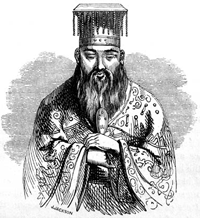
Confucius

Note: The Analects seem to be, like the Qur’an, disorganized: a mishmash of a scripture that must be studied in an order other than how it’s organized. Therefore, throughout these reasonings I’ve mostly utilized the text from The Original Analects by E. Bruce Brooks and A. Taeko Brooks, which are organized by subject with commentary. The only occasion during which I replaced their choice of translation, was when their word “gentleman” became my “higher man”, as this translation of junzi is highly controversial.

Confucianism, known in Chinese as the Tradition of the Scholars, is the eastern tradition of secular humanism. It is based on the teachings of Master Kong, whose name is known to the West as Confucius as a result of the first major reports on Chinese culture having been brought back by Marco Polo. His teachings (or the teachings attributed to him by his later disciples) were collected in a series of classics. These include The Analects, which are among the most revered and best preserved writings in world secular philosophy.

Unlike in the West, where so many of the founding writings of our humanism were destroyed by Christians, by time, and by feuding philosophical traditions, the teachings of Confucius were preserved with reverence by followers who had great respect for their sages, and are now considered to serve as the foundation for an entire civilization, conferring upon it stability, pride, and a deep sense of its own tradition and cultural wealth.

A general overview of the Confucian system will reveal a deep concern with stability, harmony and order, with emphasis placed on respect for elders and on the use of ceremony to secure stability. In this essay, as is now customary, I will present an Epicurean interpretation and commentary on the system. I will also argue that there are therapeutic components to Li, the ritual teachings, and point out some of the parallels between the two philosophies.

On the Rectification of Names

Epicurean masters have always been adamant that words without clear definitions, or that bear no relation to things in nature, must be avoided. Please refer to the Reasonings About Philodemus’ Rhetorica, the portion “Against Obscurity”. This was a major concern in Philodemus, and ergo we must imagine it was for the founders of Epicureanism. This notion is used (and, I believe, misused at times) in Confucius’ doctrine of the rectification of names. On the doctrine, Wikipedia says:

Confucius believed that social disorder often stemmed from failure to perceive, understand, and deal with reality. Fundamentally, then, social disorder can stem from the failure to call things by their proper names, and his solution to this was zhèngmíng (Chinese: [正名]; pinyin: zhèngmíng; literally: “rectification of terms”).

We begin to see, immediately, that in Master Kong’s tradition there is an association between nature (reality) and societal order. This is seen in societies with rigid class divisions and authoritarian governments, but also in societies where the philosophers of the ruling class are the proponents of narrative. Confucius certainly was one such philosopher of the polis/state. To shed some light on how this Heaven-focused naturalism affects our worldview, I should cite a passage from On Why Materialism Matters, where I argue that the study of nature presents us with a universe that emerges from the bottom-up instead of being “governed” from the top-down, and then explain:

The idea that the universe is “run” from the top down reflects a worldview that has obviously been favored by the ruling classes from the early times of the divine Pharaohs and god-kings.  It’s old trickery, the vestige of a very old ideology, one that has absolutely no foundation in the study of nature.  When we study nature, we see that there is absolutely no reason to suppose that things evolved backwards: they have always emerged and are always emerging.

It is true that much of what is enshrined in the Confucian traditions of Li, or ritual etiquette, constitutes what most Americans would identify as, well, ass-kissing. To be fair, we should let Master Kong speak for himself in Analects 13:3, and view him on his own terms. Notice the Yoda-like chain-of-causation reply by the Master:

Dz-lu said, “If the ruler of Wei were waiting for the Master to run his government, what would the Master do first?”

The Master replied, “It would certainly be to rectify names, would it not?”

Dz-lu said, “Is there such a thing? The Master is off the track. What is this about rectifying?”

The Master said, “How uncultivated you are, Yu! The superior man, with respect to what he does not understand, should maintain an abashed silence.

If names are not rectified, language is not in accordance with the nature of things. If language is not in accordance with the nature of things, affairs cannot be carried on to success. If affairs cannot be carried on to success, proprieties and music do not flourish. When proprieties and music do not flourish, punishments will not be just. When punishments are not just, the people do not know how to move hand or foot.

Therefore a superior man considers it necessary that the names he uses may be spoken appropriately, and also that what he speaks may be carried out appropriately. The superior man’s relation to words is to leave nothing whatever to chance.”

We will consider how rituals and propriety affect punishments and legal protocol in the later portion on Li. We are here concerned with how a philosopher “leaves nothing whatever to chance” when expressing himself. We begin to see the transparency exhibited by the Epicurean masters, who frequently criticized the rhetors and those who obscured speech, or used flowery words, to say nothing or, worse, to adorn lies. The decency of plain speech is hailed as a virtue in both traditions.

The Master said: “Someone who is a clever speaker and maintains a contrived smile is seldom considered to be a really good person. – Analects 1:3

Clever words confuse virtue. – Analects 15:27

Words must reach their goal. – Analects 15:41

Master Kong was not what we would today call politically correct, and he served the interests of the state and of the ruling classes. It is here that the rectification of names became an excuse to justify relations that are based on domination which do not necessarily find themselves justified in the study of nature: women must serve their husbands, and indeed Master Kong does express strong opinions against women. He also argued that if a superior loves his inferiors, he will make them work. Rectification of names implied that not only must a parent act like a parent and a son or daughter like such, but also that a ruler must act like a ruler, and a servant must act like a servant.

The rectification of names is tied to the idea that virtues vary according to the role, for purposes of efficiency. Etiquette and rules of propriety or yi (which translates as “rightness, morality, appropriateness”) are then tied to each societal role. Proper adherence to the virtues tied to one’s role produces the most efficient and harmonious society.

Duke Ding asked how a ruler should employ his ministers and how a minister should serve his ruler. Confucius replied, saying: “The prince employs his ministers with propriety; the ministers serve their prince with good faith.” – Analects 3:19

This may be quite appropriate, particularly in the case of parental roles to discipline, educate and guide children. If these roles are inverted or not fulfilled, there is disharmony. But there is a point where, by making itself useful to the rulers, the philosophy becomes a tool to advance what we Epicureans call cultural corruption. At least one Analect proposes an unnatural deontology (a duty-based morality) where a righteous man is expected to blindly follow orders even if this is a danger to him.

To see profit but think of right; to see danger but accept orders. – Analects 14:12

This, to us, constitutes a Stoic view of morality and duty which is not based on the study of nature and which celebrates resignation while letting fate decide the results of our blind obedience. This is a symptom of top-down narratives that seep into naturalism.

Moral Authority and the Importance of Role Models

To be fair, some of the narratives of common people do find their way into the Analects, which also teach that “to be poor and without resentment is difficult” (Analects 14:10). There are a couple of instances of anti-authoriarianism, or at least checks and balances, where those being ruled reserve the right to judge a superior or ruler.

But if he’s not good and everyone obeys, will this not destroy a state? – Analects 13:15

Raise up the straight and put them over the crooked, and the people will be submissive. Raise up the crooked and put them over the straight, and the people will not be submissive – Analects  2:19

If a ruler is evil, he will find it difficult to rule and will likely need to rule by force. That a master may lead by virtue has already been compared to Epicurean teachings in my Reasonings on Philodemus’ On Frank Criticism, where I said:

Confucius said that when leaders are virtuous, the people naturally feel shame when they are wrong whereas when leaders are not virtuous, they rule by fear instead and people follow the law for fear of punishment.

… We must also … distill one further insight from Confucius’ observation. Liberal societies are not a good thing in themselves: healthy association and wholesome leadership are required to make them virtuous and happy societies. In other words, it’s not enough for people to not be ruled by fear, and one of the ways in which Epicureanism is meant to work for our constant moral self-betterment, is by us avoiding the shame of disappointing the love and loyalty of our caring friends, particularly the wisest and most virtuous among them.

In other words, Master Kong theorizes that evil rulers have no choice but to be authoritarian. Virtuous rulers do not have to, because in the presence of virtuous leaders, people experience shame and fear of disapointment. With this discourse, the philosopher influenced rulers to be kinder, more virtuous, and generous.

The Master said: “If you govern the people legalistically and control them by punishment, they will avoid crime, but have no personal sense of shame. If you govern them by means of virtue and control them with propriety, they will gain their own sense of shame, and thus correct themselves.” – Analects 2:3

He developed a theory of De (moral force, or moral authority, sometimes translated as excellence), saying that it is contagious. Some Confucian traditions teach that moral authority has cultural and magical-religious power, although this is probably extra-canonical. What Analects 2:1 says is that a great man with De is like the pole star: other stars bow to it. Elsewhere in Analects 12:19, there is a famous reference to how great leaders are like the wind that makes the grass (the common people) bend.

In this sense, Master Kong’s contribution to philosophical traditions of non-violent conflict resolution is praiseworthy. For the powerless, the only non-violent resources that have worked historically to successfully create long-term societal change and end oppression have been the boycott (Martin Luther King, Jr and Ghandi) and the political act of coming out (gay, atheist, etc.) to confront people’s bigotries, but these carry potentially great risk. On the other hand, by speaking to power in these terms, Master Kong is proposing that rulers rule with propriety and fairness and arguing that, by this virtue of moral force (De), rulers can govern and bring stability without the use of force.

De is also a quality that increases with age, and serves to justify respect for elders. Like Nietzsche’s example of the honey sacrifice, Master Kong also argues that we should respecting elders because age increases ataraxia and wisdom (Analects 2:4). Just as by associating with good and happy people, we gain good and happy qualities, similarly association with people who have great moral force increases our own moral stamina. For this reason, it is almost universally preached that the practice of philosophy requires frequent wholesome association.

Honoring a sage is itself a great good to the one who honors. – Vatican Saying 32

Master Kong lived during times of great turmoil and frequently had to move from one city to the next to avoid conflict, which is why the order of priorities that Master Kong established for government was: 1. confidence of the people, 2. food, and 3. weapons. Epicurus also lived through similar times, experienced exile and used the Garden as a place to stay away from politics. We may judge Confucian emphasis on tact and protocol, as well as his advise on government and what may seem to us like an exaggerated focus on stability, as an adaptation to the difficulties of living in violent times.

Confucian Naturalism

Death is nothing to us. – Epicurus

It is clear that Master Kong’s doctrines are for the living, for this world and for human society. In this sense, Confucianism is a humanism and a naturalism (rather than a doctrine based on the supernatural). Like the Epicurean masters, Master Kong taught that reverence for the ancestral spirits and gods had a beneficial moralizing influence on the person engaged in worship and constituted a set of morale-building ritual techniques. Piety has more to do with the one doing the honoring than with the one honored. He refused to entertain ghost stories and supernatural claims.

The master never discussed strange phenomena, physical exploits, disorder or ghost stories. – Analects 7:21

Chi Lu asked about serving the spirits. Confucius said, “If you can’t yet serve men, how can you serve the spirits?” Lu said, “May I ask about death?” Confucius said, “If you don’t understand what life is, how will you understand death?” – Analects 11:12

Tian, or Heaven, is a critical component of Confucian naturalism, and one which draws some superstitious elements into the tradition. This heaven has a law, an order, ergo, its reverence is tied to ideas about Earthly government, which is then believed to be aligned with Heaven. Unfortunately, it also has a movement, ergo astrological predictions, oracles and other superstitions find justification in it.

Although immanence is stressed, there is also a numenic and transcendental component to this philosophy. Tian sounds at times like the Force from Star Wars, a mysterious, supernatural reality that is to be held in awe. However, it must be noted that Heaven bears some resemblence to Epicurean references to Nature as our Guide because it’s tied to nature and that which we can’t control (generally understood as many of the forces that shape destiny). Kurtis Hagen argues that

Misleadingly translated as “Heaven,” tian refers to the sky (Analects 19.25), and to the conditions and regularities of nature (Analects 17.19), which are held in awe (Analects 16.8). Also, tian often refers to that which is beyond human control (see Analects 9.5 and 9.6, 11.9, 12.5, 14.35). In addition, it has associations that carry over from earlier religious conceptions, which link it with ancestors and spirits.

In the Xunzi, (Heaven) as nature is stressed.

Heaven is broadly understood as reality, as the nature of things, as the laws of nature. It can also be interpreted as our own nature, insofar as it is nature that confers upon us our DNA, and ergo to a great extent, our destiny, our fate, “that which we can’t control”, which was stipulated about us before we were born. To whatever extent things are determined by nature, Master Kung attributed these things to Heaven.

There is as much of Nature beneath our feet and all around us, as there is of Nature in the skies. Why speak of Heaven, instead of Nature? Why must Nature/Reality be transcendental? I think this has to do with stressing that all the things that lie outside our control are found in Tian, and so it becomes a useful concept (particularly in therapeutic ceremony) tied to necessity and to our natural limits. There is also an aesthetic and spiritual component to Heaven.

The Master said: “The noble man stands in awe of three things: (1) He is in awe of the decree of Heaven. (2) He is in awe of great men. (3) He is in awe of the words of the sages.” – Analects 16:8

Perhaps this decree of heaven is the same as the laws of nature? In any case, Heaven literally means the Sky, but stands for cosmos, for destiny, for reality, for Nature, and is of enormous philosophical importance in Eastern naturalism.

Ceremony, the Social Contract and Stability

The first thing to understand about Li (which translates as “ritual propriety, etiquette”), which is central to Confucian tradition, is that ceremony and ritual are aligned with diplomacy. Li not only stipulates proper greetings and protocol for good working relations between the people in different societal roles (filial piety between children and parents, relations between teachers-pupils or rulers-peoples, etc.), but also is useful in law and justice, for reconciling kings/kingdoms, for reconciling enemies and sealing covenants between rulers or clans. Hence the importance of knowing and following ceremonial protocol.

Li exists in every civilized society, to some extent. There are marriage and funeral ceremonies, and usually ceremonies to welcome new children into the tribe or family (baby namings, baptismal rites). In America, we have strict rules as part of our judicial protocol, that govern behavior when we attend courts. There are societies in Oceania where elders gather in a sacred tree, the nakamal, to drink the drink of peace (kava) to settle disputes and reconcile enemies. Ritual can be cathartic and redemptive.

It is possible that Li is an inherited instinct, an archetypal element in human nature, and therefore a significant element which has not been given enough attention in Western naturalist philosophical traditions. Even chimpanzees have their own culturally-ordained greetings and grooming behavior expected between members of different ranks.

These ceremonies confer a sense of establishment. They secure stability, continuity and tradition. Epicurus recognized Li (ritual) as a preserving societal principle by instituting the eikas celebrations on the 20th of every month, and stressing their importance in his last will.

And from the revenues … make separate provision for … the meeting of all my School held every month on the twentieth day to commemorate Metrodorus and myself according to the rules now in force. – Epicurus, in his Last Will

I believe that the celebrations on the 20th of every month were part of how Epicurus applied the theory of the social contract to securing the cultural continuity of Epicureanism, and I believe that this is how Epicureanism as a school of philosophy is supposed to work. An oath was made by his pupils, which may have included the agreement to observe of “the sacred festival table“. Epicurus would not have mentioned that there were “rules now in force” if these rules had not been created through a contractarian system, which is the only means consistent with Epicurean doctrine to bring about a sense of duty. It is in this manner, and in this manner only, that Li is tied to morality: a ceremony can only be a duty if it is contract-bound.

By declaring the oath, his pupils entered into a social contract that was created with the purpose of making sure that the words and the legacy of the original founders would reach future generations. A couple of centuries later Philodemus, in On Piety, mentions that Epicurus is said to have warned against “violating the covenant of the sacred festival table”. What this means is that the oath successfully produced centuries of vibrant cultural life, and that the festival table was still viewed as the sacred ceremonial duty of all the school’s affiliates during the days of Philodemus of Gadara (who lived in the First Century of Common Era).

The oath to Epicurus was fulfilled through ceremony. It created a responsibility to continue a monthly gathering, and a simple set of ceremonial protocols, a natural and necessary measure of Li. This is how the stability of our own tradition was preserved well into the Christian age, and excelled that of all the other schools of the Hellenistic period. The tradition didn’t end until Justinian had all the philosophical schools that competed with Christianity closed in the 6th Century.

This is just one example of how ceremony ensures stability, order and tradition, as Master Kung proposed.

There is, of course, an aesthetic and harmonious component to Li. Ceremony should also create beauty and produce pleasure. Why not?

Li can assist with self-cultivation and self-expression, and have therapeutic and artistic/creative value. Ceremony is an art and an act of cosmos-creation and self-creation, in a sense, part of what the Greeks know as biou techne (art of living). It can be a way of creatively resolving our own inner conflicts and of expressing our good-will, our gratitude, our yay-saying, of asserting who we are with regards to the cosmos, to others, to reality, to our own problems, to death, and to life. According to Herbert Fingarette, who authored The Secular as Sacred, through Li the individual incorporates and extends himself into the matrix of tradition. He or she may re-contextualize the self as part of something greater. In many primitive cultures, this something is magical, but it may just as well be psychological. Through Li, a person may align himself with self-chosen virtues, with a worldview, or with a school’s masters, and therefore gain a sense of transcendence in history and time, find his/her place in society.

On the Higher Man

Just as, in our own tradition, we explore what a higher human being lives and acts like in the image of the self-sufficient, self-governing Autarch, and just as Nietzsche carries out a similar exercise with the Overman, Master Kong proposes that there is a higher man (junzi), whom he contrasts to the little man, and who possesses the following qualities: he engages in a process of contant self-cultivation, mainly through education, is respectful of elders, an assiduous servant, and is kind.

… is steadfast but not stubborn. – Analects 15:37

… easy to serve but not hard to please … – Analects 13:25

… (his) speech is sincere and honest, and (his) way of carrying (him)self is earnest and reverent … – Analects 15:6

… From afar, he appears majestic; close up, he seems warm; listening to his speech, he seems polished. – Analects 19:9

When substance predominates over style, it is crude. When style predominates over substance, it is pedantic. When style and substance are in balance, then you have the higher man. – Analects 6:18

Keep in mind, here, that style is also related to Li, refinement, good manners and etiquette. Because the rules of propriety are rigid, there is always the danger of empty ritual and the higher man must exhibit sincerity and presence when in social situations. The Confucian higher man, sometimes translated as a gentleman, is also self-sufficient.

The Master said: “The noble man seeks within himself. The inferior man seeks within others. The noble man strives but does not wrangle. He has friends, but doesn’t belong to a clique.” – Analects 15:21-22

The Master said: “The noble man is in harmony but does not follow the crowd. The inferior man follows the crowd, but is not in harmony.” – Analects 13:23

The higher man is not a utensil (2:12) to be used by others, but he uses his inferiors in ways that are appropriate (not excessive). This is reminiscent of Philodemus’ arguments that it is wrong for a philosopher to employ others in mining or to create other exploitative labor conditions. These teachings constitute moral guidance particularly applicable in societies with high degrees of inequality.

Constant Self-Cultivation Through Education

We might be able to conduct a comparative evaluation with Nietzsche’s Overman, who must constantly engage in self-overcoming to realize his highest potential, but this process of self-overcoming is not explained in detail. With N., each philosopher is left to determine how to overcome the self.

Master Kong, on the other hand, was explicit and clear on this: constant self-cultivation requires education. Confucianism teaches that man is perfectable through education. The higher man is an educated man, a scholar, and education is a long-term process that incorporates ethics, human values and philosophy, lasts a lifetime and never ends.

The virtues of the student include love of learning, being easy to correct (Analects 1:14), ability and insight enough to learn from both the more virtuous and the less virtuous (Analects 7:22), and ability to reflect when he studies (Analects 2:15).

The wisdom tradition related to learning includes advise for memorization and maximizing one’s results: the student, for instance, must also engage in leaving ideas alone for a while, sleep on them, and return to them at a later point.

Imperturbability as an Ideal

The higher man is poised and unruffled, the little man is always in a dither. – Analects 7:37

The Master was warm but strict, imposing but not aggressive, respectful but calm. – Analects 7:38

A man without stability will incur shame. – Analects 13:22

Innocence, as a component of imperturbability, suggests inner perfection and echoes doctrines on having no reason for guilt found in Epicurus’ Principal Doctrine 37 and in A Few Days In Athens. Epicurus says innocence helps us by not being regretful of past deeds, which contributes to tranquility and helps to cultivate imperturbable, abiding pleasure. Here is Master Kong’s parallel saying:

Sima Niu asked about the qualities of the noble man. Confucius said, “The noble man is free from anxiety and fear.” Niu said, “Free from anxiety and fear? Is this all it takes to be a noble man?” Confucius said, “If you reflect within yourself and find nothing to be ashamed of, how could you have anxiety or fear?” – Analects 12:4

On Friendship

The enjoyment of cultivation in music and ritual, the enjoyment of speaking of the goodness of others and the enjoyment of being surrounded by friends of good character are all beneficial. – Analects 16:5

As in the case of Epicurean philos, in Confucianism, there are specific ethical guidelines that rule friendship. In addition to being loyal, friends must be invested in each other’s constant moral self-betterment and be a good influence on each other’s characters.

Speak to your friends honestly, and skillfully show them the right path. – Analects 12:23

There are also injunctions against being accusatory, as this leads to  separation (Analects 4:26), and (just as Philodemus does in On Frank Criticism) Master Kong warns his followers against flatterers, calling them dangerous (Analects 15:11).

The closest thing to our philos (virtuous friendship, in Epicureanism) in Confucianism is ren, which has multiple translations and is tied to the experience and the art of friendship. It can translate as humanity or authoritative conduct, virtue within society, manly or humane (as opposed to beastly), and carries the connotation of humane-ness. According to wikipedia, it’s “the good feeling a person experiences when being altruistic“, but according to Brooks & Brooks, the word carries different meanings according to context.

Ren sounds like the parallel Scandinavian concept of frith, the peace and safety we feel when in good company. It’s the harmonious, peaceful and happy feeling among members of a societal group that results from the application of the golden rule.

What you don’t want done to yourself, don’t do to others. – Analects 12:2

Now the ren man, wishing himself to be established, sees that others are established, and, wishing himself to be successful, sees that others are successful. To be able to take one’s own feelings as a guide may be called the art of ren. – Analects 6:30

The virtue of ren is so quintessential to civilized human life that it can properly be understood as the art of being human. In other words, we become truly human-like by association with other humans.

On Piety

“Sacrificing as if present” means sacrificing to the spirits as if they were present. Confucius said, “If I do not personally offer the sacrifice, it is the same as not having sacrificed at all.” – Analects 3:12

The art and ceremonies of piety require sincerity in order to have the intended effects on one’s character. The practitioner must not only act as if the spirit was really there (regardless of supernatural belief: again, as was also explained by our own Masters, piety is beneficial for the one doing the honoring), but he must also be present himself. Master Kong insists that without this presence of mind, Li is void and ineffective. If carried out with presence, piety has similar effects as wholesome association.

There are other culturally-sanctioned rules regarding filial piety. One is not to travel too far from one’s parents (Analects 4:19), and must always remain available to take care of them in old age. As for reverence after they die, there is a period of ritual mourning of three years. Parents are the main shapers of character, and so Master Kong was extremely conservative in this regard when questioned about the practical inconveniences of this, asking his pupil “Didn’t your parents also love you for three years“?

How inhumane Zai Wo is! It is only after three years that a child avoids his parent’s embrace. The three-year period of mourning is observed throughout society. Wasn’t Zai Wo loved three years by his parents? – Analects 17:19

In ancient Western humanism, respect for one’s elders was no different. Epicurus himself engaged in familial piety, and observed feasts and sacrifices for his deceased family members.

Although filial piety must always be expressed while our parents are still alive, there are also proper ways to remember them after they die. Eastern tradition posits that a family shrine, certain offerings and pious practices are required, and Master Kong taught his disciples to exhibit an attitude of sincere sadness while mourning. In Epicureanism, on the other hand, loved ones who are gone must be remembered with gratefulness by the virtuous and their remembrance is a celebration of their lives.

Further Reading:

The Original Analects

In Happy Twentieth!, Luis Granados invites humanists to celebrate the traditional Epicurean monthly feasts of reason

Confucius: The Secular as Sacred, by Herbert Fingarette

INTERNATIONAL SOCIETY OF FRIENDS OF EPICURUS

Report on the 5th Pan-Hellenic Symposium of Epicurean Philosophy

Dear Friends,

With great pleasure I am sending you the Report on the recent Pan-Hellenic Symposium … We are daydreaming to organize an International Symposium of Epicurean Philosophy in Athens (and invite you first of all) sometime in the next 2-3 years, when/if the circumstances allow us.

With Epicurean Friendship,
Christos Yapijakis

5th Pan-Hellenic Symposium of Epicurean Philosophy – Report
February 7-8, 2015 – Cultural Center of Pallini, Athens
Free entrance

For the fifth consecutive year since 2011, about 400 people from all over Greece, the largest ever sum of participants, gathered at the Cultural Center of Pallini in Athens in order to attend the two-day Pan-Hellenic Symposium of Epicurean Philosophy. The Symposium is organized, with free entrance, by the Friends of Epicurean Philosophy “Garden of Athens” and “Garden of Thessaloniki” under the auspices of the Municipality of Pallini. The Pan-Hellenic Symposium of Epicurean Philosophy takes place every year in February, because Epicurus was born in that month, and always in Pallini, because that particular municipality of modern Athens metropolitan area includes the ancient Athenian demos of Gargettus, from which Epicurus originated.

The 5th Pan-Hellenic Symposium of Epicurean Philosophy was a great success and took place in a warm friendly atmosphere, despite the cold weather. There were two sessions on the first day and two sessions on the second day of the Symposium with 19 oral presentations, two discussions, 10 poster presentations, as well as three artistic intervals.

During the opening session of the first day on Saturday, February 7, 2015, the speech of the Mayor of Pallini Athanassios Zoutsos was applauded enthusiastically by all participants. The Mayor announced that the development of a green area of 5000 square meters, named “Garden of Epicurus”, was completed and will include initially a bronze relief sculpture offered by the renowned sculptor Aspasia Papadoperaki, a member of The Garden of Athens, and in the future a statue of the philosopher, and a wall with some of his Principal Doctrines. In addition, he said that a website with the Declaration of the Right of Happiness in the European Union will be launched within a month initiating a campaign of collecting signatures in order to bring the issue to the EU parliament. The Mayor also announced the funding of a book of Proceedings in English which will include the 40-50 best presentations of the first five Pan-Hellenic Symposia of Epicurean Philosophy, edited by members of the Garden of Athens.

Following the initial greetings of representatives from the Greek Gardens, the audience experienced the formation of a world-wide bridge of friendship, with the moving salute from the Consul Sienra on behalf of President of Uruguay José Mujica, and cordial greetings from Hiram Crespo (Society of Friends of Epicurus), Geoff Petersson (Garden of Sydney, Australia), and Cassius (newepicurean.com, USA).

Session 1 “PRINCIPLES OF EPICURUS’ PHILOSOPHY” started with some parts of the Letter to Menoeceus written in verses by poet Thanassis Yapijakis and beautifully recited by actor Giorgos Klonis. Then, the presentations “Life of Epicurus” and “The philosophy of Epicurus” covered a broad introduction for those attendants with limited knowledge of Epicurus and his philosophy. The topics of “Multi-valued logic” of Kostas Karderinis and “Manifold way” of Dimitris Altas discussed extensively the free and multileveled Epicurean way of thinking.
As an example of how the Epicurean philosophy may affect political thinking and realistic policies in the modern world, the video of the inspired speech of President of Uruguay José Mujica in Rio de Janeiro (Brazil) at the 2012 Earth Summit was presented and enthusiastically applauded by the Symposium attendants.

Session 2 “THE EXPERIENTIAL APPROACH TO EPICUREAN PHILOSOPHY” started with presentation “Free will according to Epicurus” of Christos Yapijakis who discussed the philosophical orientation of Epicurus’ thoughts on the matter, as well as in brief the current scientific knowledge regarding chance in nature and regarding human conscience. Two more presentations covered the topics “The Value of Epicurean Reciprocity in our Modern Era” by Dimitris Dimitriadis and “The Epicurean Philosophy as the Peak of Hellenism” by Dimitris Iarmakopoulos, followed by “Presentation of Publications and Websites of Greek Gardens” by Takis Panagiotopoulos, who discussed the over one thousand pages worth of greek books published by the Friends of Epicurean Philosophy in the last four years, as well as the wealth of information in greek websites epicuros.gr and epicuros.net.

The Session was followed by scenes from a new movie “Orpheus: How Not to Speak” by the reknown director Theodoros Marangos, which features the misery and lack of philosophical knowledge of average modern Greeks. Finally, a live discussion on “The experiential today and tomorrow of Epicurean philosophy” kept the audience until 10 pm, when it was interrupted so that the Friends of Epicurean Philosophy could participate in an actual symposium with dining, drinking, and dancing in a nearby taverna named “Aristoteles”.

On Sunday, February 8, 2015, the Mayor of Pallini Athanassios Zoutsos and the Friends of Epicurean Philosophy visited the area “Garden of Epicurus” and discussed plans for its future development.

Session 3 “EPICUREANS IN ANTIQUITY” started with “The Epicurean Naturalistic Approach to the Gods” by Giorgos Bakogiannis that presented the atomic reality of gods according to Epicurus, Velleius, Philodemus, and Lucretius. The following presentations focused mainly on the Epicurean philosopher who became famous from the Herculaneum papyri: “Philodemus, the Epicurean Philosopher” by Pavlos Kopakas, “Philodemus’ On Signs” by Panagiotis Papavassiliou and “On Wealth” by Giorgos Kaplanis.

The session was followed by an artistic interval in which the famous actor Gerassimos Gennatas most vividly read the Letter to Menoeceus and Litsa Pitsikali (a member of The Garden of Athens) played some selected piano pieces.

The final session 4 “THE ETERNAL VALUE OF THE EPICUREAN PHILOSOPHY” included presentations such as “Epicurean Philosophy and Philanthropy”, an inspired speech by professor of Applied Ethics Evangelos Protopapadakis; “Empiricism as a Continuation of Epicurean philosophy” by Litsa Pitsikali; “Time and Epicurean Worldview” a comprehensive presentation by Babis Patzoglou; “The Eternal Importance of Epicurean Philosophy” by Aspasia Papadoperaki; and finally “Epicurean Socialization: Family and Social Justice” by Themis Michos.
The following discussion “What We Learned in this Symposium” stirred the audience about several issues. Mostly the issue of the belief in Gods was lively discussed with everyone agreeing that Epicurus and most ancient Epicureans believed in the existence of Gods, and that all modern Epicureans tend to agree in lack of divine providence and in religious freedom of people, just like the Epicurean Thomas Jefferson first established in USA.

From the ten poster presentations, that were viewed during the intervals of the Symposium, the audience seemed to discuss more the following:

– “The president of Uruguay and philosopher politician Jose Mujica and his Epicurean influences” by Babis Patzoglou and Takis Panagiotopoulos

– “Francis Wright, the Epicurean pro-women’s rights and anti-slavery activist” by Eleni Michopoulou and Christos Yapijakis

– “The Cups with the Skeletons: A hymn to life and a suggestion for enjoying the present” by Takis Panagiotopoulos

– “Some thoughts on the Epicurean views and criticisms of mathematics” by Michael Aristidou

– “How we find the figure of our master philosopher Epicurus in Raphael’s The School of Athens” by Elli Pensa

The Symposium was a great success and was held in a friendly and delighful atmosphere. The only problem was that a friend from the Garden of Thessaloniki who usually video records the Symposia was gone unexpectedely ill so he did not attend, therefore only voice recording of the presentations and still pictures were taken.

Delighted with the amazing weekend, the Friends of Epicurean Philosophy in Greece renewed their appointment for the 6th Panhellenic Symposium, next year in February 2016.

INTERNATIONAL SOCIETY OF FRIENDS OF EPICURUS

On Natural Community

In Epicurean discourse we often get into discussions of minimalism from the perspective of natural and necessary desires: minimalism not for the sake of frugality and simplicity, but for the sake of having a deep conviction of what is and what isn’t necessary.

The natural measure of wealth is that which corresponds to our natural and necessary desires.

Thus, in our discussions of autarchy we talk about the natural measure of wealth, and during Pride month I discussed the natural measure of Pride (many people are forced into a healthy re-assessment of their self-worth as a result of bigotry and mistreatment). In a naturalist evaluation of equality, which is a term so misused and confusing, I argued that our shared, natural limitations and needs provide the basis for a REAL, experienced equality and that, because all mortals have a universal need to feed, when we gather around the tables we can experience true communal equality.

The contributors of the Las Indias blog, a bilingual virtual community dedicated to cooperative ethics which proclaims itself proudly Epicurean, has been steadily making the case for natural community. In a recent piece, David the Ugarte makes the case for the Epicurean communal model:

Indianos takes part in an Epicurean communitarian tradition: the community is a «society» of friends. From the Epicurean point of view friendship (fraternity) and knowledge are the central goals of community itself. So, you will accept and look for people you can become friend of. But you also will put (an)other condition to them: to share basic common contexts in order to be able (to) learn together. Consequently, community is something that happens (within) a cultural and philosophical common ground, not just a set of rules open to everybody.

The link to Epicurean communitarian tradition leads to another blog entry on community and happiness. At the core of Las Indias’ communitarian doctrine we find Adlerian theories on natural community (which is smaller in scale and based on REAL interpersonal relations), as opposed to non-natural or Platonic community: artificial ideological constructs and narratives that people use to weave their identities but that do not constitute real communities or translate into real interpersonal relations. Nation-building is the prime example. There are many other imagined communities based on political strategy and ideology that also fit the Platonic definition of being artificial communities.

Notice, also, how communities of friends evolve naturally and organically. It is easier to become friends with our friends’ friends because there is already some familiarity. A recent 20-year-long study proves that happiness (and sadness) spread like a contagion, which means that even at very subtle levels we mirror behavioral and psychological patterns in our social environment. Herd instincts exist in all social entities, whether we’re aware, whether we accept this or not. The fact that the term “contagious” is used in the study, places social relations within the framework of nature, not culture.

The idea of Epicurean friendship and intimacy is that we should be invested in the happiness, self-overcoming and moral betterment of our friends (and they in ours). In light of recent research, it makes perfect sense why this is so important: unlike with patriotic narratives and imaginary communities, in natural communities the happiness of our friends has a direct, tangible, measurable effect on our own long-term wellbeing.

Recent research on isolation demonstrates how it feels cold in the body, and how it’s a health risk factor that shortens one’s life span on par with obesity and smoking. People need to feel both productive and loved. If and when they don’t, their bodies and minds begin decaying. In other words, community is both natural and necessary, and (as with wealth, pride, etc.) people need at least a natural measure of community in their lives.

What to do? The wisdom tradition of the Scandinavians says it well in stanzas 43-44 of the Havamal. Call up your good and true friends and see them frequently, blend your mind with theirs, befriend their friends, never betray them, and honor them with gifts:

To his friend a man should bear him as friend,
to him and a friend of his;
but let him beware that he be not the friend
of one who is friend to his foe.

Do you have a friend whom you trust well,
from whom you crave good?
Share your mind with him, exchange gifts with him,
make efforts to find him often.

Further Reading:

Review of the Book of Community

logo

Reasonings on Thus Spake Zarathustra

Zoroaster4

Nietzche’s Zoroaster, the Atheistic Prophet 

When Zarathustra was alone, however, he said to his heart: “Could it be possible! This old saint in the forest hath not yet heard of it, that God is dead! – Thus Spake Zarathustra

Why did Nietzche choose to appropriate the figure of the Persian prophet to achieve his most important philosophical and spiritual project?

The historical Zarathustra (aka Zoroaster) did not just invent the idea of the One God (Ahura Mazda, whose name meant Wise Lord) and write the first Bible (the Avesta), but also proposed the duality and eternal, cosmic confrontation between good and evil (monotheistic morality, with the Holy Spirit / Spenta Mainyu and the Evil Spirit / Angra Mainyu as equal in power), of the final judgement, of the Messiah or World Savior to come in a future Age (whom he called the Saoshyant), and almost all of the ideas that later became staples of Christianity.

As part of this cosmology of eternal battle between the forces of good and evil, the tradition of expelling spirits and exorcism is a major concern in Zoroastrian religion which takes up a significant portion of the Avesta, and we see a great concern with hygiene related to this that reminds us of the Old Testament.

For all these reasons, Nietzche chose Zoroaster instead of Abraham as the first monotheist and the inventor of God. Because Zoroaster created the original monotheistic morality, it should be Zoroaster’s responsibility to reform the philosophical foundations of our civilization now that they have crumbled. Therefore, Nietzche makes him undo what he did, revert the other-worldly cosmology that he created and produce a naturalist one for this world, to give meaning to the Earth.

I conjure you, my brethren, remain true to the earth, and believe not those who speak unto you of superearthly hopes! Poisoners are they, whether they know it or not. Despisers of life are they, decaying ones and poisoned ones themselves, of whom the earth is weary: so away with them!

Once blasphemy against God was the greatest blasphemy; but God died, and therewith also those blasphemers. To blaspheme the earth is now the dreadfulest sin, and to rate the heart of the unknowable higher than the meaning of the earth! – Thus Spake Zarathustra

An Epicurean Assessment

The concept of the meaning of the Earth is central to Nietzche. Like Lokayatas, atomists and others, Nietzche believed that there is no other world, that this is the only reality. In that sense, he was a naturalist. He’s properly classified as an existentialist who did not believe that things had inherent meaning. It’s within this framework that his mission then becomes to fashion new meaning, which he believed could be done through art, culture, music, literature, etc.

Our friend Cassius, of NewEpicurean.com, argues that Nietzche did not agree with our school on one important point, that is the issue of clarity of expression: he wrote often in parables, metaphors, and obscure language. It seems at times that he is speaking in code. The Nazi appropriation of his philosophy is the most concerning example of how this leads to misuse of people’s ideas. For the record, Nietzche was NOT a white supremacist.

However, we must appreciate Nietzche on his own terms: that his philosophy was clad in parable was consistent with his own proclaimed values.

In Thus Spake Zarathustra, Nietzche fashioned his own, personal new mythology and cosmology (here, myth is meant not as a lie but as a narrative that produces meaning in life), using the creative tools that he proposes people should use in their philosophical projects. In this way, he was just being authentic. His masterpiece is as much a work of philosophy as it is a piece of art that carries within it a cosmos, a worldview with its own aesthetic sensibilities.

The Despisers of the Body

If meaning of this world is the cure that Zoroaster brings to humankind, then what is the disease? It is the death cults, the worldviews that teach that there is an OTHERworld, and that we live in this world only for the sake of that OTHERworld for which there is absolutely no evidence. Since it is to the OTHERworld that people go when they leave this world, that OTHERworld is full of ghosts, it is full of death. If we live in this world for the sake of that world, we are living for the sake of death.

The existential repercussions, the misery, the evils that are birthed by this Earth-hating original sin are innumerable. In The Perils of Alienation I discussed some of these evils.

Everywhere resoundeth the voices of those who preach death; and the earth is full of those to whom death hath to be preached. Or “life eternal”; it is all the same to me. If only they pass away quickly!

The preachers of this OTHERworld-focused morality and worldview are evil parasites to the new prophet, but they also invite Zoroaster’s pity. They’re also mortals and seekers of meaning.

Here are priests: but although they are mine enemies, pass them quietly and with sleeping swords! Even among them there are heroes; many of them have suffered too much: so they want to make others suffer. Bad enemies are they: nothing is more revengeful than their meekness. And readily doth he soil himself who toucheth them. But my blood is related to theirs; and I want withal to see my blood honoured in theirs.

The Overman

Here is perhaps one of the most misinterpreted ideas in the Nietzchean wisdom tradition. The Overman (sometimes translated as Superman, in German Ubermansch) is an artist-philosopher, a self-creator who makes his own life and meaning. In a naturalist, evolving cosmos empty of Gods and of inherent meaning, mortals need an ideal to pull them forward and to build meaning with. Hence, Zoroaster teaches that man is a rope between the ape and the Overman, who then embodies our destiny and whatever narratives we build around the Overman are our self-chosen guiding visions for becoming and for the future.

One of the great misuses of Nietzche’s philosophy took place during the Nazi period. The Nazis also appropriated and distorted many other ideologies and fields of knowledge, from Christianity to Odinism to anthropology. The transcendental projects related to the Overman are not projects of eugenics, however this does not mean that these projects must be excluded from the Overman. This is not an either/or matter. The Overman must be fashioned independently by each individual. There’s at least one passage that calls for procreation as one way to transcend:

Not only to propagate yourselves onwards but upwards; thereto, O my brethren, may the garden of marriage help you!

But we know from other passages that the Overman derives his identity not from his lineage, his racial or national background, but from his self-chosen destiny. The identity of the Overman is anchored in the future, not in the past, which is why so many transhumanists identify with Nietzchean philosophy and why Nietzchean ideas feature prominently in so much of our science fiction.

In chapter 56, “The Old and New Tables”, Zoroaster calls for a new atheistic nobility that must rise to oppose the theistic populace and rulers. He is referring to our ongoing evolution from ape to Superman, our perpetual need to ever overcome ourselves, to the passing of the generations and how we are all bridges between the previous and the future generations. This nobility is not backward-looking and does not derive its identity from its roots, its race or familial lineage but from its self-chosen future:

O my brethren, I consecrate you and point you to a new nobility: ye shall become procreators and cultivators and sowers of the future.

Unto your children shall ye make amends for being the children of your fathers: all the past shall ye thus redeem!

It is precisely to make amends for the mistakes of our ancestors that this nobility must rise, to break with the past. And elsewhere he says:

Ye lonesome ones of today, ye seceding ones, ye shall one day be a people: out of you who have chosen yourselves, shall a chosen people arise: and out of it the Superman.

Zarathustra then talks about how the life-hating beliefs of the world-maligners are often given undeserved credit because they’re ancient. The false-honor of old, established beliefs is therefore understood as having a degrading and ignoble effect on the soul. It is within this content that Zoroaster calls for new projects of nation-building, community-building and people-building that are rooted in noble ideas, not noble lineage.

On Self-Overcoming

Epicurean therapeutic practices were used in antiquity as part of a process of constant self-betterment, and seem to be vindicated in Zoroaster’s doctrine on self-overcoming, which is related to the Overman. He argued that rather than judge envy as a sin, we should own our envy instead of judging ourselves for it, and that we should seek to cultivate the things we envy in others, as it is obvious that we find them desirable. In other words, the impulse towards the Overman can be found through sincere introspection.

There is one area of controversy here: the transhumanist movement believes that, as part of self-overcoming, people should seek to physically enhance themselves, even up to the point that they may be able to challenge death.

Epicurus, on the other hand, calls mortals to accept their natural limits and never to attempt to be more than humans and mortals. He was a naturalist who taught that by giving up our arrogant, unnecessary fantasies about immortality, we would find peace and ataraxia. Nietzche shared Epicurus’ anti-clerical message and criticized OTHERworldly promises and fantasies of an immortal life. But would Nietzche, as a naturalist, have agreed with some version of transhumanist immortality, if that ever materializes?

The other controversy here concerns the use of violence, which was advocated by the Nazis, in the implementation of transcendental projects related to the Overman. Our friend Cassius argues on this point:

So long as that is not interpreted as domination over other people, I think what Nietzshe was mosty saying is that the overcoming that we have to do is overcoming the limits placed by society!!!

That is why I think Nietzche and Epicurus are compatible on that point. That is a perfect example of how it is important to be careful with Nietzsche. If, as I indicate, he is saying to overcome the limits PLACED BY RELIGION AND SOCIETY AND MORALS, then he is correct. If he means “overcome the limits of nature”, then he would be wrong, but i do not believe that is what he meant or did say.

The Epicurean view on self-overcoming is that the acceptance of our natural limits confers tranquility, gratefulness, satisfaction, and imperturbability, and leads to the goal of a pleasant life established by nature itself. It is from cultural corruption that we acquire most of what must be overcome through philosophical hygiene, and the Overman can be a naturalist moral ideal in this regard. Here is Cassius’ opinion on this matter:

I agree with that, but the controversy arises in where those limits are. Yes we will die eventually, but should we strive to live as long as possible, if so how long, etc? I think Epicurus would say: Yes, the limits are there, but where they are EXACTLY is a matter of circumstance, and we should work to extend our lives of pleasure as long as possible.

Three Stages of Self-Overcoming

Like Sufi masters and teachers in other traditions, Zoroaster even maps out his followers’ stages of spiritual development for them along with the important tasks and states related to each stage. They are somewhat reminiscent of the three gunas, or qualities of material nature, in the Vedic tradition: tamas (ignorance), tamas (passion) and sattva (goodness).

In the first stage, man is compared to a camel, which is a beast of burden that lives in chains and must be docile and submissive. In this stage, man sees himself as worthy of mercy and lives on its knees, a slave of tradition.

When he realizes his degraded state of existence and seeks to emancipate himself from it, he becomes a lion. His previous state leaves him angered and indignant, and he begins smashing the old idols.

In the mature stage, he ironically becomes child-like because the third stage is creative: he forges his own morality and worldview. He has reached existential maturity and authenticity.

The Men of the Crowd

The criticism of the men of the crowd in our tradition is part of a larger trend among thelaughing philosophers, an assorted list of naturalists who mock and question traditional authorities and societal conventions, always based on philosophical insights into human nature and into the general study of the nature of things which oftentimes reveals the holes in the belief systems of the herd. Therefore, many of these philosophers profoundly distrust the views of the men of the crowd. Nietzche says:

Older is the pleasure in the herd than the pleasure in the ego: and as long as the good conscience is for the herd, the bad conscience only saith: ego.

Hence the need that philosophers have felt throughout the ages (this is seen in all cultures, from Indian sadhus, to Greek Cynics, to European intellectuals) to avoid the men of the crowd. Cassius Amicus adds:

One chapter I like in particular is chapter 51, “On Passing By”. I think that is a good application of the principle in PD39 that if you can’t be friends — just PASS BY – don’t force yourself into a confrontation.

He was here referring to Epicurus’ Principal Doctrine 39, which states: “The man who best knows how to meet external threats makes into one family all the creatures he can; and those he can not, he at any rate does not treat as aliens; and where he finds even this impossible, he avoids all dealings, and, so far as is advantageous, excludes them from his life“.

Note: Against the Men of the Crowd, a diatribe against anti-empiricists that calls adamantly for the development of evidence-based critical thinking skills, is included as part of the Elemental Epicureanism course and text. For more information, you may also visitElementalEpicureanism.com, a NewEpicurean.com project.

The Ungodliest Uttering

In many ways, Grandfather Nietzche is reminiscent of the sages of our own tradition, who were known for their use of powerful mantras or formulas as remedies for spiritual diseases. Thus Spake Zarathustra almost feels like an atheistic Qur’an or Bible when it boldly proclaims in chapter 52, which is titled The Apostates, the quintessential monotheistic declaration of faith to be “the ungodliest uttering”.

Zoroaster envisions the old gods as an ancient Epicurean would envision them: full of bliss, healthy, laughing, dancing, ecstatic. The old gods “laughed themselves to death”, he says. The jealousy of the monotheistic God is, to the innocence of an Epicurean heathen, a contradiction, an insult, a blasphemous projection of our own weaknesses and evils.

With the old Deities hath it long since come to an end: and verily, a good joyful Deity-end had they! They did not “begloom” themselves to death: that do people fabricate! On the contrary, they laughed themselves to death once on a time!

That took place when the ungodliest utterance came from a God himself: the utterance: “There is but one God! Thou shalt have no other gods before me!” An old grim-beard of a God, a jealous one, forgot himself in such wise: And all the gods then laughed, and shook upon their thrones, and exclaimed: “Is it not just divinity that there are gods, but no God?” He that hath an ear let him hear.

The Adrian Del Caro translation is clearer. It says: “Is godliness not precisely that there are gods but no God?”

This bizarre twisting of scriptural references constitutes, to all effects, liberation atheology. The death of God is as relevant an epiphany as any previous one, a true cosmological event that had its beginnings when the jealousy of the desert God revealed itself. This god would be the last to fall, but fall he would eventually.

Towards the end of Thus Spake Zarathustra, Zarathustra exhibits a prophet’s moral stamina and spiritual leadership in the Worship of the Ass scene. Here, he has surrounded himself with the higher men, which appear to be prototypes of the kinds of people for whom Nietzche is writing, as he does not have the herd as his intended audience. It appears that the higher men have concluded that it’s better to worship an ass than to worship nothing and to be atheistic. Zarathustra then confronts them, calling them wicked just as the ancient prophets did with the idolaters in the monotheistic scriptures.

The Worship of the Ass episode has the effect of being Zarathustra’s version of Moses coming down from the holy mount and finding his chosen people worshiping the calf. Under the new code, the new spirituality that he preaches, Zarathustra considers any and all act deification a transgression.

The Earthquake Discloseth New Fountains

Now, the process of doing away with the old, with the false morals and wrong views of those that came before us, is a destructive and disruptive process for sure, one that can be extremely disorienting for many. One passage says:

For the earthquake- it choketh up many wells, it causeth much languishing: but it bringeth also to light inner powers and secrets. The earthquake discloseth new fountains. In the earthquake of old peoples new fountains burst forth.

Notice, again, how Nietzche appropriates apocalyptic imagery straight from the Bible and Quran. He also compares the work of the philosopher to an earthquake, whose role is that of destroying worlds and rebuilding them, of re-creating the cosmos.

The Ugliest Human Being

In the narrative, the ugliest human is he who has killed god. The god-killer is despised because he has rejected that which gives meaning to the men of the crowd. This passage is at once a contemplation of the spiritual crisis that happens once religion is irrelevant, and a contemplation of the very real prejudice that atheists suffer. The ugliest man here takes refuge in Zarathustra:

They persecute me; now you are my last refuge. Not with their hatred, not with their bailiffs – oh such persecution I would mock and be proud and glad!

Zoroaster falls, and then finds the strength to stand up again after beholding the ugliest human, but that does not mean he isn’t terrified. The ugliest human does not mind the hatred of religious bigots, but Zoroaster’s terror worries him. The death of God is a great cultural precipice, and since man is a rope between ape and superman, it is only the beginning of a new transition to a great work, to a great awakening that will be difficult. There is a huge existential task before the god-killer. Zoroaster is overwhelmed with pityat the sight of the ugliest human, to which this human replies:

Thou hast divined, I know it well, how the man feeleth who killed him, the murderer of God. Stay! Sit down here beside me.

To whom would I go but unto thee? Stay, sit down! Do not however look at me! Honour thus mine ugliness!

They persecute me: now art thou my last refuge …. Their pity is it from which I flee away and flee to thee. O Zarathustra, protect me, thou, my last refuge, thou sole one who divinedst me: Thou hast divined how the man feeleth who killed him. Stay!

The ugliest man flees from pity, and prefers shame, deeming it appropriate. His eyes are wide open and his soul sober when he beholds the human condition, calling not for pity but for constant overcoming.

You are ashamed of the shame of the great sufferer.

In the text, a god that is all-seeing and all-pitying, who witnesses all of our failings, is deemed shameless (perhaps because, if such a hypothesis were to be accepted, this god yet chooses not to invervene). The killing of god is likened to revenge on a witness. In the end, Zarathustra then lets the ugliest human crawl into his own cave and live like the prophet did, in solitude, away from the men of the crowd.

Haunted by the Shadow 

Zarathustra later on encounters his shadow (his subconscious self), which has been with him in all of his wanderings and laments feeling aimless and not having a home. At first, he tries to run away from his shadow, but of course he can’t. He then confronts it, saying:

To such restless ones as you even a jail ends up looking like bliss. Have you ever seen how captured criminals sleep? They sleep peacefully, they enjoy their new security.

Beware that you are not captured in the end by a narrow belief, a harsh, severe delusion! Because now you are seduced and tempted by anything that is narrow and solid.

His encounter with the shadow reminds him of the dangers of wandering, perhaps a metaphor for the process of constant transition, self-betterment and self-overcoming. In the process of fashioning meaning, one is tempted to settle for creeds that constitute prisons for the soul.

Holy Laughter and the Devil of Gravity

The antidote for this danger becomes child-like laughter and dancing, Nietzchean sacraments which perhaps replace the Zoroastrian Spenta Mainyu (the Good, cheerful Spirit) and which oppose the evil influence of the Nietzchean devil of gravity, which here replaces the Zoroastrian Angra Mainyu (evil spirit).

I want to run alone, so that things clear up around me again. For that I’ll yet have to be long on my legs and like it. But this evening at my place – there will be dancing!

We must not forget that the historical Zoroaster falls within the tradition of stray-singers and drunken poets whose role it was to concoct ecstatic experiences; hence the ecstatic drink known as soma/haoma of the Vedic and Avestan traditions, and the kvasir of the poets in the Nordic tradition. There is a freedom-seeking shamanic and Dionysian aspect to this wanderer, and like all shamans, Zoroaster must be child-like, innocent, and he must never forget to dance. This is not the first or only reference to dancing as liberation. In a passage that should be deemed prophetic, if we consider the recent Charlie Hebdo events:

I should only believe in a God that would know how to dance. And when I saw my devil, I found him serious, thorough, profound, solemn: he was the spirit of gravity. Through him all things fall. Not by wrath, but by laughter, do we slay. Come, let us slay the spirit of gravity!

The historical Zoroaster was extremely concerned with how to banish and exorcise evil spirits that bring torment, dis-ease and sadness. Perhaps this influenced Nietzche in his choice of Zoroaster as the hero of his personal mythology. In Nietzche’s worldview, there’s a battle in this world between the forces of freedom/lightness and the forces of gravity. One laughs, dances and liberates, the other one pulls down and does not know how to laugh. He frequently speaks of the devil of gravity.

This day is a triumph; he is already retreating, he’s fleeing, the spirit of gravity, my old arch-enemy.

Anyone who thinks that atheists lack a deep spirituality that resonates deeply with the human soul, hasn’t read Thus Spake Zarathustra. Like the shamans of primal cultures, the Nietzchean Zoroaster is a facilitator of meaning for his people, the exorcizer of bad spirits, the conjurer of good spirits, and even has animal spirit assistants which seem to represent his spiritual strengths. Nietzche recognizes that these motifs are human, all too human, and so he uses them in his profoundly spiritual art.

Within the new, naturalist morality and cosmology of this world, the Holy Spirit of ancient Zoroastrianism has been replaced by new charms, the most powerful of which is laughter. Zoroaster teaches that the Higher Man wears the crown of laughter, and equates the good (as it is made tangible and real in this world) with pleasure and cheer:

Laughter is holy.

All good things laugh.

Laughter and dance represent the impulse that leads to spiritual freedom and that saves us from gravity. Elsewhere, he speaks of laughter as a charm, as a spiritual power related to courage.

I want to have goblins about me, for I am courageous. The courage which scareth away ghosts, createth for itself goblins- it wanteth to laugh.

The Honey

In the last part of the book, in the passages related to The Honey Sacrifice, Zarathustra argues that old age feels like being a ripened fruit: when one ages one gets sweeter and calmer, happier, more tolerant of others’ failings. It has frequently been noted that it is easier for older people to attain ataraxia.

In A Few Days in Athens, Frances Wright’s Epicurus explains:

In our ripened years, supposing our judgement to have ripened also, when all the insidious temptations that misguided him, and all the disadvantages that he has laboured under, perhaps from his birth, are apparent to us, it is then, and not till then, that our indignation at the crime is lost in our pity of the man. – A Few Days in Athens, Chapter 2

Nietzche’s maxim: “Human, all too human”, seems to be the reflection of one man of wisdom on this matter.

The Morning Sun

At the end of Thus Spake Zarathustra, the higher men all thank Zarathustra for teaching them to love this Earth. The novel closes by referring to them as the children of Zarathustra and to his rising like a new sun to give meaning to this world.

“Well then! The lion came, my children are near, Zarathustra became ripe, my hour came. This is my morning, my day is beginning: up now, up, you great noon!”

Thus spoke Zarathustra and he left his cave, glowing and strong, like a morning sun that emerges from dark mountains.

Further Reading:

Thomas Common translation of Thus Spake Zarathustra

Reasonings About Sam Harris’ The Moral Landscape

After reading Sam Harris’ The Moral Landscape, I’ve decided to finally articulate some of the praise and criticism that, for some time now, Harris and his work have inspired in me.

The goal of The Moral Landscape is to set the groundwork for the development of a science of morality that is objective and informed by empirical facts, and therefore cross-cultural. The immediate effect of this is an attack on post-modernism, cultural relativism and the political correctness of the men of the crowd that impedes an honest moral discourse. This is important work, and follows up on a key conclusion that Harris expressed some years back in his piece Killing the Buddha:

What the world most needs at this moment is a means of convincing human beings to embrace the whole of the species as their moral community. For this we need to develop an utterly nonsectarian way of talking about the full spectrum of human experience and human aspiration. We need a discourse on ethics and spirituality that is every bit as unconstrained by dogma and cultural prejudice as the discourse of science is. What we need, in fact, is a contemplative science, a modern approach to exploring the furthest reaches of psychological well-being.

Anyone familiar with Epicurus’ distinction between nature’s guidance and cultural corruption can appreciate that Harris is headed in the right direction. Prior to delving into Harris’ work, I think it is important to present some of the work that has already been done by those that came before us in our tradition along these lines.

Polystratus’ View on Morality 

Epicurean doctrine (in the pen of Polystratus, the third Scholarch of the Athenian Garden) declares war on cultural relativism, makes the case for moral realism and teaches that good and evil are objective realities that can be discerned in the study of nature, but that these are not conventional qualities. Instead, they are dispositional qualities of things.

… fair and foul are relational or dispositional properties. In other words, they are tendencies exhibited by things in relation to other things. A magnet may only attract metal and not cement, but it remains a magnet insofar as it attracts metal. Peanuts can be nourishing or deadly (to some who are allergic), but they’re not inherently deadly: this is a relational property, not a conventional property. Colors and flavors are relational properties: we only see the color of an object when light reflects against it.

Polystratus, in his On Irrational Contempt, even says that not understanding that nature requires us to seek pleasure and avoid pain is at the root of all evil; that this is the quintessential distortion of our moral compass and the reason why hedonism is so important: pleasure and aversion are intrinsic values.

… your inability to distinguish what goal our very nature requires and with what it is by nature satisfied … the non recognition of these is the architect of all evils.

Many scientists argue that we can not go from what is (descriptive science) to what ought to be (which is generally presumed to be the role of morality and ethics), but in our tradition the doctrine that nature has established pleasure as the end is the result of a very simple observation which can be seen even in newborn babies. We observe that living beings naturally shun pain and seek pleasure; ergo pleasure is the end established by nature. Epicurus merely explains how things are, and then proposes the more intelligent, more efficient ways to pursue plesure. The question of ethics, then, becomes not just whether something is intrinsically good or bad (which, to Epicurus and to nature, only pleasure and pain are), but also becomes a matter of efficiency in the pursuit of human happiness and wellbeing. It is from this imperative of efficient pursuit of maximizing long-term happiness that Epicurus derives his “oughts”.

Polystratus argues for an objective, real morality based on our experience of pleasure and pain, which are experienced directly through our natural faculties and not imagined. Notice, also, how the moral faculty requires no logical formulas. The Reasonings on Polystratus’ On Irrational Contempt conclude:

We may forgive these ideologies for their harm by taking into account that they never promised a pleasant life. If we do not set this goal from the onset, how can we expect it as an end result?

When we do not base our views firmly on the study of nature, and when we do not have clear insight into how the good is the pleasant and the bad is the unpleasant in our direct, real and immediate experience, we end up serving ends other than the ends that nature has established for us as natural beings.

Naturalist moral realism is simple: as natural beings we can directly discern, with our faculties, both good and evil.

Harris’ Introduction

Harris begins the book arguing for the development of a moral science: a morality that would be objective. He recognizes the difficulty and complexity of this task. Intellectuals both within the scientific and religious community have argued that science cannot answer ethical questions, that it can only state to us facts about the nature of things and not how we OUGHT to live our lives.

One of the tasks that stands before Harris is to demonstrate via arguments, like Polystratus did, that the relational or dispositional nature of moral qualities (good and evil, fair and foul) are no less objective than their conventional qualities (solid, liquid, hot, cold, etc.); that insofar as they are measurable, observable, they are objective, real, and scientific.

If this is demonstrable, there is therefore no real Christian morality, no real Muslim morality, and these are arbitrary constructs, the fruits of cultural corruption, in the same way that we can not speak of an Islamic alchemy or a Christian theory of gravity.

He practices the materialist technique of the doublet by presenting in lucid description the good life versus the bad life: imagery of a life of misery, hunger and poverty in a war-torn society versus imagery of a life of opulence, luxury, tranquility and satisfaction. This exercise serves to give tangible ideas of what good and evil mean; Harris then says that he has met people who argue that these differences only exist in language. He does not say it–and uses “well-being” instead of long-term pleasure as the end–, but here he is arguing against Platonic, idealist concepts of good and evil, and for hedonism.

The moment one begins thinking about morality in terms of well-being, it becomes remarkably easy to discern a moral hierarchy across human societies.

He later goes on to argue that moral truth can be concretely determined based on the effects of actions (we would add: by their being fair or foul, pleasant or unpleasant).

This is a frequent source of confusion: consequentialism is less a method of answering moral questions than it is a claim about the status of moral truth.

Religion and Dogmatism

Harris is known for arguing against religion, but here he immediately equates religion with dogmatism. It does not appear to occur to him that there are dogmatic secular philosophies, and that not all dogma is wrong or dangerous. If a view is established and based on inequivocal empirical data, it can (and, I would argue, should) safely be asserted dogmatically so that future knowledge can be built upon its foundations. Scientists do this all the time (calling their dogmas theories once they’re no longer hypothetical), and this is a necessity of the long-term enterprise of gathering empirical data. Well, in philosophy, we call these established theories, doctrines and dogmas.

This is one instance where Harris fails at having the stamina that his own self-proclaimed mission calls for, and one of the reasons why for many years now I’ve argued that Harris desperately needs to study Epicurus and that the work that he’s attempting to do has already been done. He says:

Similarly, anyone truly interested in morality—in the principles of behavior that allow people to flourish—should be open to new evidence and new arguments that bear upon questions of happiness and suffering. Clearly, the chief enemy of open conversation is dogmatism in all its forms.Dogmatism is a well-recognized obstacle to scientific reasoning; and yet, because scientists have been reluctant even to imagine that they might have something prescriptive to say about values, dogmatism is still granted remarkable scope on questions of both truth and goodness under the banner of religion.

This is where we disagree. Religion and dogmatism are not one and the same. He later goes on to say.

… given that there are facts-real facts-to be known about how conscious creatures can experience the worst possible misery and the greatest possible well-being, it is objectively true to say that there are right and wrong answers to moral questions …

Ergo, moral dogmas can be asserted. Moral truths and moral errors can be called by their proper name. In the first chapter of his book, Harris sets out to prove that there existmoral truths and decries cultural relativism, but commits it when he fails to articulate that, perhaps, scientific morality can be served by assertions no less dogmatic than religions’ assertions. Moral truths are moral dogmas. If we recognize that science can give us certainty, then what’s wrong with being certain and dogmatic of scientific truths?

I agree with Harris that we can and should make cross-cultural moral judgements, but dogmatism is only harmful if it asserts falsehoods as truths; if it labels misery as happiness or vice-versa. Instead, what we are doing here is establishing a firm, empirical foundation for the dogmas we hold to be true. This is the responsible, reasonable thing to do. And insofar as we achieve empirical certainties, we have achieved new dogmas.

Moral Blindness in the Name of Tolerance

Fanciers of Hume’s is/ought distinction never seem to realize what the stakes are, and they do not see how abject failures of compassion are enabled by this intellectual “tolerance” of moral difference. – Sam Harris

Harris argues that the result of post-modern, arbitrary, unrestricted tolerance for all moral systems as long as they’re considered within their cultural framework, no matter how degrading or mutually contradictory, by need culminates in a tolerance for intolerance. We see it, for instance, in how we in the West must allow Muslims to settle and build mosques and preach their faith to new converts, but if a Westerner moves to Arabia, builds churches or temples of non-Muslim religions and preaches Christianity or atheism to new converts, he will likely face death or torture. We also see it in the tax-exemptions enjoyed by churches who discriminate daily, and in many other examples of religious (and, sometimes, non-religious) privilege.

This issue of how arbitrary judgements based on supernatural claims can pass for morality (and can later be shown to be deeply immoral) raises another argument, which Harris brings up later in the book. Just as the majority of people can be wrong about the Earth being flat, about the laws of physics, and about evolution, and are later shown to be wrong: Can the same not be said about treatment of women, prohibition of gay marriage, the Hindu practice of widow-burning, and other demonstrably immoral choices?

Moral Realism and Assigning a Goal to Science

In moral realism (moral claims can be true or false) and consequentialism (rightness of an act depends on how it impacts the well-being of conscious creatures.

Some time ago, I attempted to write a piece on what moral guidance Epicureanism can give to science, framing the conversation in terms of the hedonic covenant (science should maximize everyone’s pleasure and minimize everyone’s pain). In the first chapter of his book, Harris illustrates just how science can contribute to morality in three ways:

  1. by finding scientific explanations for immoral and moral human behavior
  2. by discerning and affirming moral truth in scientific terms
  3. by convincing people to abandon immoral behaviors that have been considered moral for reasons of cultural corruption

Most scientists involved in moral issues have delved into the first example, which is the least controversial of the three. The third scientific project constitutes one of the goals of scientific morality, yet it’s incredibly difficult to accomplish without tackling the second mammoth task (Harris’ own task, and Polystratus’). Hence, moral realism becomes a pre-requisite for the third project.

In the first chapter, Harris exemplifies how the second task might be completed by the example of how we may be able to measure the levels of wellbeing in societies of honor, after a man either kills his wife or his wife’s suitor as a result of jealousy versus when a man, in a more civilized society, simply accepts with compassion the event (which, in his example, did not result in disloyalty) and moves on. Measurable levels of happiness and unhappiness can be discerned by neuroscientists in the brains of survivors of abuse or death of loved ones. We know that stress finds expression in the hormone cortisone, and wellbeing in serotonin levels. We know that higher blood pressure and other physical symptoms result from suffering and high stress. These are measurable results of choices and avoidances, and therefore moral choices can be judged by their repercussions.

A Critique of Moral Objectivism

We must accept at least one important challenge to moral objectivism, and insofar as we are able to accept and tackle this challenge, it may be able to serve credibly as a source of moral guidance for future generations.

The charge is that, under the pretensions and, some may say, the arrogance of scientific moral certainty, at some point in the future someone or some group may embrace eugenics programs designed to remove people with sociopathic genes from the gene pool. This may be done via genetic manipulation, via the manipulation of fertility, or via extermination.

Certainly, if we were to fully embrace scientism, the charge would be a legitimate concern. Harris denies the charge of scientism. As long as we operate within the realm of naturalist philosophy and see science merely as a means to nature’s end, I’m not sure that the charge would apply to us, but we must still adress this problem.

In other words, how the insights of scientific morality are applied is of huge importance and carries great responsibility. But this only argues for the view that assigning a noble goal to science and to her insights is a necessity.

If we stick to the Epicurean hedonic covenant, to how hedonic calculus can be applied at the societal level, then the dual role of science is to maximize the wellbeing and to minimize the suffering of all members of society. Any application of this principle must be addressed, when the time comes, within its context.

So long as we lack the power to predict future effects, this issue is not quite the same as the rhetorical question of whether we should go back in time and kill baby Hitler, if we could do that. Scientism is precisely the kind of ideological devise that would attempt to precociously predict baseless conclusions.

The potentially dehumanizing, hellish error implicit in the misapplication of these insights finds expression in much of science fiction, particularly the post-apocalyptic kind. I recently read Ruinland, which depicts a world that has been destroyed by religious warfare where people have entirely lost faith in God, and robotic monsters are carrying out the executions of all humans who lack a gene responsible for empathy.

Like the case of the Deuteronomy law which orders the stoning to death of one’s son if he is an insolent alcoholic, I can easily think of many, more intelligent and compassionate ways to deal with a mutant that lacks empathy, including job training that maximizes the useful skills that he does have and the development of gene therapy. Presumably, by the time we’ve learned to build human-like robots to kill us, we will have also spent money on gene therapy research.

We must recognize that, once we accept moral objectivism, ethical questions of this sort do not necessarily become less complex. But that does not mean that insights gained through legitimate empirical methods are any less valid or useful. The fantasies of an infant are comforting, but once grown, the individual can’t return to them and must deal with hard reality. It is what it is.

The (Irrational) Moral Faculty

Harris dedicates a huge portion of his book to making the case for moral realism, for how science can inform the truth-value of moral claims. The problem, here, is recognizably huge. Harris says that most scientists are skeptical of scientific morality because our moral judgements seem to be emotional acts, not logical formulas or equations. But here, let us first remember a warning posed by Jostein Gaarder in Sophie’s World:

… We cannot use reason as a yardstick for how we ought to act … You know that the Nazis murdered millions of Jews. Would you say that there was something wrong with the Nazis’ reason, or with their emotional life?

… Many of them were exceedingly clear-headed. It is not unusual to find ice-cold calculation behind the most callous decisions. Many of the Nazis were convicted after the war, but they were not convicted for being ‘unreasonable’. They were convicted for being gruesome murderers.

If reliance on logic and reason is not necessarily useful here, then can we discern morals from empirical evidence? Or is there something other, some faculty inbred through natural selection that we must somehow study?

“Man was destined for society. His morality, therefore, was to be formed to this object. He was endowed with a sense of right and wrong merely relative to this. This sense is as much a part of his nature, as the sense of hearing, seeing, feeling; it is the true foundation of morality… The moral sense, or conscience, is as much a part of man as his leg or arm. It is given to all human beings in a stronger or weaker degree, as force of members is given them in a greater or less degree. It may be strengthened by exercise, as may any particular limb of the body. This sense is submitted indeed in some degree to the guidance of reason; but it is a small stock which is required for this: even a less one than what we call Common sense. State a moral case to a ploughman and a professor. The former will decide it as well, and often better than the latter, because he has not been led astray by artificial rules.” –Thomas Jefferson to Peter Carr, 1787.

This accusation by Thomas Jefferson, an Epicurean, that the moral faculty can be sometimes used best by someone undefiled by academia and that it is distinct from reason, at once argues how philosophy can be useful to everyone and not just the scholars, and yet leaves us confused as to where we can search for this moral faculty within the realm of empirical data.

The most we can say here is that, at least, scientists admit the difficulties of this task, of this responsibility, of articulating morals in scientific language. Because the moral faculty is such a complex matter that requires, at the very least, great advances in neuroscience, it seems more useful to put the moral faculty aside and focus on the true practicalities of moral questions.

The So-Called “Illusion of Free Will”

We are conscious of only a tiny fraction of the information that our brains process in each moment – Sam Harris

Harris argues that the fact that others seem to be frequently more conscious of our own thought processes than we are is an indication of lack of free will. He then argues that the fact that there is some kind of mechanism attached to volition (machines can scan conscious movements in the body milliseconds before they happen) indicates that people lack free will.

Harris at once acknowledges and dismisses the differences between voluntary action and involuntary action, and makes the mistake of non-sequitor by saying:

“Clearly, findings of this kind are difficult to reconcile with the sense that one is the conscious source of one’s actions.”

Now, in Epicurean therapy there is a recognition of something that we might today call the subconscious or the unconscious. Epicurus believed that certain behaviors and modes of thinking could “become stronger in the soul” through repetition and memorization. He believed that many of our habits have underlying dispositions that cause them, and that it was difficult or impossible to get rid of a habit without challenging the underlyingdisposition(s).

In my book, I use the example of the consumerist who tries to keep up with the Jones because he believes that having a house or car comparable to the neighbors’ will bring him happiness: it is only if and when he challenges these false notions about happiness, that he is free to pursue happiness based on new, true and healthy dispositions (subconscious views). This process of constant self-betterment is, in our tradition, the task of the ethical philosopher.

What this means is that Epicurus never rejected the existence of subconscious impulses for our behavior, and that free will operates within this context. In other words, by living the analysed life and becoming cognizant of our habitual patterns, we are then empowered to change them, if we so choose. We must be careful to question the premise that two views are mutually exclusive: they may both be true.

Is it possible that there will be people who live their lives more consciously than others, and that there will be people who are able to gain a greater level of conscious steering of their own life experience? I would say yes to both possibilities. Is it likely that some people who enjoy greater freedom, will not utilize it for reasons of culture or volition? That is also the case. There are many examples of wasted opportunities, as well as examples of addicts who recover and others who do not recover, for instance. A habit is not a death sentence.

Epicurean therapy pre-supposes a set of mutual expectations between philosophers. We have to trust each other as free moral agents in order to engage in the process of mutual correction. Therapy therefore becomes an opportunity and an incentive to live not just the analysed life, but a more fully conscious life.

It is not always necessary for two truths to be mutually exclusive: just as both tribal and universal tendencies can be moral forces in the world, similarly nature may pull the strings and human volition may interfere in that process. This is not at all unreasonable.

One Epicurean thinker, Cassius Amicus, argues that “it is outrageous that you have to say something that ought to be so clear. No one, least of all Epicurus, ever denied that there are pre-existing conditions and influences that affect our behavior. (Harris) is a smart guy – Why is he arguing against a straw man? Why does he not admit that we have SOME free will in some areas and not others? It is really too obvious to need much argument, and yet he is trying to be absolutist. Why?”

Which raises the possibility that he may not be writing in good will. I raised a similar accusation in the past against another philosopher that Harris bases his views on: Daniel Dennett. In his Prospect Magazine piece Are We Free?, he refers to Lucretius’ De Rerum Natura as a “Stoic masterpiece”. But Lucretius is not a Stoic, nor is his masterpiece a work of Stoicism.

Is it possible that Dennett, who is one of the most prominent philosophers of our generation, didn’t know that Lucretius was one of the great Epicurean thinkers in antiquity, that he was not a Stoic? There is a slim chance that might be the case, but there’s a greater chance that Dennett knew the difference between Epicurean and Stoic views on this matter and preferred to ignore the existence of the Epicurean  school and its teachings altogether. The question of free will is one of the great differences between the two schools, and it’s difficult to believe that a philosopher as immersed in the question of free will as he is was unaware of these distinctions. So the possibility of ill-will and of partiality to a certain set of views must be at least mentioned here.

Let’s look at the practical repercussions for society of free will being an illusion. Harris argues:

While viewing human beings as forces of nature does not prevent us from thinking in terms of moral responsibility, it does call the logic of retribution into question.

In other words, it is true that an instinctive murderer who suffers from a neurological disorder deserves more of our compassion than a murderer who plans and calculates for weeks an assassination and whose brain shows normal activity patterns. This is a valid point, but the logic of retribution may be questioned regardless of these facts. In other words, some of us would argue that the goal of the justice system should be, not retribution, but reform and recovery from sociopathic tendencies with the long-term goal of creating a pleasant life.

In the end the arguments of the determinists, like those of the Epicureans, seem to be calling for research that seeks to find cures instead of finding faults and declaring guilt. We are reminded of Frances Wright’s rhetorical question in A Few Days in Athens:

“When did Epicurus ever look at the vicious with anything other than compassion?”

Conclusion

It’s been said that those who ignore their history, are forced to repeat it. We are at a historical junction where fragments of an obscure scroll written by Polystratus, that were found among the ashes left behind in Herculaneum by the Mount Vesuvius eruption in the year 79 of Common Era, may hold vestiges of a conversation that we believe to be new and emerging. It’s not a new conversation: it’s at least as ancient as the second generation of Epicureans.

The Moral Landscape, in spite of its few imperfections, does a fairly good job of articulating the need for a moral realism. We’re happy that Harris has decided to join us in these ancient conversations.

Charlie Hebdo and the Terror of Free Expression

Armas

I woke up this morning to news of Islamic militants in France killing 12 people in order to avenge their prophet Muhammad for the imaginary crime of depicting the prophet. Immediately, thousands of secular activists took to social media to decry the demented incident and to express their solidarity with free expression.

The tradition of mocking false prophets goes back to 2nd Century Roman satirist Lucian, who authored “Alexander the Oracle-Monger“. In the concluding paragraph, Lucian stated:

My object, dear friend, in making this small selection from a great mass of material has been … to strike a blow for Epicurus, that great man whose holiness and divinity of nature were not shams, who alone had and imparted true insight into the good, and who brought deliverance to all that consorted with him. Yet I think causal readers too may find my essay not unserviceable, since it is not only destructive, but for men of sense, constructive also.

Alexander was a false prophet from what is now Turkey who claimed to have been sent by Apollo to give oracles and to confer healing upon the people. To impress people, he carried around a large snake-god known as Glaucon, some effigies of which still exist. Concerned about the Epicureans’ persistent attempts to expose him as a fraud, and about the potential loss of clients as a result of Lucian’s accusations, the prophet pretended to befriend and assist Lucian on a journey, and paid someone to have him murdered at sea, so that his body would never be found. However, the mercenary sent by the Oracle-Monger repented, confessed, and allowed Lucian to live, as a result of how affable and friendly Lucian had been to him, and Alexander’s strategy failed.

Lucian lived, but because (then as now) religion enjoys so much favor among the powerful, Lucian was unable to have Alexander prosecuted for attempting to kill him. So his act of vengence, in the end, was to write shit about him, to expose him once and for all, via one of the most enjoyable satires of religion ever written. Alexander the Oracle Monger is one of the earliest works of secularist comedy ever written, if not the earliest.

We are in the 21st Century. So much has happened since Lucian, yet so many things remain the same. Religious privilege remains, to a large extent, unchallenged. False prophets abound in every culture. We still hear reports of quackery and faith healing.

And mercenaries are still sent by false prophets, even dead ones, to kill comedians.

These mercenaries equate laughter, comedy, satire, with terror and avenge them in kind. They are terrified of this mystery of free expression, terrified of how the ink of a pen acts like blood, giving life to our ideas and making their ideas obsolete. The pen (or its modern version, the keyboard), today as in the days of Lucian, is a weapon of mass destruction and the words of comedians are bombs from which no shelter can protect them. Like radio waves, they expand in all directions, aren’t bound by gravity, and the entire world can be exposed to the dangerous radiation within seconds. This is the power that content creators today have, and the religious fascists are terrified of the irrevocable advance of this new power, unable to accept and understand that this is a new paradigm, that we’ve entered the age of information.

Please join me in striking a blow for Epicurus today by reading, enjoying and sharing Alexander the Oracle Monger in solidarity with #CharlieHebdo.

Originally written for The Autarkist.

Atheism 2.1: the Tension Between Atheist Politics and Ataraxia

I finally took the time to watch David Silverman’s firebrand atheism lecture. Silverman is the head of American Atheists. Upcoming atheist conventions in unlikely cities likeMemphis, Tennessee and San Juan, Puerto Rico have brought him into my radar, as I’ve recently created content for Ateístas de Puerto Rico and have been very concerned in recent years about the rise of religious privilege and intrusion in the public life in the island.

The inappropriate intrusion of religion in the lives of people in secular societies has had the side effect of birthing a militant atheist movement. Some of us argue that this is a moral necessity of our times, and that if religion had not become political there would be no need for a political secularism. For instance, Daniel Radcliffe recently said “I’m an atheist, and a militant atheist when religion starts impacting on legislation”. He also considers Richard Dawkins one of his personal heroes. Here, notice that he is not always militant: only when it comes to legislation, to politics, to significant societal changes that are backwards instead of progressive, does he feel a need to be militant.

Not Everyone Finds Advantage in Coming Out or Being Militant

The tensions arise when militancy becomes a source of conflict within our families and personal relations, and one must choose between the closet and one’s ataraxia. This is not an easy tension and we should not expect easy, clear-cut answers to ethical questions of this sort.

In one of my recent discussions with firebrand atheists on facebook, the one that frankly inspired this blog, the crux of the tension became evident. Their argument (which I fully understand) was that unless and until atheists begin to come out of the closet en masse, and proudly assume the atheist label, and until we see a normalization of atheism, there will be marginalization and exclusion. In spite of the rise of secularism in recent years, atheists are still one of the most hated groups in America.

But then my firebrand atheist friends called for obligating others to come out of the closet, to out them, to call them hypocrites, cowards, and other names if they don’t come out. This is where I reminded them that coming out can be costly for many people. Atheism (militant or not) can create heated discussions with family members and friends, and even the possibility of exile and alienation in communities and families that are deeply religious. Many ex-Mormons experience deep alienation and are entirely ostracized, becoming pariahs forever in their own communities, and former Muslims sometimes have to fear for their lives. Many Christian churches and families are no different.

Furthermore, some argue that recognizing the label atheist is not necessary at all and doesn’t even make sense. AC Grayling compares it to labeling oneself “a non-stamp-collector” and famously said “How can you be a militant atheist? It’s like sleeping furiously“.

When asked “Does God exist?”, the Dalai Lama smilingly said “I don’t know”. There are many kinds of atheists, from the militant to the very religious Buddhists, to the Epicurean philosopher who simply wants a life of ataraxia and tranquility, who just doesn’t want to be bothered with unnecessary conflict with strangers or loved ones. An atheist does not HAVE to be a militant. An atheist does not HAVE to be anything. Coming out must always be a personal choice based on one’s convictions, priorities and hedonic calculus.

Furthermore, there isn’t enough solidarity in the “atheist movement” to communally sustain the burden of people coming out. I say this because I worked in gay and lesbian non-profit organizations many years ago, and one of the communities that I served was homeless LGBT youth. To me, this is not just about statistics. I can put a face next to the LGBT homelessness problem because I was the one who had to call shelters in Chicago in the dead of winter and try to find some of my clients a place to spend the night.

If an atheist organization does not have the infrastructure needed to assist a homeless 17-year-old who has recently come out atheist in a very religious home, it is ABSOLUTELY IRRESPONSIBLE to invite, much worse to force, that youth to come out of the atheist closet. The atheist community does not have anything like the homeless shelters, non-profit organizations, community centers, hospitals, hotlines, job-search assistance, and many other resources that the gay and lesbian community has had to build over many decades to fight homophobia effectively, and these things took generations of struggle and strategy to build.

There is no need to create unnecessary statistics. Yet at the same time, having worked with LGBT youth, I know viscerally and personally the dangers and evils of religion and I have a firm commitment to fight religious tyranny and religious privilege, and to never deny that they exist.

Instead of outing people, the appropriate strategy should be educational. Many university campuses have an “Ask an Atheist a question” day and other opportunities for interfaith and ecumenical dialogue between secularists and religious people, which are not only chances to fight prejudice but also for closeted atheists to find each other. A militant atheist should, ideally, be a friendly and caring ally in the coming out process, not the asshole that forces a vulnerable youth into communal exile against his will. If a person does not feel safe coming out, then the right thing to do is to make it safer to come out. Organizations like openlysecular.org are doing much work in this regard.

I’m not against atheist preachers smashing idols and smiting people’s deeply held beliefs. Many of the concerns that Dawkins–whom I respect greatly–presents in his book The God Delusion should deeply worry us all. I recognize that there is a need today for firebrand atheism. It is a necessity of our times and a natural result of the dangers of religious privilege and tyranny. But militancy is a choice. Firebrand atheism is a personal choice, and only one way to be an atheist. There are many other ways to be an atheist.

Atheism 2.1 and Ataraxia as the End

Atheism 2.0 was introduced in a TED Speech by its main proponent, philosopher Alain de Botton. In his speech, he calls for a less militant, friendlier, more curious and affirming atheism; one that is also more inclusive of women and other ethnicities.

I generally agree with the ideas expressed in Atheism 2.0. However, I specifically use here the term Atheism 2.1 because a dialectical relationship is evolving between Epicurean philosophy and the new atheism where we oftentimes have to remind ourselves that the true goal of life is pleasure, tranquility, ataraxia. Some of us fear losing sight of the true goal established by nature in our heated political discussions, and end up distrusting militant atheism, even as we recognize the huge need for atheism in the public discourse.

Some argue that a true Epicurean must never be militant; they say “lathe biosas”, live unknown. Our compromise with our tranquility must always come first. But I do not agree with this. I do see the point that many firebrand atheists are making: that by coming out and assuming the label atheist, we do make a change in society, we do challenge religious privilege and misconceptions about atheists. And, most importantly, that any and all personal choice must involve hedonic calculus, and that in many instances the long-term profit that emerges from coming out is much greater than the losses. THAT is how it may be appropriate for a true Epicurean to be, at times, militant. Epicurus NEVER told anyone to be a hermit and always challenged people to not base their lives on fear. We must never misinterpret lathe biosas as a call to escape society, reality and life: that is the exact opposite of the realism of our predecessors.

A happy life is neither like a roaring torrent, nor a stagnant pool, but like a placid and crystal stream that flows gently and silently along.A Few Days in Athens

Atheism 2.1 can probably be labelled ataraxia atheism, to accentuate the cooling effects of a philosophy of abiding pleasure, versus the heated, controversial, conflict-seeking firebrand atheism of the militant secularists.

Perhaps attaching oneself to a particular label does not exactly fully solve the tensions that are inherent in this dialectical relationship between atheism as a moral necessity of our day (culture) and Epicureanism as an eternal ethical necessity of the human condition (nature); but it sets the tone for a different kind of conversation where we never lose track of nature’s end, at least for those of us who have chosen to be naturalist philosophers first and then, maybe, political activists.

So, please remember: @ is not just for atheism. @ also stands for ataraxia.

Originally written for The Autarkist.

The Rubáiyát of Titus Lucretius Carus

It is from the Roman poet Lucretius, who lived c. 99-55 BCE, that we have the most extensive treatment of Epicurean natural philosophy to come down to us from the ancient world. His De rerum natura, a title commonly translated as On the Nature of Things, sets forth the Epicurean view of a naturalistic universe. In so doing it goes into specifics on the science of the time, covering such areas as physics, astronomy, meteorology, earth science, human psychology, and social evolution. Along the way it seeks to dispel common fears of death and to counsel a life of simplicity.

But given the blizzard of technical detail throughout the work—much of it long outdated by modern science—and the fact that the poem runs some 7,400 lines, many readers have found Lucretius difficult to read all the way through and harder still to return to for moral inspiration. Moreover, the poet’s choice of rhythmic scheme—dactylic hexameter—hasn’t proved popular in English. Consider these opening lines of Henry Wadsworth Longfellow’s Evangeline.

This is the forest primeval. The murmuring pines and the hemlocks,
Bearded with moss, and in garments green, indistinct in the twilight,
Stand like Druids of eld, with voices sad and prophetic,
Stand like harpers hoar, with beards that rest on their bosoms.
Loud from its rocky caverns, the deep-voiced neighboring ocean
Speaks, and in accents disconsolate answers the wail of the forest.

Then compare that to the far more popular iambic pentameter used by Edward FitzGerald in The Rubáiyát of Omar Khayyám.

The Worldly Hope men set their Hearts upon
Turns Ashes—or it prospers; and anon,
Like Snow upon the Desert’s dusty Face,
Lighting a little hour or two—is gone.

Think, in this batter’d Caravanserai
Whose Portals are alternate Night and Day,
How Sultán after Sultán with his Pomp
Abode his destined Hour, and went his way.

How would Lucretius sound if rendered this way? Well, he would sound like this.

Nothing abides. Thy seas in delicate haze
Go off; those moonéd sands forsake their place;
And where they are, shall other seas in turn
Mow with their scythes of whiteness other bays.

Lo, how the terraced towers, and monstrous round
Of league-long ramparts rise from out the ground,
With gardens in the clouds. Then all is gone,
And Babylon is a memory and a mound.

These latter are the poetic lines of William Hurrell Mallock from his Lucretius on Life and Death, a selective translation from De rerum natura that he initiated as a paper in the December 1899 Anglo-Saxon Review. The poem was subsequently expanded into book form in 1900 and given its final revision in 1910.

To appreciate the value of this effort, let’s compare how a specific passage—the first wherein Lucretius referenced Epicurus—reads in three versions. We find it in Book I, lines 63-68. Because De rerum natura is most commonly translated into English prose, due in large part to its technical exposition of natural philosophy, we’ll begin with the 1886 prose translation of H. A. J. Munro, which is considered a standard.

When human life to view lay foully prostrate upon earth crushed down under the weight of religion, who shewed her head from the quarters of heaven with hideous aspect lowering upon mortals, a man of Greece ventured first to lift up his mortal eyes to her face and first to withstand her to her face.

Now we’ll compare this to the very latest translation, that of David Slavitt, done in 2008 in a slow-paced English hexameter,

It was long the case that men would grovel
upon the earth,
crushed beneath the weight of Superstition
whose head
loomed in the heavens, glaring down with her
dreadful visage
until Epicurus of Greece dared to look up and
confront her,
taking a stand against the fables and myths of
the gods.

Now comes Mallock in iambic pentameter:

For this is he that dared the almighty foe,
Looked up, and struck the Olympian blow for blow,
And dragged the phantom from his fancied skies—
The Samian Sage—the first of those that know.

In his effort to restructure Lucretius’ lines “in the metre of Omar Khayyám,” Mallock used an approach similar to that of FitzGerald. In this regard, nineteenth century literary critic Charles Eliot Norton described FitzGerald’s Rubáiyát thus: “It is the work of a poet inspired by the work of a poet; not a copy, but a reproduction, not a translation, but the redelivery of a poetic inspiration.”

So Mallock created a short work, less than 500 lines, focusing on Lucretius’ moral teaching, which he found “scattered throughout his work in a variety of isolated passages.” Mallock declared, “There are very few of the stanzas which have not some equivalent in the original,” but he acknowledged that most of the lines he wrote “are summings up of the tendency of the thought of Lucretius, or echoes of his feelings, rather than reproductions of his words.”

The result is a work that gained the admiration of humanists and freethinkers of the twentieth century. For instance, shortly after the poet’s death, freethought publisher E. Haldeman Julius reprinted Lucretius on Life and Death in 1924 as Little Blue Book #581. In 1940 Corliss Lamont provided portions of Mallock’s third canto as an inspirational reading in A Humanist Funeral Service, a book that has remained in print ever since (now as A Humanist Funeral Service and Celebration, revised by Beth K. Lamont and J. Sierra Oliva).

Which brings us to the modern relevance of Mallock’s poem.

Present-day Epicureans, like people of other persuasions, may feel a need for ceremonies to mark life’s passages. For example, after we were brought into the world we might have been presented in some manner to family and community. Christianity accomplishes this ritualistically through baptism. Others have baby-naming or child welcoming ceremonies.

Coming of age is another time of celebration, recognized in Judaism with bar or bat mitzvahs, in many Christian denominations through confirmation ceremonies, and among the nonreligious in Iceland and Norway as secular confirmations. More common than all of these is the rite of marriage. And finally there are funerals and memorial services.

For all of these, evocative language is needed. And with so little of such language from the original Epicurean philosophers having survived the upheavals of history, we must turn to later authors who have breathed new life into the old concepts—such as the author before us.

Let’s do this with the birth of a child. We know, with Epicurus, that she or he is the latest rearrangement of cosmic particles that have, over eons of time, voyaged a long, long way. As Carl Sagan put it, “We are made of star stuff.” Or, as Mallock, inspired by Lucretius, phrased it:

Observe this dew-drenched rose of Tyrian grain—
A rose to-day. But you will ask in vain
To-morrow what it is; and yesterday
It was the dust, the sunshine and the rain.

This bowl of milk, the pitch on yonder jar,
Are strange and far-bound travellers come from far.
This is a snow-flake that was once a flame—
The flame was once the fragment of a star.

A loved one dies. Rather than honor that person’s memory with the traditional religious utterance from the Book of Common Prayer, “we commit his body to the ground; earth to earth; ashes to ashes, dust to dust,” we might prefer to draw from Book II of Lucretius.

The seeds that once were we take flight and fly,
Winnowed to earth, or whirled along the sky,
Not lost but disunited. Life lives on.
It is the lives, the lives, the lives, that die.

They go beyond recapture and recall,
Lost in the all-indissoluble All:—
Gone like the rainbow from the fountain’s foam,
Gone like the spindrift shuddering down the squall.

Flakes of the water, on the waters cease!
Soul of the body, melt and sleep like these.
Atoms to atoms—weariness to rest—
Ashes to ashes—hopes and fears to peace!

These are words of emotional power. Yet despite this, Mallock’s contribution has become all but forgotten in the twenty-first century. So, to remedy this, I have put together a special digital edition of Lucretius on Life and Death for Humanist Press. It is originally being introduced as a free accompaniment to Hiram Crespo’s Tending the Epicurean Garden.

It is my hope that this century-old book will find use again and, even more, stimulate new efforts to adapt Greco-Roman philosophical thought to today’s literary and artistic forms.

***

Fred Edwords has, since 1980, worked in such capacities as executive director of the American Humanist Association, editor of The Humanist magazine, president of Camp Quest, and national director of the United Coalition of Reason. In so doing he has lectured and debated internationally and written numerous articles, essays, and reviews.

Tending the Epicurean Garden

Back to the Main Page

Tweet This