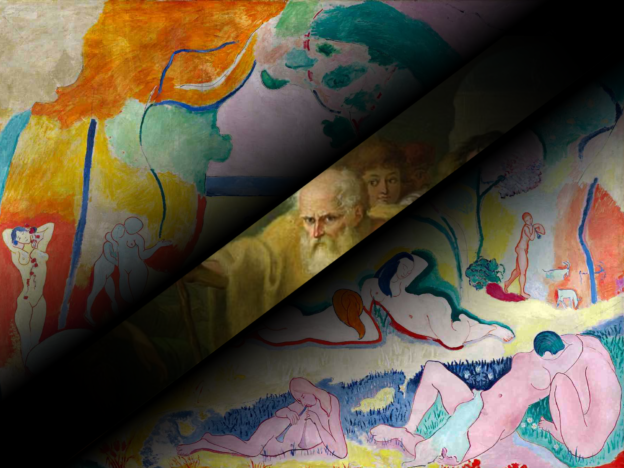
Is God willing to prevent evil, but not able? Then he is not omnipotent. Is he able, but not willing? Then he is malevolent. Is he both able and willing? Then whence cometh evil? Is he neither able nor willing? Then why call him God?
EPICURUSDavid Hume, quoting Lactantius, quoting Sextus Empiricus
To the surprise of many, the “Epicurean Paradox” is not an Epicurean argument. The logical trilemma does not reflect the theological positions of Epíkouros. Rather, it represents a skeptical method. Epicureans were pious dogmatists who rejected theological skepticism. For Epíkouros, “deities truly exist” as “knowledge of them” is “evident” (Epistle to Menoikeús 123-124).
The “Epicurean Paradox” was an argument presented by the Pyrrhonist (i.e. non-dogmatic skeptic) Séxtos Empeirikós in Outlines of Pyrrhonism, a treatise written five centuries after both Pýrrhōn and Epíkouros. The “trilemma” that he employs comes from a skeptical mode of inquiry, accompanied by dilemmas (x2), tetralemmas (x4), and quintalemmas (x5).
Séxtos introduces this “paradox” in a chapter largely devoted to refuting the theological positions of Epíkouros. In fact, the trilemma was not produced by Epíkouros to refute the existence of “god”, rather, the “Epicurean Paradox” was produced by skeptics to refute the “dogmatism” of Epicureans. Séxtos avows that “we cannot apprehend whether God exists.”
Nowhere do we have a record of Epíkouros embracing this approach. We do have Epíkouros, in his own words, exhorting his friend Menoikeús to “consider” the “blessedness” of “a deity”:
First and foremost consider the deity an incorruptible and blessed figure as the common conception of a deity prescribes; attribute to him nothing either hostile to incorruptibility or alien to blessedness rather believe anything about him that is able to preserve his incorruptibility and blessedness. For deities truly exist: apparent indeed is this knowledge of them though they are not the same sort the masses consider: for the [masses] are not observed to preserve that same sort. Impious then is not the one who rejects the deities of the masses, but the one who adheres to the masses’ doctrines about the deities. For [their] assertions are not impressions but false assumptions of the masses about the deities. Thence [so the masses assume] both the greatest harms are [vindictively] brought to the wicked from deities and also those benefits [are obligatorily promised to] the righteous. For approving of all their personal virtue, [the masses] accept [those] similar [conceptions of deities that fulfill with their expectation of rewards]; all those [conceptions] not corresponding [to their demands for God to service them] they consider as hostile. (Ep. Men. 123-124).
The modern world inherits this popular misattribution from the sceptic David Hume. As Hume writes, “EPICURUS’s old queftions are yet unanfwered. Is he willing to prevent evil, but not able? then is he impotent. Is he able, but not willing? then is he malevolent. Is he both able and willing? whence then is evil?” (Dialogues Concerning Natural Religion 10).
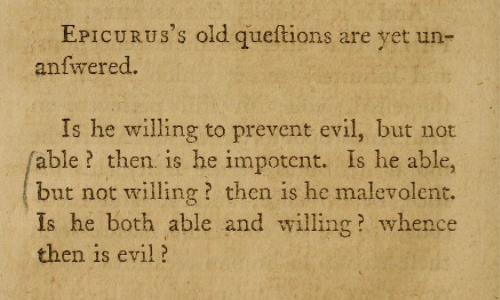
Dialogues Concerning Natural Religion by David Hume, published posthumously (1779).
Hume himself inherits this misconception from Lactantius. This early Christian writer mistook Pyrrhonian skepticism as Epicurean criticism (likely as a result of his disdain for both systems of “pagan” philosophy which seemed “atheistic” to him). So he shares erroneously:
That argument also of Epicurus [Epicuri]. God [Deus], he says [inquit], either wishes to take away evils, and is unable; or He is able, and is unwilling; or He is neither willing nor able, or He is both willing and able. If He is willing and is unable, He is feeble, which is not in accordance with the character of God; if He is able and unwilling, He is envious, which is equally at variance with God; if He is neither willing nor able, He is both envious and feeble, and therefore not God; if He is both willing and able, which alone is suitable to God, from what source then are evils? or why does He not remove them? (On the Anger of God 13)
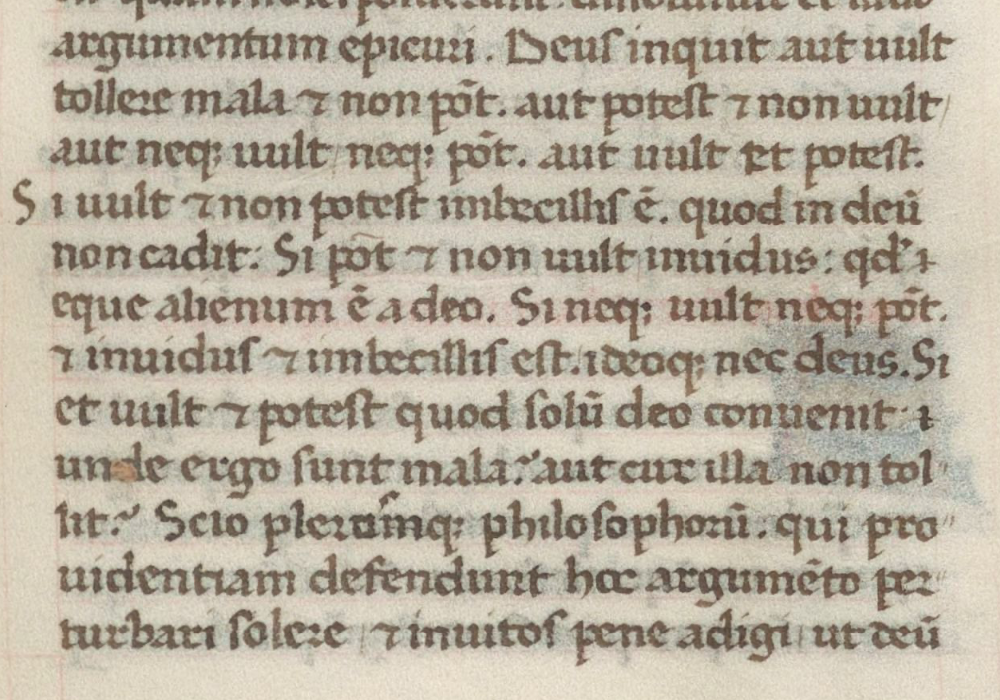
A 12th-century copy of De Ira Dei (4th-century) by Lactantius (Clm 536, fol. 63r).
The Christian author makes this error nearly six centuries after Epíkouros lived. Since Séxtos Empeirikós pre-dates Lactantius, he can be trusted as a reliable source, particularly when he positively claims to represent the skeptical position of the Pyrrhonists against all the other “dogmatists”. Séxtos provides us with the actual, skeptical trillemma regarding God:
Further, this too should be said. Anyone who asserts that god exists either says that god takes care of the things in the cosmos or that he does not, and, if he does take care, that it is either of all things or of some. Now if he takes care of everything, there would be no particular evil thing and no evil in general in the cosmos; but the Dogmatists say that everything is full of evil; therefore god shall not be said to take care of everything. On the other hand, if he takes care of only some things, why does he take care of these and not of those? For either he wishes but is not able, or be is able but does not wish, or he neither wishes nor is able. If he both wished and was able, he would have taken care of everything; but, for the reasons stated above, he does not take care of everything; therefore, it is not the case that he both wishes and is able to take care of everything. But if he wishes and is not able, he is weaker than the cause on account of which he is not able to take care of the things of which he does not take care; but it is contrary to the concept of god that he should be weaker than anything. Again, if he is able to take care of everything but does not wish to do so, he will be considered malevolent, and if be neither wishes nor is able, he is both malevolent and weak; but to say that about god is impious. Therefore, god does not take care of the things in the cosmos. (Séxtos Empeirikós, Outlines of Pyrrhonism, Book 3, 3.9-11)

A 14th-century copy of the 2nd-century Outlines of Pyrrhonism (Cod.graec. 439, fol. 76r).
As a terminal transmitter of skeptical inquiry, Séxtos may be appropriating an argument from an Academic Skeptic like Karneádēs (2nd-century BCE) as opposed to Pýrrhōn himself. In any case, the “Epicurean Paradox” was used by the opponents of Epíkouros against Epicureans. Séxtos rejects the “god” who “exists” but neither “takes care of everything” nor “wishes to do so”. For Séxtos, such a “god” is “weak” and/or “malevolent”. He accuses Epicureans of impiety, believing that the Epicurean interpretation of “blessedness” is “contrary to the concept of god”.
Though Séxtos‘ treatise was partially intended to be a refutation of Epicurean theology, numerous points shared by Séxtos positively correspond with observations made by Epíkouros.
Even a Broken Horologium Is Right Twice a Day
Skeptical Séxtos agrees with the Epicurean “dogmatists” on several points: [1] conceptually, an entity defined as being without trouble cannot cause trouble. [2] Believing otherwise, as do the masses, is not only incoherent, but “impious”. As concerns the idea of “god(s)“, [3] humans cannot conceive of anything without drawing from experience (e.g. if you come from a culture that has not experienced a horse, you can neither imagine a centaur, nor a zebra).
Epíkouros quips, “If a god listens to the prayers of humans, then all humans should instantly cease to exist, as they continuously pray for cruel [conditions] against one another” (as recorded by Maximus the Abbot). Séxtos concurs that “god shall not be said to take care of everything”, otherwise, people “will be forced to say that he is either malevolent or weak”.
Additionally, both schools observe that the myth of god’s involvement has been adopted by “the masses” who “have declared that God is the […] cause” of troubles. Here, Séxtos echoes Epíkouros who says, “Impious then is not the one who rejects the deities of the masses, but the one who adheres to the masses’ doctrines about the deities” (Epistle to Menoikeús 123).
The competing schools share further sympathy so far as the formation of concepts in the mind. For Pyrrhonists, “no one could conceive ‘horse’ unless he had first learned the horse’s form.” (Outlines of Pyrrhonism III, 3.2). For Epicureans, too, “each name primarily follows [what] is visible, since we could not have sought the investigation if we had not first perceived it, just as [we] have further established a horse is [this] or [a] cow [is that]” (Diogénēs Laértios 10.33). However, unlike Séxtos, Epíkouros does not reject the validity of reasoning by analogy.
Beyond these points, the schools differ dramatically. Séxtos devotes nearly an entire chapter of his third book on Pyrrhonism to refute Epicurean theology. He attempts to do so through his method of trilemmas; from the Epicurean perspective, he fails as a result of his misunderstandings.

Dorothy meets the Scarecrow from The Wizard of Oz (1939)
Scarecrows and an Ostrich
Overall, Séxtos misrepresents the Epicureans. In one case, the Pyrrhonist mischaracterizes the Epicurean gods as being “inactive” or “lacking energy” (perhaps as a consequence of mistaking their being “impassive” for being “motionless”). To the contrary, the founders of the Epicurean tradition observed that the gods lack nothing. They are perfectly happy figures who savor dialogue and share favors among imperturbable friend in imperishable paradises.
In another case, Séxtos obfuscates the Epicurean description of “blessedness”, confabulating that Epíkouros has “made the blessed, and consequently also god, inconceivable for us” (3.5). “[L]et the Dogmatists tell us”, goads Séxtos, “what a ‘blessed’ thing is”. Ironically, five centuries earlier, Epíkouros had already explained, in explicit terms, precisely what is “most blessed”, that which is “most pleasant”, the “best psychosomatic disposition”, “fitting all that happens to us […] in good order” (On Holiness). “God” is a being which “neither hungers, nor thirsts, nor shivers” (Vatican Saying 33). Philódēmos writes that a “blessed” being is “most worthy of emulation”, “unburdened by affairs”, “exalted and great-minded and great-spirited”, defined by “strength and perfection”, never “bad-tempered” (On Piety 45), a being that never “partakes in pains” (Ibid., 7) and enjoys a “happiness stemming from every source” (Ibid., 10).
Séxtos also fails to acknowledge an important nuance of Epicurean theology as concerns the generation of the forms of god(s) in our minds. Séxtos assumes that “no one will be able to name the source of the apprehension of God’s existence” without some “product of his”, yet the “apprehension” that Epíkouros acknowledges is not a product of “God”, but a product of natural influences on the mind. Epíkouros recognizes that nature’s gods are principally discerned through contemplation — since the diaphanous particles of deities are too small to see, we do not know “god” beyond the sanctuary of the mind, conceivable in terms of visualizations of perfection (see “All Particles Go to Heaven: The Form and Formation of the Epicurean Gods“).
Note that Epíkouros also accepts into his conception of “the divine nature” those beings that “have existed [distinctly] in number“, not only “in likeness” as “a stream of images” in the mind (Laértios 10.139), but who are also “numerically one and the same like us” (On Gods 3.10). Philódēmos imagines such gods to dwell in metacosmic space, living in communities composed of their own elements (On Gods 3). Such a conception provides a benchmark example of “blessed and imperturbable” beings. Granted, the external particles of such beings are too small for people to see, so, even still, “gods [are only] discernible by reason” (Lives 10.139).
As a final point of contention, Séxtos claims that the existence of god “is not pre-evident”, otherwise “the Dogmatists would agree about who, of what sort, and where [god] is”. Whereas Séxtos ridicules peoples’ belief in “god” due to the “interminable disagreement” of opinions about “his” form, Epíkouros accepts that “the divine nature” provides room for an infinite collection of unique divinities, each sharing the common trait of incorruptible blessedness. Epíkouros observes that the idealization of a perfectly happy, perfectly healthy being has been reproduced throughout history, and replicated countless times across the globe. Philódēmos writes that “the first people” only required “the analogy of disturbance” to conceptualize a being who is completely undisturbed. He infers that people developed a variety representations of “the divine nature” according to “traditional rites”. Even when corrupted representations contradict one another, each expression continues to validate the reality of the feeling that inspired it.

“Dictionary definition of the word ‘God’.”
god /ɡɑːd/ (n.)
Fundamentally, Séxtos and Epíkouros differ in their definitions of “god”.
For Pyrrhonists, “God’s existence” is “inapprehensible”. As Séxtos writes, “the existence of God cannot be proved from any other fact”. He surmises, “if god does not take care of anything and there is no work or product of his, [then] nobody will be able to say from whence be apprehends that god exists”. As mentioned, he claims that “the existence of God is not pre-evident” (On Pyrrhonism III 3.5). “[F]or these reasons we cannot apprehend whether God exists”.
In stark contrast with this agnostic attitude, Epíkouros affirms that not only do “deities exist” but “truly apparent is this knowledge of them” (Ep. Men. 123). The representations of god(s) around the world, dreams and memorable visions triggered by chemical sacraments have informed our notion of “divinity”. For Epíkouros, a “real” deity is “only “discernible through contemplation” — any hypothetical deity must conform to our common notion of “blessedness”, thus creating a completely happy, ceaselessly sufficient entity who has “been rendered human-like” to the human mind, “in likeness” of people, as iconic projections of the best life. (Laértios 10.139).
The “divinity” that Epíkouros observes, and the gods he reveres are bound by the restrictions and possibilities of nature. As an individual, “a god” cannot know everything, nor everyone. His reach is relative to the intercosmic void that extends infinitely — gods are thus relieved of cosmic cleanup. They do not supervise the observable universe; they feel no pressure to forecast the weather for lifeforms on Proxima Centauri b; they are unconcerned with the adulterous affairs of aliens in the Andromeda; they have no compulsion to correct the abuses of American authoritarians; they do not direct your drama. Their happiness is pure, preserved from corruption; their pleasure is permanent, saved from disruption; their lives are perfect, removed from perturbance; their identities are indestructible, immune to disturbance.
Omnibeatificence
The “gods” that Epíkouros recognizes are neither omnipotent (nothing is greater than Nature), nor omnipresent (nothing is present everywhere besides infinite void), nor omniscient (no one with limited presence can know everything at present), nor omnibenevolent (no one who is somewhere can provide charity to everyone everywhere). For Epicureans, “god” shares only in omnisufficience (being perfectly self-sufficient), omnisanctience (being “best and most holy”), as well as (what this author shall call) omni-beatificence, “always being happy”. The omnibeatific deities are only as powerful, knowledgable, and charitable as Nature allows.

Torus Interior by Don Davis (1975 NASA Ames/Stanford University Summer Study)
Zeus Helps Those Who Help Themselves
Unlike the skeptical Pyrrhonists, Epíkouros encouraged the worship of god(s) as a practical tool. As he writes, “worship of the wise is a great good to you who will worship” (Vatican Saying 32). Philódēmos records Epíkouros as having “loyally observed all the forms of worship and enjoined upon his friends to observe them” (On Piety 26). In his own words, Epíkouros explains that “to pray is natural for us, not because the gods would be hostile if we did not pray, but in order that, according to the understanding of beings surpassing in power and excellence, we may realize our fulfillments and social conformity with the laws” (On Lifecourses). In this regard, even if “no one has been prolific in finding convincing demonstrations for the existence of gods”, even if skeptics doubt the coherence of theology, there is a demonstrable practicality in exercising piety, for almost “all people […] worship”, “as do we” (On Piety 23).
For more, check out “On the Epicurean Gods” by the Society of Friends of Epicurus.